Order from Chaos: Unpacking Ancient Egyptian Cosmology and Creation

Unravel the structure of the Egyptian universe through Ancient Egyptian Cosmology, which explains how perfect order (Ma'at) was established from the infinite, chaotic void (Nun). Explore the three foundational models—Heliopolis (Atum and the Ennead), Hermopolis (the Ogdoad), and Memphis (Ptah's divine thought)—and discover how the emergence of the first land, the Benben, provided the stable platform for creation and defined the ultimate duty of the Pharaoh.
The eye of Horus
WhatsApp
Email
Print

Ancient Egyptian Cosmology: The Need for Order

Every great civilization needs a universal structure. Ancient Egyptian cosmology provided this structure. It defined the rules of existence. These concepts explained the chaotic world. They gave meaning to the cyclical Nile River. Most importantly, they defined the king’s role.

These cosmological concepts were not uniform. Different cities promoted different models. They all served one purpose. They explained how Ma’at, or order, first emerged. This guide details the essential concepts of Ancient Egyptian cosmology. You’ll discover the genesis of the universe. You’ll learn how the world stays stable. This understanding forms the foundation of all Ancient Egyptian Myths and Legends.
The eye of Horus

Ancient Egyptian Cosmology: Nun and the Benben

From Nun to Ma’at; The Complete Guide to Ancient Egyptian Creation Myths

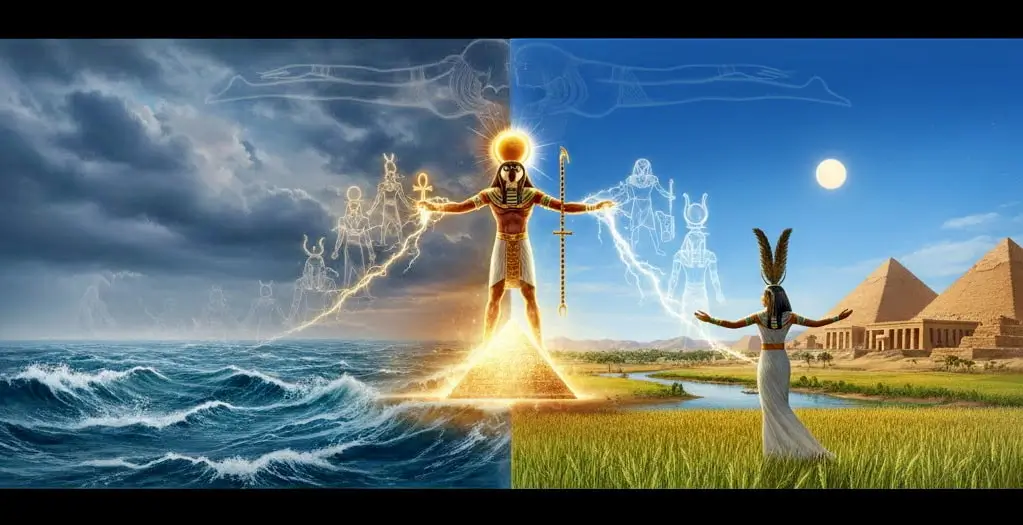
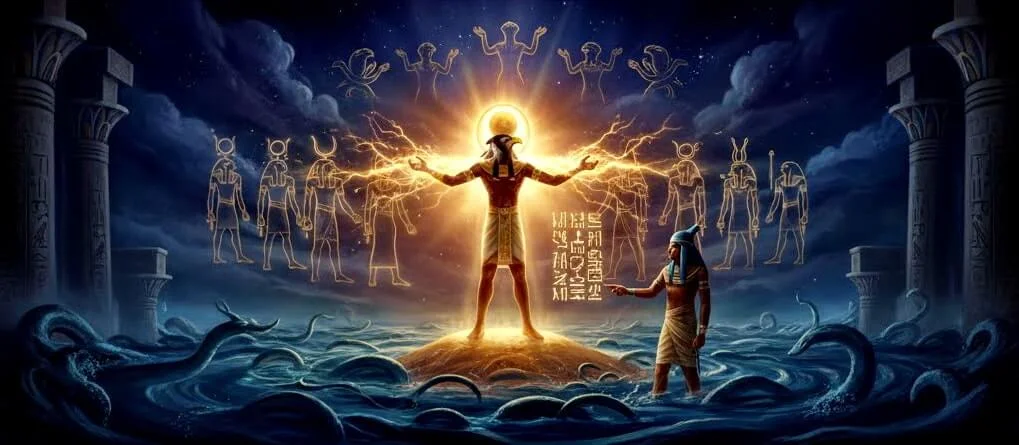
Before anything existed, there was water. The Egyptians called this infinite, formless ocean Nun. Nun was the watery void. It was darkness and silence combined. Nun represented the total, undifferentiated chaos.

This chaos was not empty, however. It held the potential for all life. Everything that would ever exist was contained within Nun. This was the source of creation. The entire framework of Ancient Egyptian cosmology begins here.

Then, a cosmic event occurred. The movement from chaos to order began. A single mound of earth rose from the depths of Nun. This primordial hill was called the Benben. This was the first solid land. The emergence of the Benben established the first point of order.

Golden Scarab

The Heliopolitan Model: The Structure of the Ennead

Significance of the Number Nine and the Concept of the Ennead

The most famous cosmological structure originated in Heliopolis. This city was the ancient center for sun worship. This model is central to Ancient Egyptian cosmology. It features the god Atum, or Ra.

Ancient Egyptian Cosmology: The Emergence of Ra and the Ennead

The sun god arose from the Benben stone. He was Atum, the “complete one.” He emerged ready to structure the world. Atum began the process alone. He was the single divine entity. All things existed within him.

Atum started creation through his own power. He produced the god of air, Shu. He also produced the goddess of moisture, Tefnut. This was a pivotal moment. The creation of air and moisture separated the watery chaos. It made space for the physical world.

The Cosmic Axes

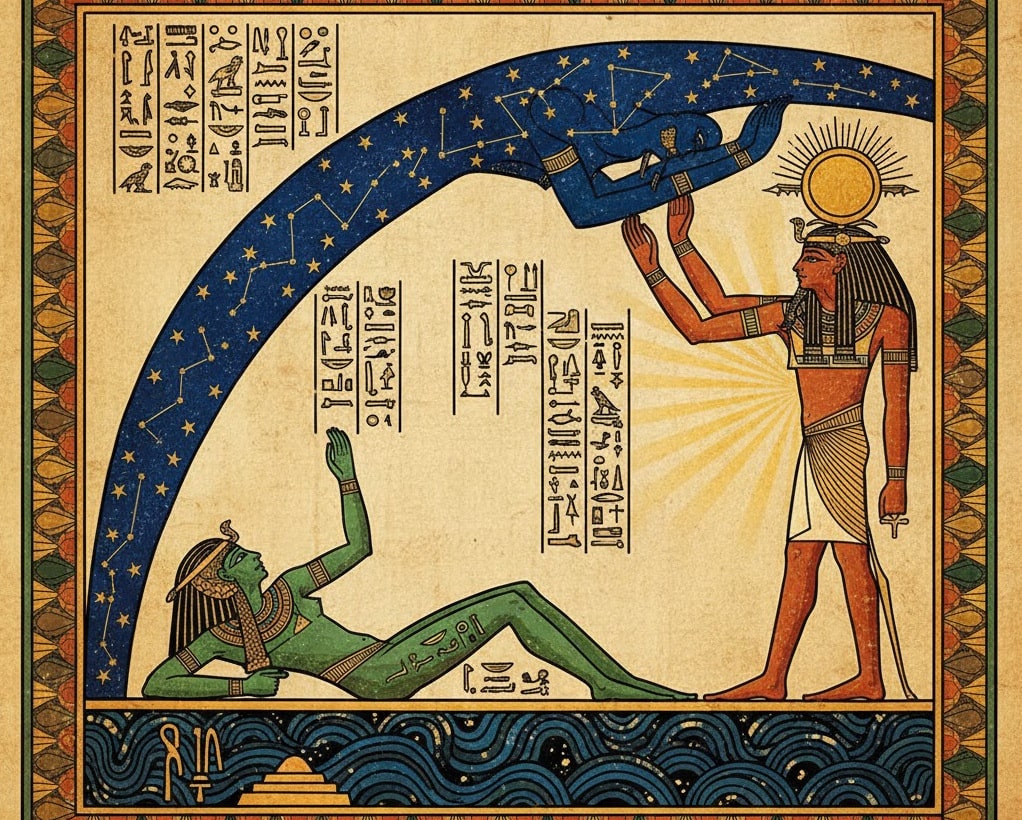
The structure continued with the next generation. Shu and Tefnut mated. They produced two important cosmic axes. These were Geb (Earth) and Nut (Sky).

Geb and Nut instantly embraced. They were locked together in perpetual union. This left no space for life to thrive. Atum commanded Shu to separate them. Shu stood on Geb, the Earth. He raised Nut, the Sky, high above. This visual defined Ancient Egyptian cosmology.

The Divine Family Tree

Geb and Nut produced the final four deities: Osiris, Isis, Seth, and Nephthys. These nine figures formed the Ennead. The Ennead’s hierarchy defined the order of the entire Egyptian pantheon.

The eye of Horus

The Hermopolitan Model: The Elements of Chaos

The Hermopolis Creation Myth

Another structure comes from Hermopolis. This model focused less on Ra. It focused more on the chaotic elements that precede creation. This specific branch of Ancient Egyptian cosmology introduced the Ogdoad.

Ancient Egyptian Cosmology: The Ogdoad and the Primeval Mix

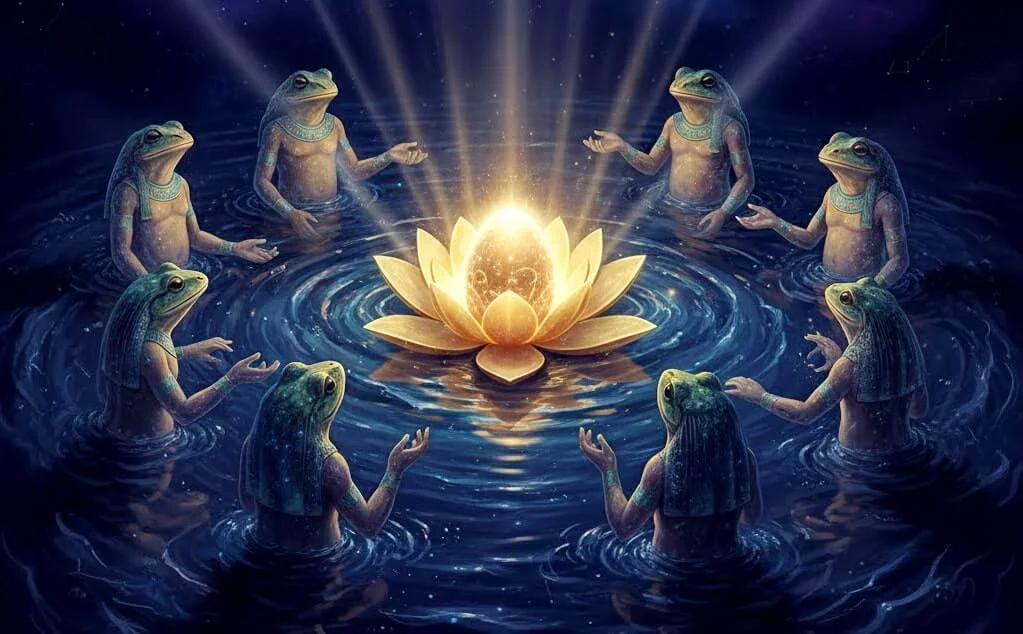
The Ogdoad was a group of eight gods. They existed deep within Nun. There were four male-female pairs. Each pair represented an essential aspect of primordial chaos: water, infinite space, darkness, and hiddenness.

These eight gods were not rulers. They were the raw, chaotic materials. They eventually mixed. This great collision generated the Benben mound. Their interaction generated the conditions for light and order to appear.

The eye of Horus

The Memphite Model: Ptah and the Logos

God Ptah of Memphis

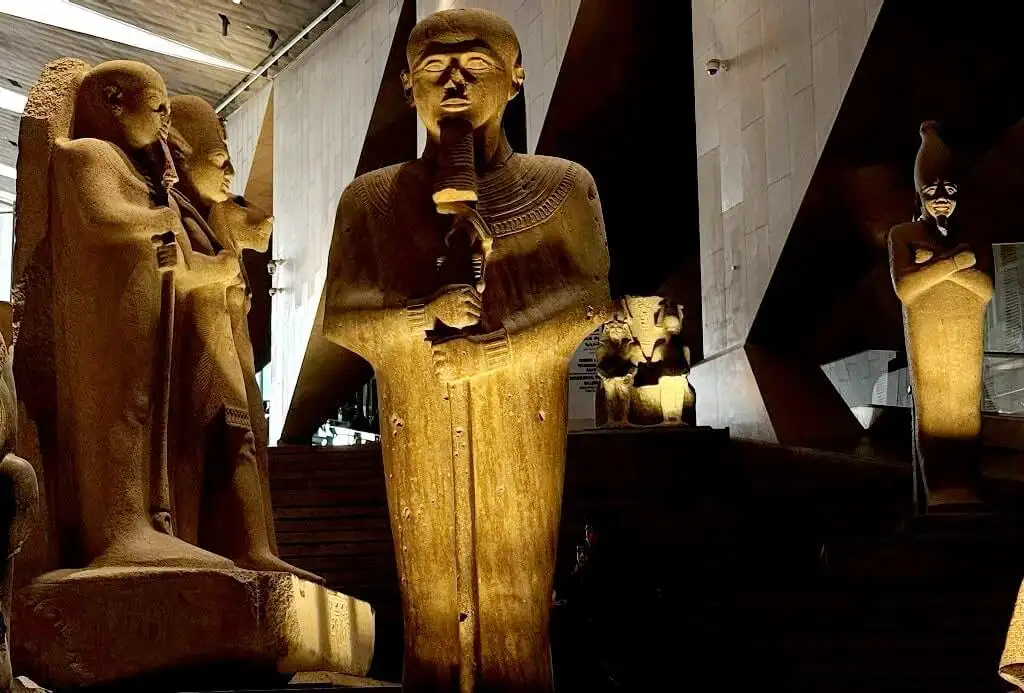
The final major cosmological concept comes from Memphis. This account is arguably the most abstract and philosophical. It elevates the local god, Ptah.

Ancient Egyptian Cosmology: Structure by Intellect

This model described Ptah as the true creator. He was the intellectual source of all order. Ptah did not create the world physically. He structured it mentally.

Ptah conceived the entire cosmos in his heart. The heart was the center of intelligence. He then commanded it into existence with his tongue.

Ptah thought of the world’s structure. He spoke the names of the gods. The gods obeyed his voice. They immediately came into being. This view of Ancient Egyptian cosmology shows the Egyptians valuing intellect and divine command as the highest form of creation.

The eye of Horus

Ancient Egyptian Cosmology: The Upholding of Ma’at

All models of Ancient Egyptian cosmology share a core theme. They show the triumph of order over chaos. The chaotic threat of Nun remained eternal.

These structures provided a blueprint for life. They mandated the need for ritual and justice. The preservation of Ma’at was the sacred duty of the Pharaoh. He was the direct link to the cosmos.

The structure of the universe offered hope. It guaranteed that life would always return. The sun would rise. The Nile would flood. The very existence of Ancient Egyptian cosmology affirmed life’s ultimate order. Read our full guide to Ancient Egyptian Myths and Legends for more on the gods who maintained this order.

Divider

AMAZING TOUR, SOLO TRAVELER.

I am a California woman who traveled to Egypt alone, and thanks to Egypt Fun Tours, I had a great time. Hani, Mohammed, Kamal, and David (my driver) were very professional and very knowledgeable. I appreciate how respectful they were and how protective they were of me. They showed me

More »
A Royal Commission The History of Al-Rifa'i Mosque

Highly recommended

Salam, This company is very responsive and accommodating. From the moment we started to chat via email, to the moment we left Egypt at the airport, these fellows were very professional. The tour covered most of what we wanted to see! We customized it to our needs and added some

More »

Excellent Tour

Really excellent tour from Mohamed, and we learned so much about Egypt and went to places we never would have found as tourists at home. My girlfriend had a 12 hour stop over on the way to Ethiopia and it was the perfect way to see Cairo. I hope people

More »
Ancient Egyptian Sarcophagus - Egypt Fun Tours

Unforgettable experience with Fun Tours – Highly recommended!

Hello everyone! We would like to share our extremely positive experience with Fun Tours. Our tour was a complete success thanks to our guide, Osama, and our driver Hassan. Osama proved to be an enthusiastic and knowledgeable guide who answered all of our questions and catered to our individual wishes

More »

HANDS DOWN, the best cultural experience I’ve ever had

Thank you, Egypt Fun Tour, for a most memorable trip. I admit I didn’t do any of the planning (it was all done by my boyfriend), but as you can read in the reviews below, Hani (the owner of Egypt Fun Tours) is superbly organized and accommodating with scheduling. My

More »
God_Anubis_Icon

Top-rated Tour Packages

God_Anubis_Icon
WhatsApp
Email
Print