

Rituals of the Nile Inundation

The Rituals of the Nile Inundation were the central annual ceremonies of ancient Egypt, designed to honor the life-giving flood (Akhet) that deposited fertile black silt, ensuring the nation's survival and prosperity. These sacred events, led by the pharaoh, involved elaborate processions, offerings to the god Hapi (the Nile personified), and the ceremonial cutting of the dykes to release the water, thereby maintaining the cosmic order known as Ma'at.
The eye of Horus
WhatsApp
Email
Print

The Sacred Flood: Rituals of the Nile Inundation

The Nile River was the lifeblood of ancient Egypt. Its annual flood, known as the inundation or akhet, brought the fertile silt essential for agriculture. Without this predictable event, civilization along the Nile would have been impossible. To honor and encourage this vital flood, ancient Egyptians performed elaborate Rituals of the Nile Inundation. These ceremonies were not mere superstitions; they were fundamental to their religion, economy, and social cohesion, ensuring the prosperity of the entire nation.

Divider

The Divine Source: Gods of the Inundation

Ancient Egyptians viewed the Nile flood as a direct manifestation of divine power. Several deities from the ancient Egyptian pantheon played crucial roles in these rituals:

  • Hapi: This fertility god was the direct personification of the Nile flood itself. Egyptians depicted Hapi with a large belly and breasts, symbolizing abundance. Priests and commoners offered prayers and gifts to him, believing his favor directly controlled the flood’s strength.
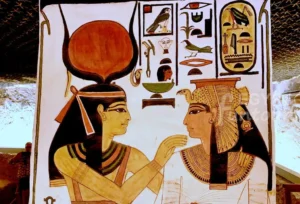
  • Osiris: The god of vegetation, death, and rebirth, Osiris, held a deep connection to the inundation. Egyptians saw the annual rise of the Nile as his resurrection, bringing new life to the parched land. His mythical death and rebirth mirrored the seasonal cycle of the Nile and the crops.
  • Isis: Osiris’s devoted wife, Isis, also played a part. Legends sometimes attributed the initial rise of the river to her tears of sorrow, mourning Osiris. Her nurturing aspect linked her to the fertility brought by the flood.
  • Meret: The goddess of music, singing, and dancing, Meret, brought joy and harmony to the flood festivals. She presided over the celebratory aspects, ensuring that the rituals were pleasing to the gods.
Golden Scarab

The Cycle of Ceremonies: Before, During, and After the Flood

Rituals of the Nile inundation

The rituals spanned the entire period of the inundation, encompassing distinct phases:

Before the Flood: Appeasing the Gods

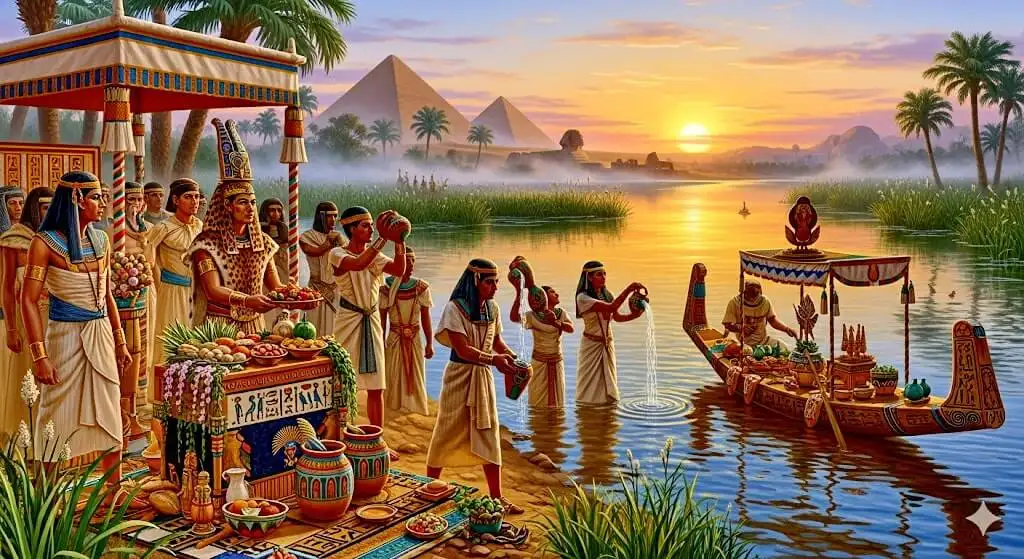
As the hot, dry season approached, Egyptians intensified their prayers. Priests performed ceremonies in temples dedicated to Hapi and other riverine deities. They made offerings, including food, flowers, and incense, to encourage a strong and timely flood. Communities often held local processions, carrying effigies of Hapi to the riverbanks.

During the Flood: Celebration and Control

When the river began to swell, often around the summer solstice, grand public festivals erupted. These were joyous occasions, filled with music, dancing, and feasting.

  • Opening of the Dykes: A pivotal moment involved the ceremonial cutting of a main dyke or the opening of floodgates. This officially released the Nile waters into the irrigation canals, allowing them to spread across the fields. The pharaoh or his appointed officials often presided over this crucial event, emphasizing the state’s role in managing the flood.
  • The “Bride of the Nile”: Historical accounts, particularly from later periods, mention a ritual involving the “Bride of the Nile.” In some traditions, people would throw a beautiful doll or even a real maiden (though evidence for human sacrifice is heavily debated and likely exaggerated in later accounts) into the river as a symbolic offering to Hapi, ensuring his benevolent generosity. More commonly, this involved rich offerings and symbolic gestures of devotion.

After the Flood: Gratitude and Preparation

Once the floodwaters receded, leaving behind rich, fertile black silt, Egyptians expressed profound gratitude. They celebrated the beginning of the planting season, offering thanks to the gods for the renewed land. Farmers immediately began sowing seeds into the moist, enriched soil, initiating the agricultural cycle anew.

The eye of Horus

Rituals of the Nile Inundation: Culture and Economy

The Rituals of the Nile Inundation were far more than religious ceremonies. They served several vital functions:

  • Economic Survival: The flood guaranteed the harvest, which formed the backbone of the Egyptian economy. Successful rituals meant food, wealth, and stability.
  • Social Cohesion: These shared rituals brought communities together. People from all social strata participated, fostering a sense of national unity and shared purpose.
  • Cosmic Order (Ma’at): Egyptians believed that proper adherence to these rituals helped maintain Ma’at, the cosmic balance and order. By honoring the gods, they ensured the natural world continued its cycle harmoniously.
  • Pharaonic Legitimacy: The pharaoh’s role in presiding over major flood ceremonies reinforced his divine authority. He acted as the chief intermediary between the gods and the people, securing the flood’s blessings for his kingdom.

Even today, the legacy of the Nile’s inundation and its ancient rituals echoes in modern Egyptian culture, symbolizing the enduring connection to this mighty river.

Weather in Egypt

Divider

The annual Nile Inundation (Akhet) was the single most pivotal event in ancient Egyptian civilization, profoundly shaping its economy, religion, and social structure. Its predictable arrival, often coinciding with the rise of the star Sirius, was not merely a natural phenomenon but a divine blessing personified by the androgynous god Hapi, who represented the river’s fertility. The rituals surrounding the flood were an extensive, multi-phase effort to guarantee the flood’s timely and optimal height.

Prior to the inundation, priests would monitor the river’s rise using Nilometers and prepare lavish offerings of food, flowers, and incense to appease Hapi and deities associated with rebirth, like Osiris. The pharaoh, acting as the chief intermediary between the gods and the people, presided over the most crucial ceremonies, reinforcing his divine legitimacy. The peak of the celebration was marked by the joyous ‘Opening of the Dykes,’ a momentous occasion where the river’s waters were officially released into the irrigation canals to saturate the waiting fields.

These ceremonies were not solely religious; they were grand communal festivals filled with music, dancing, and feasting, which strengthened social bonds and national unity across Upper and Lower Egypt (symbolized by the two Hapi figures tying the lotus and papyrus). Even after the natural flood cycle was halted by the Aswan High Dam in the 20th century, the legacy of these rituals continues, commemorated today by the national festival Wafaa El-Nil (Fidelity of the Nile), ensuring the river’s central place in the Egyptian consciousness remains eternal.

The eye of Horus

Divider

AMAZING TOUR, SOLO TRAVELER.

I am a California woman who traveled to Egypt alone, and thanks to Egypt Fun Tours, I had a great time. Hani, Mohammed, Kamal, and David (my driver) were very professional and very knowledgeable. I appreciate how respectful they were and how protective they were of me. They showed me

More »
Tailored Services for Corporate Business Transportation Needs

On time, adaptable, and fun!

My friend and I planned a whirlwind trip to Dubai, the Dead Sea, Petra, Cairo, Luxor, and Sharm el Sheikh for early November 2011 – 6 cities in 10 days! We allotted one afternoon and evening for Cairo, and we wanted to see as much as we could! We drove

More »
group tour of wonders

Solid Tour Company

Last year (2010) my wife and I did a 20 day trip in Egypt, mostly Do-It-Yourself. However, one of the first things we did was a trip to Bahariya oasis and to the White Desert — not so easy to do yourself, so we needed an agency. After e-mail back-and-forths

More »

Layover tour of Cairo Pyramids

On a recent trip, I had 8 hours from the time I landed in Cairo to when my next flight was scheduled to leave. Luckily, I arrived in the morning and left in the afternoon, so, not being one to sit around an airport for 8 hours, I visited the

More »

Great guided tour of pyramids

We travelled to Cairo on Friday, May 3, 2019, from Toronto. We landed at 0530 and were met by a representative of Fun Tours at the departure gate. We were only on a layover of 6 hours, and the tour company came with a private van, water, a driver, and

More »
God_Anubis_Icon

Top-rated Tour Packages

God_Anubis_Icon
WhatsApp
Email
Print