

The Nile River: The Eternal Lifeline of Egypt and Its Civilization

Explore the Nile River, the beating heart without which Ancient Egypt would not have existed. This guide traces the river’s journey from the heart of Africa to the Mediterranean, explaining the crucial annual inundation that fed the land and birthed the calendar. Discover how the Nile served as the empire's superhighway for transporting the massive stones of the pyramids and its spiritual role as the realm of the god Hapi.
The eye of Horus
WhatsApp
Email
Print

The Nile River in Egypt

The Nile River is crucial to Egypt. It has historically served as the country’s main source of transport, communication, and wealth. The river provided fresh water for drinking, agriculture, and industry. It also supported fishing, navigation, and leisure. The Nile’s bounty was so great that Egypt was known as the “breadbasket of the Roman Empire,” supplying a large portion of the empire’s grain. The river’s annual flood, known as the Inundation, was a predictable event that deposited fertile silt along its banks, creating ideal conditions for farming. Ancient Egyptians developed a calendar based on the Nile’s cycles, which they divided into three seasons: Akhet (inundation), Peret (growth), and Shemu (harvest).

Egypt’s unique reliance on the Nile is because most of the water originates outside its borders. The 1959 Nile Waters Agreement with Sudan allocated 55.5 billion cubic meters (BCM) of water to Egypt annually. This agreement has been a cornerstone of water management in the region, establishing rules for water usage and dam construction. The Nile’s basin spans 11 countries, but Egypt and Sudan have historically been the primary beneficiaries of its waters.

While this mighty river provided the vital water and soil needed to survive the desert, the people who settled on its banks built an empire that changed the world. Explore their monumental achievements in our comprehensive guide to Ancient Egypt.
The eye of Horus

The Aswan High Dam and Lake Nasser

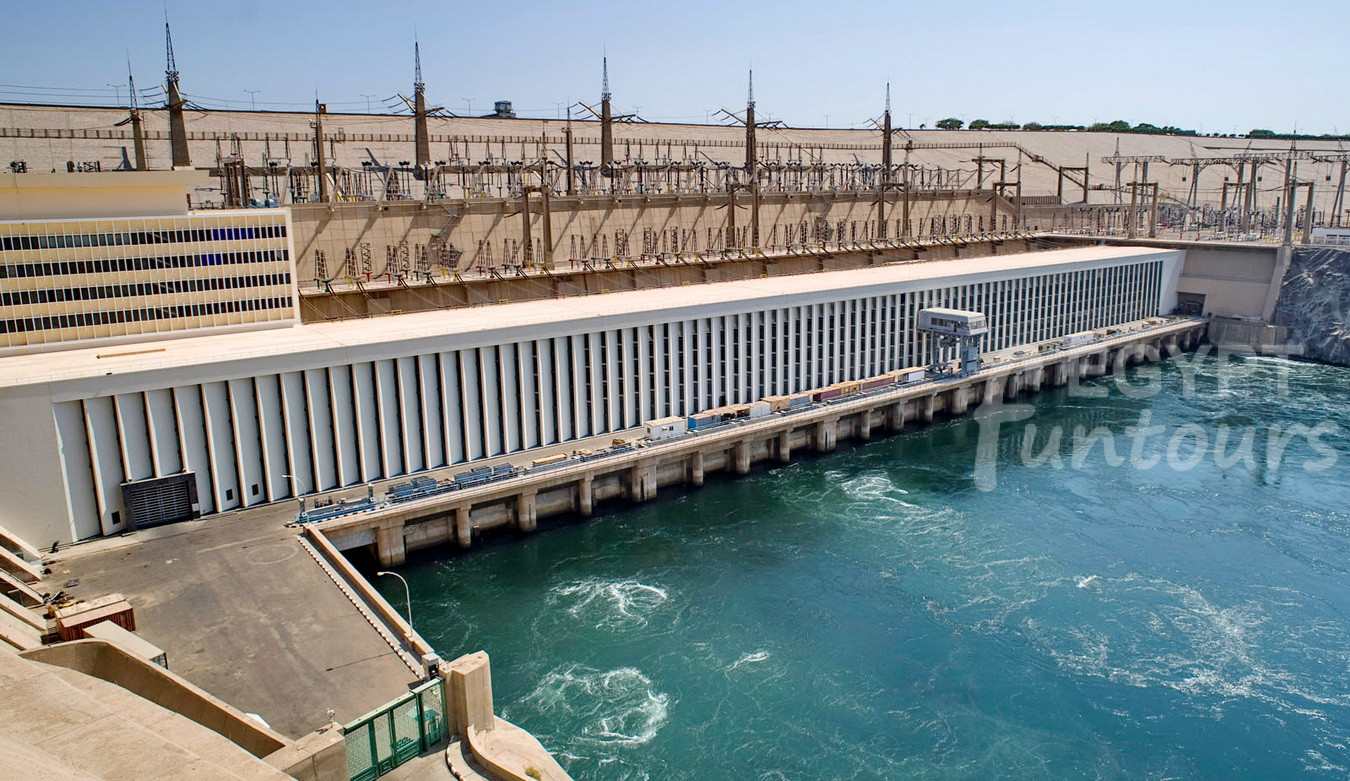
Aswan High Dam Egypt

The Aswan High Dam, built in 1968, is the Nile’s primary storage facility. Its construction was a monumental engineering feat designed to give Egypt control over the river’s annual floodwaters. The dam’s primary purpose was to protect the country from devastating floods and to store water for use during dry seasons. Before the dam, severe floods could destroy crops and villages, while low floods could lead to widespread famine. The dam allowed for perennial irrigation, which enabled farmers to grow multiple crops a year instead of just one.

Golden Scarab

Lake Nasser

The dam’s creation resulted in Lake Nasser, the world’s largest artificial lake. This massive reservoir measures 150 kilometers long, 12 kilometers wide, and 180 meters deep. It is a vital resource for the fishing industry, producing 15,000 to 25,000 tons of fish each year. However, the lake also faces a significant challenge: it loses 10-11 BCM of water annually due to evaporation in the hot desert climate. This massive evaporation has become a major concern for water resource management.

The eye of Horus

The Nile’s Branches and Modern Uses

Ancient Egyptian lotus flower in relation to the Nile River Egypt Fun Tours

Downstream from the Aswan High Dam, a vast network of canals redistributes the Nile’s water for agricultural and other uses. The river splits into two main branches in the Nile Delta: the Rosetta and the Damietta.

  • The Rosetta Branch: This western branch is 239 kilometers long and 450 to 1,000 meters wide. Its water level is regulated by two barrages: the Delta Barrage in the south and the Idfina Barrage in the north. The Rosetta branch flows into the Mediterranean Sea near the city of Rashid, also known as Rosetta.
  • The Damietta Branch: This branch is approximately 230 kilometers long and 300 to 500 meters wide. It flows into the Mediterranean Sea at the city of Damietta.
The eye of Horus

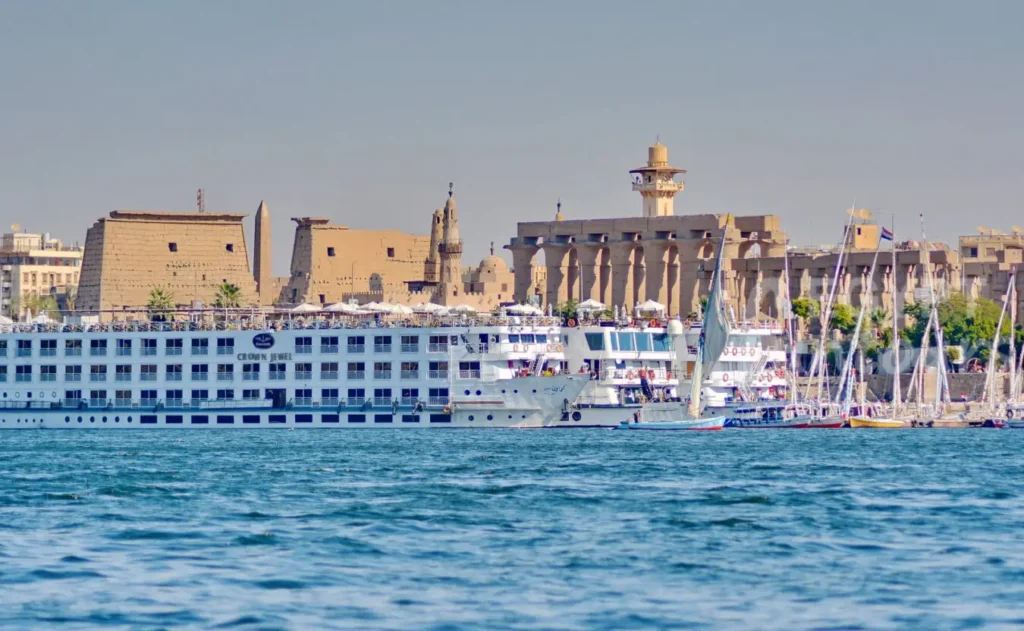
Both branches have a typical depth of 3 to 7 meters. At its deepest point, the Nile is 11 meters deep, and it spans 2.8 kilometers at its widest. These characteristics make the river ideal for water activities like rowing, cruising, and fishing. Travelers to Egypt can enjoy multi-day Nile cruises, which provide a unique way to experience the country’s historical sites along the riverbanks. These trips are a cornerstone of Egyptian tourism, offering a blend of ancient history and the serene beauty of the Nile. Modern advancements have also allowed for the use of the Nile’s flow for hydroelectric power, with the Aswan High Dam being a major source of electricity for the country.

Weather in Egypt

The eye of Horus
Divider

Day Trip to Alexandria

An enjoyable drive from Cairo to Alexandria. It was an enriching trip. I learnt so much history about the ancient civilisation. The tour guide explained the history of each site we visited. There is so much to see. I would definitely highly recommend visiting Alexandria. It’s rich in history. The

More »
9-day tour package - Egypt Fun Tours

You’re in “GREAT HANDS” with Egypt Fun Tours!

We first went to Egypt in July 2010. We were to pass through Cairo on our way to Africa, and we had arranged to be picked up from the Cairo airport and shown around the city during our 6-hour layover. This was arranged through emails with Hamada, of Egypt Fun

More »
group tour of wonders

Solid Tour Company

Last year (2010) my wife and I did a 20 day trip in Egypt, mostly Do-It-Yourself. However, one of the first things we did was a trip to Bahariya oasis and to the White Desert — not so easy to do yourself, so we needed an agency. After e-mail back-and-forths

More »

Absolutely the best

We visited Cairo over a 15-hour layover. Egypt Fun Tours organized a customized and wonderful experience for us. We could not be happier. The day included a visit to all the great sites, the marketplace, dinner, a boat ride on the Nile, and a host of other special requests. I

More »
God_Anubis_Icon

Top-rated Tour Packages

God_Anubis_Icon
WhatsApp
Email
Print