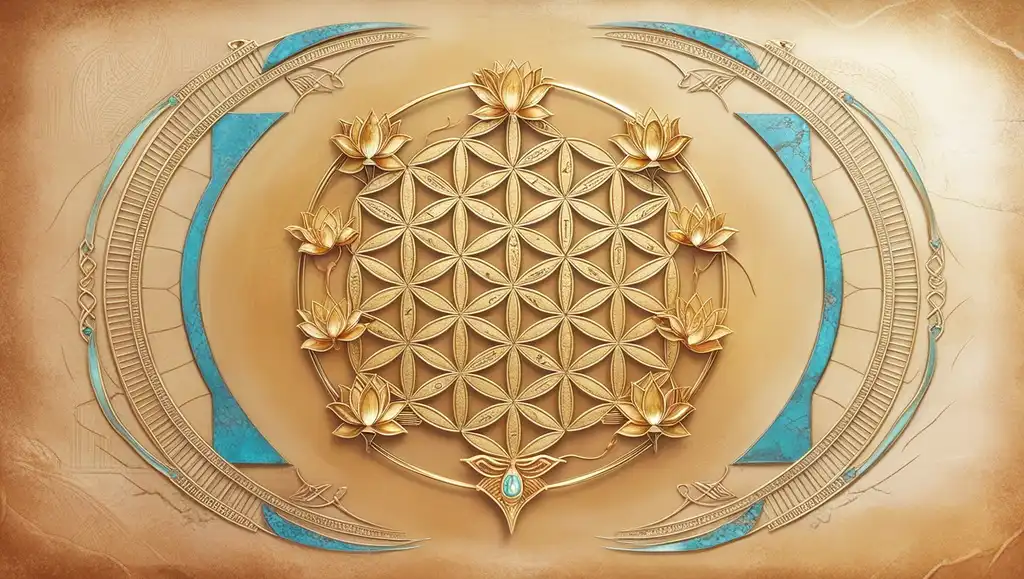
The Flower of Life Symbol: Meaning, Origins & Sacred Geometry

The Flower of Life is a potent symbol in sacred geometry, composed of multiple evenly-spaced, overlapping circles arranged in a hexagonal pattern. Dating back to Ancient Egypt, it is revered across cultures as the blueprint of creation and the source of all existence. This intricate structure is believed to contain the fundamental patterns of the universe, representing the interconnectedness of all life and the continuous, unified cycle of creation.
The eye of Horus
WhatsApp
Email
Print

The Flower of Life symbol is a captivating geometric design made up of overlapping circles. Martha Bartfeld, an author of geometric art tutorial books, discovered this design independently in 1968. She described it as consisting of circles with a radius of 1 inch (25 mm). Each intersection of these circles serves as a new center. This design can expand infinitely, creating concentric hexagonal rings of circles.

Divider

Flower of Life Meaning

The Flower of Life meaning - Egypt Fun Tours

The meaning of the flower of life is significant in sacred geometry. It represents the interconnectedness of all life and the stages of creation. The initial stage is known as the Seed of Life, which consists of seven overlapping circles. This foundational shape symbolizes new beginnings and the essence of life itself. An overlapping circles grid is a geometric pattern that features repeating circles of equal radius in two-dimensional space. Commonly, these designs are based on circles centered on triangles, such as the Vesica piscis, or arranged in a square lattice pattern. The triangular grid of overlapping circles can extend indefinitely, forming hexagonal rings of 1, 7, 19, 37, 61, or even 91 circles.

Golden Scarab

Flower of Life Origin

The flower of life origin - Egypt Fun Tours

The Abydos Temple in Egypt is the oldest known site where overlapping circle patterns have been discovered. However, these patterns are classified as graffiti from the early Christian era. In contrast, the patterns found at the threshold of the palace of Assyrian King Aššur-bāni-apli in Dur Šarrukin are believed to be older.

Yet, we cannot confirm this with certainty. The patterns in Egypt are carved into granite columns, which are much more solid than the sandstone or limestone typically used for graffiti. This durability suggests that the Egyptian patterns may have been purposefully created rather than hastily inscribed.

flower of life - lotus flower - Egypt Fun Tours

Furthermore, the overlapping circles in the Flower of Life pattern often take the shape of lotus and papyrus flowers. These flowers held significant meaning as they were the national symbols of ancient Egypt. This connection may indicate that the Egyptian version of the Flower of Life is indeed original and native to its culture. While both sites feature overlapping circle patterns, the context and material used in Egypt suggest a deeper cultural significance.

The eye of Horus

The History of the Flower

flower of life - lotus flower - Egypt Fun Tours

Historically, similar geometric patterns have appeared in various decorative arts since ancient times. The oldest known occurrence of the overlapping circles pattern dates back to the 7th or 6th century BCE. It was found on the threshold of the palace of Assyrian king Aššur-bāni-apli in Dur Šarrukin, now housed in the Louvre. Interestingly, five patterns of 19 overlapping circles were discovered on the granite columns at the Temple of Osiris in Abydos, Egypt, which is older. These patterns, drawn in red ochre, are faint and difficult to distinguish. They are considered graffiti and are not found in native Egyptian ornaments.

Divider

In England

In England, similar patterns were sometimes used as protective marks to keep witches away from buildings. Additionally, consecration crosses, which indicate points in churches anointed with holy water, also take the form of overlapping circles. In Islamic art, the Flower of Life pattern is one of several arrangements of circles used to create intricate geometric designs. These designs often include 6- and 12-pointed stars as well as hexagons, in a style known as Girih. The resulting patterns typically conceal the construction grid, presenting a beautiful design of interlaced strapwork.

In Europe

In Europe, patterns of seven overlapping circles can be found in Roman mosaics, such as those at Herod’s palace in the 1st century BC. The design later appeared in Gothic architecture and European folk art during the early modern period. High medieval examples include the Cosmati pavements in Westminster Abbey from the 13th century. Notably, Leonardo da Vinci discussed the mathematical proportions of this design.

The eye of Horus

The Flower of Life, in modern times

The flower of life today - Egypt Fun Tours

In modern times, the term “Flower of Life” is associated with the New Age movement. It is commonly attributed to Drunvalo Melchizedek, who popularized it in his book The Ancient Secret of the Flower of Life (1999).

Today, the Flower of Life symbol appears widely in popular culture, including fashion, jewelry, tattoos, and decorative products. For instance, the album Sempiternal (2013) by Bring Me the Horizon features the 61 overlapping circles grid on its cover. Similarly, Coldplay’s album A Head Full of Dreams (2015) showcases the 19 overlapping circles grid as a central design element. Teaser posters for this album were prominently displayed on the London Underground in late October 2015.

Additionally, the “Sun of the Alps” symbol has been used as an emblem of Padanian nationalism in northern Italy since the 1990s. This symbol resembles patterns often found on local buildings. Furthermore, a seven-circle “Flower of Life” design appears in the coat of arms of Asgardia, the space nation.

In summary, the Flower of Life symbol encompasses various meanings and stages of creation. Its intricate designs and rich history continue to inspire and resonate with people across cultures and periods.

Divider

Transit Stopover in Cairo

We have just returned from a two week holiday in Cape Town. On the way out our airline schedule meant that we had a 15 hour stop in Cairo. We decided to arrange a tour of the city and after asking for quotes/itineraries we chose Egypt Fun Tours. This worked

More »

11 Wonderful Hours in Cairo

I had an 11 hour layover in Cairo, and it couldn’t have been better spent than with Manal from Egypt Fun Tours. I was able to adjust my tour once we left the airport and Manal had some really great suggestions when I told her what it was I wanted

More »

Islamic cairo and khan el khalili- great tour

Wonderful tour with the guide Hamada. I did not feel rushed at all. He explained a lot of facts about the city, the mosque, the water storage room, and also brought me to no-hassle shops. He picked a great place to eat and have Turkish coffee and a cold lemon

More »

One of the best tours I have ever had!

I was thoroughly impressed by the professionalism of this tour company. I emailed to inquire about the Cairo layover tour about 30 hours before my flight was scheduled to leave from New York. I was pleasantly surprised to get a quick response confirming the tour and assuring that a guide

More »
God_Anubis_Icon

Top-rated Tour Packages

God_Anubis_Icon
WhatsApp
Email
Print