The Unification Battle by King Narmer

The Unification Battle by King Narmer

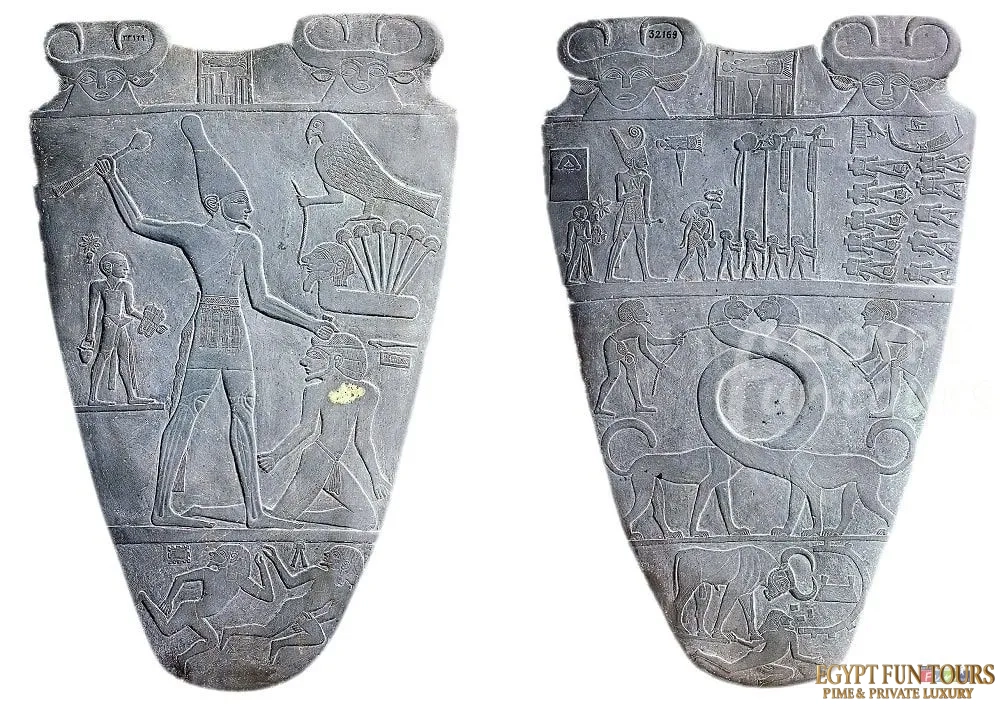
The unification battle of King Narmer is shown on his Palette from ancient Egypt’s Predynastic Period. This cosmetic palette is a stone slab with a central hollow used for mixing makeup. However, palettes also took on a commemorative role and were made from valuable materials. The Narmer Palette, made of schist, is a triangular slab measuring 64 x 42 cm.

Archaeologists found the palette in 1898 among the ruins of the Temple of Horus at Hierakonpolis, near Edfu. It dates to around 3000 BC and is now housed in the Egyptian Museum in Cairo. Narmer, also known as Menes, was the first monarch recorded on the Royal List of Abydos. This list includes the names of almost all pharaohs of the Nile Valley. Historians consider him the founder of the First Dynasty and a forefather of Egyptian government.

The unification battle of King Narmer, around c.3100 BCE, marked the beginning of the early dynastic period. This battle led to the creation of the first royal dynasty in Egypt, with Narmer emerging as the first pharaoh. His name, Menes, means “He Who Endures,” signifying his enduring legacy in Egyptian history. Together, these elements illustrate not only the foundational role Narmer played in Egyptian governance but also the pivotal event that initiated this significant epoch in ancient Egypt.

The iconographic study of this palette shows the goal of glorifying Narmer’s persona and enables us to comprehend his reign’s political importance. The piece is etched on both sides with reliefs and depicts the effort to unite the country’s north and south. The first unified capital of Egypt was named Memphis.
Narmer Palette at The Egyptian Antiquities Museum

Narmer palette and the unification battle by king Narmer - Egypt Fun Tours

The back of the Narmer Palette has three distinct levels. The top level displays the king’s name. It sits inside a box supported by two cow heads. These heads belong to the goddess Hathor. They show one of the oldest depictions of a god with human features.

The central section shows a huge image of Narmer. He wears the white crown of Upper Egypt, a fake beard, and a short skirt with an oxtail. The King holds a mace in his right hand and raises it to strike a defeated enemy, whose hair he grips with his left hand.

This image shows the king’s conquest of the country’s north. It established an iconography used for centuries to show pharaohs’ military might. A sidekick, a “sandal-bearer,” accompanies Narmer. His shaven head and a jug in his hand suggest he is likely a priest.

On the opposite side, the god Horus appears as a hawk. He sits on six papyrus stalks. These stalks represent the Nile Delta. Horus subdues an enemy by a hook through his nose. This symbolizes Horus controlling the life of those who oppose him.

Religious Symbols and Divine Power

The ankh and the Djed pillar were common religious symbols during Narmer’s reign. The ankh symbolizes life and immortality. Gods and goddesses often hold it to show their power to give life. The Djed pillar represents stability and strength. It was linked to the god Osiris and symbolized his backbone. These symbols were key to ancient Egyptian identity.

Horus’ involvement shows the pharaoh as a living god. Divine forces guided his actions. Narmer’s name was also inscribed with symbols similar to Horus’. The image, therefore, represents a conquering pharaoh. He subdued the Delta area and unified the entire Nile Valley for the first time. He brought order out of chaos. On the bottom level, two terrified enemies flee Narmer’s fury.

The Other Side of the Palette

The other side of the palette has four scenes. The top scene has an inscription between two cow heads, just like the reverse. The next section shows Narmer wearing the red crown of Lower Egypt. He carries symbols of authority, including a mace. His sandal-bearer stands behind him, holding a purifying vessel.

In front of the king stand his vizier and four standard-bearers. Each standard represents one of the country’s prefectures. To the right, ten ritually beheaded victims lie with their heads between their knees. This shows Narmer’s victory over his enemies. A falcon and a symbolic boat appear above them. This boat may have been for pilgrimages to sacred towns in the Western Delta.

The third level shows two magnificent quadrupeds with long, intertwined necks. Two servants hold them with ropes. This likely symbolizes the pharaoh’s power. It unified Egypt’s north and south and brought peace. On the bottom, Narmer is a powerful bull. He tears down fortress walls. One of his enemies rests under his feet.

Historians believe this image shows the “white triumph,” the final stage of Egypt’s unification. Historians also credit King Menes with creating government structures still used today.0

King Narmer’s Economic Impact

After the unification battle of King Narmer, he started to pay great attention to Egypt’s economy. His strategic initiatives laid the foundation for centuries of prosperity.

Enhancing the Economy

Narmer’s reign saw an expansion of trade networks. He established trade routes across North Africa and nearby regions. This allowed Egypt to import valuable goods and export surplus resources, which boosted the economy and encouraged cultural exchange.

Narmer also initiated major construction projects. These projects created jobs and developed vital infrastructure. Notably, he oversaw the construction of granaries and transport routes, which facilitated commerce and trade.

By unifying Upper and Lower Egypt, Narmer founded a centralized state. This improved administrative efficiency and resource distribution. This unification created a stable society, paving the way for future kingdoms.

Finally, Narmer strengthened Egypt’s military presence. A strong military safeguarded trade routes and protected national resources. This stability was crucial for sustained economic growth.

In summary, King Narmer’s economic enhancements were multifaceted. He combined strategic trade expansion, infrastructure development, effective governance, and military fortification. These efforts set Egypt on the path to becoming an ancient powerhouse.

FUN
FUN

The Hyksos: The Foreign Rulers Who Transformed a Civilization

Stop calling the Hyksos just 'invaders.' This group, known as the "Rulers of Foreign Lands,"...
Related post
FUN

The Story of the Two Brothers: A Guide to the Tale of Bata and Anubis

The Story of the Two Brothers is a sweeping epic of betrayal, supernatural endurance, and...
Related post
FUN

The Story of the Two Brothers: A Guide to the Tale of Bata and Anubis

The Story of the Two Brothers is a sweeping epic of betrayal, supernatural endurance, and...
Related post
FUN
Sailing across a series of one-kind temples & tombs....
The best classic tour covering Cairo, Luxor, and Aswan in only 6 Days....

Jeep Safari in the Sahara

I contacted Hani two days before I went to Egypt and asked him if it was possible to combine two of their tours as we were short on time. We had planned to stay in Cairo but with the uprising we decided it would be safed outside of the hot

More »

Layover tour of Cairo Pyramids

On a recent trip, I had 8 hours from the time I landed in Cairo to when my next flight was scheduled to leave. Luckily, I arrived in the morning and left in the afternoon, so, not being one to sit around an airport for 8 hours, I visited the

More »

Amazing layover Tour

We had 12 hour layover in Cairo, and our guide Hani waited patiently for us when we had a few visa issues entering the country! We got on our tour, and had the best experience ever! We saw the pyramids, the sphinx, Islamic Cairo and rode through the city! We

More »
A Royal Commission The History of Al-Rifa'i Mosque

Highly recommended

Salam, This company is very responsive and accommodating. From the moment we started to chat via email, to the moment we left Egypt at the airport, these fellows were very professional. The tour covered most of what we wanted to see! We customized it to our needs and added some

More »
Isis with wings

Top-rated Tour Packages

Isis with wings