Sobek-Ra and Montu-Ra: How Local Gods Claimed Solar Legitimacy

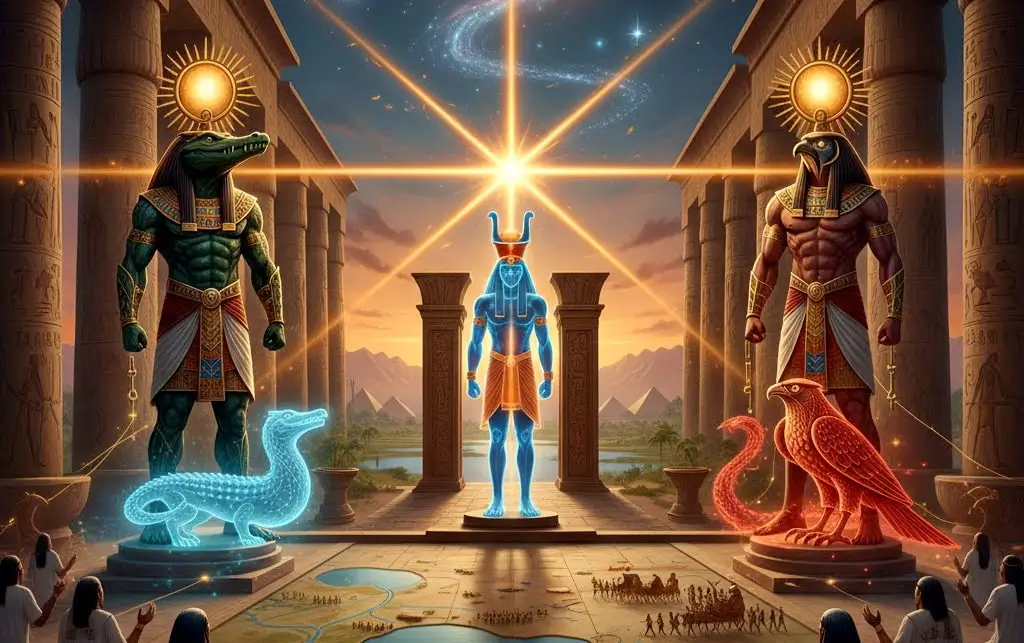
The political genius of the Egyptian Sun God (Ra) was its transferability. Pharaohs maintained centralized power by forcing powerful regional deities, like the crocodile god Sobek and the war god Montu, to merge with Ra, creating fusions like Sobek-Ra and Montu-Ra. This process, known as solar syncretism, legitimized local cults and their political influence, but only by subjecting them to the supreme, universal solar mandate, ensuring all power ultimately flowed from the pharaoh's central authority.

The Sun God’s political brilliance lay in its transferability—it grafted onto rising local deities, thereby maintaining centralized control. As regional centers gained political or military prominence, they elevated their patron gods. However, they could only claim national, supreme authority by successfully merging with Ra. This process, known as syncretism, served a crucial political function: it acknowledged the regional power base while simultaneously subjecting it to the universal, solar mandate of the pharaoh. We see this vividly in the development of the Sobek-Ra political role and the application of Montu-Ra syncretism. These two deified fusions provide the clearest case studies of this strategic solar-political absorption.
FUN

Sobek-Ra: The Crocodile God and the Solar State

Sobek-Ra, The Crocodile God and the Solar State

Sobek, the crocodile god, was originally a powerful, chaotic deity associated with water, fertility, and sudden danger. His main cult center was the Faiyum region, particularly the city of Shedet (later known as Crocodilopolis).

1. The Need for Syncretism

Sobek’s local power base surged during the Middle Kingdom, especially under the 12th Dynasty. These pharaohs heavily invested in the Faiyum, developing its irrigation systems and making Sobek’s temple a major center of state activity. As the patron god of a politically and economically vital region, Sobek needed universal legitimacy. The pharaohs provided it through fusion.

FUN

2. The Fusion: Sobek-Ra

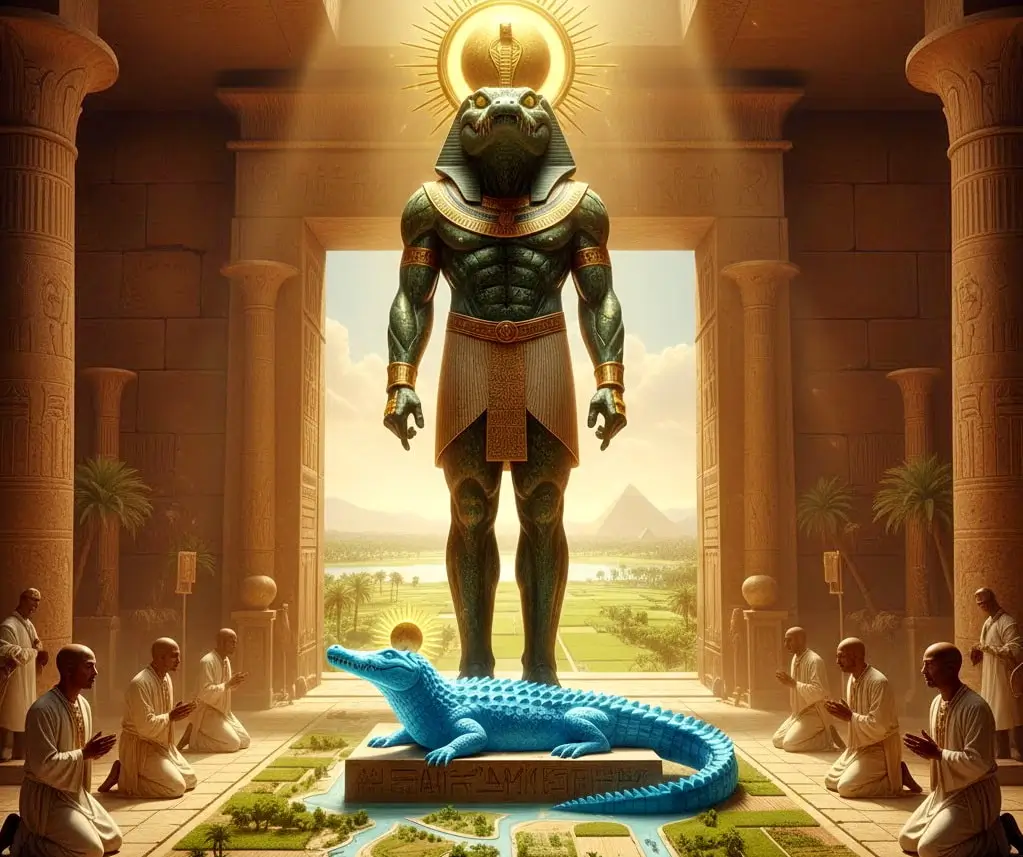
The composite deity Sobek-Ra was created to resolve this political-theological challenge. Sobek retained his crocodile head and powerful physique, but he was crowned with the solar disk and uraeus (sacred cobra).

This theological merger immediately conferred solar authority upon the regional god. Sobek was no longer just the god of the Faiyum; he became a manifestation of the Sun God himself, ensuring that the wealth and influence of his region remained under the solar, pharaonic umbrella.

3. Political Role

The creation of Sobek-Ra was a masterstroke of political absorption. It legitimized the pharaohs’ investment in the Faiyum, associating their development projects with the creative and life-giving power of the Sun God. It demonstrated that even a powerful, independent-minded regional god ultimately served the supreme, solar principle that defined the entire state.

Egyptian Phoenix Bennu: Myth, Symbolism, and Legacy

Forget the fire. The original legend is even better. Meet the Bennu, the Egyptian Phoenix....
Related post
FUN

Montu-Ra: The War God and the Imperial Mandate

Montu-Ra, The War God and the Imperial Mandate

Montu was the ancient, often aggressive, falcon-headed god of war, whose cult center was located near Thebes. While an important local deity, his national importance dramatically increased when the Theban 11th and 18th Dynasties rose to power, launching the New Kingdom and an age of empire.

1. The Military Need

When the Theban rulers expelled the foreign Hyksos and established the powerful, imperial New Kingdom, they needed a supreme state god who could sanction their military expansion. Montu, the god of martial prowess, was the obvious choice. However, to command the entire nation and sanction the pharaoh’s universal rule, Montu had to claim cosmic, solar authority.

Apophis: The Egyptian Lord of Chaos and the Eternal Serpent

Apophis, the primordial serpent of ancient Egyptian mythology, serves as the ultimate embodiment of Isfet...
Related post
FUN

2. The Fusion: Montu-Ra

The combination of Montu-Ra integrated the power of the local war god with the national sovereignty of the Sun God. Montu retained his falcon head and often carried weapons, but he was always depicted with the solar disk and twin plumes.

This fusion meant that when the pharaoh went to war—conquering territories in Nubia or the Levant—he was not just acting on the authority of a local war god. He was enacting the will of the Sun God himself, establishing a divinely sanctioned solar empire.

3. Political Role

Montu-Ra was the theological engine of the New Kingdom’s expansionist foreign policy. The victories of pharaohs like Thutmose III and Amenhotep I were portrayed as the triumph of Montu-Ra. This fusion effectively made the pharaoh the chief military delegate of the supreme cosmic power, reinforcing the principle that all political and military might flowed from the solar mandate.

Amun: The Hidden One Who Became King of the Gods in Ancient Egypt

God Amun stands as one of the most powerful and enduring deities of the Egyptian...
Related post
FUN

Summary: Solar Transference

Both Sobek-Ra and Montu-Ra perfectly illustrate the genius of solar transference. The pharaohs did not eliminate local power; they co-opted it. By fusing local deities with Ra, they successfully transferred the paramount political role of the Sun God to a regional manifestation, ensuring the central authority remained inviolable and universally recognized throughout the consolidated state.

Embark on this special voyage to discover the wonders of ancient Egypt....
This makes it feasible for you to make the most of your time in Egypt...
FUN
God_Anubis_Icon

Excellent Layover Tour

I would recommend Egypt Fun Tours to everyone who is looking for either a cultural or relaxing trip in Egypt. I was recently on a private layover tour and could not have been any happier with my day in Cairo. My tour guide, Hani was waiting just outside immigration and

More »

Perfect layover Tour

I had a 10 hour layover in Cairo so booked a tour with Hani at Egypt Fun Tours. The tour was brilliant. I saw exactly what I wanted to see during the day which included the pyramids, Sphinx, Egyptian museum and the Bazaar. Hani was very knowledgeable and was the

More »

11 Wonderful Hours in Cairo

I had an 11 hour layover in Cairo, and it couldn’t have been better spent than with Manal from Egypt Fun Tours. I was able to adjust my tour once we left the airport and Manal had some really great suggestions when I told her what it was I wanted

More »
hani ahmed 1

Hani Was our Awesome Tour Guide!

We had an 11-hour layover in Cairo on 12/15/2011. We wanted to go to see the Pyramids, Tahrir Square, and possibly the museum. We were so lucky to have a guide, Hani from Egypt Fun Tour, who made it possible to see all the above, plus the Bazaar, and time

More »
God_Anubis_Icon

Top-rated Tour Packages

God_Anubis_Icon