God Aten: The Hidden Power Behind Sun Disk

The God Aten is unique in Egyptian history, representing the solar disk itself and serving as the singular, omnipotent deity during the controversial Amarna Period. This guide explores Aten's brief but radical ascent under Pharaoh Akhenaten (formerly Amenhotep IV), who abolished the traditional polytheistic worship of Amun and the other gods, establishing the Aten as the sole creator and life-giver. You will discover the theological revolution of Atenism, examining its aniconic depiction—the sun disk with life-giving rays—and the impact of this monotheistic experiment on Egyptian art, politics, and religion, and its sudden decline after Akhenaten's death.

God Aten, the hidden power behind the sun disk “Atenism”, holds a unique and controversial position in the ancient Egyptian pantheon. Unlike the many other gods who were human-animal hybrids or abstract forces, the Aten was the visible disk of the sun itself. Its worship became the central focus of a radical monotheistic religion during the reign of Pharaoh Akhenaten (originally Amenhotep IV). This “Amarna Period” marked a dramatic, but short-lived, break from traditional Egyptian polytheism.
FUN

Origins and Early Worship

Why the ancient Egyptians worshipped the sun - Atenism - God Aten

Aten was not an entirely new god. Egyptians had revered the sun and its various forms for centuries. The god Ra, for example, was closely linked to the sun. However, before Akhenaten, the Aten was simply one aspect of the sun, a minor deity. In earlier periods, artists often depicted it as a secondary element in a larger scene. It rarely had its own cult. Its role was to serve other, more prominent sun gods.

FUN

The Rise of Atenism

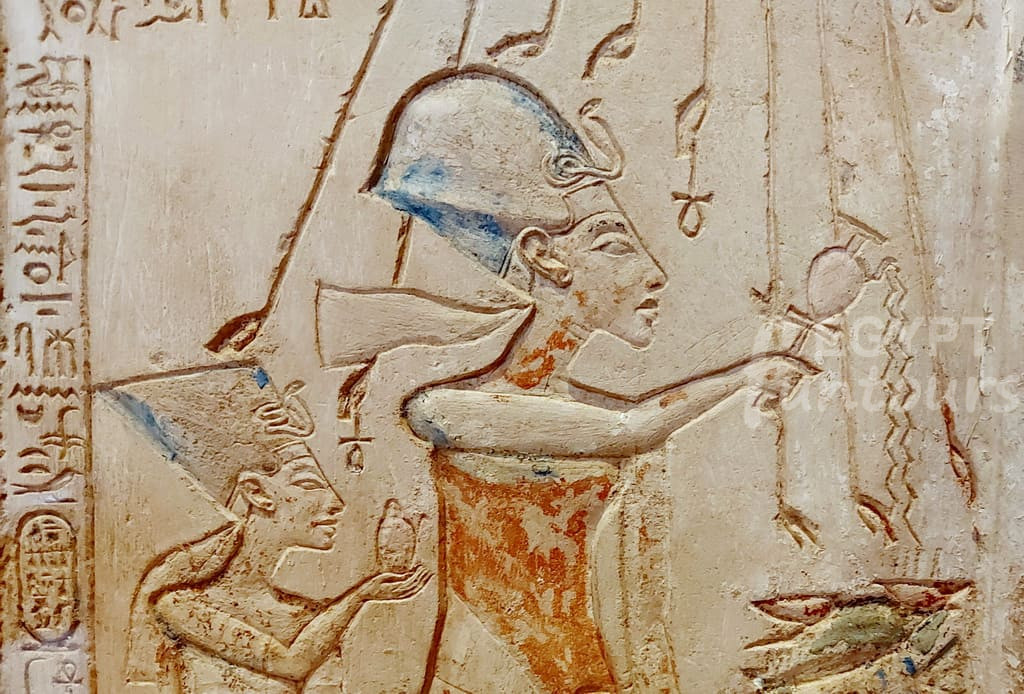
Ankh under the reign of King Akhenaten Ankh the Key of life by the ancient Egyptians Egypt Fun Tours

Akhenaten’s ascent to the throne completely changed the Aten’s status. Around the fifth year of his reign, he began a radical religious reform. King Akhenaten declared the Aten the only true god. He actively suppressed the worship of all other gods, especially Amun-Ra, the powerful king of the gods. He even changed his name from Amenhotep to Akhenaten (“Effective for the Aten”).

Akhenaten moved his capital from Thebes to a new city he built from scratch. He called the city Akhetaten (“Horizon of the Aten”). Today, we know it as Amarna. This new capital was a physical embodiment of his religious revolution. The city was dedicated entirely to the worship of the Aten. The temples were open to the sky, allowing direct sunlight to enter. This was a stark contrast to the dark, enclosed temples of other gods.

Egyptian Phoenix Bennu: Myth, Symbolism, and Legacy

Forget the fire. The original legend is even better. Meet the Bennu, the Egyptian Phoenix....
Related post
FUN

Iconography and Philosophy of God Aten

King Akhenaten NMEC Egypt Fun Tours

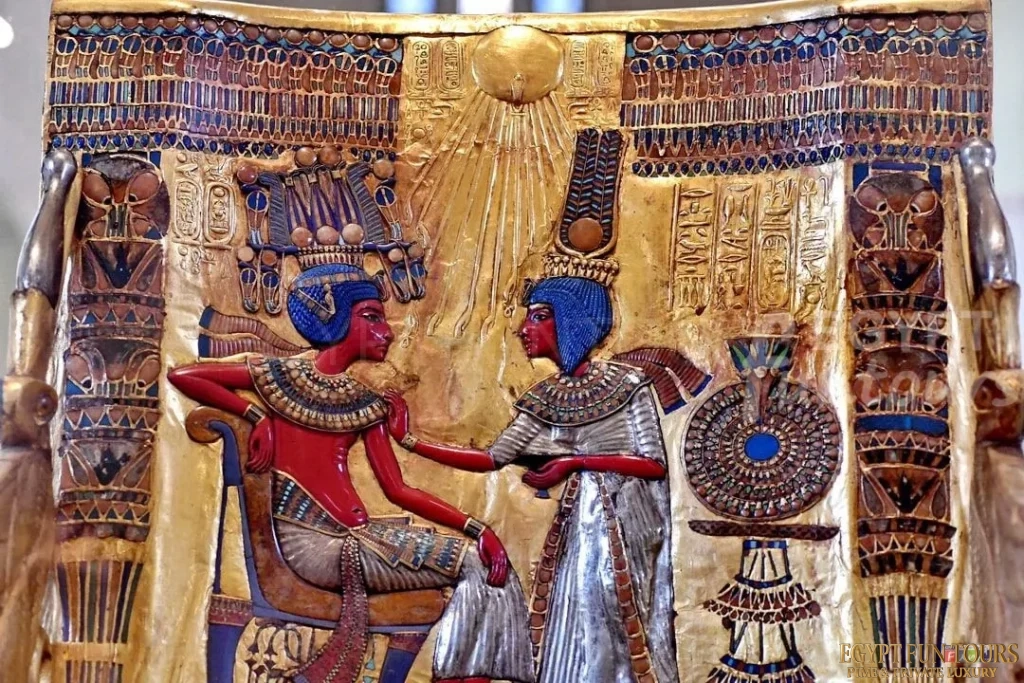
Artists depicted the Aten in distinct and symbolic ways. It was a sun disk with rays extending downwards. These rays often ended in little hands holding the ankh, the symbol of life. This showed that the Aten not only provided light and warmth but also gave life and sustenance to all living things.

The theology of Atenism was revolutionary. It was a form of monotheism, a belief in one single god. This was a radical departure from the traditional polytheism of ancient Egypt. The faith focused on the Aten as a universal god. It was not a local or national deity. Akhenaten promoted a direct and personal relationship with the Aten. This eliminated the need for a complex pantheon of intermediary gods.

Apophis: The Egyptian Lord of Chaos and the Eternal Serpent

Apophis, the primordial serpent of ancient Egyptian mythology, serves as the ultimate embodiment of Isfet...
Related post
FUN

The Decline and Legacy of Atenism

Egyptian antiquities museum at tahrir square - 6-day classic egypt tour - Group tour of wonders

Akhenaten’s religious revolution did not outlast his reign. After his death, his son, Tutankhaten (“Living Image of the God Aten”), quickly reversed the reforms. He changed his name to Tutankhamun (“Living Image of Amun”). The old priests reclaimed their power. They restored the old gods, especially Amun-Ra. Akhenaten’s name was removed from monuments. His temples were dismantled. His new capital was abandoned. The Egyptians sought to erase the memory of Atenism and its founder. They considered it a heresy.

Hapi: The God of the Nile Flood and Bringer of Fertility in Ancient Egypt

God Hapi is the quintessential Egyptian deity, personifying the life-giving annual flood of the Nile...
Related post
FUN

Despite its failure, Atenism had a lasting impact. It introduced the world to one of its earliest known attempts at monotheism. The art from the Amarna Period, with its unique naturalism and realism, also left a significant legacy. Atenism remains a fascinating chapter in the history of religion. It demonstrates the power of a single individual to challenge a civilization’s most fundamental beliefs.

Current weather in Egypt

Live a vacation worthy of cherishing....
Fantastic Deluxe experience and wonderful adventure trip of Egypt....
God_Anubis_Icon

Egypt Fun Tours makes the most out of your layover!

I had a really short layover in Cairo and didn’t want to be stuck in the Cairo Airport for several hours. It was like Mission Impossible: Egypt Fun Tours’ mission was to show me around Cairo during my short 5 hour layover which was made even shorter because my plane

More »

Absolutely the best

We visited Cairo over a 15-hour layover. Egypt Fun Tours organized a customized and wonderful experience for us. We could not be happier. The day included a visit to all the great sites, the marketplace, dinner, a boat ride on the Nile, and a host of other special requests. I

More »
Memnon colossi of king amenophis III 4 min

Book with them, they are Professionals

It has always been my dream to visit Egypt. This was a beautiful tour, almost two years later, I can’t stop thinking about my time in Egypt, Valley of the Kings, Temple of Kom Ombo, Edfu, Luxor! I was able to add an eighth day to see Abu Simbel (a

More »
God_Anubis_Icon

Top-rated Tour Packages

God_Anubis_Icon