The Mastaba of Ti: A Masterpiece of Old Kingdom Art and Life

The Mastaba of Ti is an architectural and artistic masterpiece of the Old Kingdom, serving as a vital window into the 5th Dynasty. As the tomb of a high-ranking official, it shifts the focus from royal grandeur to the intricate details of ancient Egyptian daily life. Its world-class reliefs—ranging from bustling agricultural scenes to the famous hippopotamus hunt—represent the pinnacle of non-royal funerary art. Ultimately, the site remains an essential anchor for understanding the cultural, religious, and economic rhythms of the Memphite Necropolis.

The Artistic Brilliance of the Mastaba of Ti

While the great pyramids neighboring the site capture the world’s imagination with their sheer scale, the Mastaba of Ti in North Saqqara offers an unparalleled look into the soul of the Old Kingdom. Built during the mid-Fifth Dynasty, this funerary monument serves as the eternal resting place for a high-ranking official named Ti, who served multiple pharaohs as the supervisor of royal works and sun temples. Unlike royal tombs that focus on the king’s journey to the stars, this mastaba functions as a vibrant stone encyclopedia of ancient Egyptian daily life. It represents the pinnacle of private tomb architecture and remains one of the most decorated and well-preserved sites in the entire Memphite Necropolis.

FUN

A Monument to Non-Royal Power

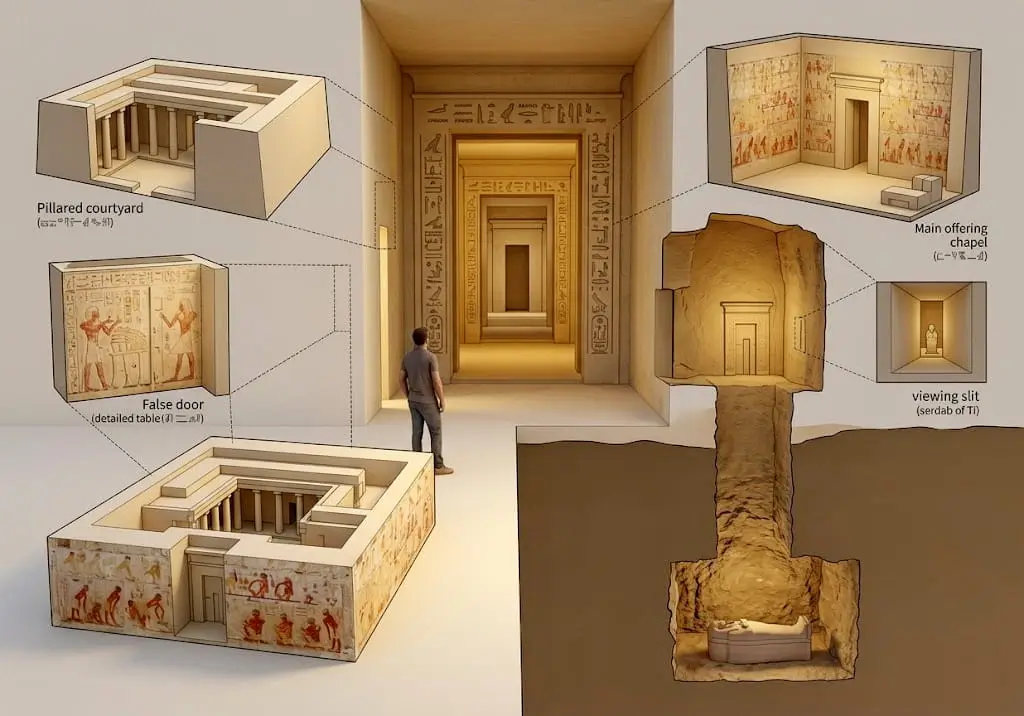
Ti was not a king, yet his tomb rivals royal constructions in its sophistication and artistic detail. His high status allowed him to commission the finest craftsmen of the era to carve intricate bas-reliefs across nearly every interior wall. Consequently, the mastaba serves as a testament to the growing influence of the elite bureaucracy during the 5th Dynasty. As visitors navigate through the large pillared courtyard and into the inner chambers, they witness a transition from the public-facing areas of the cult to the deeply private sanctuaries intended for the spirit.

A Window into the Ancient World

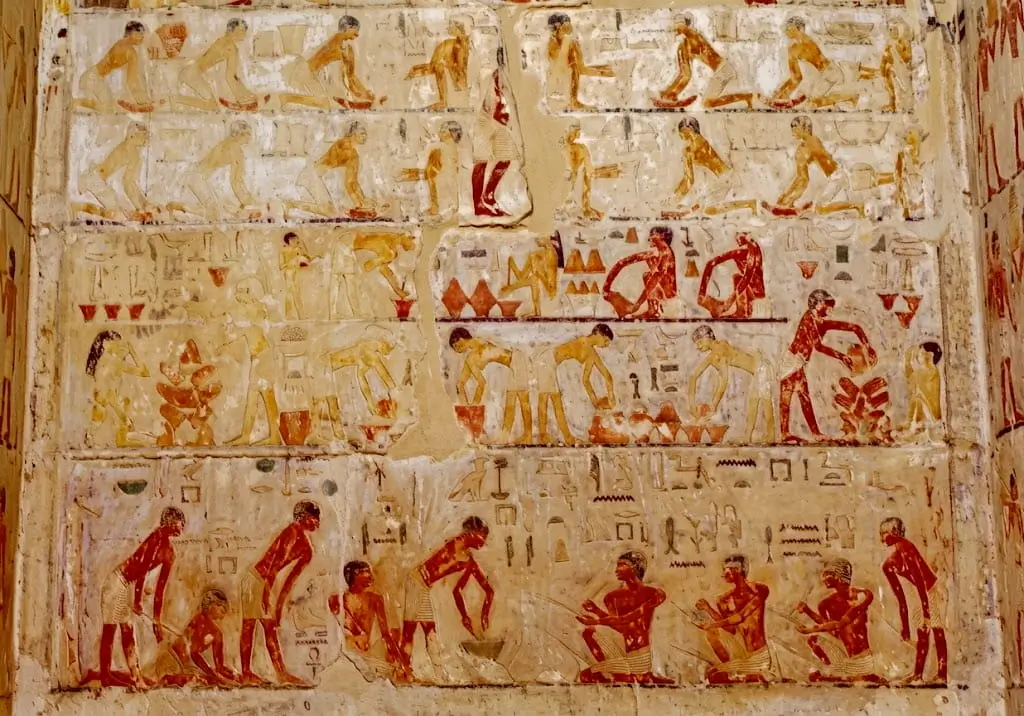
The primary fame of the Mastaba of Ti lies in its incredibly detailed scenes of agriculture, craftsmanship, and nature. From the famous depiction of Ti standing on a papyrus boat during a hippopotamus hunt to scenes of gold-working and bread-making, the reliefs capture the rhythm of life along the Nile with startling realism. These images were not merely decorative; they were designed to magically provide for the deceased in the afterlife. Therefore, every carved harvest and every line of cattle ensured that Ti would remain wealthy and well-fed throughout eternity.

Discovery and Archaeological Importance

Discovered by Auguste Mariette in 1860, the mastaba immediately became a focal point for the study of Old Kingdom art. Its clean, elegant lines and the preservation of its original paint in certain areas offer scholars a baseline for understanding the aesthetic standards of the 25th century BCE. Furthermore, the architectural layout—featuring a unique “Serdab” (statue chamber) with small viewing slits—highlights the complex religious beliefs regarding the soul’s interaction with the physical world. This guide explores the technical mastery behind these reliefs and provides a deep dive into the stories told within Ti’s limestone walls. the chapel.

FUN

The Architectural Layout: A Journey into the Eternal Sanctuary

The Architectural Layout A Journey into the Eternal Sanctuary

The Mastaba of Ti is celebrated not just for its art but for its complex and innovative architectural design. Unlike earlier, simpler tombs, this 5th Dynasty structure features a sophisticated multi-room floor plan that separates the public ritual spaces from the private, sacred chambers. Visitors enter through a grand pillared courtyard, where twelve massive square columns once supported a roof, creating a shaded space for priests to perform initial ceremonies. This layout reflects the growing architectural ambition of the elite officials who served the pharaohs at Saqqara.

The Serdab: The Soul’s Viewing Room

One of the most fascinating technical features of this tomb is the Serdab, or statue chamber. Located behind the southern wall of the offering chapel, this room remained completely sealed to the public. However, the architects included two small eye-level slits in the wall. These “viewing holes” allowed the spirit of Ti, inhabiting his stone statue within, to witness the smoke of incense and the presentation of food offerings in the outer room. Consequently, the Serdab acted as a physical bridge between the world of the living and the realm of the Ka (the life force).

The Catacombs of Kom Esh-Shokafa: Roman-Egyptian Underworld

Descend into one of the "Seven Wonders of the Middle Ages" at the Catacombs of...
Related post
FUN

Masterpieces in Stone: Reliefs of Daily Life

Masterpieces in Stone Reliefs of Daily Life

The walls of the Mastaba of Ti contain some of the most famous bas-reliefs in the history of art. These carvings do more than decorate; they act as a functional “backup plan” for the afterlife. By depicting scenes of abundance and industry, the craftsmen ensured that Ti would magically possess everything he needed for eternity. The level of detail is extraordinary, capturing the anatomy of animals and the specific tools used by workers with scientific precision.

The Famous Hippopotamus Hunt

The Famous Hippopotamus Hunt

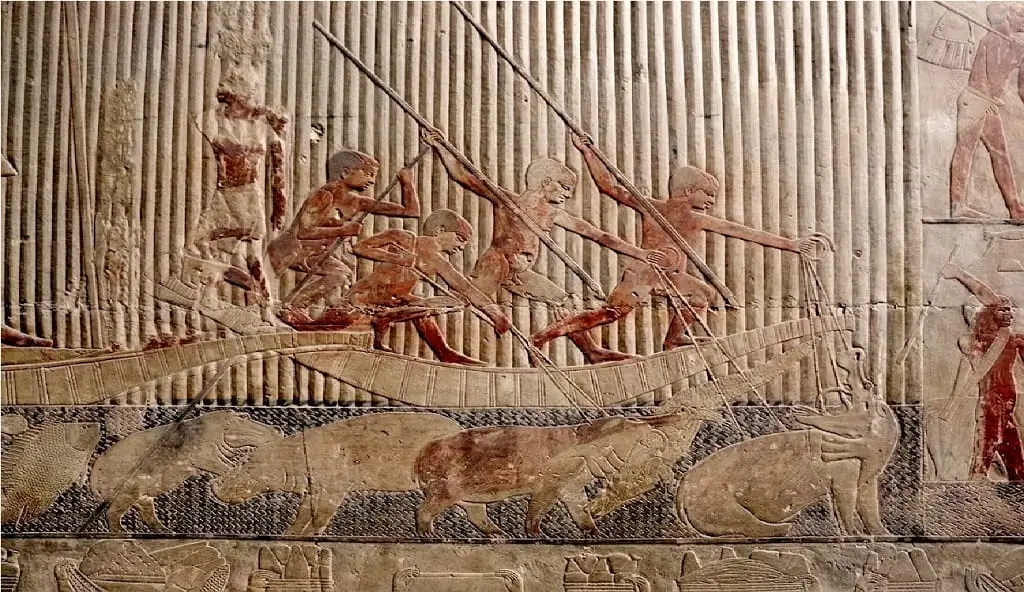
In the interior chapel, the most iconic relief shows Ti standing tall on a papyrus boat in the marshes. Below the water’s surface, a chaotic battle unfolds between crocodiles and hippopotami, while birds nest in the papyrus stalks above. While the workers are shown in active, smaller-scale poses, Ti is depicted in a large, static, and “idealized” form. This artistic choice emphasizes his high status and his role as a bringer of order over the chaotic forces of the wild Nile.

Agriculture and Craftsmanship

Other sections of the tomb provide a vivid record of 5th Dynasty technology. You can see scenes of:

  • Tilling and Sowing: Farmers drive oxen and sheep over the fields to trample seeds into the fertile mud.
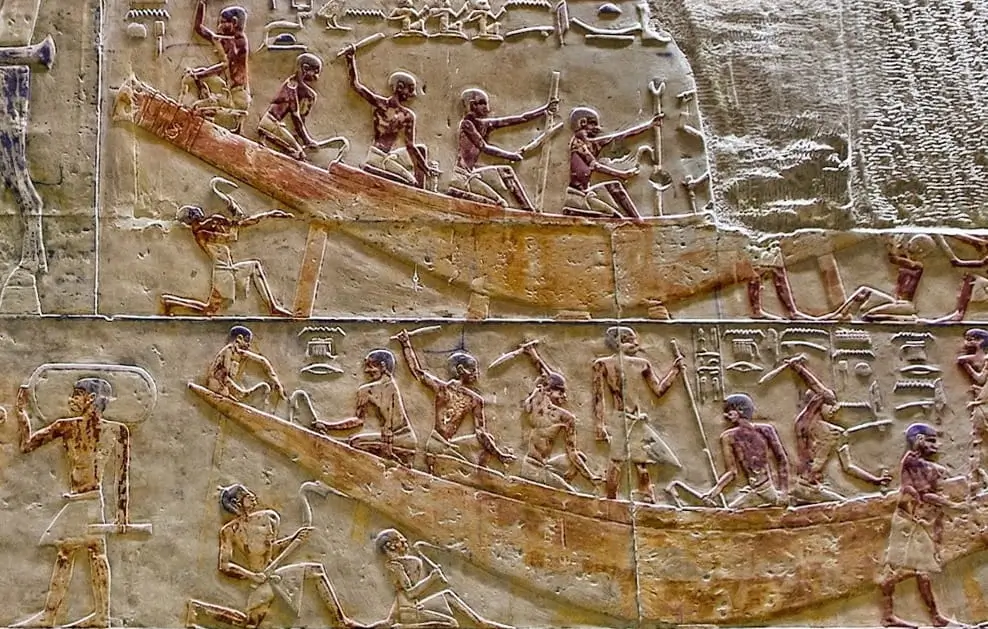
  • Shipbuilding: Craftsmen using adzes and drills to construct the very boats that would transport goods across the river.
  • Accounting: Scribes diligently record the harvest, highlighting the organized bureaucracy that Ti himself supervised.

The Tomb of Petosiris: A Unique Blend of Greek and Egyptian Art

The Tomb of Petosiris at Tuna el-Gebel is a premier example of Greco-Egyptian art from...
Related post
FUN

The Mastaba of Ti vs. The Mastaba of Mereruka

The Mastaba of Ti vs. The Mastaba of Mereruka

For those exploring the necropolis of Saqqara, comparing the Mastaba of Ti (5th Dynasty) with the Mastaba of Mereruka (6th Dynasty) provides a masterclass in the evolution of Egyptian funerary art and elite status. While both represent the pinnacle of non-royal tomb construction, they reflect different stages of Old Kingdom history.

Feature Mastaba of Ti Mastaba of Mereruka
Dynasty Mid-5th Dynasty Early 6th Dynasty
Total Rooms ~7 Chambers 32 Chambers (Largest in Saqqara)
Artistic Style Precise, delicate, and scientific detail Bold, expansive, and high-relief carving
Primary Theme Order, nature, and bureaucratic duty Family legacy and immense political power
Key Highlight The Hippopotamus Hunt in the Marshes The life-sized statue of Mereruka stepping out

Evolution of Scale and Complexity

The most immediate difference is the sheer size. The Mastaba of Ti is a model of refined, compact elegance, focusing on the quality of its internal reliefs. In contrast, Mereruka’s tomb is a sprawling complex that includes separate sections for his wife and son. This expansion mirrors the decentralization of power during the 6th Dynasty, where high-ranking viziers gained nearly king-like authority and resources. Consequently, while Ti’s tomb feels intimate and scholarly, Mereruka’s feels like a palace for the afterlife.

[Image comparing the floor plans of the Mastaba of Ti and the Mastaba of Mereruka]

The Shift in Artistic Expression

Artistically, the Mastaba of Ti is often cited as the peak of “classical” Old Kingdom proportions. The carvings are shallow but incredibly sharp, emphasizing the scientific observation of flora and fauna. By the time of Mereruka, the art became more robust and dramatic. For instance, the famous statue of Mereruka emerging from a niche is a dynamic architectural statement that goes beyond the “viewing slits” found in Ti’s Serdab. Furthermore, while Ti’s tomb excels in depicting the rhythm of the Nile, Mereruka’s reliefs often lean into complex social hierarchies and expansive ritual scenes.

Giza Pyramids Complex: The Eternal Horizon of the Fourth Dynasty

The Giza Pyramid Complex remains the ultimate testament to human ingenuity, spanning the intersection of...
Related post
FUN

FAQs: The Mastaba of Ti

Where is the Mastaba of Ti located?

It is situated in the North Saqqara necropolis, not far from the Step Pyramid of Djoser and the Serapeum. It is one of the most popular private tombs for visitors due to its accessibility and the quality of its carvings.

Was Ti a member of the royal family?

No, Ti was a high-ranking official, not a royal. He held titles such as “Overseer of the Sun Temples of Neferirkare and Nyuserre,” which gave him the wealth and permission to build a tomb that rivaled royal standards.

Why are the animals in the reliefs so detailed?

Ancient Egyptian artists viewed these reliefs as functional magic. The details had to be accurate so the spirit (Ka) could correctly identify and “use” the animals for food or sport in the afterlife. This led to the incredible biological accuracy seen in the hippopotamus and fish carvings.

What is a “Serdab” and why does it have holes?

A Serdab is a hidden room that holds a statue of the deceased. The two small holes in the wall allowed the statue (the physical vessel for the spirit) to “breathe” the scent of incense and “see” the offerings being made in

Explore the wonders of Egypt in 9-day adventure....
The 10-Day Egypt Deep Heritage Tour is not a vacation; it is a chronological reconstruction of an empire....
FUN
God_Anubis_Icon

AMAZING Layover Tour

We had the MOST amazing layover tour with Egypt Fun Tours. Hanni was amazing, and we loved every moment. Pyramids, authentic food, and Islamic Cairo – amazing!

More »

Great one day tour in Cairo

My husband and I had a long layover in Cairo on our way to Kenya in 2010. Since we had never been to Egypt, we decided to sign up for a one-day tour with Egypt Fun Tours Day Trips. Our guide was there when we arrived and quickly guided us

More »
15-Day Historical Egypt Tour Package

all good!

we took pyramid and Cairo city tours and all went smoothly. The were very flexible to adapt to our requirements. Car, car driver and guide were great. very knowledgable and professional tour. Very recommendable

More »

11 Wonderful Hours in Cairo

I had an 11 hour layover in Cairo, and it couldn’t have been better spent than with Manal from Egypt Fun Tours. I was able to adjust my tour once we left the airport and Manal had some really great suggestions when I told her what it was I wanted

More »

Transit Stopover in Cairo

We have just returned from a two week holiday in Cape Town. On the way out our airline schedule meant that we had a 15 hour stop in Cairo. We decided to arrange a tour of the city and after asking for quotes/itineraries we chose Egypt Fun Tours. This worked

More »
God_Anubis_Icon

Top-rated Tour Packages

God_Anubis_Icon