
The Waterwheels of Fayoum: Egypt’s Ancient Irrigation Icons

Discover the Waterwheels of Fayoum, an ancient irrigation system of over 200 wooden wheels introduced in Ptolemaic Egypt. Learn how these iconic 'sakias' still turn today, lifting Nile water to green the oasis with their distinctive, groaning sound.

The Waterwheels of Fayoum

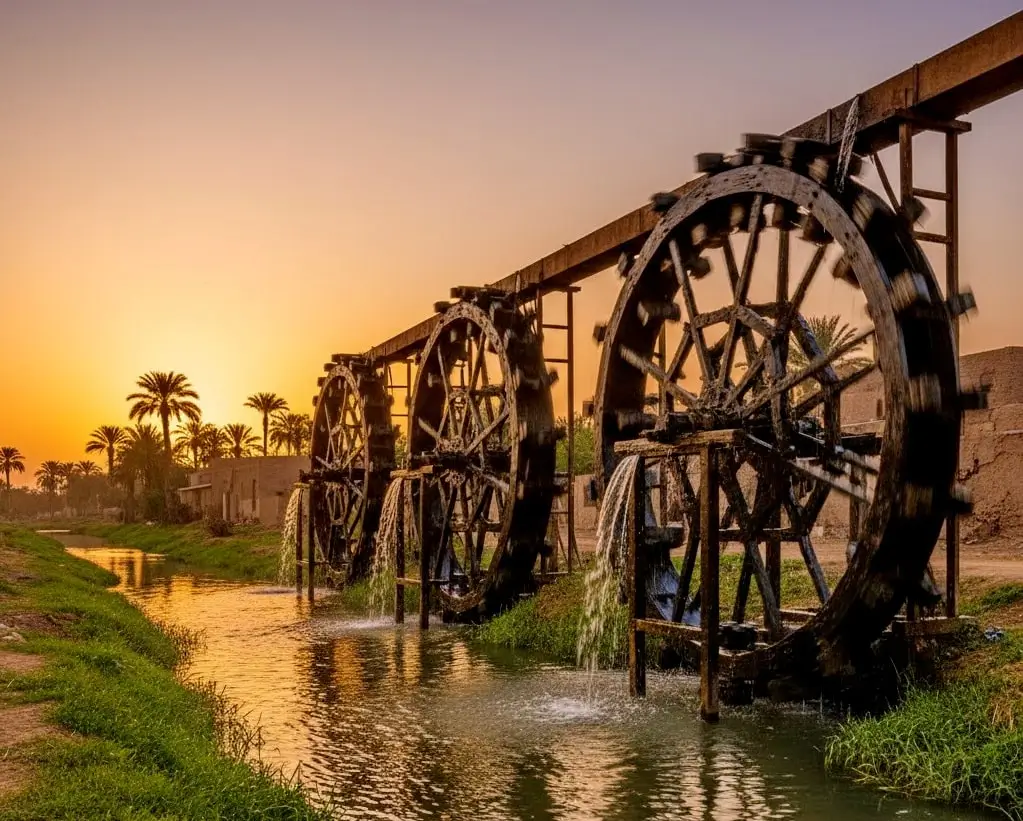
Long before you see them, you hear them. A rhythmic, haunting groan that echoes through the canals—the sound of wood turning against wood, powered by water, just as it has for over two millennia. This is the soundtrack of the Fayoum Oasis, and its source is the region’s most iconic feature: the waterwheels of Fayoum.

These are not mere relics. They are over 200 pieces of living, working ancient technology that straddle the canals, testifying to a long history of human ingenuity. In an oasis often called “Egypt’s Garden,” these wheels are the heart, pumping life-giving water to the fields.

Key Takeaways: The Fayoum Waterwheels at a Glance

  • What Are They? A system of over 200 large, wooden, water-powered wheels that lift water from canals to irrigate farmland.
  • How Old Are They? Egyptian engineers during the Ptolemaic time introduced them around the 3rd century BCE, making them over 2,000 years old.
  • Why Are They Special? Unlike the animal-powered “Sakia,” the canal’s current drives Fayoum’s “Taboot” wheels entirely.
  • Where Can I See Them? Key sites include the “Famous Seven” on the Bahr Sinnuris canal and the city center of Fayoum.
  • The “Crying” Sound: Their famous creaking and groaning sound is a signature of the region, caused by the wooden gears and axles turning.
FUN

A 2,000-Year-Old Feat of Ptolemaic Engineering

A 2,000-Year-Old Feat of Ptolemaic Engineering - Waterwheels of Fayoum oasis

The Fayoum Oasis is not a true oasis fed by springs. It’s a unique depression in the desert, fed by a canal of the Nile called the Bahr Yussef (Joseph’s Canal). During the Ptolemaic era, engineers faced a challenge: how to lift the canal water to the higher, fertile ground.

Their solution was a marvel of hydrological engineering. By creating a system of smaller, faster-moving canals with a specific gradient, they harnessed the power of the water itself to turn massive wooden wheels.

How the Waterwheels Work

The design is both simple and brilliant:

  1. Power: The fast-moving current of the canal pushes against paddles on the wheel, causing it to turn.
  2. Lifting: As the large wheel rotates, clay pots or wooden compartments built into its rim dip into the canal, fill with water.
  3. Delivery: The wheel lifts the water to its highest point, where the pots automatically tilt and empty their contents into an aqueduct or channel.
  4. Irrigation: This elevated channel then uses gravity to distribute the water to the surrounding fields, orchards, and gardens.

Each wheel, typically 4 to 5 meters in diameter, can lift water up to 3 meters. To ensure their longevity, the wood is coated in thick black tar, protecting it from rot and giving the wheels their distinctive dark appearance.

The “Taboot” vs. the “Sakia”

Fayoum’s peasants have a special name for their unique waterwheels: the “Taboot.” This name is crucial as it distinguishes them from the more common “Sakia” found elsewhere in Egypt.

  • Sakia: The traditional “sakia” is an animal-driven wheel. It requires a donkey, ox, or buffalo to walk in a circle, turning a set of gears to lift the water.
  • Taboot (The Fayoum Wheel): The “taboot” is entirely water-powered. It is a more advanced, self-sufficient machine that runs 24/7 as long as the canal water is flowing.
FUN

A Living Tradition: Maintenance and Celebration

These ancient machines are not a “set it and forget it” technology. They require constant care, which is deeply woven into the local culture and agricultural calendar.

Every January, the main sluices in Fayoum are closed to allow for the cleaning of the canals. This low-flow season is when the real work begins. Farmers and craftsmen gather to inspect, clean, and repair the wheels, replacing worn-out wooden parts and re-tarring the structures.

This annual maintenance is vital for the region’s survival, ensuring a continuous supply of water for the crops.

The Basiouniya Giant

While hundreds of wheels dot the landscape, the largest and most famous waterwheel in all of Egypt is located in the village of Basiouniya, about 14 kilometers from Fayoum city.

  • Height: An impressive 8 meters (26 feet) tall.
  • Weight: Weighs over 2 tonnes.
  • Impact: This single, monumental wheel provides fresh water to 88 acres (37 hectares) of agricultural land.

This giant wheel is serviced annually, but its entire structure must be replaced every six years. This replacement is not a simple construction job; it’s a community festival. Locals celebrate the installation of a new wheel, recognizing it as a vital source of their economic well-being and a continuation of their ancestral heritage.

FUN

A Guide: Where to See the Waterwheels of Fayoum

For any traveler to Fayoum, seeing the waterwheels is a must. They are easily accessible and offer a mesmerizing glimpse into the past.

1. The “Famous Seven” Waterwheels

This is the most picturesque and well-known group of waterwheels. Located in the countryside along the Bahr Sinnuris canal, these seven wheels are clustered together, creating a beautiful and incredibly photogenic scene. Their combined creaking and groaning is the sound that most visitors remember.

2. Fayoum City Center

You don’t even have to leave the provincial capital to see the wheels in action. Four of them are located right in the center of Medinat Fayoum (Fayoum City), serving as a proud symbol of the governorate. Strolling around the city streets, you can see this wonderful irrigation machinery as a part of daily life.

FUN

Waterwheels of Fayoum (FAQ)

Q: Why do the Fayoum waterwheels make so much noise?

A: The iconic “creaking” or “groaning” sound comes from the friction of the massive wooden axles and gears turning. This all-wood construction, groaning under the strain of lifting tons of water, gives the wheels their unique “crying” sound, which many locals find peaceful and rhythmic.

Q: Do people still use the waterwheels for farming today?

A: Yes. While people preserve some for cultural and tourism purposes, many of the 200+ waterwheels in Fayoum remain fully functional and are essential parts of the local irrigation system. They are a rare example of an ancient technology surviving into the 21st century.

Q: What is the best time to visit Fayoum?

A: You can visit Fayoum year-round. However, the winter months (October to April) offer the most pleasant weather for exploring. Keep in mind that canal maintenance occurs in January, so some wheels may be temporarily stationary.

FUN
Explore pyramids, Karnak temples, Valley of the kings, Khan El Khalili & museums...
You're a few moments away to enjoy a memorable holiday for the entire family....

Goes well beyond “tour”

I am tempted to say “my friend Hani” runs an amazing service, because that is how he makes you feel. I first went on the 9-hour layover tour in summer 2011. Hani and driver picked me up at the airport at 3am, and by the time I left at noon

More »

Amazing tour to the pyramids of Sakkara and Dahshur

This week we had a great tour with Mohamed to the pyramids of Sakkara and Dahshur, as well as Memphis. He tailored the tour to our preferences, took a lot of time with us, and gave us detailed background information on everything. It was also great that he never tired

More »

Excellent Adventure

These guys put together an amazing itinerary that allowed me see the sunrise at the sun festival in Abu Simbel, King Tut’s tomb, and mask! That was just the tip of the iceberg. Aswan, Kom Ombo, Edfu and Luxor. So much visited with plenty of rest time. An amazing trip

More »

Islamic cairo and khan el khalili- great tour

Wonderful tour with the guide Hamada. I did not feel rushed at all. He explained a lot of facts about the city, the mosque, the water storage room, and also brought me to no-hassle shops. He picked a great place to eat and have Turkish coffee and a cold lemon

More »

Perfect layover Tour

I had a 10 hour layover in Cairo so booked a tour with Hani at Egypt Fun Tours. The tour was brilliant. I saw exactly what I wanted to see during the day which included the pyramids, Sphinx, Egyptian museum and the Bazaar. Hani was very knowledgeable and was the

More »
Isis with wings

Top-rated Tour Packages

Isis with wings