The Secrets of Ancient Egyptian Mummification: Engineering the Afterlife

Forget the Hollywood myths of cursed scrolls and magical incantations; the true story of mummification is a masterclass in ancient forensic science and biological engineering. In this authoritative deep dive, we strip away the bandages to reveal how the early inhabitants of the Nile transformed a terrifying observation of desert scavengers into a multi-generational quest for immortality. You will discover how a primitive understanding of the sun's energy birthed the concept of the human "Soul," and how the "Alchemy of the Wabet" turned chemical desiccation into a sophisticated technology for vacuum-sealing the human spirit. This is not just a history of the dead—it is an exploration of how the first great civilization engineered a way to bypass biological decay and build a permanent bridge to eternity.

Secrets of Ancient Egyptian Mummification

Most history books frame mummification as a religious ritual that appeared fully formed in the Nile Valley. However, the true story feels far more visceral and scientific. Humans did not receive the secrets of ancient Egyptian mummification from the gods; instead, they discovered them by watching nature, the sun, and desert predators, as there was a need to preserve their dead bodies even before believing in the afterlife.

To grasp the “How” of this process, we must travel back to an era of zero human knowledge. This was a time before the concept of the “Soul” even existed. In this world, death acted not as a mystery, but as a terrifying malfunction in the daily cycle of life.

The Solar Battery: A World Without the Soul

In the beginning, early Nile inhabitants lived within a binary reality. A single, undeniable truth governed their existence: the Sun provides the source for all movement.

Daytime is Life, Nighttime is Death

To the early Egyptian mind, the sun functioned as the ultimate life-giver. When the sun rose, the world “activated”—animals moved, plants grew, and humans regained consciousness. Consequently, people viewed sleep as death. Every night, as the sun vanished, the human “system” shut down entirely. Therefore, the Egyptians saw waking up not as a biological function, but as a daily resurrection performed by the Sun.

The First Questions: Why Don’t They Wake Up?

In this state of total ignorance, communities did not view a death as a “departure.” Instead, they saw a “Long Sleep.” They expected that the Sun would eventually provide the energy to jumpstart the body, just like any other morning. However, as days passed and the Sun failed to reanimate the deceased, they faced a horrific new observation: decay.

FUN

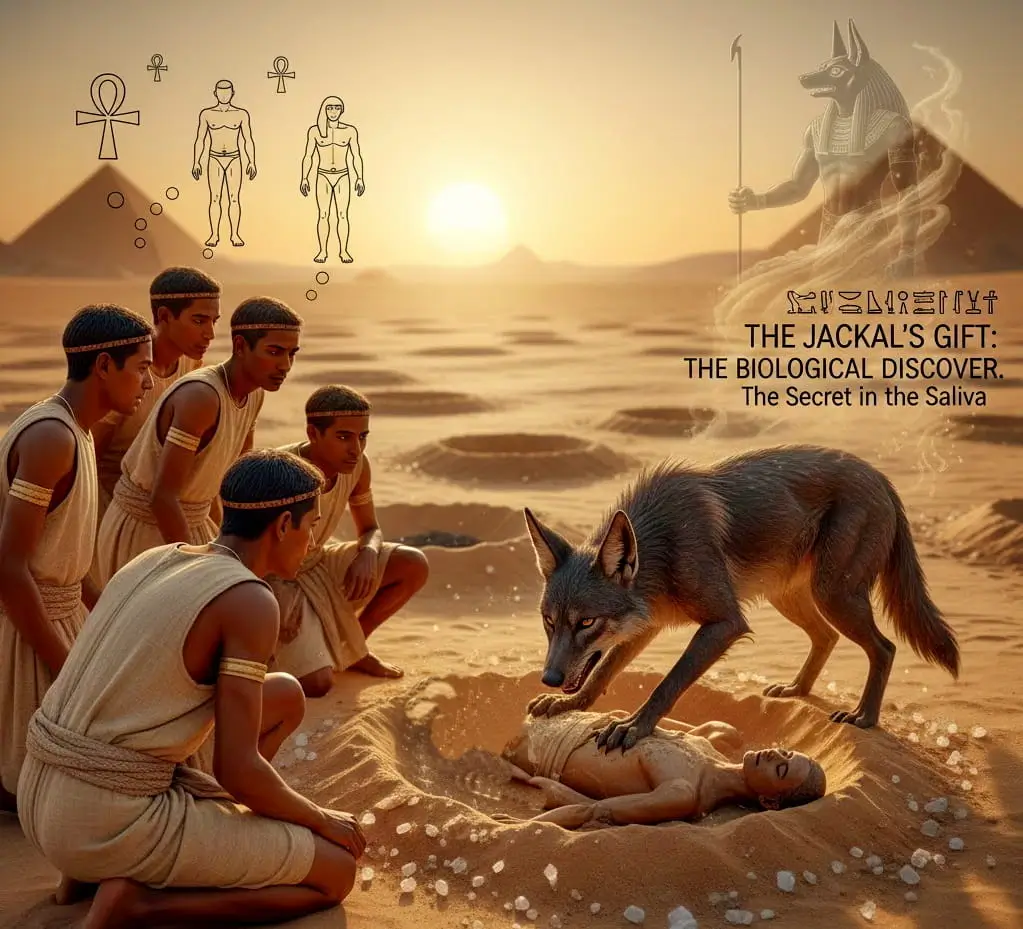
The Jackal’s Gift: The Biological Discovery

The Jackal’s Gift The Biological Discovery - The Secrets of the ancient Egyptian mummification

The invention of mummification began as a desperate response to this crisis of rot. If the Sun could not wake the person, perhaps the body “leaked” its life-energy. This breakthrough arrived when they observed the desert’s most feared scavenger: the stray wild jackal.

The Mystery of the “Clean” Remains

Early Egyptians buried their dead in shallow pits within the “Red Land” of the desert. Eventually, they noticed that jackals dug up these graves to feed. In fact, they witnessed a strange phenomenon where the parts of the body the jackals touched often failed to rot. While the rest of a corpse might liquefy in the heat, the remains left by the jackal stayed hard, dry, and preserved.

The Secret in the Saliva

Through intense observation, these early humans developed a radical theory. They believed the jackal—a creature that moved between the worlds of the living and the dead—possessed a chemical secret. Moreover, they tracked the way jackals licked their “kills” and opened the body.

We now know that jackal saliva contains specific enzymes, and their scavenging behavior exposed the flesh to high-alkaline, mineral-rich sands. As a result, the Egyptians associated the jackal with preservation. This explains why they gave the first “Doctor of the Dead,” Anubis, a jackal’s head. They were not merely worshipping an animal; they were honoring their first “Forensic Teacher.”

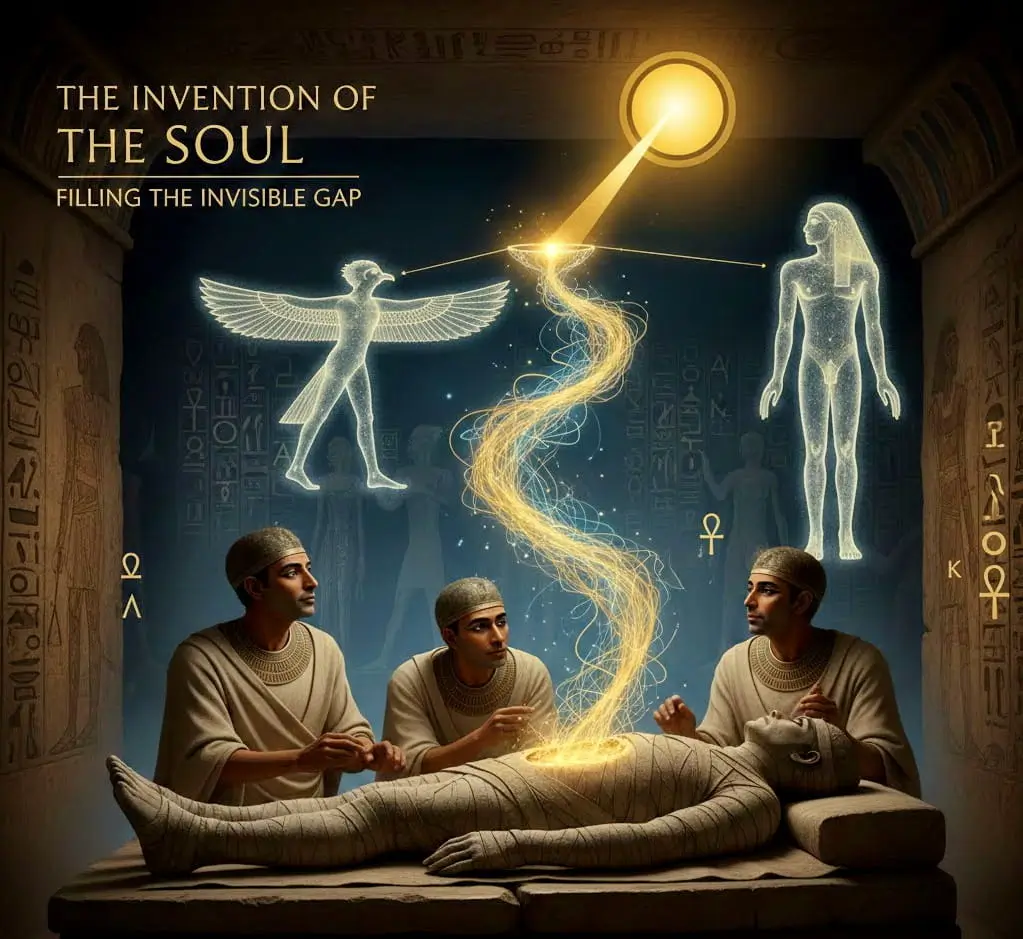
The Invention of the Soul: Filling the Invisible Gap

The Invention of the Soul Filling the Invisible Gap - Secrets of ancient Egyptian mummification

Once the Egyptians mimicked the “Jackal’s Secret” and learned to preserve the body (the Khet), they hit a wall. They possessed a body that looked alive and resisted rot, yet it remained motionless. This exact moment in history marks when humanity “invented” the Soul.

The Non-Physical Component

The Egyptians realized that while the Sun gave life and the body could receive it, a “missing wire” existed in the circuit. Consequently, they concluded that a non-visible, non-physical part must act as the bridge.

  • The Soul as the Life-Conductor: They theorized that the Sun delivers a “spark,” but that spark requires an invisible vessel to hold it.+
  • The Invisible Engine: These non-physical parts—the Ka and the Ba—explained why a preserved mummy still failed to wake up.

Because of this realization, mummification shifted from a physical task to a metaphysical necessity. They had to preserve the body not just for storage, but to provide a permanent docking station for this newly discovered “Soul.”

Replicating the Jackal: The Chemistry of the Embalming Tent

Replicating the Jackal The Chemistry of the Embalming Tent

Once the Egyptians understood the “Why,” they had to perfect the “How.” They moved from accidental desert preservation to a controlled, state-sponsored science. This required them to transform the embalming tent, known as the Wabet (the “Pure Place”), into the world’s first high-tech laboratory.

The Desiccation Protocol (Natron)

The embalmers realized that to stop the “Long Sleep” from turning into decay, they had to remove every trace of moisture. They used Natron, a naturally occurring salt found in the Wadi Natrun. However, they did not just sprinkle it on the skin. They packed the body in hundreds of pounds of salt for exactly forty days. Because of its high alkalinity, the Natron acted as a molecular sponge, drawing water out of the cells and stopping the growth of bacteria.

Botanical Engineering and Anti-Microbials

After drying the body, the “Forensic Teachers” applied a complex layering of resins and oils. They did not choose these substances for their scent alone. In fact, they selected materials like Frankincense, Myrrh, and Cedar Oil for their powerful anti-fungal properties. By sealing the skin with these resins, they created a sterile barrier. This barrier protected the “docking station” for the soul from the humidity of the Nile.

FUN

Anatomical Mapping: The Embalmer as Surgeon
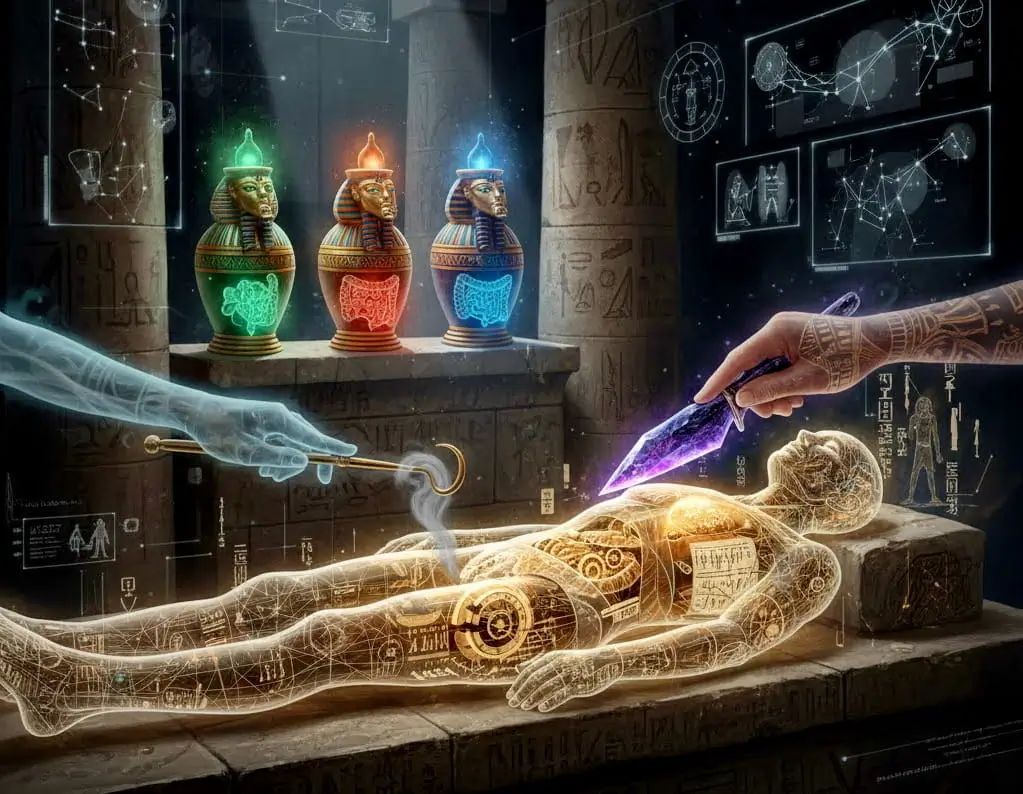
Anatomical Mapping The Embalmer as Surgeon

To prepare the Khet (physical body) for eternity, the Egyptians had to master human anatomy. This led to the birth of surgery and the first systematic mapping of the human interior.

The Precision of Internal Removal

The embalmers knew that decay begins in the moist internal organs. Consequently, they developed a specialized surgical procedure. Using a razor-sharp obsidian blade, they made a precise incision in the left flank. They carefully removed the liver, lungs, stomach, and intestines—the very parts the jackal would target in the wild. Moreover, they treated each organ with its own chemical formula and placed them in Canopic Jars.

The Brain and the Heart: A Technical Distinction

In a fascinating technical move, the Egyptians treated the heart and brain differently. They believed the heart held the record of a person’s life, so they often left it in place or wrapped it carefully to be weighed later. Conversely, they viewed the brain as a source of “coolant” or waste. Therefore, they developed a method to extract it through the nose using a hooked bronze tool. This required an intimate knowledge of the ethmoid bone at the base of the skull, representing the earliest documented neuroanatomy.

The “Opening of the Mouth”: Activating the Machine
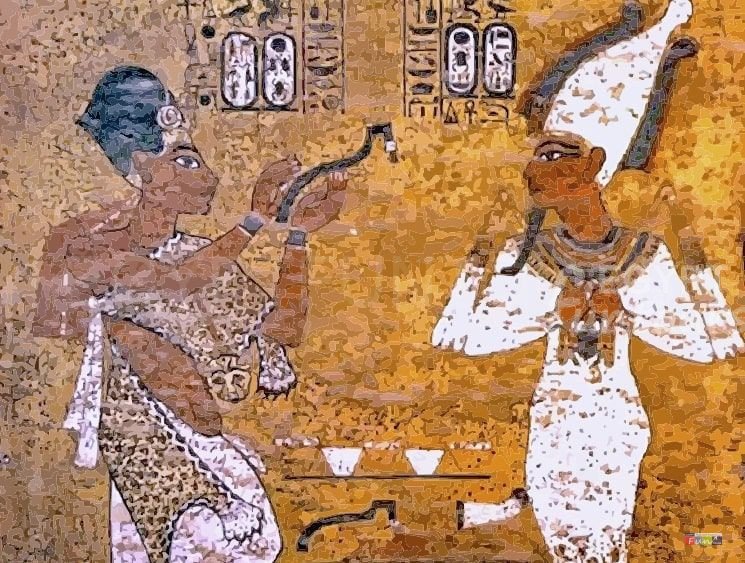
Opening of the Mouth ancient egyptian mummification - ancient Egyptian embalmer

The final secret of mummification was not chemical, but ritualistic. Even after the body was preserved and the “Soul” was defined, the Egyptians believed the mummy was still a “silent” object. It needed to be “switched on.”

The Tool of Activation

During the funeral, the heir or a high priest performed the Opening of the Mouth ceremony. They used a specialized tool called an adze to touch the face of the mummy or the statue of the deceased. In effect, this ritual was meant to “restore” the senses to the preserved body. By touching the mouth, eyes, and ears, the priest signaled to the Ba (the personality) that it could now use the mummy to eat, see, and hear in the afterlife.

The Final Re-Connection with the Sun

This ceremony usually took place under the morning sun. As a result, the cycle was complete. The Sun (God) provided the spark, the mummy provided the physical receiver, and the ritual provided the activation. The Egyptian had successfully used technology to turn the “Long Sleep” into a permanent, active existence.

The Alchemy of the Wabet: Master Class in Chemical Engineering

The Alchemy of the Wabet Master Class in Chemical Engineering

To reach the level of “Eternity,” the Egyptians had to move beyond simple salt. They developed a sophisticated understanding of how different chemicals interact with human tissue. The Wabet, or “The Pure Place,” was not a temple of prayer; it was a factory of preservation.

The Secrets of the Seven Oils

The Egyptians didn’t just use one oil; they used a specific sequence of seven sacred oils. Each had a different chemical purpose.

  • Festival Oil: Used to soften the skin after the harsh 40-day salt bath.
  • Hekenu Oil: A thick, resinous blend that acted as a deep-tissue sealer.
  • Syrian Balsam: An imported antiseptic that killed any remaining surface bacteria.

Consequently, the embalmers acted as the first cosmetic chemists. They realized that the Natron bath made the skin brittle, like old leather. Therefore, they had to “re-plasticize” the body. By massaging these oils into the dehydrated flesh, they made the skin supple enough to be wrapped without cracking. This was the birth of advanced dermatology.

The Bitumen Mystery

In later periods, the Egyptians began using Bitumen (natural asphalt). This is actually where the word “Mummy” comes from (the Arabic word mumiya means bitumen). In fact, they discovered that this black, tar-like substance provided a 100% waterproof seal. By dipping the bandages in liquid bitumen, they created an airtight shell. This was the ancient equivalent of “vacuum-sealing” the deceased, a technology that was thousands of years ahead of its time.

The First Nation-State: How Ancient Egypt Invented Modern Government

The concept of the first nation-state marks the pivotal moment in human history when scattered,...
Related post
FUN

The Logistics of the Bandage: Engineering a Textile Armor

The Logistics of the Bandage; Engineering a Textile Armor

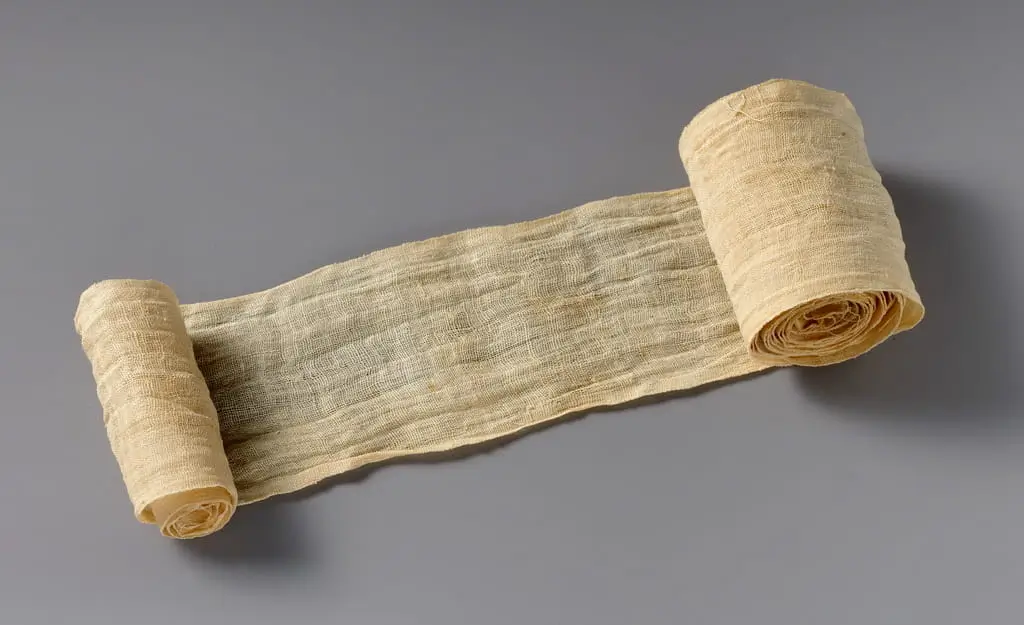
Wrapping a mummy was not just about covering the body. It was a structural engineering project. A single high-status mummy could require up to 1,000 yards of linen.

The Physics of Compression

The embalmers used linen of different widths for different body parts. Moreover, they applied the bandages with varying levels of tension.

  1. Fine Gauze: Used for fingers and toes to maintain their distinct shape.
  2. Heavy Webbing: Used on the torso to prevent the rib cage from collapsing under its own weight over centuries.
  3. Resin-Soaked Pads: Placed in the hollows of the cheeks and the eye sockets to maintain a “life-like” facial structure.

As a result, the mummy became a rigid, composite structure. It was no longer just a body; it was a reinforced pillar of carbon and resin. This “textile armor” protected the remains from physical damage during the frequent tomb robberies that plagued the Nile Valley.

The Funerary Economy: The Business of Immortality

The Funerary Economy; The Business of Immortality

We must realize that the secrets of ancient Egyptian mummification were the foundation of the national economy. The “Why” created a massive demand that the “How” had to supply.

A Nation of Specialized Labor

The mummification industry was the largest employer in Egypt outside of agriculture.

  • The Lector Priests: The “Project Managers” who read the technical manuals.
  • The Parachistes: The surgeons who made the primary incisions.
  • The Kher-Heb: The chemists who mixed the Natron and resins.

Because of this specialized labor, a distinct middle class emerged. These were people whose entire livelihood depended on the “Long Sleep” of others. This created a stable social structure that lasted for millennia.

Trade and Global Supply Chains

As we noted, Egypt lacked many of the chemicals needed for high-end mummification. Consequently, the state had to fund massive expeditions.

  • Cedar from Lebanon: Required for the high-end sarcophagi.
  • Pistacia Resin from the Aegean: Used for the highest-grade anti-bacterials.
  • Gold from Nubia: Used to create the “Flesh of the Gods” for royal masks.

Therefore, the search for immortality was the primary driver of the first global trade network. The Egyptian “Soul” didn’t just stay in the Nile; it reached out and connected the entire Mediterranean world through commerce.

The Architecture of the Gods: Unlocking the Ancient Egyptian Engineering Secrets

The Great Pyramid of Giza stands as the ultimate testament to Ancient Egyptian engineering secrets,...
Related post
FUN

The Physics of the Tomb: The “Hard Drive” for the Soul

The Physics of the Tomb The Hard Drive for the Soul

If the mummy was the “data” of the person, the tomb acted as the “hard drive.” The Egyptians realized that even the best chemistry could not survive if the physical environment failed. Consequently, they applied their understanding of geology and climate to create the perfect storage conditions.

Controlling the Micro-Climate

The Egyptians were the first to understand that temperature and humidity are the enemies of preservation. Therefore, they carved tombs deep into the limestone cliffs of the West Bank. Limestone acts as a natural insulator. By placing the mummy in a stone chamber, they kept the temperature constant year-round. This prevented the expansion and contraction of the skin, which would have cracked the delicate resin seals of the mummy.

The Engineering of Sealing and Security

As the state became more obsessed with protecting the “Khet” (the body), their tomb engineering became more complex.

  • Portcullis Stones: Massive granite slabs that dropped into place to block corridors.
  • False Shafts: Vertical pits designed to trap thieves or lead them to empty rooms.
  • Plaster Sealing: Every door was sealed with gypsum plaster and stamped with the royal seal.

Because of these measures, the tomb became more than a grave; it was a fortress. The state invested massive resources into this “Passive Security” to ensure that the soul’s docking station remained undisturbed for eternity.

The Science of the “Opening of the Mouth”: A Psychological Bridge

We often dismiss the rituals as mere “magic.” However, from a psychological and social perspective, the Opening of the Mouth ceremony served a vital function in the science of immortality. It was the moment the community accepted that the “Technology” had worked.

The Restoration of the Senses

The ceremony involved the use of a specialized tool called an adze, often made from meteoric iron (the “Iron from Heaven”). In fact, by touching the eyes, ears, and mouth of the mummy, the priest was symbolically “rewiring” the body. As a result, the family believed the deceased could now see the offerings and hear the prayers. This prevented the social breakdown that usually follows a death, keeping the “Ma’at” (order) of the living world intact.

The Modern Legacy: How Ancient Secrets Built Modern Science

The search for the “Secrets of Ancient Egyptian Mummification” did not end with the fall of the Pharaohs. Instead, it laid the foundation for much of our modern medical and forensic knowledge.

The Birth of Forensic Pathology

Modern forensic scientists still study Egyptian mummies to understand how tissues degrade over time. Moreover, the way Egyptians identified internal diseases—like heart disease and tuberculosis—through mummification provided the first “medical case studies” in history. By looking at the “Secrets” of the past, modern doctors have confirmed that even 3,000 years ago, humans struggled with many of the same ailments we face today.

The Chemistry of Modern Embalming

While we no longer use Natron, the basic logic of modern funeral science is identical to the Egyptian Wabet. Therefore, every time a modern embalmer uses chemicals to preserve a body for a funeral, they are practicing a science that was perfected in the Nile Valley. The Egyptians were the first to prove that death is not an immediate event, but a biological process that can be slowed, managed, and even halted.

The Architecture of the Gods: Unlocking the Ancient Egyptian Engineering Secrets

The Great Pyramid of Giza stands as the ultimate testament to Ancient Egyptian engineering secrets,...
Related post
FUN

Secrets of Ancient Egyptian Mummification: The Eternal Machine

Ancient Egypt was the first nation-state to realize that a civilization is more than just its living citizens; it is a continuum of the past, present, and future. The secrets of ancient Egyptian mummification were the tools they used to bridge those worlds.

From the observation of the jackal’s saliva in the desert to the complex chemistry of the Wabet, the Egyptians turned death into a technological triumph. They did not fear the “Long Sleep.” Instead, they engineered a way to wake up from it. They proved that with enough knowledge, science, and national will, humanity could challenge the finality of nature.

Secrets of Ancient Egyptian Mummification (FAQ)

1. Why did the Ancient Egyptians mummify their dead?

The Egyptians did not mummify out of a morbid obsession with death. Instead, they viewed the physical body (the Khet) as a necessary “docking station” for the soul. They believed the soul had several parts, like the Ka and the Ba, which required a recognizable home on Earth to survive eternity. If the body decayed, the soul became “homeless” and would eventually vanish, resulting in the “Second Death”—total non-existence.

2. How did the Egyptians discover the mummification process?

Discovery likely began through the observation of nature. Early Egyptians buried their dead in the hot, desert sand. They noticed that these bodies did not rot but became naturally preserved. Moreover, as they observed wild jackals digging up remains, they noticed that the “Jackal’s Secret”—the combination of specific enzymes and exposure to alkaline sand—kept tissues intact. They spent the next few centuries trying to replicate this natural desert “miracle” in a controlled, artificial setting.

3. What was the “Secret” ingredient in mummification?

The most important chemical was Natron. This naturally occurring salt—a mix of sodium carbonate and sodium bicarbonate—acted as a molecular sponge. While many believe the “secret” was the bandages, the true preservation happened during the 40-day salt bath. Consequently, by removing every drop of moisture from the cells, the embalmers made it impossible for decay-causing bacteria to survive.

4. Was everyone in Ancient Egypt mummified?

Initially, only the Pharaoh and the royal family had access to the full “Secrets of Mummification.” However, as the Egyptian state grew and the middle class expanded, mummification became a massive national industry. Eventually, anyone who could afford the service could be mummified. For the poorest citizens, the state relied on the “Original Mummifier”—the desert sand—to provide a basic level of preservation in simple pit graves.

5. Why was the heart left inside the mummy while the brain was removed?

This choice reflects the Egyptian “Science of the Soul.” They believed the heart (the Ib) was the seat of intelligence, memory, and emotion. It had to remain in the body so it could be weighed against the feather of Truth in the afterlife. Conversely, they viewed the brain as a useless organ that simply produced mucus. Therefore, they removed it to prevent the rapid decay that occurs in cranial tissue, using hooked tools to extract it through the nose.

6. How long did the mummification process take?

The standard “High-End” mummification took exactly 70 days. This timeline was not random; it followed a strict scientific and astronomical schedule.

  • 15 Days: Cleaning and preparation.

  • 40 Days: The Natron desiccation period.

  • 15 Days: Wrapping, resin application, and ritual “activation.”

7. Does the jackal saliva theory have scientific backing?

While the Egyptians didn’t understand “enzymes” in the modern sense, their observation was remarkably accurate. Jackal and canine saliva contain lysozymes and other antimicrobial properties. By observing that jackal-disturbed remains resisted rot, the Egyptians identified the “Forensic Markers” of preservation. This led them to focus on the removal of internal organs—the same organs a jackal would target—to stop decay from the inside out. Perhaps this is the greatest secret among all the secrets of ancient Egyptian Mummification.

A magical journey to begin your Bedouin experience....
Explore the wonders of Egypt in 9-day adventure....

Big tick off our bucket list!

Booked the evening before and were able to do everything we hoped to in a day, with a knowledgeable guide & at a reasonable price! Lunch was included and absolutely delicious! Learnt about the history of Egypt, which was the most important part of sightseeing in Cairo/Giza. Hamada also gave

More »

Valley of Whales – Wadi El Hitan and Wadi El Rayan

What a blast! It was an amazing day and a 5-star day trip. Everything was organised from A to Z by Hamada and Mohamed at Egypt Fun Tours in a timely manner. Pick up/drop off from/to the hotel, exquisite lunch and snacks, 4×4 jeep. Everything was as advertised. Also, the

More »
4-day-christmas-nile-cruise

Hossam Rashwan Tour Guide

We took this trip with Hossam Rashwan as our tour guide, and I must say that Hossam was the greatest tour guide in Luxor who showed us around. Our tour guide’s tales transported us to Luxor’s past, and we felt as if we were living in ancient Egypt. We really

More »

Pyramids in the Mist, Egypt Adventure

Our long drive from Cairo turned into a terrifying flight through Alexandria’s impossibly crowded streets. Our minivan miraculously avoided hitting pedestrians, donkey carts, and old Lada cars. We arrived at the port gates with only 10 minutes to spare. But the guards ignored our U.S. passports, and they refused to

More »
Isis with wings

Top-rated Tour Packages

Isis with wings