The Ultimate Guide to the Twenty-Ninth Dynasty of Egypt (398–380 BCE)

The Twenty-Ninth Dynasty of Egypt (398–380 BCE) was a powerful Mendesian ruling house that successfully defended Egypt's newly won sovereignty against the Achaemenid Persian Empire. Founded by Pharaoh Nefaarud I after a swift military coup, the dynasty strategically relocated the national capital to Mendes, transforming the eastern Delta city into a highly defensible, maritime stronghold. Under its longest-reigning monarch, Pharaoh Hakor, Egypt experienced an architectural renaissance alongside masterful international diplomacy, forming vital mutual defense treaties with Athens and hiring elite Greek mercenaries under General Chabrias. Though this eighteen-year era ultimately ended due to internal military instability when General Nectanebo I launched a successful coup, the Mendesian pharaohs successfully repelled a massive, three-year Persian invasion, establishing a crucial defensive shield that preserved native Egyptian culture and independence.
The eye of Horus
WhatsApp
Email
Print

The Twenty-Ninth Dynasty of Egypt stands as a masterclass in military defense and high-stakes international diplomacy. Lasting from 398 to 380 BCE, this dynamic era proved that Egypt was not just surviving, but actively thriving on the world stage. Native pharaohs successfully transformed the country from a vulnerable, newly liberated territory into an aggressive Mediterranean power.

The story of this dynasty began with a dramatic shift in leadership. After launching a swift coup against the previous regime, Pharaoh Nefaarud I moved the imperial capital from Sais to the strategic trading hub of Mendes. Operating from this new power base in the eastern Delta, the Mendesian kings faced an immediate, colossal threat. The Achaemenid Persian Empire was desperate to reclaim Egypt, its most valuable former territory. To survive, the pharaohs of the Twenty-Ninth Dynasty of Egypt could not rely on isolation. Instead, they forged bold, expensive military alliances with Greek city-states like Sparta and Athens.

While foreign policy dominated the battlefield, the domestic front was marked by intense internal rivalries and a surprising cultural renaissance. The dynasty weathered violent succession crises, including a multi-sided power struggle between rival rulers like Hakor and Psammuthes. Yet, despite this political chaos, the era produced incredible economic stability and monumental architectural achievements. Pharaohs like Hakor left a lasting stone legacy, building and restoring grand temples across Upper Egypt.

This comprehensive pillar article investigates the remarkable eighteen-year history of the Twenty-Ninth Dynasty of Egypt. We will track the rise of the Mendesian pharaohs, deconstruct their complex use of Greek mercenary armies, and analyze the archaeological evidence they left behind. Discover how this short-lived but powerful house built a secure shield around Egypt, preserving its sacred culture and native independence for generations to come.

Divider

The Rise of Nefaarud I and the Shift to Mendes

The Rise of Nefaarud I and the Shift to Mendes

The story of the Twenty-Ninth Dynasty of Egypt began with a decisive and bloody transition of power. In 398 BCE, a powerful military commander from the eastern Delta named Nefaarud I (known in Greek as Nepherites I) led a successful revolt against Pharaoh Amyrtaeus. Nefaarud captured the Saite monarch, brought him to Memphis, and executed him publicly. This execution brought a swift end to the Twenty-eighth Dynasty.

Nefaarud I immediately claimed the pharaonic titles. However, he chose not to rule from the traditional capital of Sais. Instead, he shifted the administrative and royal heart of the country east to his hometown of Mendes (known anciently as Djedet).

Shifting the capital to Mendes was a brilliant strategic move that provided three key advantages for the new dynasty:

  • A Secure Military Base: Mendes was situated deep within the Mendesian branch of the Nile Delta. It was surrounded by complex marshlands, making it highly defensible against sudden Persian land assaults.
  • A Bustling Maritime Port: The city had direct access to the Mediterranean Sea via the river. This allowed the Mendesian kings to quickly trade with Mediterranean nations, launch naval fleets, and welcome incoming foreign soldiers.
  • Strong Religious Legitimacy: Mendes was the sacred home of Banebdjedet, the powerful ram god of spiritual authority, and the fish goddess Hatmehit. By building up this religious center, Nefaarud I gained the vital backing of the local priesthood.

Consolidating Power: By grounding his rule in a wealthy, well-fortified trading hub, Nefaarud I successfully united the rival military factions of Lower Egypt under a single banner.

The Birth of the Spartan Alliance

Once Nefaarud I secured his domestic position, he faced an urgent geopolitical reality. The Achaemenid Persian Empire was slowly rebuilding its forces to launch a counter-invasion of Egypt. To protect his borders, the pharaoh realized that Egypt needed strong, external military allies. He looked across the sea to the Greek city-states, which were already locked in their own bitter conflicts against Persia.

In 396 BCE, the legendary Spartan King Agesilaus II launched a massive military campaign against the Persians in Asia Minor. Recognizing a perfect strategic opportunity, Nefaarud I quickly established a formal military alliance with Sparta.

Instead of sending native Egyptian soldiers overseas, the pharaoh weaponized Egypt’s vast agricultural wealth. He sent a massive military aid package to the Spartan fleet. This legendary shipment included:

  • 100,000 Bushels of Grain: This massive food supply was sent to feed the Spartan soldiers and naval crews during their long campaigns.
  • Full Equipment for 100 Triremes: The pharaoh provided raw timber, sails, ropes, and naval supplies to help build and maintain one hundred Spartan warships.

This alliance was a masterpiece of early international diplomacy. Unfortunately, the shipment suffered a tragic fate. The Egyptian transport ships sailed into the Mediterranean, completely unaware that the Spartan navy had just lost control of the seas. The rival Athenian admiral Conon intercepted the defenseless Egyptian cargo ships near Rhodes and captured the entire supply.

Despite this tactical loss, the bold move established a crucial historical precedent. It proved that the Twenty-Ninth Dynasty of Egypt was ready to act as an aggressive, wealthy superpower on the Mediterranean stage.

Golden Scarab

Internal Chaos: The Succession Crisis of 393 BCE

Internal Chaos The Succession Crisis of 393 BCE

The stability of the Twenty-Ninth Dynasty of Egypt was suddenly shattered in 393 BCE. Pharaoh Nefaarud I died after a successful six-year reign, leaving a major power vacuum behind. Because the dynasty was still very young, it lacked a clear, undisputed system of royal succession. This institutional weakness immediately triggered a fierce, multi-sided civil war among the Delta’s ruling elite.

The conflict began when a prince named Muthis claimed the throne. Traditional historical records, including the ancient chronologies of Manetho, list him as the direct son and intended heir of Nefaarud I. However, his claim was quickly challenged by a rival noble named Psammuthes.

Psammuthes launched a rapid military coup in the capital city of Mendes. He successfully overthrew Muthis, completely ending his reign after just a few short months. Yet, Psammuthes could not hold onto his stolen power for long. Deep within the Delta, another powerful claimant was preparing to strike.

The Rise of Hakor: Securing the Throne

The true victor of this chaotic succession crisis was a brilliant military commander named Hakor (known in Greek historical texts as Achoris). Hakor refused to recognize the authority of the usurper Psammuthes. He gathered a large, loyal faction of Delta soldiers and launched a fierce counter-rebellion.

By late 393 BCE, Hakor’s forces successfully defeated Psammuthes in open combat. Psammuthes was ousted from power, having ruled for barely a single year. Hakor immediately seized the double crown of Upper and Lower Egypt, bringing a decisive end to the bloody civil war.

To stabilize the country after months of internal fighting, Hakor knew he needed to prove his absolute legitimacy to the public and the priesthood. He used two clever political strategies to solidify his position:

  • Erasing His Rivals: Hakor ordered a systematic campaign of damnatio memoriae against his immediate predecessors. Stone carvers went across the country to erase the names of Muthis and Psammuthes from official monuments, effectively wiping them out of the official king lists.
  • Claiming Royal Lineage: Hakor explicitly dated his official regnal years back to 393 BCE, completely ignoring the reigns of his rivals. He presented himself as the direct, spiritual successor of Nefaarud I, claiming he was the only true guardian of the Mendesian line.
Claimant to the Throne Method of Taking Power Approximate Reign Length Ultimate Historical Fate
Muthis Inherited from Nefaarud I A few weeks/months Overthrown by a military coup.
Psammuthes Launched a coup against Muthis Roughly 1 Year Defeated and ousted by Hakor.
Hakor (Achoris) Led a counter-rebellion 13 Years (393–380 BCE) Successfully consolidated power and stabilized Egypt.

A Turning Point for Mendes: Through military brilliance and political resolve, Hakor transformed a fragile, warring nation into a highly centralized state. His victory ended the internal chaos, paving the way for the longest and most prosperous era of the Twenty-Ninth Dynasty of Egypt.

The eye of Horus

Pharaoh Hakor: The Great Builder of the Twenty-Ninth Dynasty of Egypt
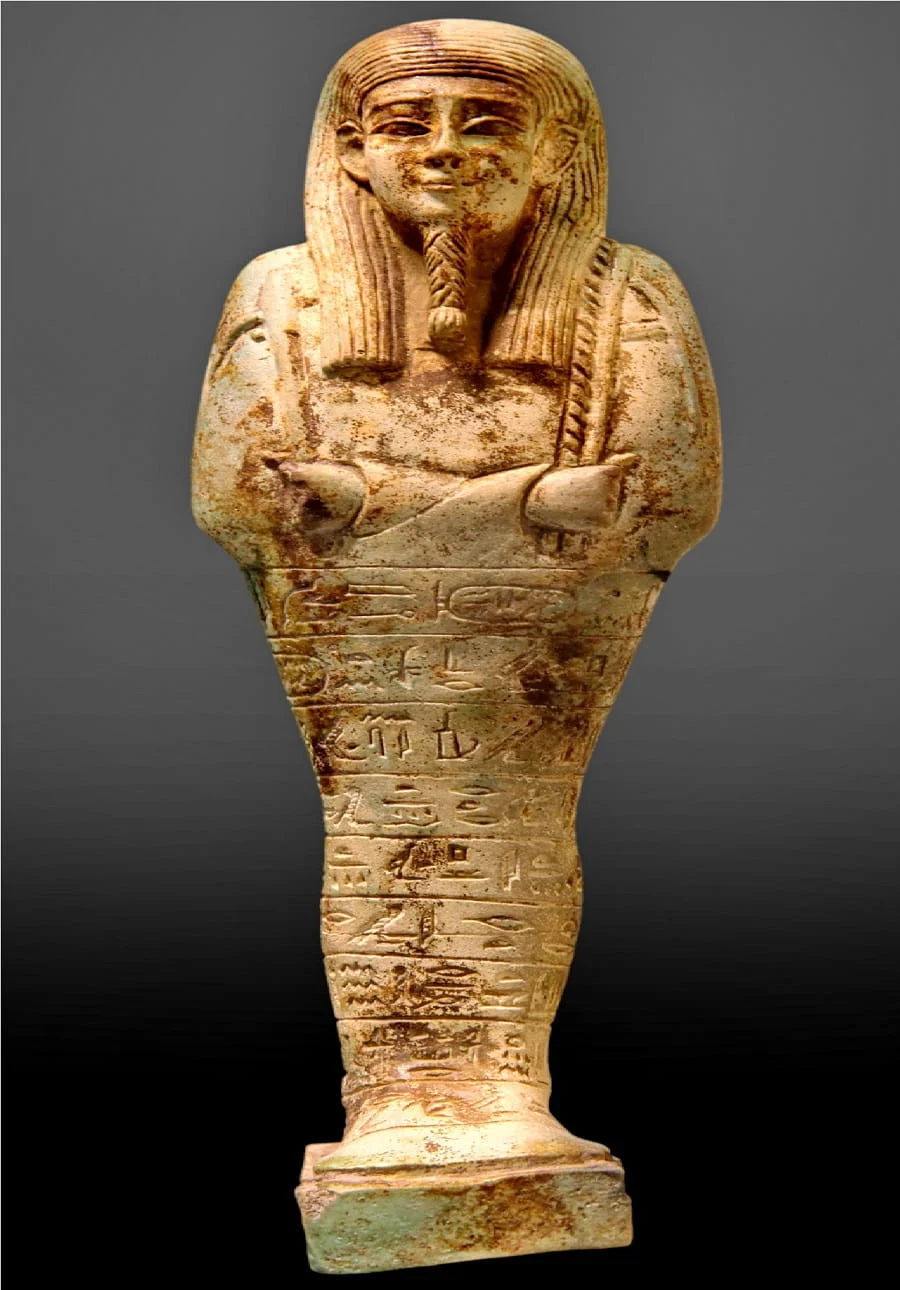
Pharaoh Hakor The Great Builder of the Twenty-Ninth Dynasty of Egypt

Once Pharaoh Hakor secured his position on the throne, he turned his focus toward domestic renewal. The short-lived Twenty-eighth Dynasty and the early years of the Mendesian line had been defined by constant warfare and internal coups. This meant that previous kings had very little time or wealth to dedicate to traditional pharaonic architecture. Hakor changed this entirely, leaving behind the most significant archaeological footprint of the Late Period.

Hakor realized that building grand monuments was the ultimate way to project power and divine legitimacy. He launched an aggressive, nationwide building campaign that focused heavily on the traditional religious centers of Upper Egypt.

His most notable architectural achievements included:

  • The Karnak Temple Complex: Hakor constructed a magnificent, standalone chapel near the first pylon at Karnak. This chapel served as a sacred resting place for the divine barque of the god Amun-Ra during religious festivals.
  • Medinet Habu: He directed extensive restoration projects and added fine decorative elements to the small temple of Amun at this historic site on the West Bank of Luxor.
  • The El-Kab Temple: Hakor built a beautifully decorated kiosk temple deep in Upper Egypt, dedicated to Nekhbet, the protective vulture goddess of the south.
  • The Quarries of Turah: He reopened the famous limestone and sandstone quarries near Memphis. This provided a steady supply of premium building materials for projects throughout the Nile Valley.

A Renaissance of Stone: By filling Egypt’s historic sanctuaries with his name and image, Hakor successfully convinced the powerful priesthood that the Twenty-Ninth Dynasty of Egypt was fully committed to honoring the traditional gods.

The Athenian Alliance and the Persian Invasions
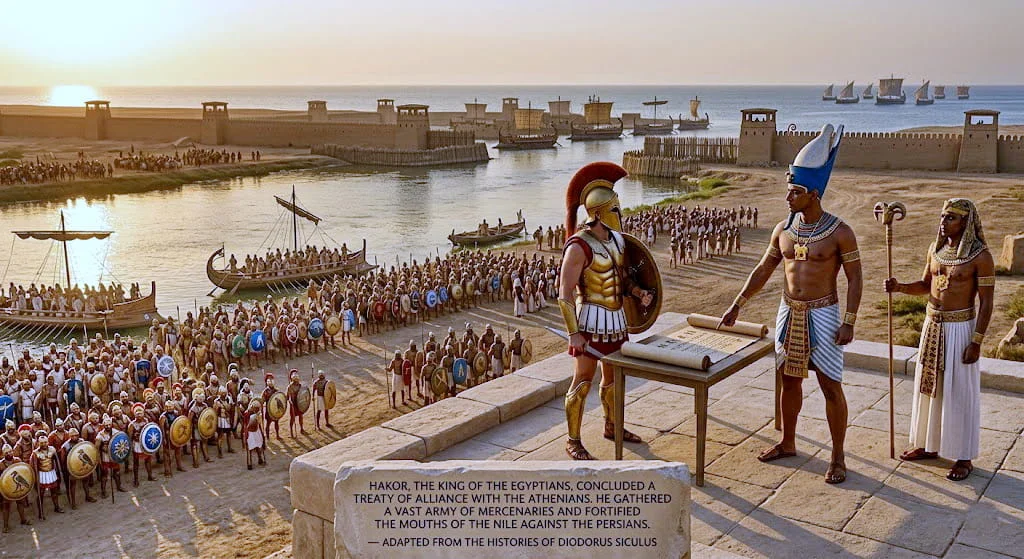
The Athenian Alliance and the Persian Invasions

While Hakor spent massive amounts of wealth on temples, his primary challenge remained the looming military threat of the Achaemenid Persian Empire. By 389 BCE, the Persian King Artaxerxes II had finally stabilized his own borders. He was now fully prepared to launch a massive, coordinated invasion to crush Egyptian independence once and for all.

To prepare for this onslaught, Hakor enacted a brilliant, aggressive foreign policy. He realized that the Spartan alliance had faded, so he turned his attention to their bitter rivals: Athens.

Hakor signed a comprehensive mutual defense treaty with the Athenian assembly. This alliance changed the entire dynamic of the war. Athens sent their most brilliant military mind, the legendary general Chabrias, along with thousands of elite Greek hoplite mercenaries, to serve directly under Hakor’s command.

Between 385 and 383 BCE, the Persian Empire launched a relentless, three-year military offensive against Egypt. The Persian forces attacked with an army of over 200,000 soldiers and a massive naval fleet.

However, Hakor and General Chabrias were fully prepared. They used a masterful joint defense strategy to repel the invasion:

The Delta Fortifications

Chabrias designed a highly sophisticated network of earthworks, deep trenches, and stone forts along every major branch of the Nile Delta. These defensive barriers completely blocked the Persian land columns and protected the northern coast.

Naval Interception

Hakor used Egypt’s wealth to build a powerful navy. The Egyptian and Athenian fleets worked together in the Mediterranean Sea, aggressively cutting off the Persian supply ships and isolating the enemy on the beaches.

The Great Repulsion

Because of these brilliant tactical maneuvers, the Persian army suffered massive casualties, ran out of vital food supplies, and collapsed into internal arguments. After three grueling years of fighting, the imperial forces were forced to retreat in utter disgrace. Hakor had achieved the impossible: he had successfully defended the sovereignty of the Twenty-Ninth Dynasty of Egypt against the largest empire on Earth.

Divider

The Twilight of Mendes: The Fall of the Twenty-Ninth Dynasty of Egypt

The incredible military and architectural triumphs of Pharaoh Hakor kept Egypt safe for over a decade, but they could not permanently fix the country’s deepest political weakness: internal military instability. In 380 BCE, Hakor died after a prosperous thirteen-year reign. Just as it had done after the death of Nefaarud I, the absence of a strong, established succession plan immediately plunged the nation back into vulnerability.

Hakor’s young son, Nefaarud II, claimed the throne in the capital city of Mendes. However, he possessed none of his father’s strategic brilliance or political support. He faced immediate opposition from the powerful military elites of the Western Delta.

Before Nefaarud II could even complete his first year of rule, a brilliant Egyptian general named Nekhtnebef (known in Greek as Nectanebo I) launched a rapid and highly organized coup d’état. Nectanebo, who hailed from the city of Sebennytos, marched his forces into Mendes, overthrew the young king, and claimed the double crown for himself. This rapid overthrow brought an abrupt end to the short-lived Twenty-Ninth Dynasty of Egypt, shifting the pharaonic seat of power to the Thirtieth Dynasty.

Conclusion: The Legacy of the Mendesian Shield

Though the Twenty-Ninth Dynasty of Egypt lasted for only eighteen years, its historical impact was absolutely vital to the survival of late pharaonic civilization. The Mendesian pharaohs successfully transformed Egypt from a fragile, newly liberated territory into an aggressive and highly respected Mediterranean superpower.

Historical Contribution Long-Term Strategic Impact
The Move to Mendes Created a highly defensible, trade-friendly capital in the Eastern Delta to anchor national resistance.
The Greek Strategy Pioneered massive financial and military alliances with Sparta and Athens, setting a template for future rulers.
The Great Repulsion Defeated a massive, three-year Persian invasion, proving that Egypt could successfully defend its sovereignty.
The Architectural Revival Reopened vital national quarries and filled Upper Egyptian sanctuaries with grand stone monuments.

Ultimately, the pharaohs of the Twenty-Ninth Dynasty of Egypt acted as an indispensable shield. By blending clever international diplomacy with fierce domestic resolve, they successfully held back the Achaemenid Empire. This critical victory bought Egypt another two decades of sovereign peace, allowing native art, architecture, and spiritual traditions to reach their final, brilliant peak before the close of antiquity.

The eye of Horus

Frequently Asked Questions

What was the Twenty-Ninth Dynasty of Egypt?

The Twenty-Ninth Dynasty of Egypt was a brief but powerful native ruling house that governed from 398 to 380 BCE. Originating from the city of Mendes, these pharaohs successfully defended Egypt’s newly won independence against the Achaemenid Persian Empire.

Who was the founder of the Twenty-Ninth Dynasty of Egypt?

The dynasty was founded by Nefaarud I (known in Greek as Nepherites I). In 398 BCE, he led a successful military coup against Pharaoh Amyrtaeus of the 28th Dynasty, claimed the pharaonic titles, and shifted the nation’s capital.

Why did the capital move to Mendes during this dynasty?

Pharaoh Nefaarud I moved the capital to Mendes, located in the eastern Nile Delta, for key strategic reasons. The city’s surrounding marshlands offered an excellent defense against land attacks, while its direct river access to the Mediterranean allowed for rapid naval trade and military deployment.

Who was the most successful pharaoh of the 29th Dynasty?

Pharaoh Hakor (Achoris) was the most successful and longest-reigning ruler of the dynasty, governing from 393 to 380 BCE. He is famous for restoring grand temples throughout Upper Egypt and successfully repelling a massive, three-year Persian invasion.

How did the Twenty-Ninth Dynasty of Egypt defeat the Persian invasions?

The Mendesian pharaohs used a brilliant strategy of international diplomacy and mercenary warfare. They formed close military alliances with Greek city-states, particularly Athens, and hired thousands of elite Greek hoplites led by the legendary general Chabrias to fortify the Nile Delta.

How did the Twenty-Ninth Dynasty of Egypt end?

The dynasty ended in 380 BCE due to internal military instability. After the death of Hakor, his young son Nefaarud II took the throne but was quickly overthrown in under a year by General Nectanebo I, who went on to establish the Thirtieth Dynasty.

Divider

11 Wonderful Hours in Cairo

I had an 11 hour layover in Cairo, and it couldn’t have been better spent than with Manal from Egypt Fun Tours. I was able to adjust my tour once we left the airport and Manal had some really great suggestions when I told her what it was I wanted

More »

Egypt Fun Tours – Does it All!

My husband and I visited Egypt in March 2013. First, let me say, ‘Go, go, go!’ – it’s safer and definitely friendlier than many places we’ve visited. Tourism is drastically down – thanks mostly to media misinformation – so it’s a great time to visit to avoid line-ups and crowds

More »

Excellent Tour

Really excellent tour from Mohamed, and we learned so much about Egypt and went to places we never would have found as tourists at home. My girlfriend had a 12 hour stop over on the way to Ethiopia and it was the perfect way to see Cairo. I hope people

More »
9-day tour package - Egypt Fun Tours

You’re in “GREAT HANDS” with Egypt Fun Tours!

We first went to Egypt in July 2010. We were to pass through Cairo on our way to Africa, and we had arranged to be picked up from the Cairo airport and shown around the city during our 6-hour layover. This was arranged through emails with Hamada, of Egypt Fun

More »
God_Anubis_Icon

Top-rated Tour Packages

God_Anubis_Icon
WhatsApp
Email
Print