
Ancient Egyptian Craftsmen: The Hands That Built an Empire

SUMMARY: Meet the masters who built a civilization. This summary explores the world of ancient Egyptian craftsmen, from the potters and weavers in local villages to the elite goldsmiths and sculptors working for the pharaoh. Discover the tools, techniques, and daily life of the skilled artisans whose hands shaped the legacy of an empire, creating everything from daily necessities to timeless masterpieces.
The eye of Horus
WhatsApp
Email
Print
Ancient Egyptian Craftsmen Egypt Fun Tours

When we picture ancient Egypt, we see the Great Pyramids, the golden mask of Tutankhamun, and towering, carved temples. But who actually built these timeless wonders? Beyond the pharaohs who commissioned them and the scribes who recorded them, a vast and vital class of skilled artisans and ancient Egyptian craftsmen brought these visions to life. As one of the most critical categories of ancient Egyptian jobs, this group included everyone from the humble potter shaping clay jars to the master goldsmith inlaying a pharaoh’s coffin.

This guide explores the fascinating world of these ancient masters—their techniques, their tools, their daily lives, and their crucial role in building the wealth and legacy of an entire civilization.

The eye of Horus

Ancient Egyptian Craftsmen’s Social Value

Ancient Egyptian craftsmen social value

The great mass of the populace could not afford the bulk of the objects created by the ancient Egyptian craftsmen. Their customers were primarily aristocracy or affluent middle-class people who could afford their services and high-quality goods. The prosperity of the ancient Egyptian craftsmen was also influenced by commerce and trade. When it came to the quality of some items, social status made all the difference: the affluent had finely carved furniture, while the middle class had to make do with coarsely painted chairs and chests, and the people with low income had to rely on these materials in excess.

Golden Scarab

Materials Used by Ancient Egyptian Craftsmen

Since prehistoric times, ancient Egyptian craftsmen used stones, clay, wood, fibers, ivory, animal skins, bones, and feathers as their principal materials. They introduced metal into the crafting process later in ancient Egypt’s history. Craftsmsmen discovered gold in its metallic condition, used silver as an adjunct to gold, and smelted ore. They also used copper, tin, and iron.

Rule your journey to this destination

The eye of Horus

The Craftsmen of Ancient Egypt (facts)

Ancient Egyptian craftsmen facts

Pharaohs, the government, or temple priests hired most Egyptian craftsmen and artisans, so they structured them hierarchically. They acquired their skills from past masters who upheld the principles of balance and maintained stylistic continuity. These masters may have learned from their parents, neighbors, or close relatives.

The builders of Dier el-Medina worked in well-organized workshops and special communities. Egyptians recognized the craftsmen for their skills, but the artisans remained anonymous. Highly skilled craftsmen included carpenters, stonemasons, sculptors, builders, weavers, blacksmiths, spinners, dressmakers, glass-blowers, potters, foundry workers, and scribes. Because few could become independent artisans, most worked as hired laborers for temples or royal organizations.

The eye of Horus

Tools for Ancient Egyptian Crafts

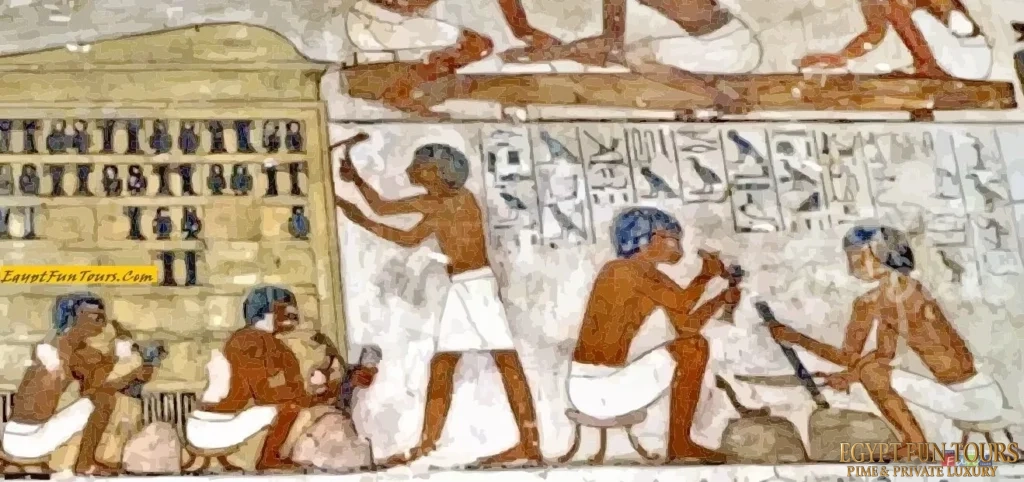
Carpenters used saws, axes, chisels, bow drills, wooden mallets, and adzes to construct a wide range of items, from roofing beams to wooden sculptures to furniture. They brought the wood from Lebanon. Sculptors used stone hammers and copper chisels to shape and polish the stone according to their designs. They constructed many magnificent, everlasting gigantic or life-size sculptures and stone containers.

Brickmakers and potters used Nile mud to create everything ancient Egyptian society needed. They combined mud and sand, slapped it into wooden molds, and dried it in the sun to make bricks. Potters used a potter’s wheel to create various containers. They would then coat the pots in a reddish liquid or decorate them with a comb or stylus before burning them in kilns. Bead makers were also very creative. They smashed stones together, rolled them between other stones to shape them and make them abrasive, then used a bow drill to cut a hole in the beads. The beads were then rolled in a receptacle.

Weather in Egypt.

Rule your journey to this destination

The eye of Horus

Witness the Craftsmen’s Legacy with Egypt Fun Tours

The ancient Egyptian craftsmen have been gone for millennia, but their legacy is immortal, etched into the very fabric of the country. Every colossal statue, intricate relief, and dazzling gold artifact you see in a museum was once held in their hands. Reading about their skill is fascinating, but seeing it with your own eyes is a truly profound experience. Egypt Fun Tours bridges that gap between past and present. Our expert guides don’t just show you the temples and tombs; they bring the artisans’ world to life. We’ll take you to the masterpieces at Karnak, Luxor, and the Egyptian Museum, pointing out the subtle tool marks, the brilliant color, and the hidden details that prove these were not just monuments, but the life’s work of true masters.

Need our help for packages? send an enquiry!

Looking for a custom travel plan? Get in touch and we will create your perfect package.
RULE YOUR JOURNEY

Very Considerate and Helpful

Guide and driver were on time, open to my requests and took care that I felt safe and saw the Pyramids and parts of old cairo during my less than 24 hour stay between flights. Office staff were great in communicating by email before and during the trip.

More »

Great layover Tour!!

I had an excellent layover tour with Hani. He is knowledgable, fun, and passionate about his city. I went for a tour of the pyramids, sphinx, and to a papyrus factory which were all great. Ask him any question about Egyptian history and he will surely know the answer! Also

More »
Tailored Services for Corporate Business Transportation Needs

On time, adaptable, and fun!

My friend and I planned a whirlwind trip to Dubai, the Dead Sea, Petra, Cairo, Luxor, and Sharm el Sheikh for early November 2011 – 6 cities in 10 days! We allotted one afternoon and evening for Cairo, and we wanted to see as much as we could! We drove

More »
group tour of wonders

Solid Tour Company

Last year (2010) my wife and I did a 20 day trip in Egypt, mostly Do-It-Yourself. However, one of the first things we did was a trip to Bahariya oasis and to the White Desert — not so easy to do yourself, so we needed an agency. After e-mail back-and-forths

More »
God_Anubis_Icon

Top-rated Tour Packages

God_Anubis_Icon
WhatsApp
Email
Print