Weather:
In the summer, Egypt may be quite hot, yet the environment is extremely dry. Upper Egypt (in the south) will be hotter than Cairo and the north, with temperatures varying from north to south. Although all cities can experience heat waves, average temperatures in Cairo vary from 15 to 35 degrees Celsius and 23 to 45 degrees Celsius in Upper Egypt. In the summer, temperatures in Luxor, Abu Simbel, and Aswan may reach 50 degrees Celsius. The winter and spring seasons are cooler, making them a more enjoyable time to visit.
Mt. Sinai’s peak, at 2,285 meters, may be extremely cold and snow-covered in the winter. It may be quite chilly even in the other seasons, especially around daybreak, when the majority of visitors make the trip to the top. If you plan on making the ascent, bring warm gear with you, even if you just need it this one time.
Temperatures:
Average daily temperatures in ºC:
Summer is from the beginning of May to the end of August (around 30 ºC)
Winter is from the beginning of November to the end of February (around 20 ºC)
Language:
Although Arabic is the official language of Egypt, English is commonly used in tourist areas.
Opening Hours:
The following hours are merely a recommendation because they differ from one business to the next.
Banking
Sun – Thurs 08:30 am – 5:00 pm Fri / Sat 08:30 am – 5:00 pm
Business
Monday through Thursday 9:00 a.m. to 2:00 p.m.; Friday and Saturday 9:00 a.m. to 2:00 p.m.
Shopping
Saturday through Thursday
9:00 a.m. to 3:00 p.m. and 5:00 p.m. to 9:00 p.m.
These are only estimates; some stores are open on Fridays, and many are closed on Sundays. The hours may be extended in tourist areas. From 1:00 p.m. until 5:00 p.m., certain stores may close for a longer length of time.
Shopping:
When shopping in Egypt, bargaining is a popular habit and an art. Aside from fixed-price stores, most business owners accept price haggling, with the initial quotation rarely being the final price. Gold and silver jewelry (particularly cartouches), brassware, alabaster, perfume, papyrus, spices, and cotton products are all popular commodities in Egypt.
The majority of our tours include an overnight train ride. While there is a bar on board and airline-style food and drink are available, it is quite costly. Before the voyage, the Trip Leader will drive you to a store where you may stock up on fruit, cookies, chocolate, beverages, and other necessities.
Electricity:
Egypt’s electricity is supplied at a voltage of 220 volts and a frequency of 50 hertz. (You’ll need a normal European plug or an adaptor).
Feluccas:
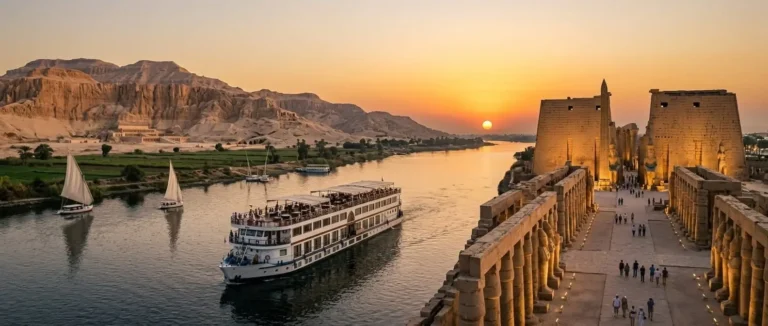
Feluccas are ancient Egyptian sailing vessels that have been used for generations to transport people up and down the Nile. A felucca cruise is very soothing because it is a basic boat with no engine or contemporary amenities. Throughout the year, you sleep on cushioned mattresses (bring a sleeping bag) under a canopy for protection from the weather. The felucca crew is in charge of the cooking aboard the boat. Feluccas are still a popular mode of transportation for those traveling up and down the river.
You should be informed that the bathroom facilities on the Nile’s banks where we halt are, to put it mildly, inadequate. Leave the modesty at home and bring the toilet paper.
During the winter months, the river may be rather chilly, especially at night. It is even possible for it to rain! During these months, we recommend that travelers carry a jacket or a warm windcheater. The daytime temperatures are often comfortable throughout these months.