The Pyramid of Senusret I: Engineering the Middle Kingdom’s Greatest Wonder

The Pyramid of Senusret I at Lisht marks the architectural peak of the 12th Dynasty. By introducing a revolutionary "grid-wall" skeleton of radiating stone walls, architects solved the structural instabilities of earlier mud-brick cores. This internal frame supported a massive volume of limestone rubble, all encased in high-quality Tura limestone. With its ten satellite pyramids and a gallery of life-sized royal statues, the complex transformed the landscape into a sprawling center of political and artistic power. Ultimately, the monument stands as an authoritative example of the Middle Kingdom "Renaissance," successfully blending Old Kingdom grandeur with sophisticated, forward-thinking engineering.

A Vision of Stability

Senusret I did not just inherit a throne; he inherited a mission to solidify the 12th Dynasty. Following his father’s assassination, Senusret I chose a site just two kilometers south of Amenemhat I’s monument. However, he abandoned the “recycled” aesthetic of the previous generation. Instead, he commissioned a masterpiece of precision and symmetry. The Pyramid of Senusret I stands as the best-preserved monument of the Middle Kingdom. It showcases a radical new internal skeleton designed to withstand the weight of the ages. While the outer casing has long since vanished, the remaining core reveals a level of planning that rivals the Great Pyramids of Giza. This pillar examines how Senusret I transformed the desert at Lisht into a high-tech center of religious and political power.

The Grid-Wall Innovation: A Skeleton of Stone

Architects for the Pyramid of Senusret I introduced a revolutionary “skeleton” technique. They moved away from the chaotic fill of earlier Middle Kingdom cores. Instead, they built a rigid internal frame.

Workers constructed eight massive stone walls that radiated from the center to the corners and the middle of each face. They then connected these with cross-walls, creating 16 distinct compartments. Finally, they packed these cells with limestone rubble and sand. This grid acted like a modern skyscraper’s steel frame. It prevented the internal pressure from shifting or collapsing. Therefore, the Pyramid of Senusret I serves as a primary example of Middle Kingdom engineering ingenuity.

The Ten Satellite Pyramids: A Family Legacy

Senusret I surrounded his monument with an unprecedented number of satellite structures. He built ten smaller pyramids for his wives and daughters within the inner and outer enclosure walls.

  • Symmetry: These smaller tombs demonstrate a level of planning rarely seen in funerary complexes.
  • Ritual Power: Each satellite pyramid had its own small mortuary temple and offering chapel.
  • Legitimacy: By placing his family in such prominent structures, Senusret I reinforced the divine status of the entire 12th Dynasty bloodline.

These structures offer vital clues about the roles of royal women during the Middle Kingdom. Archaeologists have recovered exquisite jewelry and ritual items from these sites, proving that the Lisht Necropolis functioned as a high-status artistic hub.

FUN

The White Limestone Casing: A Giza Rival

The White Limestone Casing, A Giza Rival

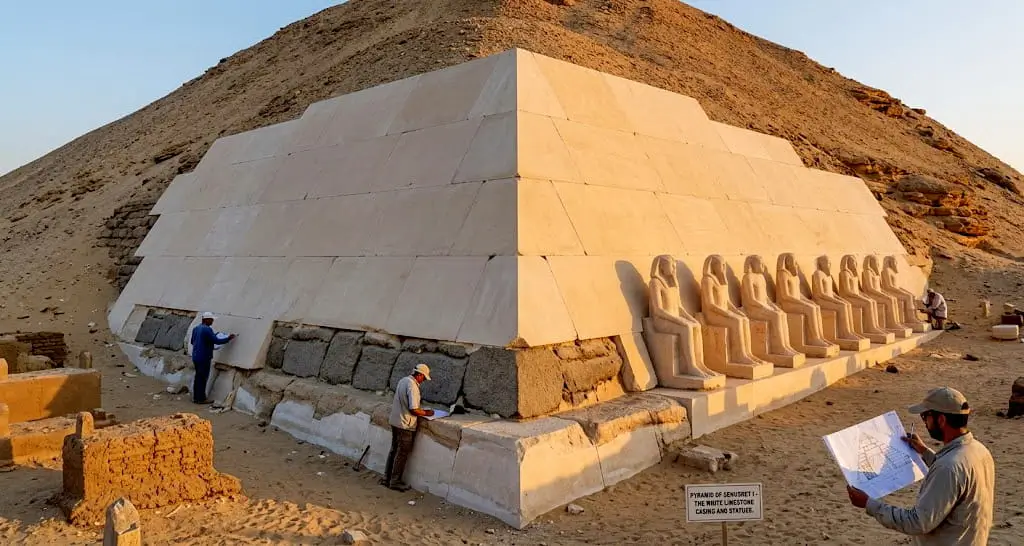
To complete the “wow” effect, Senusret I wrapped his grid-wall core in the finest Tura limestone. At its peak, the pyramid reached a height of 61 meters. This made it a visible landmark for miles across the Nile Valley.

Builders cut each casing stone with extreme precision. They utilized a “stepped” method for the inner core, which then supported the smooth outer layer. Because of this high-quality finish, the Pyramid of Senusret I successfully rivaled the visual prestige of the Old Kingdom giants. Consequently, it signaled to the people of Egypt that the “Renaissance” was complete. The Pharaoh had restored the glory of the pyramid age to its full brilliance.

The Hidden Army: The Ten Life-Sized Statues of Senusret I

The Hidden Army The Ten Life-Sized Statues of Senusret I

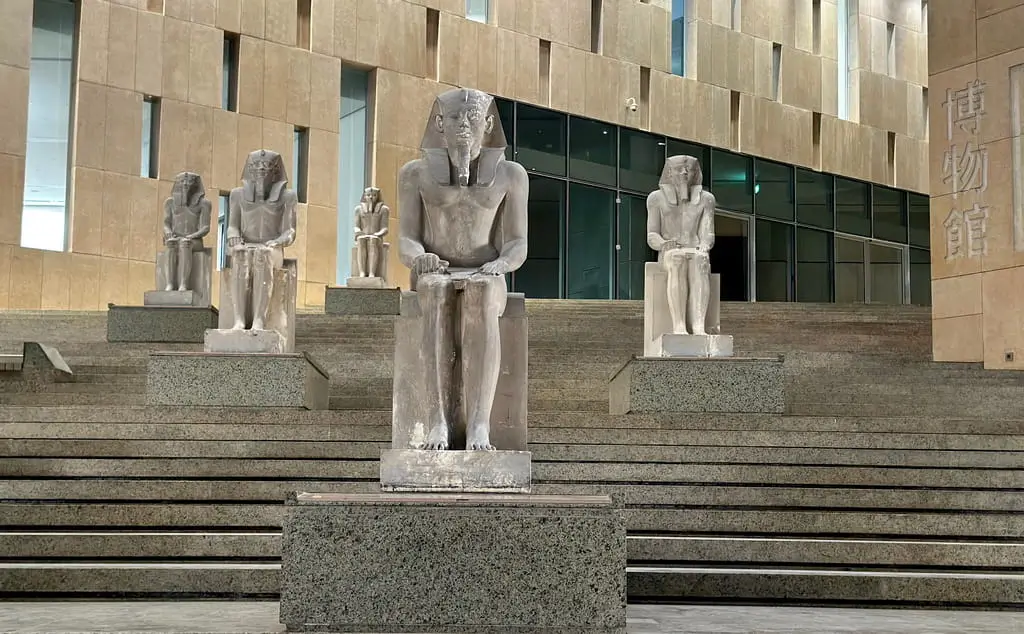
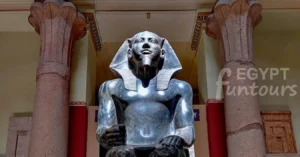
Architects and artists transformed the funerary complex of the Pyramid of Senusret I into a high-status gallery. During excavations, archaeologists discovered ten life-sized seated statues of the King. These masterpieces utilize fine-grained white limestone. Each statue displays a slightly different facial expression, suggesting a “portrait” style rather than a generic royal mask.

Originally, these statues lined the interior walls of the mortuary temple. They faced the central courtyard, creating a permanent audience with the divine Pharaoh. Today, these figures serve as a primary reference for Middle Kingdom artistic evolution. They bridge the gap between the stiff formalism of the Old Kingdom and the expressive realism of later dynasties. Consequently, the Pyramid of Senusret I preserves a unique record of the “Renaissance” in Egyptian sculpture.

FUN

Engineering for Eternity: The Drainage System

While most visitors focus on the height of a pyramid, the true genius of the Pyramid of Senusret I lies in its “invisible” engineering. The 12th Dynasty architects understood the destructive power of rare desert flash floods. Therefore, they designed a sophisticated water-management system for the mortuary temple.

Builders carved deep channels into the limestone pavement of the open courtyard. These drains diverted rainwater away from the mud-brick core of the main structure. By doing this, they protected the internal “grid-wall” from water damage and erosion. This foresight explains why the foundations of this complex remain far more stable than those of its predecessors at Lisht. Ultimately, this drainage system proves that Senusret I prioritized structural longevity over simple aesthetics.

The Transformation of the Landscape: The Outer Enclosure

Senusret I did not stop at the pyramid; he reshaped the entire desert plateau. He commissioned two massive enclosure walls to protect the sacred space.

  • The Inner Wall: This limestone barrier encircled the main pyramid and its immediate cult structures. Artists decorated the interior with high-relief panels showing the “Unification of the Two Lands.”
  • The Outer Wall: This mud-brick perimeter enclosed the ten satellite pyramids of the royal family. It created a vast “City of the Dead” that signaled the King’s role as the protector of his lineage.

Consequently, the Pyramid of Senusret I functioned as a massive political billboard. It projected a message of order, stability, and ancestral pride to anyone traveling along the Nile. By standing at the center of this sprawling complex, the King reclaimed the Giza-style authority for the Middle Kingdom.

Dahshur Pyramids: Where Pyramids Were Perfected

Escape the crowds at the Dahshur Pyramids, a true "hidden gem" just south of Saqqara....
Related post
FUN

The Evolution of Lisht: Amenemhat I vs. Senusret I

The transition from the father’s pyramid to the son’s marks the movement from a “Dynasty in Crisis” to an “Architectural Renaissance.” Amenemhat I focused on legitimacy through recycling, while Senusret I focused on stability through engineering.

Feature Pyramid of Amenemhat I Pyramid of Senusret I
Core Structure Loose fill of mud-brick and rubble Rigid “Grid-Wall” stone skeleton
Philosophy Spolia: Used Old Kingdom Giza stones Originality: Purpose-cut stone and precision
Complexity Single main pyramid Ten satellite pyramids for the royal family
Aesthetic Rugged and hybrid Smooth, high-quality Tura limestone
Durability High erosion (looks like a hill) Best-preserved Middle Kingdom core

Engineering the Internal Skeleton

The most significant technical difference lies beneath the surface. Amenemhat I’s architects built a simple structure. In contrast, Senusret I’s team invented the “Skeleton” method.

They constructed sixteen internal compartments using radiating stone walls. They then filled these “cells” with limestone fragments and sand. This grid prevented the pyramid from shifting under its own weight. Therefore, the Pyramid of Senusret I solved the structural weaknesses that caused earlier Middle Kingdom pyramids to collapse. This innovation allowed the 12th Dynasty to build taller and more durable monuments than their predecessors.

Giza Pyramids Complex: The Eternal Horizon of the Fourth Dynasty

The Giza Pyramid Complex remains the ultimate testament to human ingenuity, spanning the intersection of...
Related post
FUN

The Flooded Frontiers: A Shared Mystery

Despite their engineering differences, both pyramids share a common enemy: the rising water table. In 2026, the burial chambers of both Amenemhat I and Senusret I remain inaccessible to traditional archaeology.

  1. The Submerged Shafts: In both monuments, the sloping entrance passages lead directly into groundwater.
  2. The Granite Sarcophagi: Remote cameras and sonar suggest that the burial chambers utilize massive granite blocks. However, the pressure and depth of the water make physical entry impossible without risking the structural integrity of the pyramid.
  3. Modern Efforts: Archaeologists now use specialized underwater drones to map these chambers. Consequently, these two pyramids remain the “Final Frontier” of the Lisht Necropolis.

Who Built the Pyramids? The Truth About Egyptian Laborers

Forget the popular myth of slaves building the pyramids. Archaeological evidence reveals the truth: the...
Related post
FUN

Artistic Mastery: The Statues of the Court

Finally, the two complexes differ in their artistic output. While Amenemhat I reused reliefs from Giza, Senusret I commissioned original, life-sized masterpieces.

The discovery of the ten seated statues of Senusret I revolutionized our understanding of Middle Kingdom art. Unlike the stiff statues of the Old Kingdom, these figures show a hint of humanity and individualized portraiture. They originally stood in the mortuary temple, acting as eternal guardians of the King’s soul. By commissioning these, Senusret I proved that the 12th Dynasty had successfully revived the high-culture standards of the ancient past.

Giza pyramids & Sphinx, & Sakkara pyramids | Sound & Light show & Nile dinner cruises (optional) | Cairo museum, Khan El-Khalili, Citadel of Saladin,...
An adventure designed for family is an absolute gift worthy of remembering....
God_Anubis_Icon
Memnon colossi of king amenophis III 4 min

Book with them, they are Professionals

It has always been my dream to visit Egypt. This was a beautiful tour, almost two years later, I can’t stop thinking about my time in Egypt, Valley of the Kings, Temple of Kom Ombo, Edfu, Luxor! I was able to add an eighth day to see Abu Simbel (a

More »
hani ahmed 1

Hani Was our Awesome Tour Guide!

We had an 11-hour layover in Cairo on 12/15/2011. We wanted to go to see the Pyramids, Tahrir Square, and possibly the museum. We were so lucky to have a guide, Hani from Egypt Fun Tour, who made it possible to see all the above, plus the Bazaar, and time

More »

Amazing one day tour

Fantastic tour. We were picked up at the airport early in the morning (6 am), and were dropped off in the evening after discovering amazing Cairo. The guide was knowledgeable and took us to many hidden places, which we wouldn’t have found without him. Thank you!

More »

Highly Recommend Egypt Fun Tours!

Several weeks ago, I reached out to Egypt Fun Tours regarding a 9-hour layover in Cairo. From the very beginning, Hani Ahmed was responsive and professional, quickly providing a well-organized itinerary tailored to our limited time. The itinerary included a visit to the pyramids, other historical sites, a delicious dinner,

More »

Transit Stopover in Cairo

We have just returned from a two week holiday in Cape Town. On the way out our airline schedule meant that we had a 15 hour stop in Cairo. We decided to arrange a tour of the city and after asking for quotes/itineraries we chose Egypt Fun Tours. This worked

More »
God_Anubis_Icon

Top-rated Tour Packages

God_Anubis_Icon