Sobek-Ra and Montu-Ra: How Local Gods Claimed Solar Legitimacy

The political genius of the Egyptian Sun God (Ra) was its transferability. Pharaohs maintained centralized power by forcing powerful regional deities, like the crocodile god Sobek and the war god Montu, to merge with Ra, creating fusions like Sobek-Ra and Montu-Ra. This process, known as solar syncretism, legitimized local cults and their political influence, but only by subjecting them to the supreme, universal solar mandate, ensuring all power ultimately flowed from the pharaoh's central authority.

The Sun God’s political brilliance lay in its transferability—it grafted onto rising local deities, thereby maintaining centralized control. As regional centers gained political or military prominence, they elevated their patron gods. However, they could only claim national, supreme authority by successfully merging with Ra. This process, known as syncretism, served a crucial political function: it acknowledged the regional power base while simultaneously subjecting it to the universal, solar mandate of the pharaoh. We see this vividly in the development of the Sobek-Ra political role and the application of Montu-Ra syncretism. These two deified fusions provide the clearest case studies of this strategic solar-political absorption.

FUN

Sobek-Ra: The Crocodile God and the Solar State

Sobek-Ra, The Crocodile God and the Solar State

Sobek, the crocodile god, was originally a powerful, chaotic deity associated with water, fertility, and sudden danger. His main cult center was the Faiyum region, particularly the city of Shedet (later known as Crocodilopolis).

1. The Need for Syncretism

Sobek’s local power base surged during the Middle Kingdom, especially under the 12th Dynasty. These pharaohs heavily invested in the Faiyum, developing its irrigation systems and making Sobek’s temple a major center of state activity. As the patron god of a politically and economically vital region, Sobek needed universal legitimacy. The pharaohs provided it through fusion.

FUN

2. The Fusion: Sobek-Ra

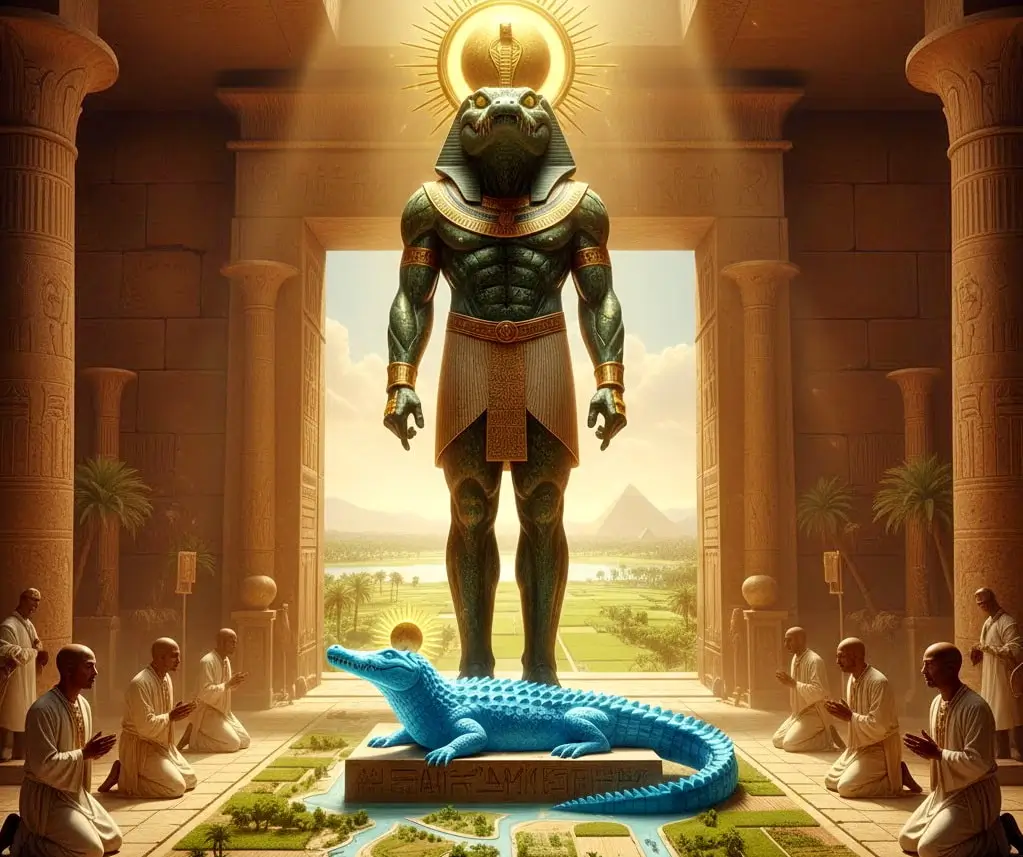
The composite deity Sobek-Ra was created to resolve this political-theological challenge. Sobek retained his crocodile head and powerful physique, but he was crowned with the solar disk and uraeus (sacred cobra).

This theological merger immediately conferred solar authority upon the regional god. Sobek was no longer just the god of the Faiyum; he became a manifestation of the Sun God himself, ensuring that the wealth and influence of his region remained under the solar, pharaonic umbrella.

3. Political Role

The creation of Sobek-Ra was a masterstroke of political absorption. It legitimized the pharaohs’ investment in the Faiyum, associating their development projects with the creative and life-giving power of the Sun God. It demonstrated that even a powerful, independent-minded regional god ultimately served the supreme, solar principle that defined the entire state.

Egyptian Phoenix Bennu: Myth, Symbolism, and Legacy

Forget the fire. The original legend is even better. Meet the Bennu, the Egyptian Phoenix....
Related post
FUN

Montu-Ra: The War God and the Imperial Mandate

Montu-Ra, The War God and the Imperial Mandate

Montu was the ancient, often aggressive, falcon-headed god of war, whose cult center was located near Thebes. While an important local deity, his national importance dramatically increased when the Theban 11th and 18th Dynasties rose to power, launching the New Kingdom and an age of empire.

1. The Military Need

When the Theban rulers expelled the foreign Hyksos and established the powerful, imperial New Kingdom, they needed a supreme state god who could sanction their military expansion. Montu, the god of martial prowess, was the obvious choice. However, to command the entire nation and sanction the pharaoh’s universal rule, Montu had to claim cosmic, solar authority.

Hathor, Sekhmet, and the Volatile Eye of Ra: Dual Power for Political Control

The pharaohs used the terrifying dual nature of the Volatile Eye of Ra as a...
Related post
FUN

2. The Fusion: Montu-Ra

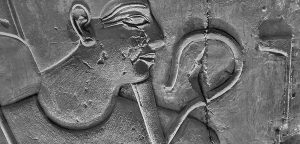
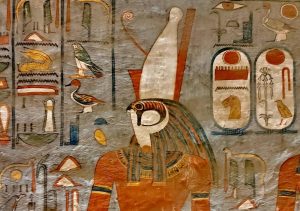
The combination of Montu-Ra integrated the power of the local war god with the national sovereignty of the Sun God. Montu retained his falcon head and often carried weapons, but he was always depicted with the solar disk and twin plumes.

This fusion meant that when the pharaoh went to war—conquering territories in Nubia or the Levant—he was not just acting on the authority of a local war god. He was enacting the will of the Sun God himself, establishing a divinely sanctioned solar empire.

3. Political Role

Montu-Ra was the theological engine of the New Kingdom’s expansionist foreign policy. The victories of pharaohs like Thutmose III and Amenhotep I were portrayed as the triumph of Montu-Ra. This fusion effectively made the pharaoh the chief military delegate of the supreme cosmic power, reinforcing the principle that all political and military might flowed from the solar mandate.

God Ra: The Definitive Guide to the Supreme Sun God of Ancient Egypt

Ra is the supreme deity of the ancient Egyptian pantheon. As the self-created Sun God,...
Related post
FUN

Summary: Solar Transference

Both Sobek-Ra and Montu-Ra perfectly illustrate the genius of solar transference. The pharaohs did not eliminate local power; they co-opted it. By fusing local deities with Ra, they successfully transferred the paramount political role of the Sun God to a regional manifestation, ensuring the central authority remained inviolable and universally recognized throughout the consolidated state.

Explore the best of Luxor attractions through our 3 days Luxor tour where you will discover the best temples & tombs of Pharaohs. Read more...
Take in the views of the magic blue lakes, the breathtaking waterfalls, the dunes, and mountains....

Amazing Experience

Hamada was incredible! So knowledgeable and kind. He had information about every item, street corner, and relic we looked at. Any questions we had, he had answers! He even made sure to give us tips while walking through the crowds so that we would feel more comfortable when being approached
More »

Day trip to Wadi el Hitan and Wadi el Rayan

We went on a full-day trip to Wadi el Hitan and Wadi el Rayan with Mohamed (Hamada). Mohamed was a wonderful guide, always making sure we had plenty of water and enough to eat, and providing us with information about the area and Egypt more generally. He also gave us

More »

Egypt Fun Tours – Does it All!

My husband and I visited Egypt in March 2013. First, let me say, ‘Go, go, go!’ – it’s safer and definitely friendlier than many places we’ve visited. Tourism is drastically down – thanks mostly to media misinformation – so it’s a great time to visit to avoid line-ups and crowds

More »

A great day!!!!

Thank you Hamada for an incredible day! Thank you for the stories and the history, you are so knowledgeable and we didn’t feel rushed at all or like we missed out on things, will definitely be recommending this tour to everyone 🙂

More »
4-day-christmas-nile-cruise

Hossam Rashwan Tour Guide

We took this trip with Hossam Rashwan as our tour guide, and I must say that Hossam was the greatest tour guide in Luxor who showed us around. Our tour guide’s tales transported us to Luxor’s past, and we felt as if we were living in ancient Egypt. We really

More »
Isis with wings

Top-rated Tour Packages

Isis with wings