
The Tomb of Ramose (TT55): A Masterpiece of Artistic Revolution

The Tomb of Ramose (TT55) acts as a rare artistic time capsule, capturing the transition from the classical elegance of Amenhotep III to the radical "Amarna" revolution of Akhenaten. As the Vizier of Upper Egypt, Ramose commissioned breathtaking limestone reliefs that experts consider the height of Egyptian draftsmanship. The tomb famously displays two competing styles: the refined, traditional carvings of the 18th Dynasty and the early, distorted aesthetics of the Sun Disk (Aten) cult. Even in its unfinished state, the site remains one of the most intellectually and visually rewarding monuments in the Theban Necropolis.

To understand the dramatic shift in ancient Egyptian history, one must step inside the Tomb of Ramose (TT55). Situated in the prestigious Sheikh Abd el-Qurna district of the Theban Necropolis, this monument serves as more than just a burial chamber; it acts as a frozen frame of a civilization in flux. Because Ramose held the position of Vizier (the highest-ranking official) under both Amenhotep III and his son Akhenaten, his tomb preserves the exact moment when the traditional elegance of the 18th Dynasty collided with the radical “Amarna” revolution.

Notably, the tomb is world-renowned for its breathtaking limestone reliefs. Unlike the vibrant, multi-colored walls of the Royal Tombs, the majority of TT55 remains unpainted. However, this lack of color reveals a level of sculptural finesse that experts consider the pinnacle of Egyptian draftsmanship. Specifically, the master carvers achieved such delicate detail that the unpainted stone captures the transparency of linen and the intricate braids of heavy wigs with lifelike precision. Consequently, visitors often describe the experience of entering the main hall as walking through a gallery of fine white marble.

Furthermore, the tomb offers a unique visual timeline. On one wall, you witness the classic, idealized beauty of the Old World. Directly opposite, you see the early, distorted, and sun-focused art of the “Heretic King” Akhenaten. Therefore, a visit to the Tomb of Ramose provides a rare opportunity to see two competing worldviews coexisting within a single space. In this guide, we will explore the architectural grandeur, the artistic dualities, and the historical mysteries of the man who served two of Egypt’s most famous Pharaohs.

Tomb of Ramose: Inside This Guide

  • The Vizier’s Power: Who was Ramose, and how did he survive the transition of kings?
  • A Tale of Two Styles: Comparing the “Classical” and “Amarna” reliefs.
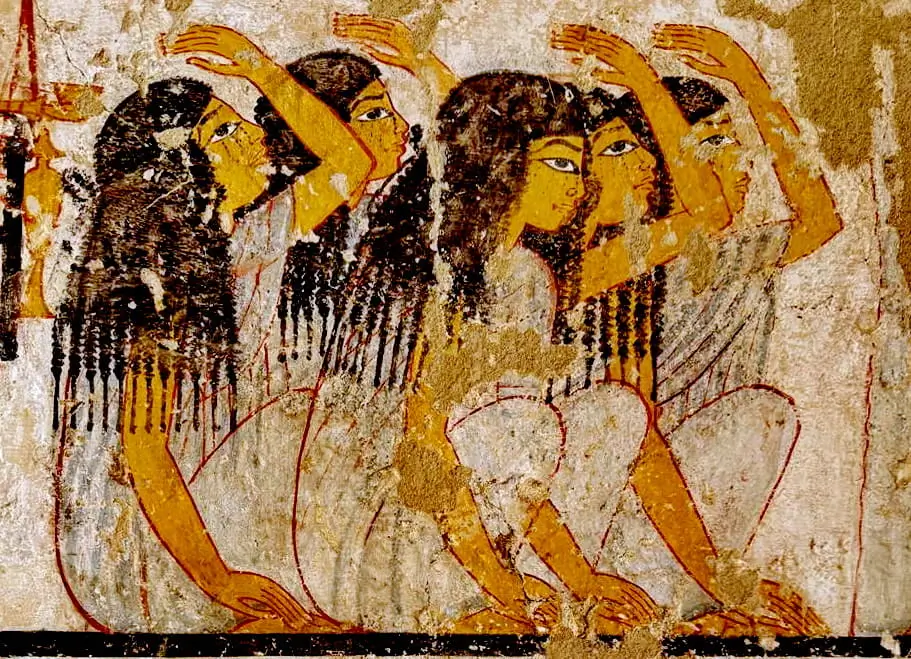
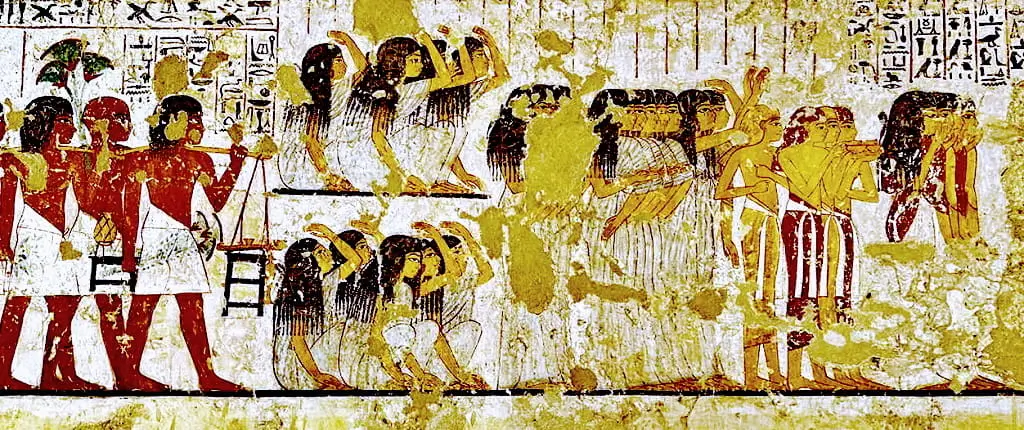
  • The Mourning Women: Analyzing the famous painted wall of the funeral procession.
  • Unfinished Grandeur: Why did such a high-ranking official leave his masterpiece incomplete?
  • Visitor Intelligence: Practical tips for accessing the Sheikh Abd el-Qurna cluster.

FUN

Tomb of Ramose: Classical Perfection vs. Amarna Revolution

Tomb of Ramose Classical Perfection vs. Amarna Revolution

To appreciate the Tomb of Ramose, one must first recognize the clash of artistic philosophies etched into its walls. Because this tomb served as a bridge between two eras, it provides a rare, side-by-side comparison of the 18th Dynasty’s peak and the sudden birth of the Amarna style. Notably, the master craftsmen who worked here had to pivot their entire aesthetic mid-construction, leaving us with a visual record of an empire in transition.

The Southern Wall: The Pinnacle of Classical Elegance

On the southern wall, you witness the “Old World” at its most refined. Specifically, the reliefs depicting the funeral banquet of Ramose’s family represent the absolute height of New Kingdom artistry. Unlike the painted tombs of Deir el-Medina, these limestone carvings rely entirely on shadow and depth. Furthermore, the detail is staggering; the artists rendered the individual strands of the heavy, tiered wigs and the delicate folds of transparent linen robes with a precision that rivals modern sculpture. Consequently, even without color, the stone seems to possess a soft, lifelike texture.

The Western Wall: The Amarna Transformation

In sharp contrast, the Western Wall introduces the radical aesthetic of Akhenaten. As the young Pharaoh introduced the cult of the Sun Disk (the Aten), he mandated a shift in how the royal family appeared. Therefore, the traditional, idealized figures vanish, replaced by the early Amarna style: elongated necks, protruding bellies, and the presence of the Sun Disk extending rays that end in tiny human hands. Notably, these reliefs remain largely unfinished, as the court eventually abandoned Thebes for the new capital at Amarna. By comparing these two walls, you can physically see the moment the old gods were cast aside for a new, revolutionary vision.

FUN

Tomb of Ramose: The Painted Path — The Funeral Procession

Tomb of Ramose The Painted Path — The Funeral Procession

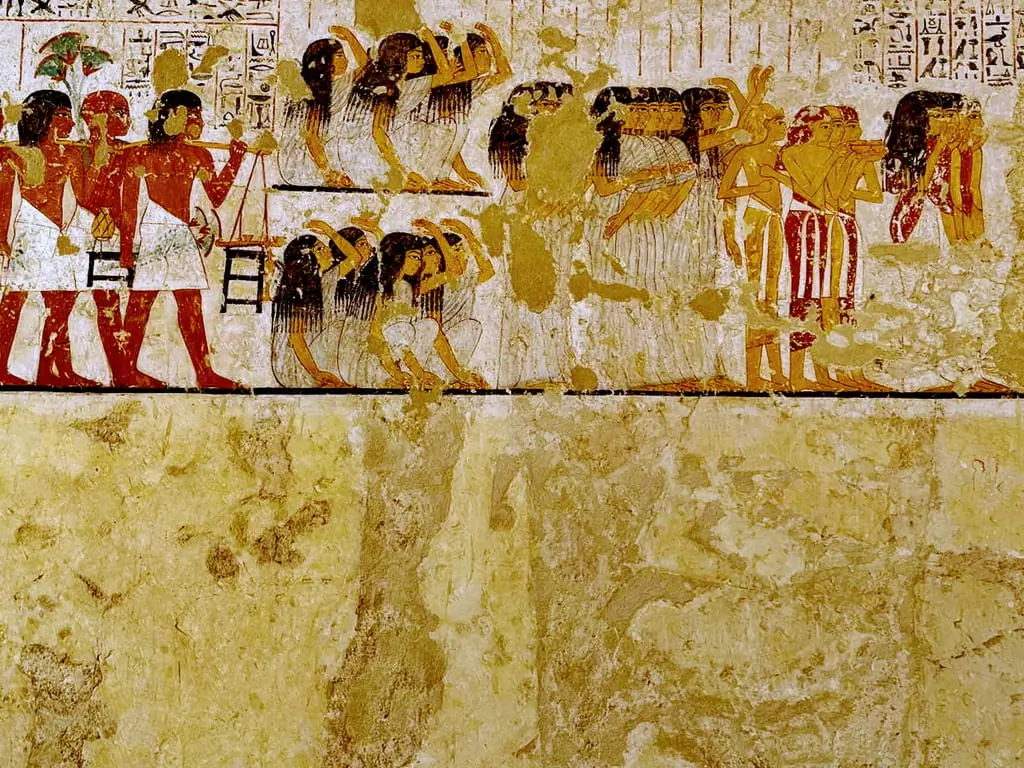
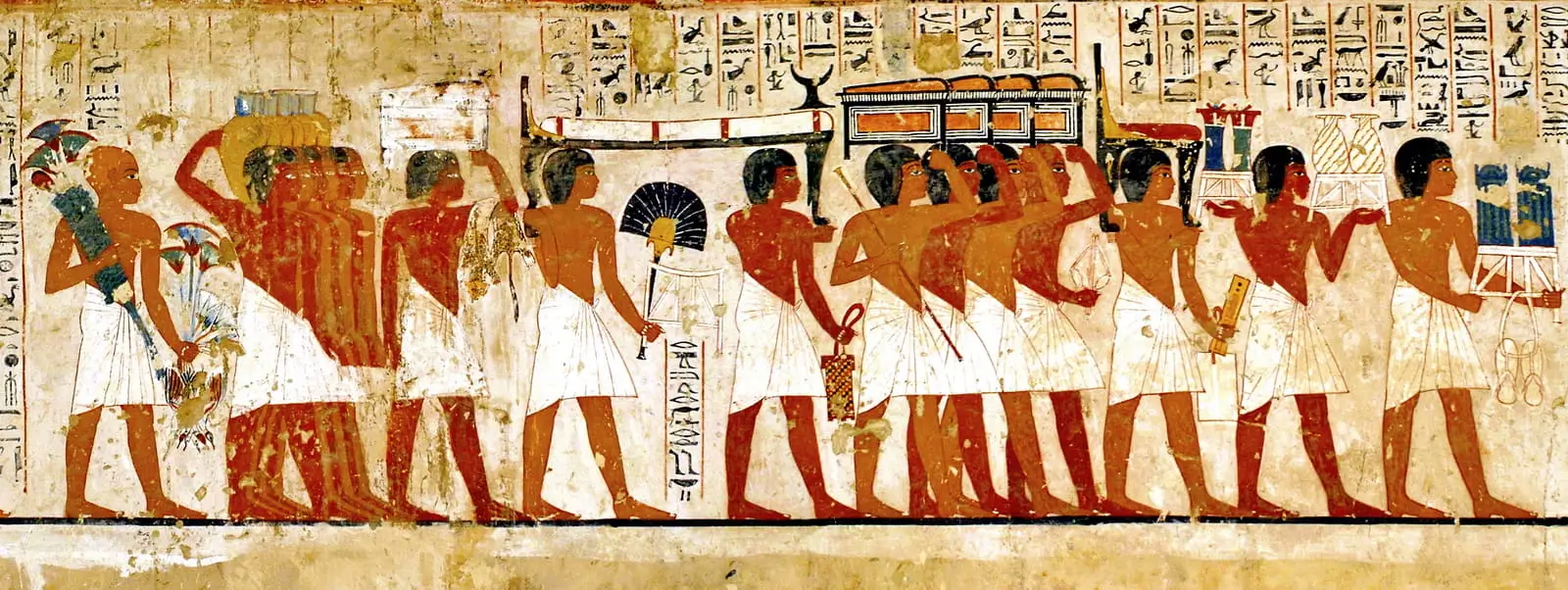
While the unpainted reliefs capture the architectural majesty of the tomb, the southern wall’s painted section brings a surge of human emotion to the site. Because the Egyptians viewed the funeral as a vital transition, they documented every ritual with meticulous care.

The Mourning Women

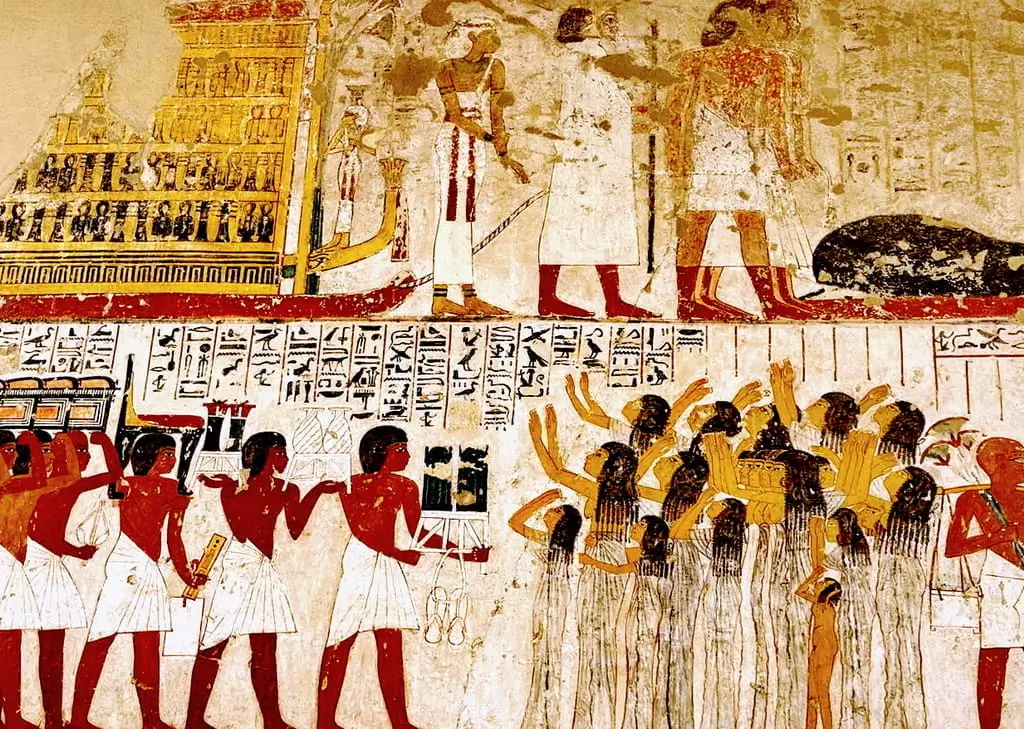
Notably, the scene of the “Mourning Women” is one of the most famous images in all of Egyptian art. Instead of a stiff, formal line, the artists painted these women in a dynamic state of grief. Specifically, you can see their tears, their disheveled hair, and their expressive gestures as they wail for the deceased Vizier. Furthermore, the use of varying skin tones and overlapping figures creates a sense of depth and crowded movement that is rare in earlier periods. Consequently, this wall provides a bridge between the divine order of the reliefs and the messy, visceral reality of human loss.

The Journey to the Afterlife

Beyond the mourners, the painting follows the coffin as it moves toward the tomb. By including these details, Ramose ensured that his funerary rites would be celebrated for eternity. Interestingly, this section remains one of the few areas where the vibrant polychromy (multi-color painting) survived, offering a glimpse of what the entire tomb might have looked like had it ever been finished.

The Catacombs of Kom Esh-Shokafa: Roman-Egyptian Underworld

Descend into one of the "Seven Wonders of the Middle Ages" at the Catacombs of...
Related post
FUN

Tomb of Ramose: Unfinished Grandeur — Why Ramose Left

Tomb of Ramose Unfinished Grandeur — Why Ramose Left

Ultimately, the most haunting aspect of TT55 is its incomplete state. Because the political center of gravity shifted to Tell el-Amarna, Ramose likely abandoned his Theban project to follow his King.

Therefore, we see massive blocks left uncarved and halls that remain rough-hewn. However, this “work in progress” status actually provides archaeologists with a treasure trove of information. Specifically, we can see the red grid lines used by the draftsmen to guide the carvers, offering a direct look at the ancient Egyptian creative process. Notably, the transition from the Vizier’s massive 32-column hall to the smaller, more intimate chambers shows a change in priority—favoring speed over the sprawling grandiosity of his earlier plans.

The Tomb of Sennefer (TT96): Inside the Legendary Vineyard Tomb

The Tomb of Sennefer (TT96), or the "Vineyard Tomb," is a masterpiece of 18th-century artistry...
Related post
FUN

Practical Visitor Intelligence — Mastering Your Visit to TT55

Practical Visitor Intelligence — Mastering Your Visit to TT55

To ensure you capture the full beauty of the Tomb of Ramose, you must plan your logistics with precision. Because the Sheikh Abd el-Qurna area contains the highest density of noble tombs, navigating the hillsides requires a strategic approach. Specifically, the Tomb of Ramose stands as the anchor for a specific cluster of sites, making it the perfect starting point for your morning exploration.

Tickets and Entry Requirements

First and foremost, you cannot buy tickets directly at the tomb entrance. Instead, you must stop at the central West Bank ticket office (the Maffish) near the Colossi of Memnon. Notably, authorities sell the ticket for TT55 as part of a three-tomb bundle. Currently, this group includes:

  • The Tomb of Ramose (TT55)
  • The Tomb of Userhet (TT56): Known for its vibrant hunting and barber scenes.
  • The Tomb of Khaemhat (TT57): Famous for its high-relief agricultural and religious scenes.

By visiting these three together, you witness the full spectrum of 18th Dynasty art, from the unpainted finesse of Ramose to the high-relief complexity of Khaemhat.

Lighting and Photography: The Photographer’s Guide

Unlike the deep, dark corridors of the Valley of the Kings, the Tomb of Ramose features a massive, open hypostyle hall. Because the walls consist of white limestone, the interior is surprisingly bright. Therefore, photographers should prioritize this tomb during the mid-morning hours when the sun reflects off the desert floor, naturally illuminating the low-relief carvings. Specifically, the unpainted walls capture light and shadow beautifully; consequently, you should avoid using a flash, as it flattens the delicate depth of the chisel work.

Timing and Crowds

To avoid the large tour groups that often bypass the Nobles’ tombs in favor of the Royal Valleys, arrive exactly at opening time (typically 6:00 AM). By getting there early, you often have the massive 32-column hall entirely to yourself. Furthermore, the climb to Sheikh Abd el-Qurna is steep; therefore, tackling this site before the 10:00 AM heat peak is essential for your comfort.

The Tomb of Maya and Meryt at Saqqara: A Masterpiece of Egypt’s Golden Age

The Tomb of Maya and Meryt stands as a pinnacle of New Kingdom artistry and...
Related post
FUN

Summary: Why the Tomb of Ramose is Essential

Summary Why the Tomb of Ramose is Essential

Ultimately, the Tomb of Ramose serves as a historical and artistic time capsule. Through its walls, we witness the transition from the “Golden Age” of Amenhotep III to the revolutionary “Amarna Period” of Akhenaten. Whether you are drawn to the emotional intensity of the “Mourning Women” or the technical perfection of the unpainted reliefs, TT55 remains one of the most intellectually rewarding sites in the Theban Necropolis.

In conclusion, no visit to Luxor is complete without witnessing the masterpiece of the Vizier who served two worlds. As you stand before these limestone walls, you aren’t just looking at art—you are looking at the exact moment an empire changed its soul.

Bring the history of the Pharaohs back to life while exploring Egypt...
Step into the "melting pot" of ancient history in the Greco-Roman Hall at the NMEC. This fascinating section shows what happened when Egypt's pharaonic legacy...
God_Anubis_Icon
Top 10 restaurants in cairo Egypt Fun Tours 2

Tour & Overnight camping with Mohamed

The breathtaking views and the isolation with a night under the stars! The trip was memorable with Mohamed, our tour guide, who drove us to all the sites on the way to the White Desert, and is clearly someone who knows the desert inside out. He also cooked a delicious

More »
Ancient Egyptian Sarcophagus - Egypt Fun Tours

Unforgettable experience with Fun Tours – Highly recommended!

Hello everyone! We would like to share our extremely positive experience with Fun Tours. Our tour was a complete success thanks to our guide, Osama, and our driver Hassan. Osama proved to be an enthusiastic and knowledgeable guide who answered all of our questions and catered to our individual wishes

More »
Amazing Egypt Tours Vacations in December Egypt Fun Tours

Amazing trip with Egypt Fun Tours

We had the time of our lives on a trip to Egypt and the Bahariya/White Desert with Egypt Fun Tours, too. I would highly recommend this company. They are very familiar with organizing this trip, and this means they are well-connected in the desert area. This was invaluable to us

More »

Great guided tour of pyramids

We travelled to Cairo on Friday, May 3, 2019, from Toronto. We landed at 0530 and were met by a representative of Fun Tours at the departure gate. We were only on a layover of 6 hours, and the tour company came with a private van, water, a driver, and

More »
God_Anubis_Icon

Top-rated Tour Packages

God_Anubis_Icon