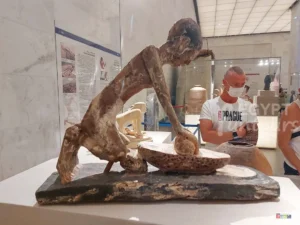

Imhotep: The First Genius, Step Pyramid Architect, and God of Healing

Meet Imhotep, history's first recorded genius and the true "Father of Medicine." This guide explores the life of the commoner who rose to become the Vizier of Pharaoh Djoser. Discover how he revolutionized architecture by designing the Step Pyramid at Saqqara—the world’s first stone monument—and pioneered rational medical diagnosis 2,000 years before Hippocrates. Learn how this polymath was eventually deified as the god of healing, separating the benevolent historical figure from the fictional Hollywood movie villain.
The eye of Horus
WhatsApp
Email
Print

Imhotep: The Leonardo da Vinci of Ancient Egypt

Imhotep is probably the most famous non-royal Egyptian in history. Two thousand years before the Greeks celebrated their great thinkers, this one man in Egypt mastered stone, medicine, and philosophy.

Today, his name is even more well-known thanks to various Hollywood mummy movies where he plays the villain. However, the real Imhotep was the exact opposite of a monster. His name literally means “The One Who Comes in Peace.” He achieved such great success as a polymath that today, more people know his name than that of the king he served, Pharaoh Djoser.

For a long time, scholars dismissed him as a mythological figure. But at the end of the nineteenth century, archaeologists confirmed he was a real, historical person.

This guide explores the life of Imhotep. We will uncover how he became the world’s first known architect, why Sir William Osler called him the true “Father of Medicine,” and how he achieved the rarest honor in Egyptian history: becoming a full god.

Imhotep: Key Takeaways

  • The Name: Imhotep means “The One Who Comes in Peace.”
  • The Architect: He designed the Step Pyramid at Saqqara, the first monumental stone structure in the ancient world.
  • The Physician: He is the first doctor known by name, diagnosing over 200 diseases and writing texts 2,200 years before Hippocrates.
  • The God: He is one of only two Egyptian commoners ever deified, worshipped as the son of Ptah.
Divider

Imhotep, The Vizier of Djoser: Power Behind the Throne

Imhotep Egypt Fun Tours

To understand Imhotep’s impact, you must first understand his position. He lived during the Third Dynasty (c. 2630–2611 BC), a time when Egypt was stabilizing into a powerful state. While he may have lived under four different kings, his legacy is tied forever to Pharaoh Djoser.

Imhotep: A Commoner’s Rise

Unlike most high officials who were born into royalty, Imhotep likely began life as a commoner. Historians believe he was born in a suburb of Memphis (or possibly Gebelein). His parents were likely Kanofer, an architect, and Khreduonkh. He may have also married a woman named Ronfrenofert.

Despite humble beginnings, his intelligence propelled him through the ranks. He eventually became the High Priest of Heliopolis, the religious center of Lower Egypt. This role gave him immense spiritual authority, but his power extended far beyond the temple.

Imhotep: The Man of Many Titles

We know about his status because of a statue base found at Saqqara. On it, Djoser listed Imhotep’s titles alongside his own—an honor almost unheard of in Egyptian history. These titles reveal a man who ran the entire country:

  • “Chancellor of the King of Lower Egypt”
  • “The First One Under the King”
  • “Administrator of the Great Mansion”
  • “Chief Sculptor” and “Chief Carpenter”

*Essentially, Imhotep was the Vizier (Prime Minister), the head of the religion, and the chief master builder. He was the mind that turned Djoser’s wealth into power.

Golden Scarab

The Architect Imhotep: Changing History with Stone

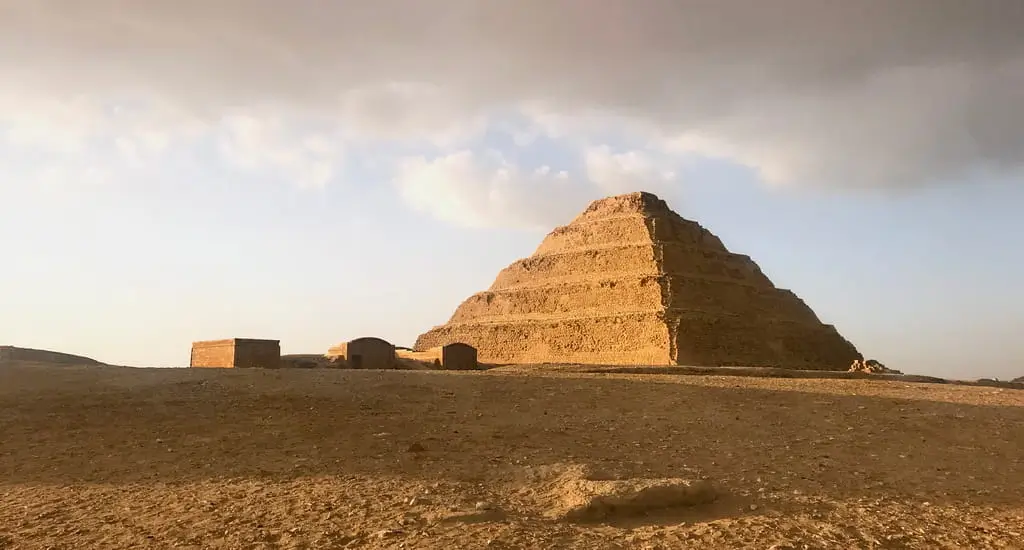
Step Pyramid of Djoser Saqqara 2026 hydraulic lift theory illustration

While he held many titles, Imhotep is most famous today as the world’s first known master architect. Before his time, royal tombs were built of sun-dried mud brick. These structures, called mastabas, were rectangular and flat-topped. While functional, they were not built to last for eternity. Imhotep changed everything. He decided to build a tomb for King Djoser using a new, enduring material: stone.

Imhotep: Inventing the Pyramid

His vision began simply. He started by building a traditional stone mastaba. However, he didn’t stop there. Instead of a single layer, he stacked five smaller mastabas on top of the first one. The result was a revolutionary 200-foot-tall “stairway to heaven.” This structure, the Step Pyramid at Saqqara, became the first monumental stone structure in the history of the world. It was an engineering marvel that paved the way for the Great Pyramids of Giza that would follow.

Saqqara: A City of Stone

Crucially, Imhotep didn’t just build a single tomb; he created a vast funerary complex. He surrounded the pyramid with a limestone wall, dummy temples, and the first known stone columns. To achieve this, he invented the technique of using small, manageable stone blocks that workers could carry by hand, a method that defined the Third Dynasty.

Some historians believe his architectural genius didn’t stop at Saqqara. He may have also contributed to the design of the Temple of Edfu and an unfinished pyramid found nearby, cementing his status as the father of architecture.

The eye of Horus

Imhotep The Physician: Healing Without Magic

The Physician; Healing Without Magic

Imhotep’s genius extended far beyond stone and mortar. He was also a medical pioneer who revolutionized how humanity understood the human body. While ancient medicine often relied heavily on magic and spells, Imhotep introduced a radical new concept: rational observation.

Imhotep: The True “Father of Medicine”

Two thousand years before the Greek physician Hippocrates was born, Imhotep was already practicing what we would recognize today as science. In fact, the renowned modern physician Sir William Osler called Imhotep “the first figure of a physician to emerge clearly from the mists of antiquity.”

His legacy is preserved in the Edwin Smith Papyrus. Although this document was written centuries after his death, most scholars believe it is a copy of Imhotep’s original casebook. It describes 48 distinct injuries, 90 anatomical terms, and—crucially—offers rational, practical treatments rather than just magical incantations.

Diagnosis and Treatment

Medical Tools of Imhotep Egypt Fun Tours

Imhotep’s medical knowledge was staggering for his time. He diagnosed and treated over 200 diseases. His practice covered a vast range of conditions, including:

  • Internal Diseases: Tuberculosis, gallstones, and appendicitis.
  • Chronic Conditions: Arthritis and gout.
  • Surgery & Dentistry: He performed surgeries and practiced early forms of dentistry.

Furthermore, he understood the function of vital organs and the circulatory system, using plants and natural remedies to treat skin, hair, and eye problems. Because of this unparalleled skill, the Greeks later identified him with their own god of medicine, Asclepius.

Divider

The God: Deification and Legacy

Imhotep The God; Deification and Legacy

Imhotep’s impact was so profound that it transcended his mortal life. While he died a man, the Egyptian people slowly transformed him into something much more. He serves as the ultimate example of a “personality cult” in ancient Egypt, where a human of exceptional ability rises to the status of a deity.

From Sage to Son of Ptah

This process took centuries. Initially, he was revered as a “sage” and a patron of scribes. In fact, scribes would honor him by pouring a few drops of water from their jugs as a libation before beginning their work.

However, about 2,000 years after his death (around 525 BC), Imhotep achieved the rarest honor in Egyptian history: full deification. He became one of only two commoners (along with Amenhotep, son of Hapu) to ever become a full god. Theology evolved to accommodate him; he replaced the god Nefertem in the great Memphis Triad, becoming the divine “Son of Ptah,” the creator god of craftsmen.

Cult Centers and Worship

Temples dedicated to Imhotep sprang up across Egypt, including major sites at Karnak, Philae, and his primary cult center at Saqqara. These temples functioned as hospitals and medical schools. Pilgrims flocked to them seeking cures. Archaeologists have found thousands of offerings at these sites, including mummified ibises (linking him to Thoth, the god of wisdom) and clay models of sick body parts, left by patients hoping for his divine healing.

The eye of Horus

Was Imhotep Joseph? (The Biblical Theory)

One of the most popular theories on the internet today asks: Was Imhotep actually the biblical patriarch Joseph? Proponents point to striking similarities: both were high officials who rose from humble beginnings, both served a pharaoh, both lived to be 110 years old (the ideal age in Egypt), and both are associated with a seven-year famine. The evidence often cited is the Famine Stela on Sehel Island. It tells a story of Djoser facing a seven-year famine and asking Imhotep for help. Imhotep consults the sacred texts and advises the king to make offerings to the god Khnum, ending the drought.

However, mainstream historians and Egyptologists reject this theory. The primary reason is the timeline. Imhotep lived in the Old Kingdom (c. 2600 BC), while most biblical scholars place Joseph in the Middle Kingdom or Second Intermediate Period (c. 1700–1600 BC)—a gap of nearly a thousand years. While the parallels are fascinating, they likely reflect common literary themes of the wise advisor rather than a single historical identity.

The Man Who Built Eternity

Imhotep was the ultimate polymath. He changed how humans build, how they heal, and how they worship. He transformed architecture by turning mud into stone, revolutionized medicine by replacing magic with observation, and achieved immortality not just as a god, but as a symbol of human potential.

Although his physical body has never been found—his lost tomb remains the “Holy Grail” of Egyptology—his mind is perfectly preserved in the enduring stone of Saqqara.

FAQs About Imhotep

Here are the quick answers to the most common questions about the first genius.

Q: What did Imhotep invent?

A: He invented stone architecture. Specifically, the Step Pyramid, which was the first monumental stone structure in history. He also pioneered rational medicine, diagnosing and treating diseases without relying solely on magic.

Q: Where is Imhotep buried?

A: No one knows. His tomb is believed to be somewhere at Saqqara, near the Step Pyramid, but it has never been found. Discovering it is considered the biggest potential find in modern Egyptology.

Q: Why is Imhotep the villain in movies?

A: Hollywood creative license. The 1932 film The Mummy (and the 1999 remake) needed an ancient, mystical-sounding name. In reality, Imhotep was a benevolent healer and sage, not an evil priest.

Q: Was Imhotep a pharaoh?

A: No. He was a vizier (prime minister) and high priest who served under Pharaoh Djoser. He was a commoner by birth who rose to the highest office in the land.

Divider

Highly Recommend Egypt Fun Tours!

Several weeks ago, I reached out to Egypt Fun Tours regarding a 9-hour layover in Cairo. From the very beginning, Hani Ahmed was responsive and professional, quickly providing a well-organized itinerary tailored to our limited time. The itinerary included a visit to the pyramids, other historical sites, a delicious dinner,

More »
Amazing Egypt Tours Vacations in December Egypt Fun Tours

Amazing trip with Egypt Fun Tours

We had the time of our lives on a trip to Egypt and the Bahariya/White Desert with Egypt Fun Tours, too. I would highly recommend this company. They are very familiar with organizing this trip, and this means they are well-connected in the desert area. This was invaluable to us

More »

Like two days of touring in one day!

I had a 12 hour stay in Cairo- and had made no plans on how to spend it until 8pm the night before departure. I emailed Egypt Fun Tours in a panic and they responded immediately. They made it incredibly easy to arrange a tour and we made arrangements via

More »

Egypt Fun Tours makes the most out of your layover!

I had a really short layover in Cairo and didn’t want to be stuck in the Cairo Airport for several hours. It was like Mission Impossible: Egypt Fun Tours’ mission was to show me around Cairo during my short 5 hour layover which was made even shorter because my plane

More »
God_Anubis_Icon

Top-rated Tour Packages

God_Anubis_Icon
WhatsApp
Email
Print