The Queen Who Became King: Trade and Architecture of Hatshepsut
Following the death of Thutmose I, the throne passed briefly to his son, Thutmose II. However, his premature death left Egypt in a delicate political position. The rightful heir, Thutmose III, was merely a young child. Consequently, his stepmother and aunt, Hatshepsut, stepped forward to act as regent. What began as a conventional regency soon transformed into one of the most remarkable and prosperous reigns in Egyptian history.
From Regent to Pharaoh: A Masterclass in Political Legitimacy
Hatshepsut was not content to simply rule from the shadows. Within a few years, she made a bold and unprecedented move. She officially declared herself Pharaoh of Egypt, co-ruling alongside the young Thutmose III.
To justify her rule to a conservative society, Hatshepsut executed a brilliant propaganda campaign. She instructed royal artists to depict her with the traditional masculine attributes of kingship, including the pharaonic kilt, the double crown, and even the ceremonial false beard. Furthermore, she claimed divine right. Inscriptions carved into her temple walls proclaimed that she was the literal daughter of Amun-Ra, who had taken the form of Thutmose I to conceive her. Through these shrewd political and religious maneuvers, she successfully secured her place on the throne.
The Golden Trade: The Expedition to the Land of Punt
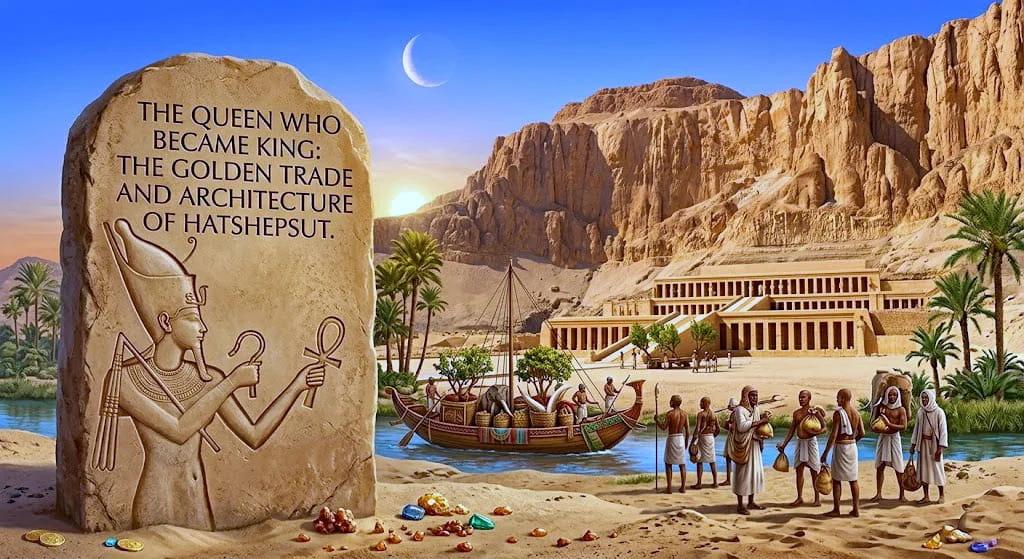
Unlike her military-minded predecessors, Hatshepsut focused her foreign policy primarily on economic wealth and international commerce rather than aggressive conquest. Her greatest foreign achievement was a legendary maritime expedition to the mysterious, wealthy African kingdom of Punt (likely located in modern-day Somalia or Eritrea). She dispatched a fleet of five massive, highly advanced ships down the Red Sea. The voyage was an overwhelming success. The Egyptian trade delegation returned to Thebes laden with unfamiliar riches that left the royal court in absolute awe.
- Precious Myrrh Trees: The ships brought back living myrrh trees with their roots packed in baskets, which were successfully replanted around her mortuary temple.
- Unfamiliar Materials: The expedition secured vast amounts of raw frankincense, fragrant myrrh resin, dark ebony wood, and pure ivory.
- Precious Metals: Large quantities of gold and electrum were poured into the treasury, boosting the domestic economy significantly.
This lucrative trade network permanently enriched the priesthood of Amun and elevated Egypt’s status as a peaceful commercial superpower in the region.
Monumental Masterpieces: The Architecture of Divine Elegance
With the treasury overflowing from the Punt trade, Hatshepsut initiated an aggressive, luxury-driven building program that transformed the landscape of Upper Egypt. Her architectural legacy is defined by clean lines, perfect symmetry, and grand proportions that perfectly balance luxury with classical Egyptian aesthetics.
- Djeser-Djeseru (Deir el-Bahari): Her crowning achievement is her magnificent mortuary temple at Deir el-Bahari. Designed by her brilliant royal architect (and rumored close advisor) Senenmut, this terraced masterpiece cuts directly into the towering limestone cliffs of western Thebes. It features grand, colonnaded terraces that perfectly mimic the natural geometry of the mountain behind it.
- The Karnak Obelisks: To honor her divine father, Amun-Ra, she erected two colossal, single-piece red granite obelisks at Karnak. At nearly 100 feet tall and covered in brilliant gold-textured electrum, they caught the desert sun and could be seen from miles away.
- The Red Chapel: She constructed a beautifully detailed quartzite sanctuary at Karnak, showcasing the absolute pinnacle of New Kingdom artistic refinement and stone carving.
Hatshepsut’s reign proved that an empire could be successfully maintained and expanded through economic genius and cultural brilliance. She inherited a secure kingdom and transformed it into a breathtaking, golden showcase of architectural perfection.
The Warrior Empire: The Unstoppable Conquests of Thutmose III
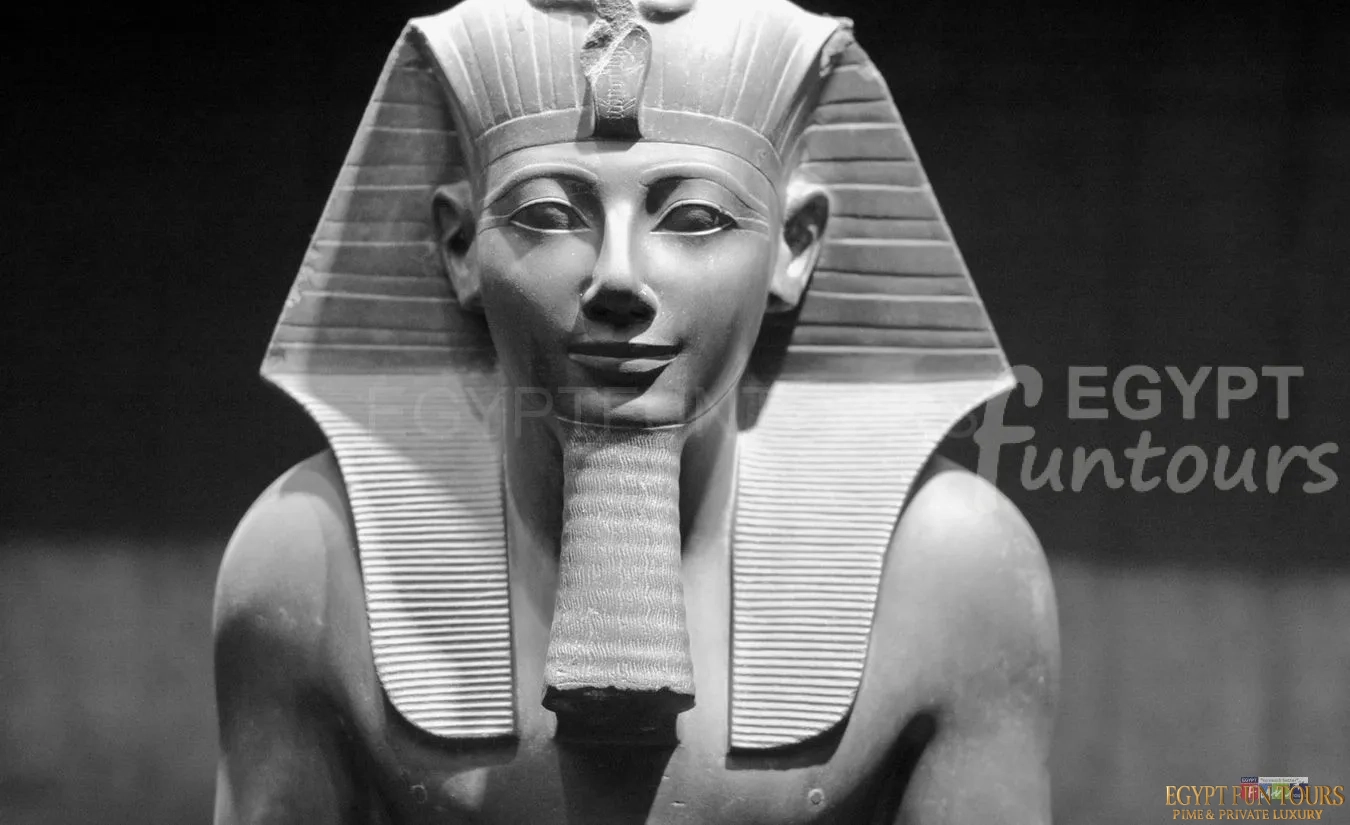
When Hatshepsut passed away, Thutmose III finally took sole command of the Egyptian throne. Having spent decades under his stepmother’s shadow, the young king was eager to prove his worth. He did not waste any time. Immediately, he channeled his energy into the military, transforming Egypt’s army into an unstoppable machine. Today, historians often call him the “Napoleon of Egypt” because of his brilliant tactical mind and flawless campaign record.
The Battle of Megiddo: A Masterclass in Military Strategy (Eighteenth Dynasty)
Almost immediately after Hatshepsut’s death, a dangerous coalition of Canaanite kings revolted against Egyptian authority. Led by the Prince of Kadesh, the rebels gathered their forces at the heavily fortified city of Megiddo. This strategic site controlled the vital trade routes between Egypt, Mesopotamia, and Anatolia.
Thutmose III marched his army north with incredible speed. When he reached the vicinity of Megiddo, his generals urged caution. Three paths led to the city: two wide, safe routes and one narrow, rocky mountain pass called the Aruna Lane. His advisors warned that the narrow pass would force the army to march in a single file, leaving them completely vulnerable to ambush.
However, Thutmose III made a bold, unexpected decision. He reasoned that because the enemy expected him to take the safe routes, they would leave the mountain pass unguarded. He personally led his men, step by step, through the treacherous, narrow corridor.
The gamble paid off perfectly. The Egyptian army emerged directly in front of Megiddo, completely surprising the rebel forces. A fierce battle ensued, and the Egyptian chariot divisions quickly shattered the enemy lines. The defeated rebels fled behind the city walls, leading to a grueling seven-month siege. When Megiddo finally surrendered, Thutmose III treated the defeated kings with surprising leniency, cementing their loyalty while securing vast amounts of plunder for Egypt.
The Eighteenth Dynasty: Expanding the Borders to the Edge of the Known World
The victory at Megiddo was merely the beginning of Thutmose III’s military career. Over the course of 20 years, he launched 17 successful military campaigns into the Levant and Syria. He engineered brilliant logistics systems to sustain his empire. For instance, he built massive naval supply depots along the Mediterranean coast to quickly transport troops and heavy equipment by sea. His forces successfully pushed through the Mitanni Kingdom and, just like his grandfather Thutmose I, crossed the Euphrates River. To mark his absolute triumph, he erected a victory stele right next to his grandfather’s monument.
Furthermore, he was equally aggressive in the south. He marched his armies deep into Nubia, pushing the Egyptian frontier down to the Fourth Cataract of the Nile. Through these relentless efforts, Thutmose III expanded the Egyptian Empire to its absolute greatest territorial extent.
The Eighteenth Dynasty: Funding the Glory of Amun-Ra
Vast wealth in the form of annual tribute, unfamiliar animals, rare plants, and captured treasures poured into Thebes from every corner of the ancient world. Thutmose III dedicated the majority of this wealth to the state god, Amun-Ra.
- The Akh-Menu (The Festival Hall): He built a magnificent, uniquely styled celebration hall at the Karnak Temple complex. The columns were beautifully shaped like ancient tent poles, permanently commemorating his life in military camps.
- The Botanical Garden: He commissioned highly detailed wall reliefs inside Karnak that accurately depicted the unfamiliar plants and animals he collected during his foreign campaigns.
- The Giant Obelisks: He erected several massive granite obelisks. Interestingly, one of his towering monuments stands today as the “Lateran Obelisk” in Rome, the tallest standing ancient Egyptian obelisk in the world.
Thutmose III left behind a legacy of absolute military dominance and unmatched administrative organization. He successfully forged an empire held together by a professional military, securing unparalleled peace and prosperity for the generations that followed.