
The Story of The Two Brothers: The World’s Oldest Epic
Imagine a story that combines a family feud, a supernatural transformation, and a royal conspiracy. This is not a modern thriller. Instead, it is The Story of the Two Brothers, an ancient Egyptian masterpiece written over 3,000 years ago. Most scholars agree that this text, found in the famous Papyrus D’Orbiney, represents the earliest known example of the “fairy tale” genre. However, it is much more than a simple bedtime story.
First, the narrative serves as a window into the morality of the New Kingdom. Second, it explores complex themes like reincarnation and divine justice. Throughout this guide, we will analyze why this tale remains a cornerstone of world literature. We will look at the lives of the two protagonists, Bata and Anubis, and discover how their journey mirrors the eternal struggle between truth and deception. Consequently, by the end of this pillar, you will understand the deep cultural significance of this Egyptian legend.
The Domestic Betrayal: Loyalty Tested by Deceit
The story begins in a rural setting, long before the brothers become legends. In this section, we meet Anubis, the elder brother, and Bata, his loyal sibling. Their relationship defines the Egyptian ideal of family unity—at least, in the beginning.
Life in Harmony
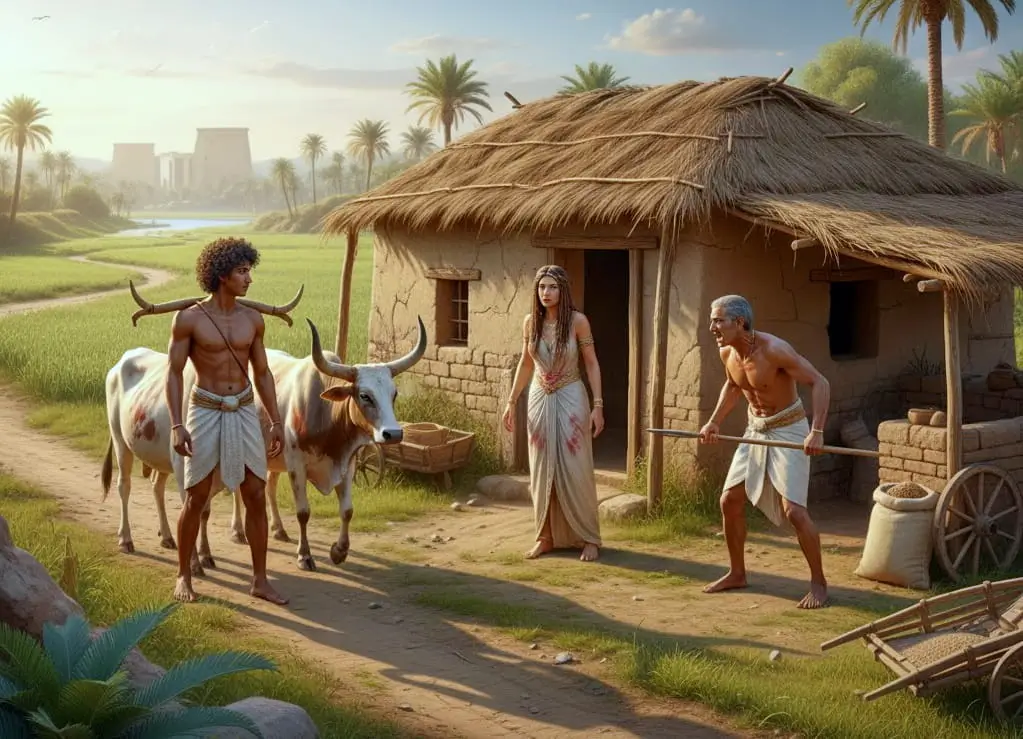
Anubis is a settled man with a home, a wife, and a steady life. Bata, the younger brother, lives with them. However, Bata is no ordinary laborer. He is described as having the “strength of a god.” He works the fields, tends the cattle, and performs every chore with perfection. Furthermore, the story tells us that Bata has a magical connection to nature. He can speak to his cows, and they, in turn, guide him to the best pastures. Because of this harmony, the household prospers. For many years, the two brothers lived in peace, showing that hard work and loyalty lead to a blessed life.
The Moment of Betrayal
Peace, however, rarely lasts in ancient epics. One day, while the brothers are working in the fields, Anubis sends Bata back to the house to fetch more seed. When Bata arrives, he finds Anubis’s wife braiding her hair. In a sudden turn of events, she becomes overwhelmed by Bata’s strength and beauty. She asks him to stay with her and “lie with her.”
Bata reacts with immediate horror. He does not hesitate to defend his brother’s honor. He tells her plainly that Anubis is like a father to him, and she is like a mother. Therefore, he rejects her completely and returns to the fields. He promises to keep her secret, hoping to maintain the family’s peace.
The False Accusation

Unfortunately, the wife is consumed by fear and spite. She realizes that her rejected advances could lead to her own ruin. To protect herself, she devises a wicked plan. She applies grease and paint to her body to look like she has been beaten. When Anubis returns home at sunset, he finds his wife in tears.
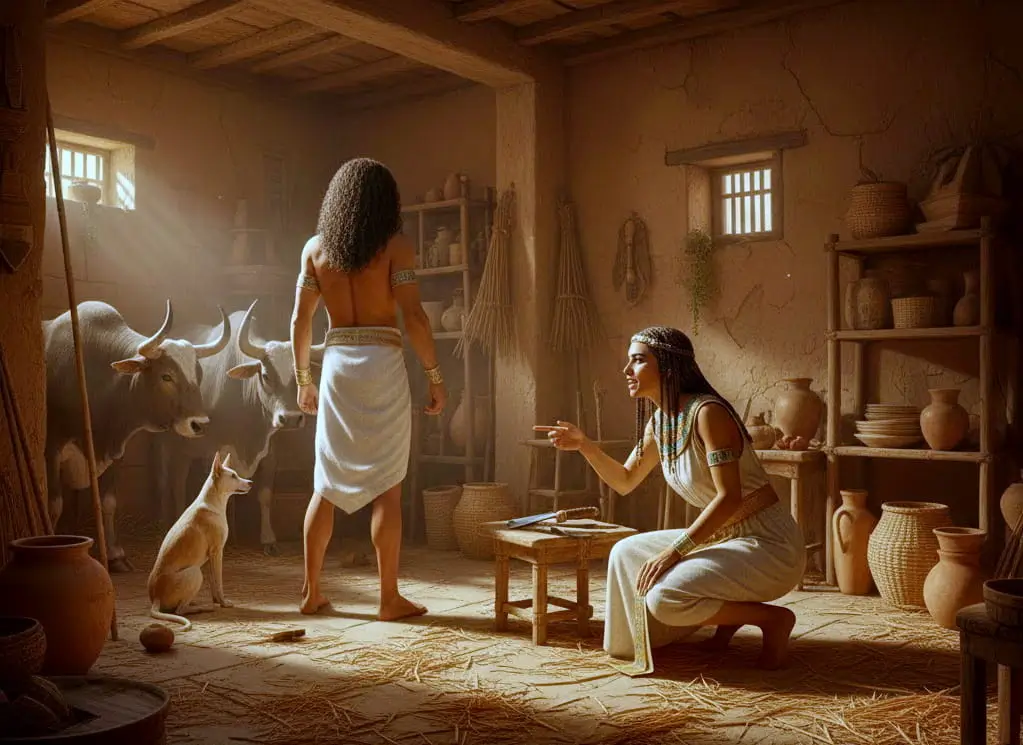
She tells a devastating lie. She claims that Bata tried to seduce her and beat her when she refused. Because Anubis is blinded by sudden rage, he does not stop to investigate. Instead, he grabs a spear and hides in the shadows of the stable, waiting to kill his younger brother. This moment marks the transition from a domestic drama to a high-stakes survival story.
The Divine Intervention
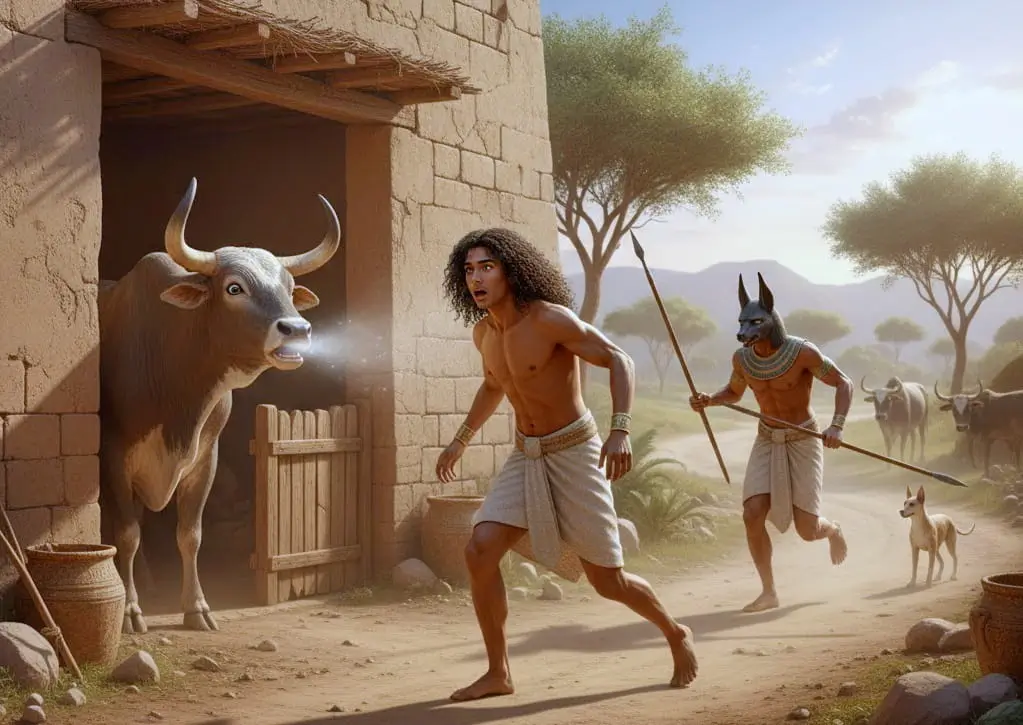
As Bata approaches the stable with his cattle, the lead cow speaks to him. “Behold,” the animal warns, “your elder brother stands before you with a spear to kill you.” Immediately, Bata realizes the danger and begins to run. Anubis pursues him with the spear in hand, fueled by the lies of his wife.
At this critical moment, Bata cries out to the sun god, Re-Horakhty. He asks the god to judge between the righteous and the guilty. Because the gods favor the truth, Re-Horakhty creates a miraculous barrier: a massive body of water filled with hungry crocodiles. Suddenly, the brothers are separated by a literal river of divine judgment. This ensures that Anubis cannot reach Bata, allowing the truth to finally come to light.