The Clash of Empires: Sais vs. Napata (Twenty-fourth Dynasty of Egypt)
The Threat to the Holy Heartland
The rapid southern expansion of the Twenty-fourth Dynasty of Egypt triggered a major geopolitical crisis. By marching his coalition past Hermopolis, Tefnakht directly threatened Upper Egypt. This aggressive movement deeply alarmed the Kushite rulers of the 25th Dynasty, based at Napata in modern-day Sudan.
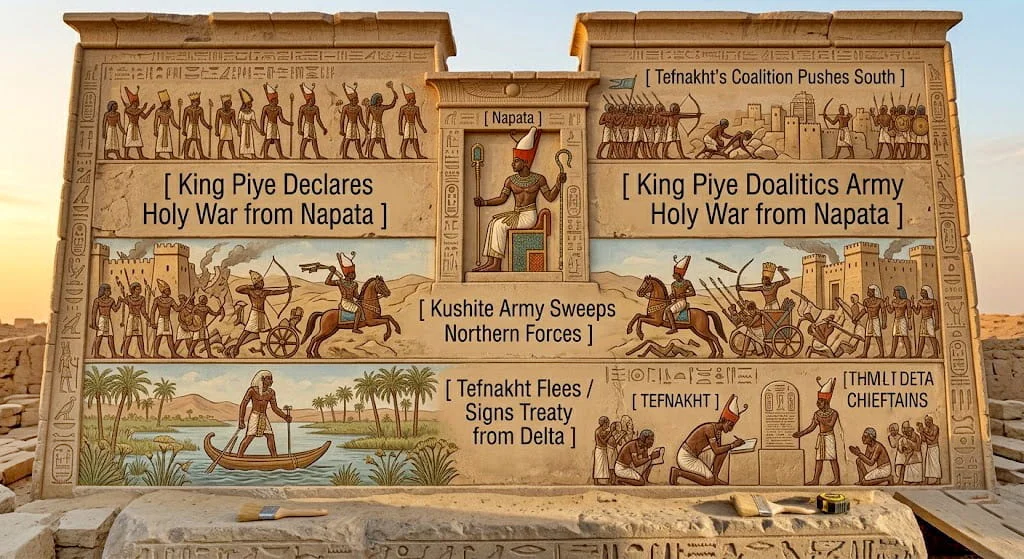
The Kushite King, Piye, viewed the rise of the secular, Libyan-led northern coalition as a direct insult to the supreme god Amun-Ra. He believed that Tefnakht was an ambitious upstart trying to destroy the ancient religious fabric of the land. Therefore, Piye declared a holy war to liberate Egypt from the northern invaders.
The Counter-Offensive and the Marshland Treaty
Piye acted with devastating speed and precision. He mobilized a massive Kushite fleet and army, sending them charging northward down the Nile. The two massive military forces clashed in a series of brutal river engagements and land battles across Middle Egypt.
Ultimately, Piye’s highly disciplined Kushite troops shattered Tefnakht’s alliance. They broke the siege of Herakleopolis and recaptured the city of Memphis after a bloody assault.
Tefnakht recognized that he could not win a direct war of attrition against the Nubian empire. Consequently, he retreated deep into the inaccessible, fog-covered marshes of the western Delta. From this hidden stronghold, he sent an embassy to Piye to negotiate terms. He offered a formal surrender and valuable tribute, but he refused to travel south to bow in person.
Piye accepted this compromise because hunting the Saite leader through the treacherous Delta swamps was too risky. As a result, the Kushite army marched back to Nubia, allowing Tefnakht to preserve his localized kingship at Sais.
The Tragic Climax: Shabaka and the Fate of Bocchoris
The Second Nubian Wave
The fragile peace between Sais and the Kushite Empire did not last long. Following the deaths of King Tefnakht and King Piye, a new generation of leaders took power. Bakenranef assumed the throne at Sais, while Piye’s successor, King Shabaka, grabbed the reins of the 25th Dynasty.
Unlike his predecessor, Shabaka abandoned the policy of allowing northern rulers to remain as loose vassals. He recognized that as long as the Saite monarchy existed, Egypt would remain vulnerable to rebellion. Therefore, around 720 BCE, Shabaka mobilized a massive, highly disciplined Kushite army and launched a definitive invasion to unify the entire country by force.
Twenty-fourth Dynasty of Egypt: The Grim Fate of King Bocchoris
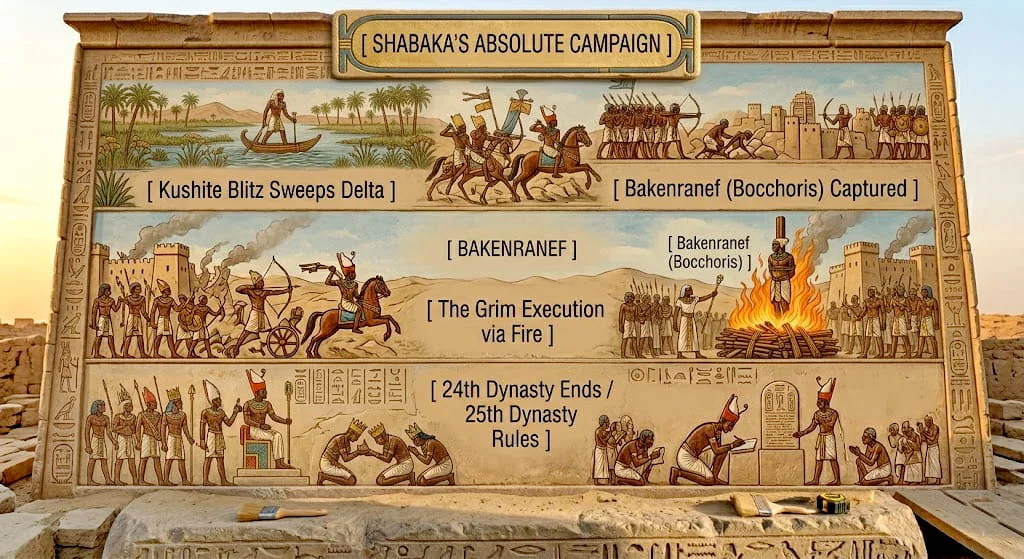
The Kushite forces swept northward with unstoppable momentum, bypassing traditional buffer states and punching straight into the Delta heartland. They quickly overwhelmed the local defenses of Sais, trapping Bakenranef within his own capital.
What followed became one of the most dramatic and shocking tales in ancient historiography. According to the third-century BCE Egyptian priest and historian Manetho, Shabaka captured Bakenranef alive. To send a terrifying message to any future rebels, the Kushite king ordered Bakenranef to be burned alive at the stake.
While some modern Egyptologists debate whether this execution was a literal burning or a symbolic destruction of his mummy, the political result was absolute. This brutal act permanently extinguished the independent 24th Dynasty line.