How the Persian Civil War Launched the Twenty-eighth Dynasty of Egypt
The path to the Twenty-eighth Dynasty of Egypt opened because of a bloody family feud thousands of miles away. In 405 BCE, the Persian King Darius II died. His death triggered a violent war of succession between his two sons. His eldest son, Artaxerxes II, took the imperial throne in Susa. However, his younger son, Cyrus the Younger, wanted the crown for himself.
Cyrus the Younger ruled as a governor in Asia Minor (modern-day Turkey). To defeat his brother, he needed a massive army. He emptied Persian garrisons across the entire empire to gather troops. Crucially, he drained the imperial forces stationed along the Nile. He also hired thousands of elite Greek mercenaries, known as hoplites.
This massive troop withdrawal created a sudden power vacuum in Lower Egypt. The remaining Persian governors had very few soldiers left to police the local population. Amyrtaeus recognized this perfect window of opportunity. In 404 BCE, as Cyrus marched his forces away to fight the Persian king, the prince of Sais stepped out of the Delta marshes and declared open rebellion.
The Military Strategy of the Twenty-eighth Dynasty of Egypt
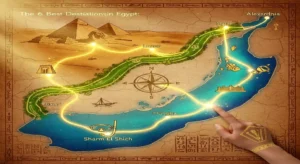
The campaign to establish the Twenty-eighth Dynasty of Egypt was a brilliant, multi-stage military operation. Amyrtaeus did not try to fight the Persians in a single, open battlefield right away. Instead, he used a highly calculated strategy to reclaim the country step by step.
Stage 1: Liberating the Delta
First, Amyrtaeus secured the entire northern coast. He united the rival Delta clans under his command. He used his small, agile rebel units to overwhelm the isolated Persian outposts that Cyrus the Younger had left behind. By 403 BCE, the entire Delta region recognized Amyrtaeus as the true leader of Egypt.
Stage 2: The Fall of Memphis
Next, Amyrtaeus turned his eyes toward Memphis. For thousands of years, Memphis served as the administrative heart of Egypt. The Persian satrap (governor) had fortified himself inside the city’s massive white walls. Amyrtaeus marched his army south and launched a fierce assault. By roughly 401 BCE, the native Egyptian forces successfully broke through the defenses. Capturing Memphis was a huge psychological victory. It signaled to the entire population that foreign rule was ending.
Stage 3: Controlling Upper Egypt
Reclaiming the south proved to be the final challenge. The Persian forces retreated deep into Upper Egypt, holding onto key positions like Elephantine (modern-day Aswan). Amyrtaeus pursued them ruthlessly.
We know his campaign succeeded because of ancient documents called the Elephantine Papyri. These Aramaic legal texts were written by a Jewish military garrison stationed at the southern border. For years, the soldiers dated their documents using the regnal years of the Persian King Artaxerxes II. However, in the year 400 BCE, a sudden shift occurred. The scribes abruptly stopped using the Persian king’s name. Instead, they began dating their records to “Year 5 of Amyrtaeus.”
This small administrative change is monumental. It proves that by 400 BCE, the Twenty-eighth Dynasty of Egypt held undisputed control over the entire length of the Nile, from the Mediterranean Sea all the way to the Nubian border.
| Phase of Campaign |
Primary Target |
Military Outcome |
Historical Evidence |
| Phase 1 |
Nile Delta Marshes |
Secured rebel base; destroyed minor Persian outposts. |
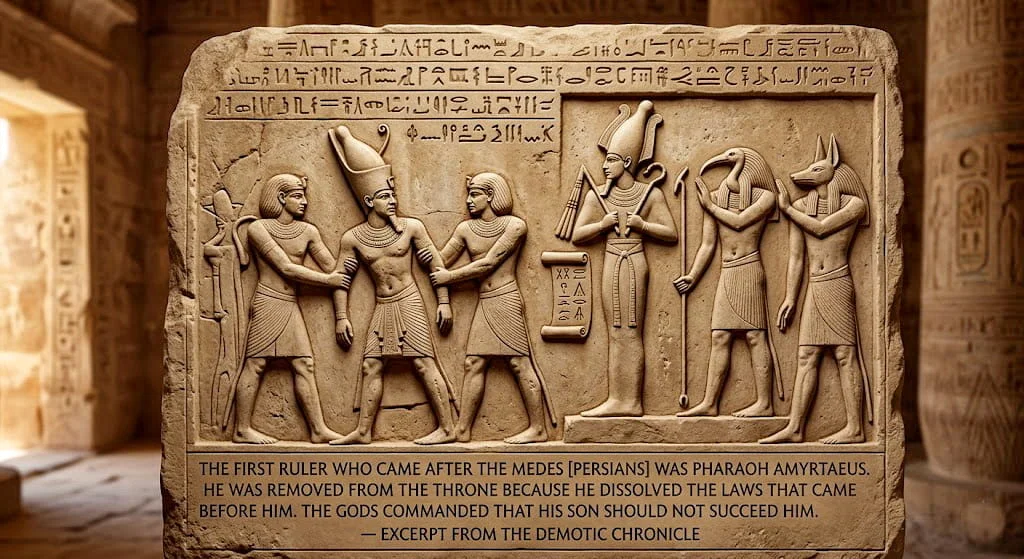
The Demotic Chronicle |
| Phase 2 |
Memphis Capital |
Captured the administrative heart of Egypt; expelled the Satrap. |
Classical Greek histories |
| Phase 3 |
Elephantine (Aswan) |
Reclaimed the southern border; achieved total territorial control. |
The Aramaic Elephantine Papyri |