31st Dynasty of Egypt: The 2nd Persian Period and Fall of the Pharaohs

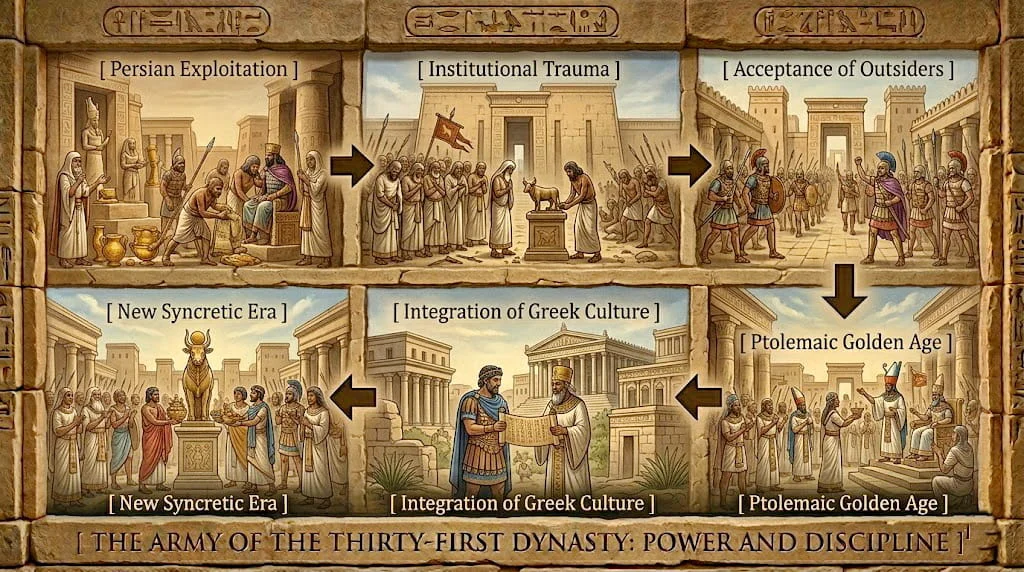
The 31st Dynasty of Egypt represents a brief but brutal decade of Second Persian Period occupation, initiated by Artaxerxes III's harsh conquest at the Battle of Pelusium and characterized by the systematic oppression of native religious traditions, such as the desecration of the sacred Apis Bull. Despite a fierce three-year native revolt led by the shadow pharaoh Khabash in the Delta, the heavily taxed and resource-stripped province remained vulnerable under subsequent Persian rulers like Satrap Mazaces. Ultimately, the weakened dynasty collapsed without bloodshed in 332 BCE when the conquering Macedonian army arrived, leading to the enthusiastic embrace of Alexander the Great as a divine liberator and paving the way for a syncretic, respectful Greco-Egyptian golden age under the Ptolemies.
The eye of Horus
WhatsApp
Email
Print

The Thirty-first Dynasty of Egypt: The Dawn of the Second Persian Period

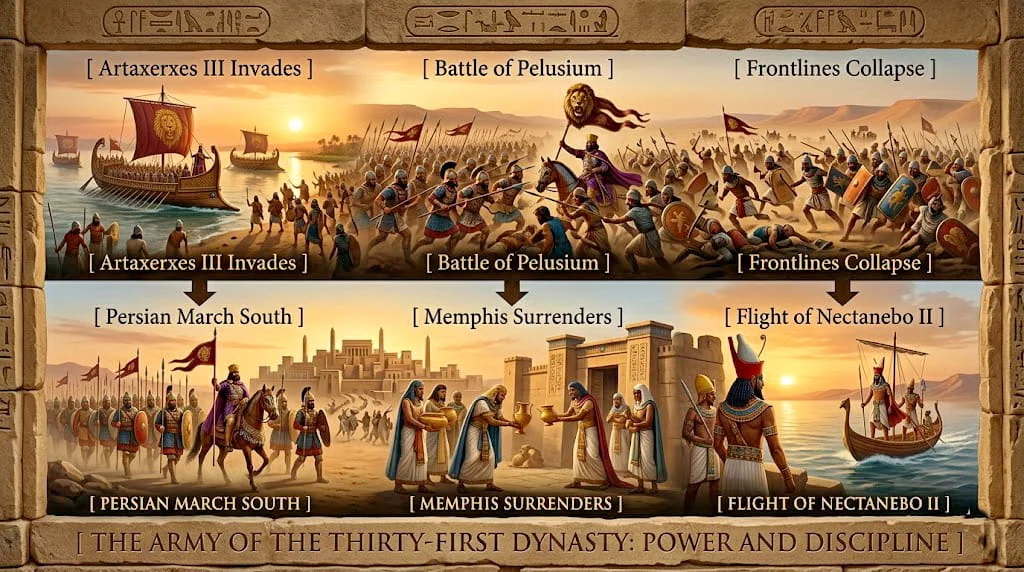
The year 343 BCE brought deep trauma to the Nile Valley. The final native pharaoh, Nectanebo II, gathered his royal treasures and fled south into Nubia. His escape shattered a three-thousand-year-old tradition of native rule. In his wake, the triumphant Achaemenid Empire swept across the land. This invasion established the Thirty-first Dynasty of Egypt, which historians also refer to as the Second Persian Period.

Unlike older Egyptian eras, this brief dynasty (343–332 BCE) left no grand monuments. Rulers completely ignored the peaceful maintenance of Ma’at. Instead, the era brought military oppression, heavy taxes, and deep religious conflict. The Persian Great Kings did not rule as divine living gods. They viewed Egypt simply as a distant province to exploit.

This harsh treatment soon sparked fierce local rebellions. The Nile Delta quickly became a dangerous frontline of native resistance. By exploring this dark twilight of the Late Period, we see exactly why the Egyptian people changed. They eventually welcomed Alexander the Great not as an enemy, but as a true savior.
Divider

The Iron Fist of Artaxerxes III and the Fall of Memphis

Thirty-first Dynasty of Egypt: The Iron Fist of Artaxerxes III and the Fall of Memphis

The Persian King Artaxerxes III wanted to crush Egyptian independence once and for all. In 343 BCE, he marched a massive army across the harsh Sinai Desert. The Egyptian forces waited at Pelusium, the strategic eastern gateway to the Nile Delta. This critical border fortress became the site of a brutal, decisive showdown.

The Battle of Pelusium quickly turned into a disaster for Egypt. Artaxerxes III used clever tactics and fierce Greek mercenaries to outmaneuver the defenders. The Egyptian frontlines collapsed under the relentless pressure.

The Capture of the Sacred Capital

After the disaster at Pelusium, the Persian army marched south toward Memphis. Pharaoh Nectanebo II realized he could not defend the capital. He gathered his royal treasures and abandoned the city, fleeing south into Upper Egypt and Nubia.

Without a king to lead them, the authorities in Memphis surrendered. The fall of this sacred city marked the practical end of native pharaonic rule. Artaxerxes III claimed the throne and officially established the Thirty-first Dynasty of Egypt. He immediately tore down the city walls to prevent future resistance and installed a permanent Persian garrison to watch over the defeated population.

Golden Scarab

Oppression and Desecration – The Persian Policy on Egyptian Religion

Oppression and Desecration – The Persian Policy on Egyptian Religion

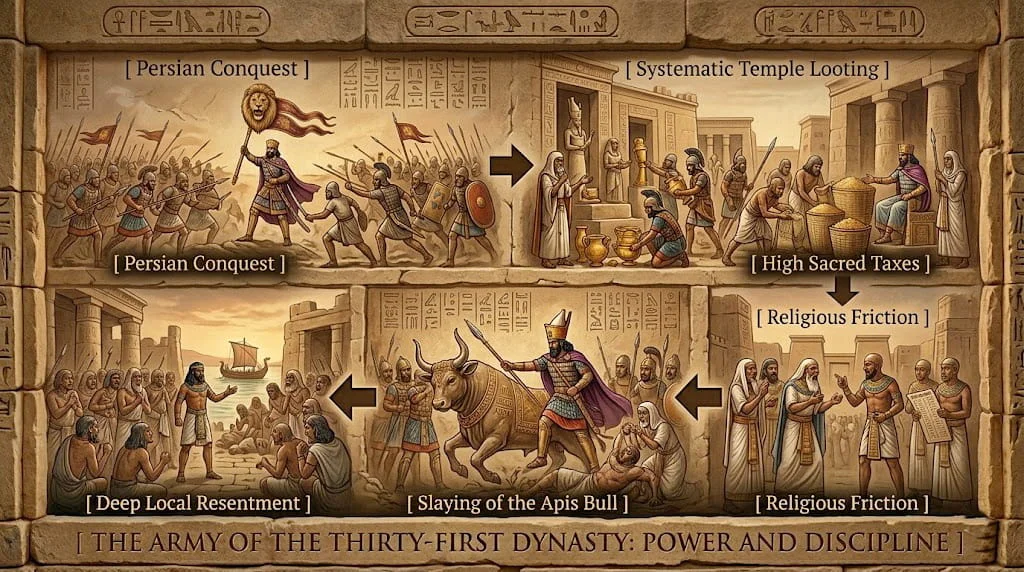
The new rulers did not respect the ancient traditions of the Nile Valley. Under the Thirtieth Dynasty, native pharaohs had spent decades building temples to honor Ma’at. The kings of the Thirty-first Dynasty of Egypt took the opposite approach. They systematically targeted the powerful Egyptian priesthood and indigenous cults.

Historical accounts from Greek and Egyptian sources paint a grim picture of this occupation. Artaxerxes III sought to break the people’s spirit, so he attacked their most sacred symbols.

The Assault on the Sacred Symbols

The most devastating blow occurred in Memphis. According to historical records, Artaxerxes III ordered the execution of the sacred Apis Bull. To the Egyptians, this animal was the living manifestation of the god Ptah. Killing the bull was a direct, shocking assault on their religious identity.

The Persians did not stop there. They looted rich temple treasuries across Lower and Upper Egypt, stealing gold, silver, and sacred texts. The government also forced high taxes on temple lands, stripping the priesthood of their wealth and political power. This aggressive iconoclasm deeply offended the local population. It turned the temples into breeding grounds for secret, anti-Persian resistance networks.

The eye of Horus

The Shadow Pharaoh – The Rebel King Khabash

Thirty-first Dynasty of Egypt: The Shadow Pharaoh – The Rebel King Khabash

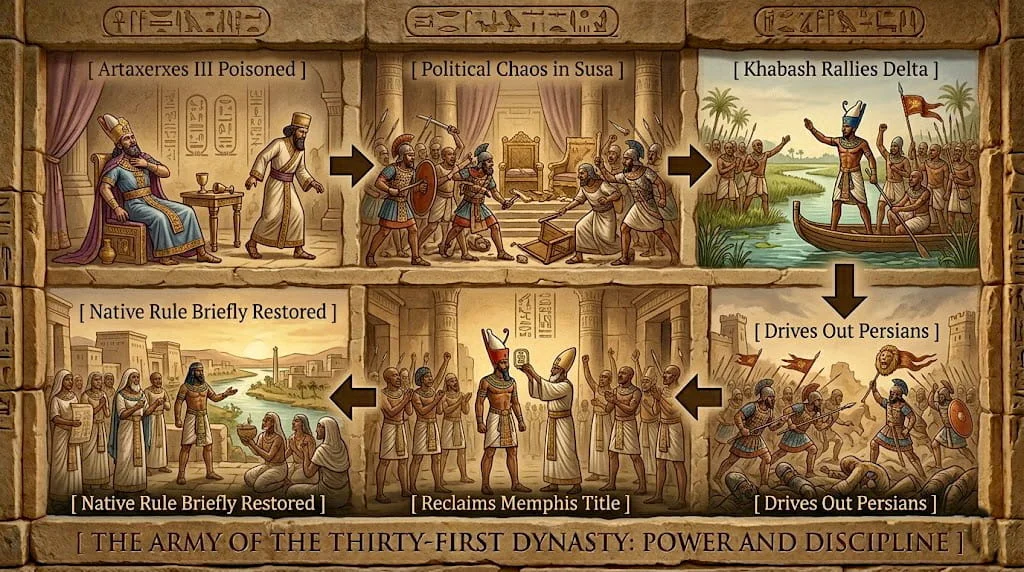
The harsh treatment by the Persians soon sparked a massive native backlash. Around 338 BCE, political chaos struck the heart of the Achaemenid Empire. An assassin poisoned King Artaxerxes III in Susa, throwing the empire into deep confusion. A brave native leader named Khabash seized this perfect opportunity to strike a blow for freedom against the Thirty-first Dynasty of Egypt.

Khabash successfully rallied the desperate people of the Nile Delta. He tapped into decades of deep local anger to build a powerful rebel army.

Defying the Thirty-first Dynasty of Egypt

Khabash led a swift, victorious march on the ancient capital of Memphis. He completely drove out the Persian administrators and claimed the traditional pharaonic titles. For nearly three years, this shadow pharaoh successfully restored native governance to large parts of Lower Egypt.

The rebel king knew the Achaemenid Empire would eventually retaliate. He spent months organizing strong coastal defenses along the marshy Delta. He wanted to block any incoming Persian fleets from landing troops. While Darius III eventually gathered enough forces to crush this rebellion, the legendary defiance of Khabash severely weakened the grip of the Thirty-first Dynasty of Egypt. It proved to the world that the native spirit could never be fully broken.

Divider

The Reign of Darius III and the Satrapy of Mazaces

The Reign of Darius III and the Satrapy of Mazaces

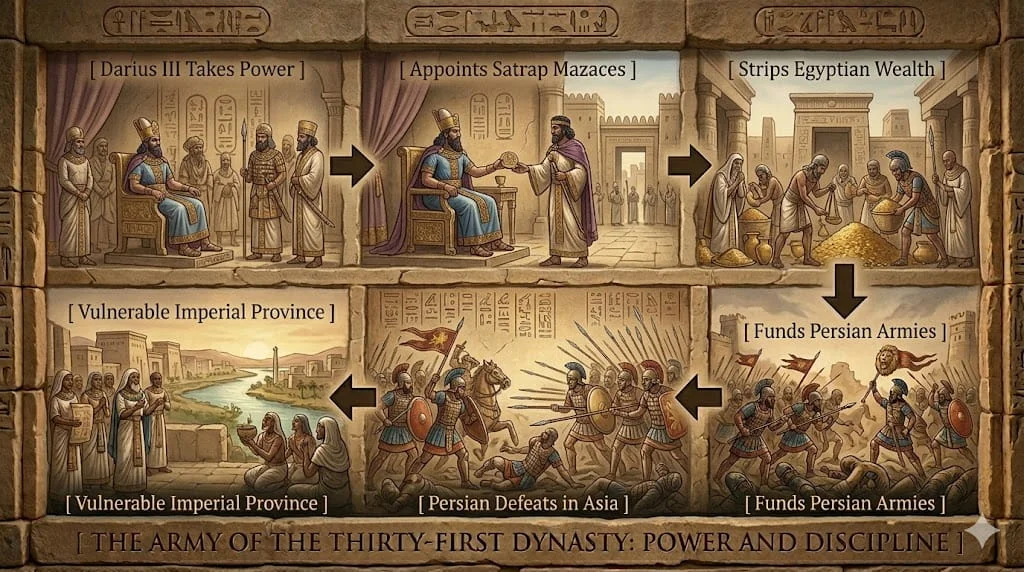
By 335 BCE, the Persian Empire stabilized under a new ruler, King Darius III. He quickly reestablished imperial control over the Nile Valley. However, Darius III did not view Egypt as a land to cultivate. Instead, he treated it strictly as a conquered province to fund his growing military needs. This policy defined the final, tense years of the Thirty-first Dynasty of Egypt.

To maintain control, the Great King appointed a Persian nobleman named Mazaces as the governor, or satrap, of Memphis.

The Falling Grip of the Thirty-first Dynasty of Egypt

Mazaces faced an impossible task. He had to squeeze heavy taxes from a highly hostile population. He used the remaining military garrisons to enforce strict order and collect vital resources. These funds went directly to Asia, where Darius III desperately tried to defend his crown against a rising new threat from Macedonia.

As the Macedonian forces won stunning victories in Asia, the local Persian defenses in Egypt began to collapse. Mazaces soon found himself completely cut off from reinforcements. The local administration grew weak, isolated, and highly vulnerable. The people openly prayed for a major political change, setting the stage for the definitive end of the unpopular Thirty-first Dynasty of Egypt.

The Macedonian Deliverance – Alexander the Great’s Arrival

The Macedonian Deliverance – Alexander the Great’s Arrival

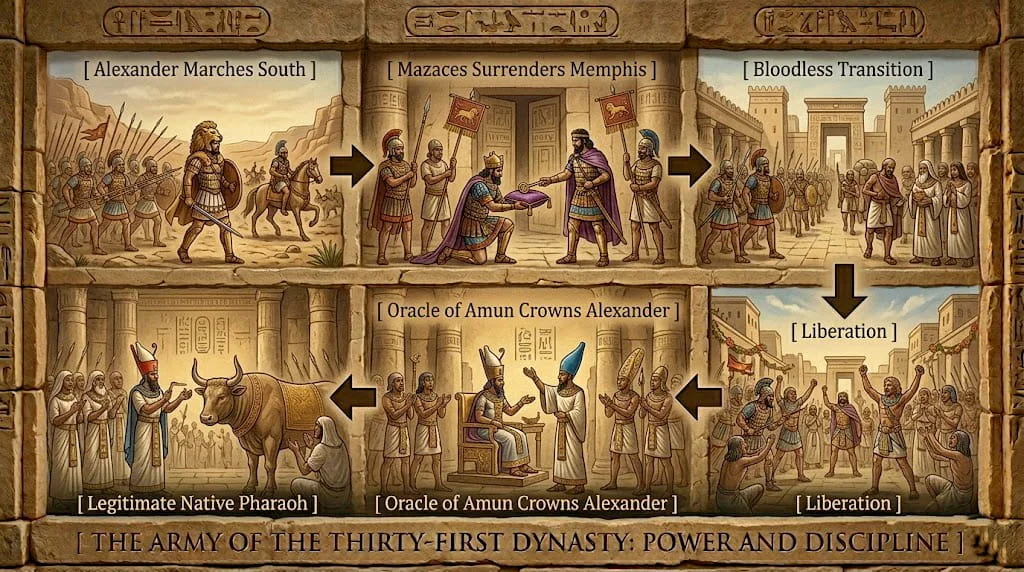
The rapid advance of Alexander the Great spelled immediate doom for the Achaemenid Empire. In 332 BCE, the Macedonian army marched down the Mediterranean coast toward the eastern gates of Egypt. The oppressive reign of the Thirty-first Dynasty of Egypt was about to face its ultimate trial.

Satrap Mazaces found himself in an impossible position. He possessed no fresh Persian reinforcements, and he knew the native Egyptians actively despised his administration.

The End of the Thirty-first Dynasty of Egypt

Instead of fighting a hopeless war, Mazaces chose to surrender. He opened the gates of Memphis and handed the treasury over to Alexander without shedding a single drop of blood. This peaceful handover officially ended the rule of the Thirty-first Dynasty of Egypt.

The Egyptian people did not view Alexander as a foreign conqueror. Instead, they celebrated his arrival as a divine liberation from Persian tyranny. Alexander carefully respected local traditions and rushed to worship the sacred Apis Bull—the very deity the Persians had desecrated. He then journeyed deep into the Western Desert to the Oracle of Amun at Siwa. There, the high priests declared Alexander the true son of Amun, restoring the sacred crown to a ruler who honored the ancient ways.

The eye of Horus

The Legacy of Egypt’s Shortest Dynasty

Thirty-first Dynasty of Egypt: The Legacy of Egypt’s Shortest Dynasty

The collapse of the Achaemenid administration in 332 BCE closed one of the darkest chapters in Nile history. Though it lasted just over a decade, the Thirty-first Dynasty of Egypt left a permanent scar on the cultural memory of the region. This brutal interlude fundamentally shifted how the local population interacted with outside forces.

The harsh rule of the Great Kings forever altered the political landscape. It broke the long tradition of native pharaonic isolation.

The Lasting Impact of the Thirty-first Dynasty of Egypt

The intense spiritual and financial oppression of this era created an unexpected historical turning point. Because the Thirty-first Dynasty of Egypt systematically attacked local religious cults, the desperate priesthood actively looked for outside allies. This trauma paved the way for the subsequent Ptolemaic Dynasty to flourish.

The early Greek pharaohs learned a critical lesson from the failures of the Persian satraps. Instead of crushing native traditions, the Ptolemies adopted Egyptian royal titles, rebuilt destroyed temples, and funded the powerful priesthood. By studying the short, turbulent reign of the Thirty-first Dynasty, we see how Persian tyranny indirectly triggered the birth of a vibrant, syncretic Greco-Egyptian golden age.

Divider

Day trip to Wadi el Hitan and Wadi el Rayan

We went on a full-day trip to Wadi el Hitan and Wadi el Rayan with Mohamed (Hamada). Mohamed was a wonderful guide, always making sure we had plenty of water and enough to eat, and providing us with information about the area and Egypt more generally. He also gave us

More »

Absolutely the best

We visited Cairo over a 15-hour layover. Egypt Fun Tours organized a customized and wonderful experience for us. We could not be happier. The day included a visit to all the great sites, the marketplace, dinner, a boat ride on the Nile, and a host of other special requests. I

More »

Pyramids in the Mist, Egypt Adventure

Our long drive from Cairo turned into a terrifying flight through Alexandria’s impossibly crowded streets. Our minivan miraculously avoided hitting pedestrians, donkey carts, and old Lada cars. We arrived at the port gates with only 10 minutes to spare. But the guards ignored our U.S. passports, and they refused to

More »
4 Days Egypt Experience for Solo Woman Egypt Fun Tours min 1

Amazing experience

My husband and I had a ten-hour layover in Cairo and luckily found Egypt Fun Tours while researching tour companies online. The owner, Hamada, picked us up from the airport and brought us around Cairo. He took us to see the pyramids, which was a memory I will never forget.

More »
God_Anubis_Icon

Top-rated Tour Packages

God_Anubis_Icon
WhatsApp
Email
Print