Hathor: The Ancient Egyptian Cow Goddess of Love, Joy, and Motherhood

Meet Hathor, the Golden Goddess who embodied the joy of life itself. This guide explores the many faces of the ancient Egyptian cow goddess, from the nurturing "Universal Mother" who suckled pharaohs to the terrifying "Lady of Drunkenness" who once nearly destroyed humanity. Discover the secret meaning behind her name ("The House of Horus"), her vibrant festivals of music and dance, and her magnificent cult center at Dendera, where she was worshipped as the Mistress of the Sky.

The Golden Goddess of Joy

To understand the Ancient Egyptian Cow Goddess Hathor, you must first understand the animal itself. In ancient Egypt, cows were not just livestock; they were vital. They provided daily necessities and were the sole source of several healthy foods, like milk. Therefore, what the animal provided brought physical joy, just as mothers provide pleasure and sustenance to their children.

Hathor embodies this connection. She is one of the oldest and most significant deities in the pantheon, archeologists having found her representations on the very earliest unearthed objects. While she is famous as the goddess of maternity, music, love, and joy, her nature is complex.

Traditionally, artists depicted her as a cow or a beautiful woman wearing a crown of two horns with a sun disc between them. However, she had many faces. Beyond the cow and the woman, the Egyptians also portrayed Hathor as a fierce lioness, a protective snake, and even a life-giving sycamore tree.

This guide explores the “Universal Mother” in all her forms: from the nurturing Hathor Goddess to the vengeful Eye of Ra, and finally to her enduring legacy at the Temple of Dendera.

Key Takeaways

  • Appearance: Woman with cow ears/horns and a sun disk, or a full cow.
  • Main Domains: Love, joy, music, dance, fertility, and the protector of women.
  • Key Myth: Her transformation into the Lady of Drunkenness (Sekhmet) during the Festival of Drunkenness.
  • Cult Center: The massive Dendera Temple was her primary seat of worship.
FUN

Origins, Name & Iconography: The “House of Horus”

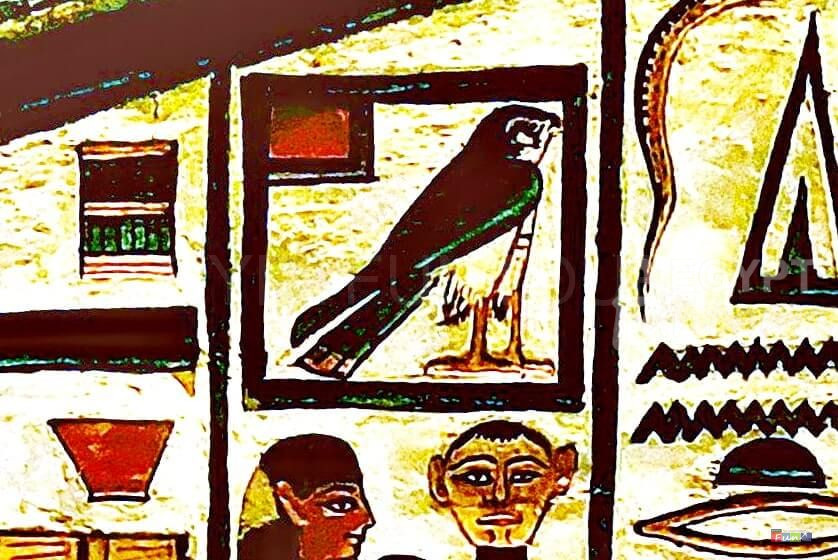
Goddess Hathor Name - Egypt Fun Tours

To truly know the Hathor Goddess, you must learn to read her name. In fact, her identity is hidden in plain sight within the ancient hieroglyphs.

Decoding Her Name

The name “Hathor” (Hwt-Hr) literally translates to “The House of Horus.” If you look at her hieroglyphic symbol, you will see a falcon (representing her husband, the god Horus) sitting inside a square enclosure (representing a house or walled estate).

This symbol offers a profound insight into the Egyptian view of marriage. It suggests two beautiful interpretations:

  1. The Home: A woman is the “dwelling” or sanctuary for her husband.
  2. The Protector: She is the “cage” or fortress that secures him, ensuring he is always safe and present. Regardless of how you interpret it, the symbol confirms that she is the eternal partner of Horus, appearing alongside him on the very oldest Egyptian artifacts.
FUN

Hathor’s Many Faces: Goddess of Heavenly Motherhood

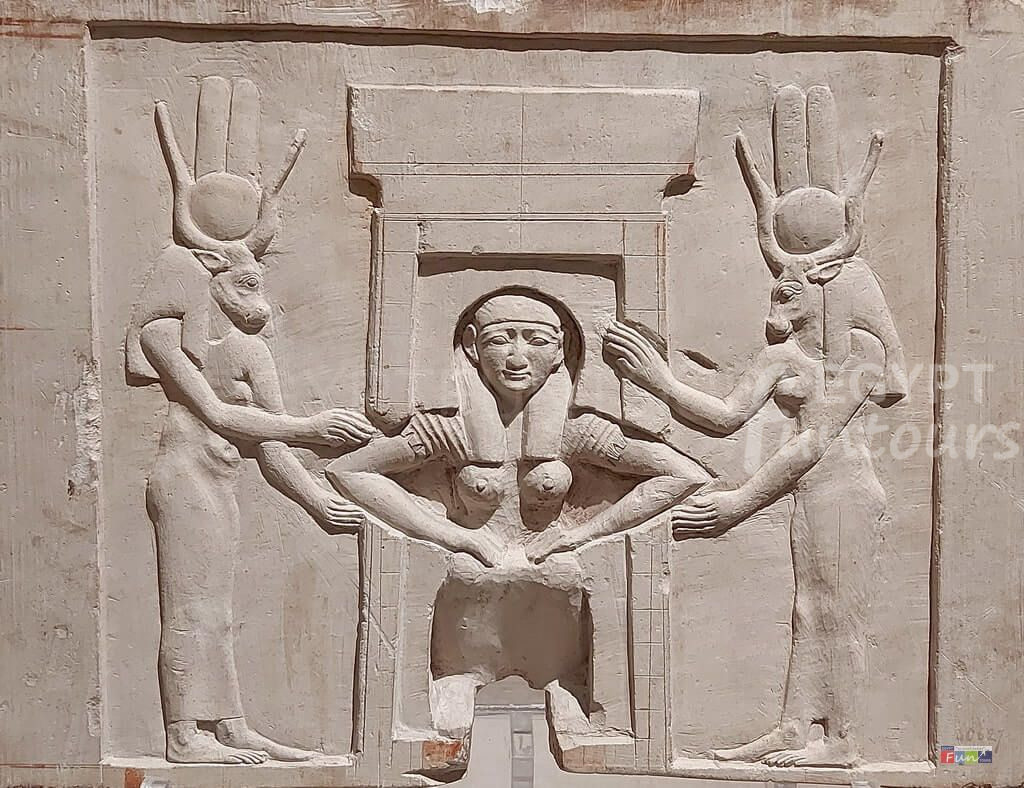
Hathor goddess of heavenly motherhood - Egypt Fun Tours

While she was a wife, Hathor was defined even more by her role as a mother. She served as the symbolic mother to every living pharaoh, who was seen as the “son of Hathor.”

The Universal Mother

Her maternal care extended beyond the king to all of humanity. Because she helped guide souls to the afterlife, she was considered a “universal mother.” Consequently, nearly every ancient Egyptian temple, regardless of which god it honored, contained a chapel dedicated to Hathor.

One unique and family-friendly way people worshipped her was by consuming milk. Artisans often depicted Hathor’s udders as “flowing with milk.” Drinking milk became a sacred act, honoring the goddess’s nourishment and the health benefits she provided to children and families.

Mistress of Music and Dance

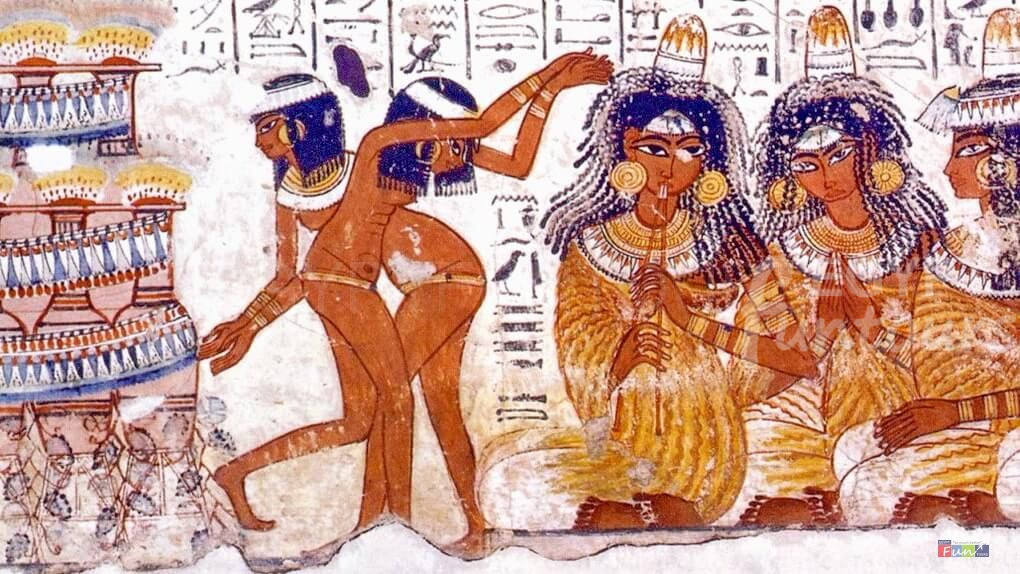
However, Hathor was not just a quiet, nurturing mother; she was the life of the party. She was known as the “Mistress of Music” and the “Lady of Dance.” Worship in her temples involved the shaking of the sistrum (a sacred rattle), dancing, and singing to appease and delight her.

The ancient “Hymn of the Seven Hathors” beautifully captures this joyous worship:

“We play the tambourine for your ka, Dance for your majesty, Exalt you To the height of heaven. You are the Mistress of Sekhem, the menat and the sistrum, The Mistress of Music For whose ka one lays. We praise your majesty every day From dusk until the Earth grows light, We rejoice in your countenance, O Mistress of Dendera. We praise you with song.”

Goddess Nut of Ancient Egypt

Goddess Nut of Ancient Egypt The Sky Goddess Nut stands as a magnificent and enduring...

Related post
FUN

The Fierce Aspect: The Eye of Ra and the Lady of Drunkenness

The Fierce Aspect; The Eye of Ra and the Lady of Drunkenness

While Hathor was the goddess of love, she possessed a terrifying dual nature. She was not only the gentle mother but also the Eye of Ra, the sun god’s violent protector. This aspect reveals that the Egyptians believed maternal love could turn into ferocious wrath when threatened.

From Gentle Cow to Roaring Lioness

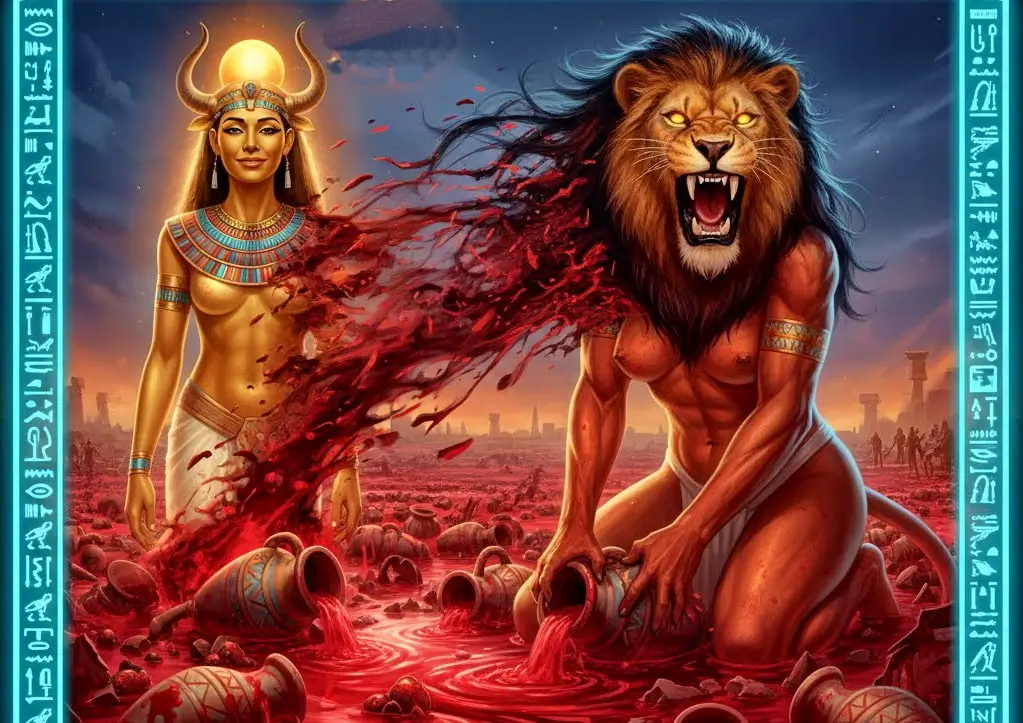
The most famous myth involving Hathor tells of a time when humanity rebelled against Ra. Enraged, Ra sent his “Eye” (Hathor) to punish them. Transforming from a gentle woman into the bloodthirsty lioness Sekhmet, she descended upon the land. She slaughtered humans with such ferocity that Ra feared she would wipe out all of human being.

To stop her, Ra devised a trick. He flooded the fields with thousands of jars of beer, dyed red with ochre to look like human blood. Sekhmet, thinking it was blood, drank it all. She became so intoxicated that she forgot her rage and transformed back into the beautiful, gentle Hathor.

The “Tekh Festival” (Festival of Drunkenness)

Hathor drunkenness goddess - Egypt Fun Tours

This myth gave rise to one of ancient Egypt’s most wild and unique celebrations: the Tekh Festival, or “Festival of Drunkenness.” During this annual event, ancient Egyptians celebrated how humanity survived the angry goddess. To honor her, participants would drink alcohol until they passed out, replicating the goddess’s stupor. The festival also included engaging in sexual acts to honor Hathor as the goddess of love and fertility.

Through these rituals, people toasted to the drink that saved the world. Hathor thus earned the epithet “The Lady of Drunkenness,” a title that celebrated the intoxicating power of both wine and love.

Goddess Sekhmet: The Complete Guide to the Lioness of War and Healing

Goddess Sekhmet is the most terrifying figure in the Ancient Egyptian pantheon. Depicted as a...
Related post
FUN

Cult Centers and Worship: The Grand Temple of Dendera

Ancient Egyptian Cow Goddess - Dendara Temple of Goddess Hathor - Egypt Fun Tours

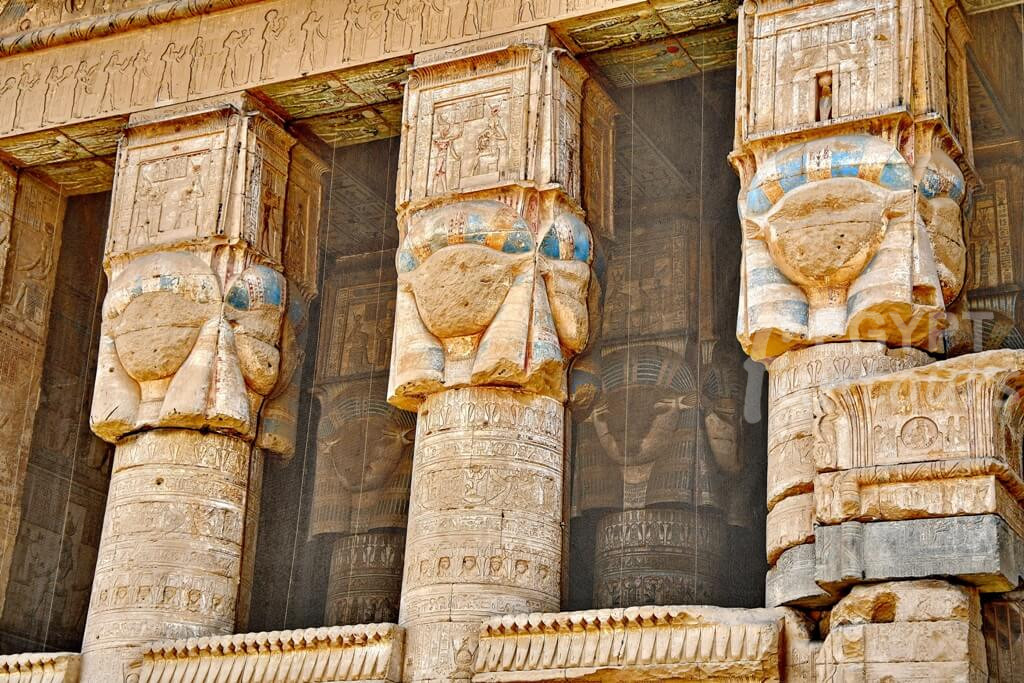
While Egyptians worshipped Hathor in every temple across the land, she had one true home. Located about 60 kilometers north of Luxor, the Temple of Dendera stands as her primary cult center and one of the best-preserved temples in all of Egypt.

A Masterpiece of Ptolemaic Art

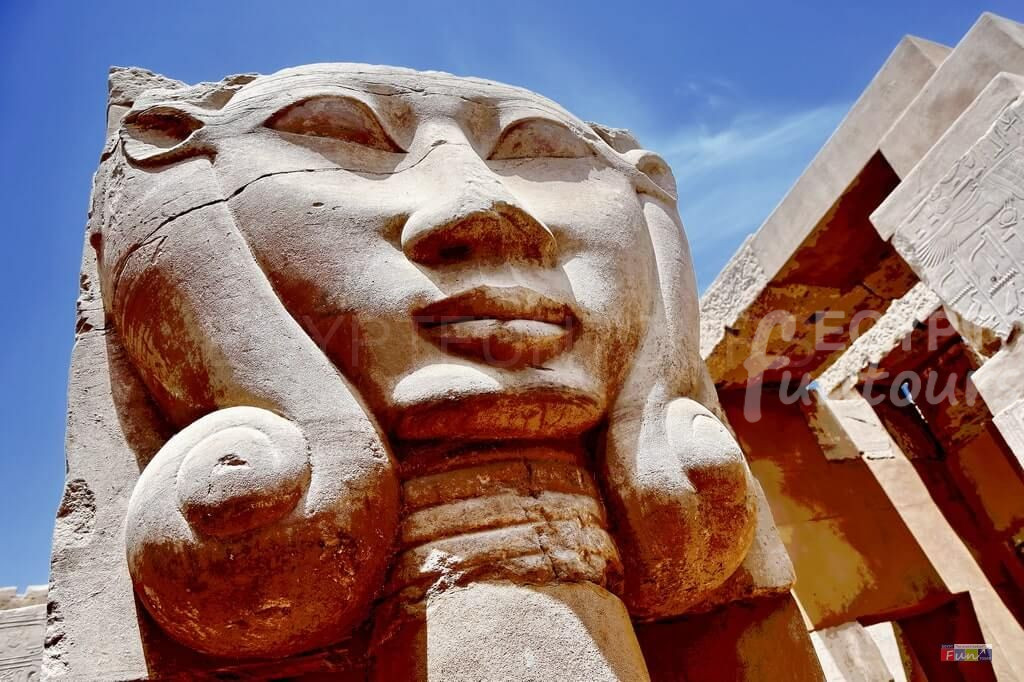
Builders constructed the current structure during the Ptolemaic and Roman periods, but it sits on extremely ancient sacred ground. When you enter the massive Hypostyle Hall, you are immediately struck by the architecture. Instead of the usual lotus or papyrus capitals, the 24 colossal columns are crowned with the “Hathoric capital”—a four-sided carving of the goddess’s face, depicted as a beautiful woman with cow’s ears.

A Center of Joy and Healing

Ancient Egyptian Cow Goddess - Hathoric Pillar - The Hymn of Seven Hathors - Egypt Fun Tours

Dendera was not a somber place. It was a center of music, celebration, and healing.

  • The Mammisi: The complex features a “Birth House” (Mammisi), celebrating the divine birth of her son, Ihy (a god of music).
  • The Roof: Uniquely, priests would carry the statue of Hathor up to the roof of the temple on New Year’s Day. There, in a special kiosk, she would be exposed to the rays of her father, the sun god Ra, to be “recharged” with solar energy for the coming year.

Today, the vibrant blue astronomical ceiling of Dendera (home to the famous Dendera Zodiac) remains one of the most spectacular sights in Egypt, a fitting tribute to the Mistress of the Sky.

Goddess Nephthys

The Egyptian Goddess Nephthys Goddess Nephthys, also known as Nebet-het in ancient Egypt, is a...

Related post
FUN

The Decline: Eclipse by Isis

The Decline; Eclipse by Isis

For millennia, the Hathor Goddess reigned supreme as the female archetype of the Egyptian pantheon. However, religion is not static. During the New Kingdom and especially into the Ptolemaic period, the spiritual landscape began to shift.

The Rise of Isis

Slowly but surely, the goddess Isis began to eclipse Hathor. Originally a distinct figure in the Osiris myth, Isis grew in popularity and power. She began to absorb many of Hathor’s primary attributes. Eventually, Isis took over the roles of the divine mother of Horus and the supreme queen of magic.

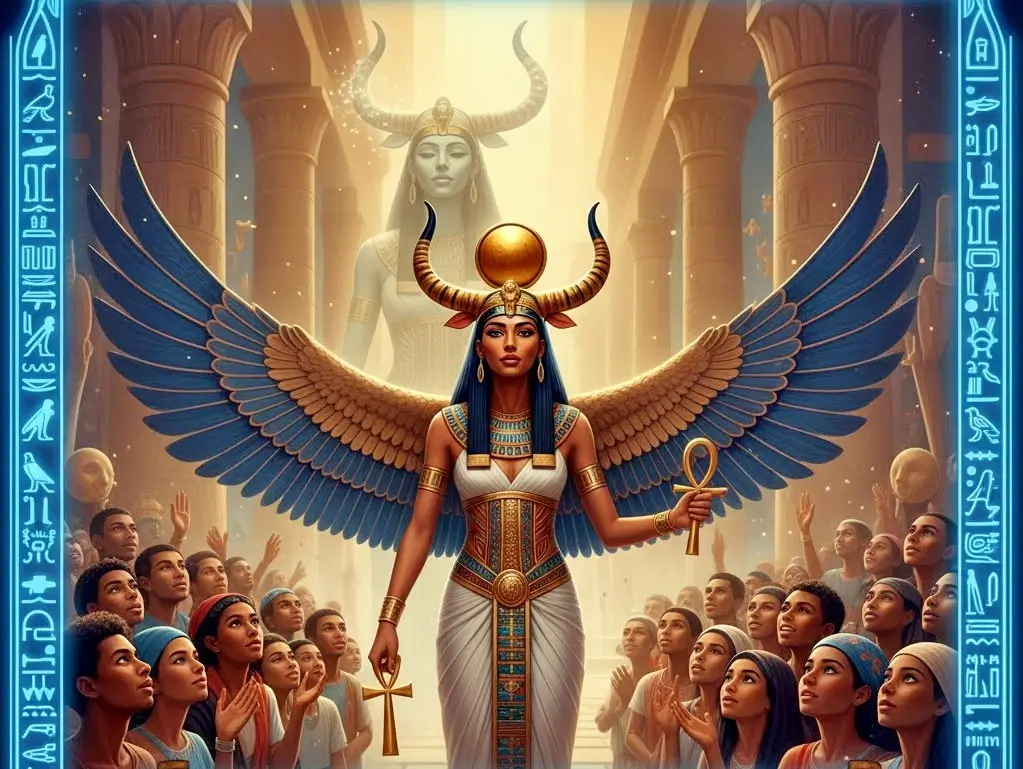
You can see this transition clearly in art. In later periods, artists depicted Isis wearing Hathor’s signature crown—the sun disk between cow horns. To the untrained eye, the two goddesses became almost indistinguishable.

An Enduring Reverence

Despite this theological shift, the common people never abandoned the Cow Goddess. Even as Isis dominated the royal theology, Hathor remained one of the most commonly revered deities in households across Egypt. Her promise of joy, music, and an afterlife filled with light held a grip on the Egyptian heart until the very end of the ancient religion.

Current weather in Egypt.

Explore Ancient Egypt: Cairo, Alexandria, and Wadi El Hitan Safari....
Embark on a special journey for 12 days UNESCO Tour...

Highly Recommend Egypt Fun Tours!

Several weeks ago, I reached out to Egypt Fun Tours regarding a 9-hour layover in Cairo. From the very beginning, Hani Ahmed was responsive and professional, quickly providing a well-organized itinerary tailored to our limited time. The itinerary included a visit to the pyramids, other historical sites, a delicious dinner,

More »

Outstanding layover tour

I had the opportunity to do a layover tour with Egypt Fun Tours this Friday, and it was amazing. I had a 10-hour layover tour in Cairo, and I was met by Mohamed on time at the airport. He picked me up in a clean, new, safe, and comfortable van.

More »
Egyptian western desert oases egypt fun tours

Jeep Safari in the Sahara

I contacted Hani two days before I went to Egypt and asked him if it was possible to combine two of their tours as we were short on time. We had planned to stay in Cairo but with the uprising we decided it would be safed outside of the hot

More »

Egypt Fun Tours makes the most out of your layover!

I had a really short layover in Cairo and didn’t want to be stuck in the Cairo Airport for several hours. It was like Mission Impossible: Egypt Fun Tours’ mission was to show me around Cairo during my short 5 hour layover which was made even shorter because my plane

More »
Isis with wings

Top-rated Tour Packages

Isis with wings