The Ultimate Guide to Daraw Camel Market: History, Logistics, and Tips

The Daraw Camel Market remains a vital cornerstone of Upper Egypt’s cultural and economic landscape. By bridging the ancient traditions of the Forty Days Road with the practical demands of modern Egyptian agriculture and commerce, it preserves a way of life that high-speed logistics cannot replace. For the visitor, the market offers more than just a glimpse of livestock trading; it provides a sensory journey into the heart of Saharan history and a rare look at the deep-rooted tribal bonds that still govern the desert. As a site where history, humanity, and trade converge, Daraw stands as an essential chapter in the story of the Nile Valley.

Daraw Camel Market: The Pulse of the Desert

The quiet town of Daraw sits on the banks of the Nile. It rests between Aswan and Kom Ombo. Here, the air carries a scent unchanged for centuries. You will smell dry hay, Nile silt, and the musk of desert animals. This is the Daraw Camel Market. It is the most visceral livestock exchange in the Middle East. This market does not cater to casual tourists. Instead, it serves as a living monument to an ancient economic system. This system still thrives today.

Daraw Camel Market: The Legacy of the Forty Days Road

For historians, Daraw represents the final stop of the Darb Al Arba’een. People know this legendary route as the “Forty Days Road.” This grueling path once spanned over a thousand miles. It crossed the inhospitable Sahara Desert. The route connected Sudan’s Darfur and Kordofan regions to the Nile Valley. Modern trucks now handle parts of the journey. However, the spirit of the trade remains fiercely traditional. Traders still measure a camel’s value with a keen eye. They judge the animal by its strength and its history.

Daraw Camel Market: A Crossroads of Culture

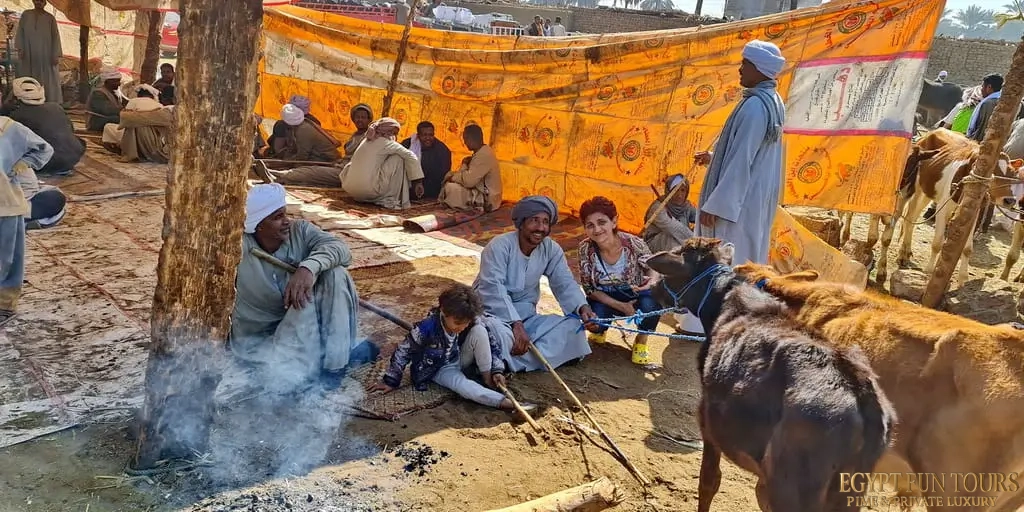
A Sunday dawn at the market reveals a masterclass in human interaction. You will hear the lowing of livestock. You will hear the rhythmic calls of auctioneers. The market acts as a cultural melting pot. Sudanese traders wear flowing white jalabeyas. They negotiate with local farmers and buyers from Cairo. These men carry the stories of the desert on their faces. Handshakes and glasses of hot tea seal every deal. Here, the “Ship of the Desert” remains the most valuable currency.

Daraw Camel Market: What This Guide Covers

This guide views the Daraw Camel Market as a cultural phenomenon. We will journey through its deep historical roots. We will also examine the logistics of moving animals across borders. Finally, we provide the practical insights you need to navigate this intense landscape. Travelers seeking the “real” Egypt will find Daraw unforgettable. It offers a raw experience far beyond the temple walls.

FUN

The Legacy of the Darb Al Arba’een: The “Forty Days Road”

The Legacy of the Darb Al Arba’een The Forty Days Road - Daraw Camel Market

To understand the Daraw Camel Market, one must first understand the invisible thread that connects it to the heart of Africa: the Darb Al Arba’een. Translated from Arabic as the “Forty Days Road,” this ancient caravan route is one of the oldest and most treacherous trade arteries in human history. For centuries, it served as the primary bridge between the Sultanate of Darfur in Sudan and the bustling markets of Middle and Upper Egypt.

The Geography of Endurance

The route stretches approximately 1,100 miles (1,800 kilometers) across some of the most unforgiving terrain on Earth. Historically, the journey began in Kobbei, north of El Fasher in Sudan, and wound its way through a series of essential oases, including Selima and Kharga, before terminating in the Nile Valley near Assiut or Daraw.

The name “Forty Days” was not a mere suggestion; it was a testament to the speed required to survive. A caravan that moved too slowly risked running out of water between the sparse desert wells. Conversely, moving too quickly could exhaust the livestock. The camels arriving in Daraw today are the descendants of those that survived this natural selection for generations—animals bred for unparalleled endurance and the ability to thrive on the meagerest of desert scrub.

Daraw Camel Market: A Multimodal History of Trade

While the Darb Al Arba’een is synonymous with camels, it was historically a highway for a vast array of goods. In the 18th and 19th centuries, caravans numbering as many as 12,000 camels would arrive in Egypt laden with:

  • Gold and Ivory: Sourced from the African interior.
  • Ostrich Feathers and Ebony: Highly prized by the Egyptian and European elite.
  • Medicinal Herbs and Natron: Essential for local industry and traditional healing.

However, the camel was always the primary “vehicle” of this trade. Unlike the horse or the donkey, the camel’s unique physiology—specifically its ability to store fat in its hump and minimize water loss—made the Darb Al Arba’een a viable economic route rather than a suicide mission.

The Transition to Modernity

Today, the “Forty Days Road” has evolved. While the geopolitical borders between Egypt and Sudan have become more regulated, the biological and economic necessity of the trade remains. In the modern era, particularly following the completion of the High Dam and the expansion of Lake Nasser, the route has shifted slightly.

Many camels now enter Egypt via Abu Simbel, where they undergo strict veterinary inspections and quarantine. From there, they are moved in massive convoys—sometimes on foot through the desert fringes, but increasingly in multi-tiered trucks—to reach the holding pens of Daraw. This shift from “hoof to horsepower” has shortened the transit time, but it hasn’t diminished the cultural significance of Daraw as the terminal point where the desert finally meets the Nile.

The Enduring Spirit of the Caravan

Despite the presence of GPS and modern transport, the men who lead these animals are the spiritual heirs to the caravan leaders of old. Known for their navigational prowess and their ability to read the desert stars, these traders bring with them a specific dialect, a unique style of dress, and a code of honor that has governed Saharan trade for a millennium. When you walk through the gates of the Daraw market, you are not just entering a place of business; you are entering the final chapter of a story that began in the age of the Sultans.

FUN

The Anatomy of the Trade: Breeds, Origins, and Uses

The Anatomy of the Trade Breeds, Origins, and Uses - Daraw Camel Market

The Daraw Camel Market is not merely a collection of animals; it is a specialized exchange where different breeds are valued for vastly different purposes. For the untrained eye, a camel is a camel. But for the traders of Daraw, every animal tells a story of its origin, its upbringing, and its ultimate destiny in the Egyptian economy.

Sudanese vs. Egyptian Specimens

While Egypt has its own camel populations, particularly in the Sinai and the Eastern Desert, approximately 90% of the animals in Daraw are Sudanese imports.

  • The Sudanese Dromedary: These are the “heavyweights” of the market. Often coming from the Kordofan and Darfur regions, they are known for their massive frames and incredible carrying capacity. Having survived the grueling journey through the desert, they arrive with diminished humps—their fat reserves used up—but their skeletal strength remains prized by Egyptian farmers.
  • Local Breeds: Smaller, leaner Egyptian camels are often present, though they are more likely to be used for local agricultural work or as breeding stock for specific regional needs.

The Hierarchy of Value

A camel’s price in Daraw—which can range from 35,000 to over 65,000 EGP for high-quality specimens—is determined by a rigorous visual inspection. Buyers look for specific traits:

  1. Age: The most desirable camels are between four and nine years old. Younger camels are viewed as an investment for growth, while those over ten are often destined for the meat market.
  2. Limb Strength: A buyer will often walk around the animal, checking for any signs of lameness or weakness in the joints, which is vital for animals intended for agricultural labor.
  3. Coat and Color: While most are various shades of tan or brown, rare pure white or deep black camels can command a significant premium, often used for prestige or specific ceremonial purposes.

The Triple Purpose: Labor, Meat, and Breeding

Unlike the racing camels of the Gulf, which are bred for speed and elegance, the camels in Daraw are functional.

  • Agricultural Labor: Many camels are bought by farmers from the Nile Delta. These animals are used to pull plows, transport heavy loads of sugarcane, and navigate fields where tractors cannot reach.
  • The Meat Industry: Camel meat is a lean, protein-rich staple in many parts of Egypt. A significant portion of the livestock sold in Daraw is eventually transported to the Birqash Camel Market near Cairo, which serves as the primary hub for the country’s meat supply.
  • Breeding: High-quality males (studs) are selected to maintain the vitality of Egyptian herds, ensuring that the next generation of “Ships of the Desert” remains hardy and resilient.

A Convergence of Cultures: The People of Daraw

A Convergence of Cultures The People of Daraw - Daraw Camel Market

The market is as much a human spectacle as it is an animal one. It serves as a meeting ground for diverse ethnic and tribal groups, each playing a distinct role in the ecosystem of the trade.

The Sudanese Cameleers

These are the men who have spent weeks in the desert. Often wearing the iconic white jalabeya and a distinctive turban, they represent the pastoral traditions of the South. They are the primary sellers, often managing herds that belong to wealthy tribal leaders in Sudan.

The Beshari and Ababda Families

Local to the desert regions between Aswan and the Red Sea, the Beshari and Ababda are the master navigators of the desert. In Daraw, they often act as intermediaries or “brokers.” Their knowledge of the terrain and their linguistic ability to speak both Arabic and local desert dialects make them indispensable in the negotiation process.

The Egyptian “Fellahin” and Urban Buyers

On the other side of the deal are the buyers. They arrive from all over Egypt—from the lush fields of Menoufia to the urban centers of Giza. You will see them moving through the dust with intensity, poking at humps and checking teeth, engaged in a verbal dance of bartering that can last for hours over a single animal.

Aswan Botanical Garden: A Peaceful Paradise on Kitchener’s Island

Escape to the Aswan Botanical Garden, a floating, green paradise on the historic Kitchener's Island....
Related post
FUN

Practical Planning: Navigating the Market

Practical Planning Navigating the Market

Visiting the Daraw Camel Market is a journey into the heart of Upper Egyptian commerce. Because it is a functional business hub rather than a curated tourist site, successful navigation requires careful timing and an understanding of local etiquette.

When to Visit: The Market Calendar

While Daraw is a bustling town throughout the week, the camel market operates on a specific rhythm. To see the maximum volume of livestock—often up to 2,000 animals—you must time your visit correctly.

  • Saturday & Sunday: These are the peak days for camel trading. Buyers and sellers arrive from across the country, and the energy is at its highest.
  • Tuesday: This is the general livestock and agricultural market. While you will still see camels, the focus shifts to cattle, sheep, goats, and local produce.
  • The Golden Hours: The market begins at dawn, around 6:00 AM. To witness the most intense bartering and avoid the blistering midday heat, aim to arrive no later than 8:30 AM. By noon, the majority of the deals are finalized, and the market begins to wind down.

Getting There from Aswan

Daraw is located approximately 40 kilometers north of Aswan. You have several options for the journey:

  1. Private Taxi: The most flexible option. A round-trip taxi from Aswan (including waiting time) typically costs between 600 and 900 EGP (approximately $12–$18 USD). This allows you to combine the market with a visit to the nearby Temple of Kom Ombo.
  2. Local Microbus: For a truly local experience, take a microbus from the Aswan bus station heading toward Kom Ombo. Ask the driver for “Souq al-Gimal” (the camel market). It is affordable (around 20-30 EGP) but requires some comfort with local transit.
  3. Train: Local “Spanish” or commuter trains stop at Daraw station. From the station, it is a short tuk-tuk ride to the market grounds.

The Visitor’s Code: Ethics and Etiquette

The Daraw market is a raw environment. To ensure a respectful and safe experience, keep the following in mind:

  • Dress Code: This is a conservative rural area. Men should wear long trousers and shirts (avoid shorts). Women are advised to wear loose-fitting clothing that covers the shoulders, chest, and knees. A lightweight scarf is a versatile accessory for both sun protection and modesty.
  • Photography: Most traders are proud of their animals and are happy to be photographed, but always ask first. A simple nod and the word “Moumkin?” (Is it possible?) is usually enough. Be prepared that some may ask for a small tip (baksheesh) in exchange for a posed photo.
  • Safety: The market is crowded, and camels are large, unpredictable animals. Stay alert, keep a respectful distance from the animals’ hind legs, and follow the lead of the traders.
  • The “Squeamish” Factor: This is a place of business and, ultimately, the food chain. You may see animals being handled roughly or branded. If you are sensitive to animal welfare, be prepared for the unsanitized reality of a traditional livestock market.

The Local Flavor: Beyond the Camels

Don’t leave without trying the local hospitality. Near the market entrance, small cafes serve Halfabar—a refreshing, deep-red hibiscus tea popular in Upper Egypt—or strong Sahidi coffee. It is the perfect place to sit for a moment and process the sensory overload of the market while watching the final deals of the morning conclude.

Exploring Gebel el-Silsila: Why This Hidden Nile Gem is a Must-Visit

Gebel el-Silsila was the essential sandstone quarry for Egypt's greatest New Kingdom temples. However, it...
Related post
FUN

The Enduring Pulse: The Camel’s Role in Modern Egypt

The Enduring Pulse The Camel’s Role in Modern Egypt

As the dust settles on another Sunday morning in Daraw, it becomes clear that this market is far more than a relic of the past. It is a vital artery of the modern Egyptian economy. While the world around it moves toward automation and digital commerce, the camel remains an irreplaceable asset in the agricultural and cultural landscape of the Nile Valley.

Daraw Camel Market: The Economic Ripple Effect

The transactions made in Daraw resonate far beyond Aswan’s borders. A single market day can see millions of Egyptian Pounds change hands, fueling a supply chain that supports:

  • Small-Scale Farmers: In the fertile lands of the Delta and Middle Egypt, the camel is often a more viable and repairable “machine” than a tractor for navigating narrow irrigation canals.
  • The Culinary Heritage: Camel meat remains a cornerstone of rural and traditional Egyptian cuisine. Leaner and more sustainable than beef, it is the secret behind the unique flavor of authentic Kofta and Basterma found in the butcher shops of Cairo and Giza.
  • Logistics & Transport: In the remote corners of the Eastern and Western Deserts, where paved roads end, the camel remains the only reliable means of transporting water, supplies, and people.

Daraw Camel Market: A Bridge Between Nations

Perhaps most importantly, Daraw serves as a peaceful point of contact between Egypt and Sudan. Here, geopolitical borders blur in favor of mutual economic benefit. Decades—sometimes centuries—of family-to-family relationships form the trust between Sudanese cameleers and Egyptian brokers. In an increasingly fractured world, the Daraw Camel Market stands as a testament to the power of traditional trade in maintaining regional stability.

Daraw Camel Market: Preserving the “Spirit of the South”

For the traveler, visiting Daraw is an exercise in perspective. It challenges the “postcard” version of Egypt, replacing sanitized monuments with the grit, sweat, and noise of real life. It reminds us that Pharaohs did not just write the history of Egypt in stone, but also by traders in the sand.

By visiting Daraw, you are supporting a way of life that values heritage as much as profit. Whether you come to photograph the light hitting the dust at dawn, to study the ancient routes of the Darb Al Arba’een, or simply to witness a deal sealed with a handshake, you leave with a deeper understanding of what keeps the heart of Upper Egypt beating.

Quick Reference for the Daraw Camel Market

Quick Reference for the Daraw Camel Market

To wrap up your journey, here are the essential takeaways for any visitor or researcher:

Feature Detail
Location Daraw, 40km North of Aswan (approx. 45-min drive

Aswan High Dam: The Colossal Dam That Changed Egypt Forever

Visit the Aswan High Dam, a colossal 20th-century marvel that forever tamed the Nile River....
Related post
FUN

The Ultimate Day Trip: Daraw Camel Market & Kom Ombo

The Ultimate Day Trip A Sample Itinerary for Daraw & Kom Ombo - Daraw Camel Market

For many travelers, the most efficient way to experience the Daraw Camel Market is to integrate it into a broader exploration of the Nile Valley. Because Daraw is located just a few kilometers south of the Temple of Kom Ombo, these two sites form a natural and contrasting pair: one representing the living traditions of the present, and the other the architectural majesty of the past.

The Timeline: A Morning of Contrast

  • 06:30 AM | Departure from Aswan: Leave your hotel in Aswan early. The drive north along the agricultural road offers beautiful views of the Nile at sunrise and the lush green fringes of the desert.
  • 07:30 AM | Arrival at Daraw Camel Market. Enter the market during its peak energy. Spend about 90 minutes to two hours wandering through the different sections.
    • Pro-Tip: Start at the camel pens to witness the early morning bartering, then move toward the cattle and sheep sections if you are visiting on a Tuesday.

  • 09:30 AM | The Local Café Break Find a small stall at the edge of the market for a glass of hot Sahidi tea or a cold hibiscus juice. This is the best time to review your photos and soak in the atmosphere as the traders begin to lead their purchased animals to waiting trucks.
  • 10:15 AM | Short Drive to Kom Ombo: A 15-minute drive north brings you to the Temple of Kom Ombo. This temple is unique in Egypt because it is a “double temple,” dedicated to both Sobek (the crocodile god) and Horus the Elder.
  • 11:45 AM | The Crocodile Museum Adjacent to the temple, visit the Crocodile Museum to see mummified remains of the Nile’s ancient apex predators—a fascinating parallel to the livestock you just witnessed in the modern market.
  • 12:30 PM | Riverside Lunch Enjoy lunch at one of the small restaurants overlooking the Nile near the temple entrance before heading back to Aswan or continuing north toward Edfu and Luxor.

Daraw Camel Market: Logistical Checklist for the Trip

  1. Transport: Hire a private car for the day. This allows you to leave your bags safely in the vehicle while you navigate the dusty market grounds.

  2. Cash is King: Neither the market nor the small cafes in Daraw accept cards. Ensure you have plenty of small-denomination Egyptian Pounds (EGP) for tips, tea, and local purchases.
  3. Sun Protection: By 10:00 AM, the sun in Upper Egypt is intense. Bring a hat, high-SPF sunscreen, and plenty of bottled water.
  4. Footwear: Wear closed-toe shoes. The market ground is a mixture of sand, hay, and animal waste; this is not the place for sandals or flip-flops.

Daraw Camel Market: Why it Remains Essential

In a world that is becoming increasingly homogenized, the Daraw Camel Market stands as a defiant reminder of Egypt’s enduring character. It is a place where the ancient “Forty Days Road” still finds its destination, and where the “Ship of the Desert” continues to be the backbone of a rural economy.

To visit Daraw is to step outside the polished corridors of five-star tourism and into the raw, unfiltered heart of the Nile Valley. It is an experience that challenges the senses, enriches historical understanding, and provides a profound respect for the men and animals who have navigated these desert paths for centuries. For the researcher, the photographer, or the curious traveler, Daraw is not just a market—it is a living archive of human resilience and trade.

This isn't just a vacation; it's a 15-day Archaeological Expedition Egypt. You'll trace the full arc of Egyptian history from the Old Kingdom to the...
Affordable holiday package of Cairo tours and accommodation included....
FUN
God_Anubis_Icon
Amazing Egypt Tours Vacations in December Egypt Fun Tours

Amazing trip with Egypt Fun Tours

We had the time of our lives on a trip to Egypt and the Bahariya/White Desert with Egypt Fun Tours, too. I would highly recommend this company. They are very familiar with organizing this trip, and this means they are well-connected in the desert area. This was invaluable to us

More »

Amazing tour to the pyramids of Sakkara and Dahshur

This week we had a great tour with Mohamed to the pyramids of Sakkara and Dahshur, as well as Memphis. He tailored the tour to our preferences, took a lot of time with us, and gave us detailed background information on everything. It was also great that he never tired

More »
9-day tour package - Egypt Fun Tours

You’re in “GREAT HANDS” with Egypt Fun Tours!

We first went to Egypt in July 2010. We were to pass through Cairo on our way to Africa, and we had arranged to be picked up from the Cairo airport and shown around the city during our 6-hour layover. This was arranged through emails with Hamada, of Egypt Fun

More »

Amazing Experience

Hamada was incredible! So knowledgeable and kind. He had information about every item, street corner, and relic we looked at. Any questions we had, he had answers! He even made sure to give us tips while walking through the crowds so that we would feel more comfortable when being approached

More »

Highly Recommend Egypt Fun Tours!

Several weeks ago, I reached out to Egypt Fun Tours regarding a 9-hour layover in Cairo. From the very beginning, Hani Ahmed was responsive and professional, quickly providing a well-organized itinerary tailored to our limited time. The itinerary included a visit to the pyramids, other historical sites, a delicious dinner,

More »
God_Anubis_Icon

Top-rated Tour Packages

God_Anubis_Icon