Atum: The Self-Created God Who Rose From Chaos (Creator of the Ennead)

God Atum is the central figure in the Heliopolitan creation myth, regarded as the ultimate self-created god and the source of all existence. Known as "The All-Risen One," Atum initially existed as a single entity in the dark, watery chaos (Nu) before creating the universe from his own being upon the primordial mound. This guide explores his role as the great primeval creator, detailing how he breathed life into the first divine couple, Shu (air) and Tefnut (moisture), thereby establishing the structure of the cosmos. You will discover his connection to the setting sun, his frequent depiction as a man wearing the Double Crown of Egypt, and his eternal significance as the one who governs both creation and its ultimate return to chaos.

God Atum: The All-Risen One

The Egyptian pantheon is built upon the story of creation, and at the absolute beginning stands God Atum. Known as the “All-Risen One” or “He Who Completes,” Atum is the primordial deity who created himself and, subsequently, the entire cosmos. While later gods like Amun and Osiris commanded greater popular devotion, Atum’s importance remains unparalleled: he is the source from which all other gods and, indeed, all existence flows.

Atum’s central role is defined by the Heliopolitan Creation Myth, which established the theological foundation for centuries of Egyptian rule. This guide will explore his origin in the dark waters of Nu, detail the incredible act of self-creation, and uncover his lasting significance as the father of the Ennead—the nine foundational gods who shaped the world. To understand the Egyptian view of order, life, and the sun, we must begin with God Atum, the first spark of consciousness in the void.

FUN

The Primordial Act: Rising from the Nu

From Nun to Ma’at; The Complete Guide to Ancient Egyptian Creation Myths

The creation myth of Heliopolis (Iunu), the ancient religious center dedicated to the sun, places Atum at the genesis of all things. His creation was not a miraculous external event, but a necessary, solitary act of self-will.

Existence in the Nun (Nu)

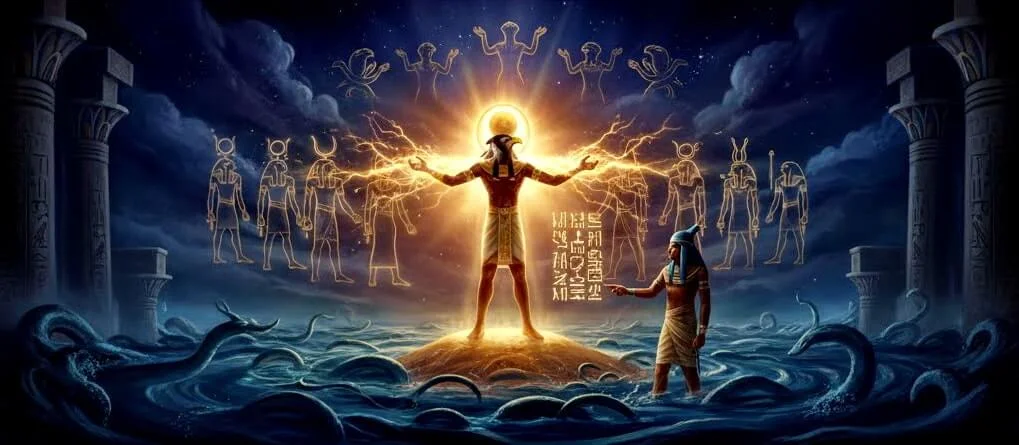
Before light, before land, and before time itself, there was only the boundless, dark, chaotic abyss known as Nu (or Nun)—the primordial waters. Within this limitless expanse, Atum existed as a dormant, single potentiality. He was the latent spirit of the cosmos, the consciousness waiting to be born.

The Egyptian texts describe this state with profound mystery:

“I am Atum, I am the only one… I am the great Soul, who was created in the primeval depths.” — Pyramid Texts

The Self-Creation and the Benben

Driven by the will to create, Atum made himself manifest. He separated himself from the watery chaos and rose onto the Benben, the first solid mound of earth that emerged from the receding waters. This Benben mound became the conceptual center of all temples and symbolized the beginning of ordered existence.

Atum’s act of self-creation was often depicted symbolically. He achieved this through a sheer act of will, but also sometimes through a physical, bisexual act:

  • Masturbation: Atum was believed to have generated the first pair of deities by ejaculating them into existence. This seemingly crude depiction underscores his absolute self-sufficiency and overwhelming, potent generative power.
  • Spitting: Alternatively, the texts state he spat out his children, a less visceral representation of his creative breath.

This dramatic emergence defined the transition from chaos to Ma’at (order) and established Atum as the creator ex nihilo (from nothing).

FUN

The Father of the Ennead: Establishing the Cosmos

Holy ennead of ancient egypt

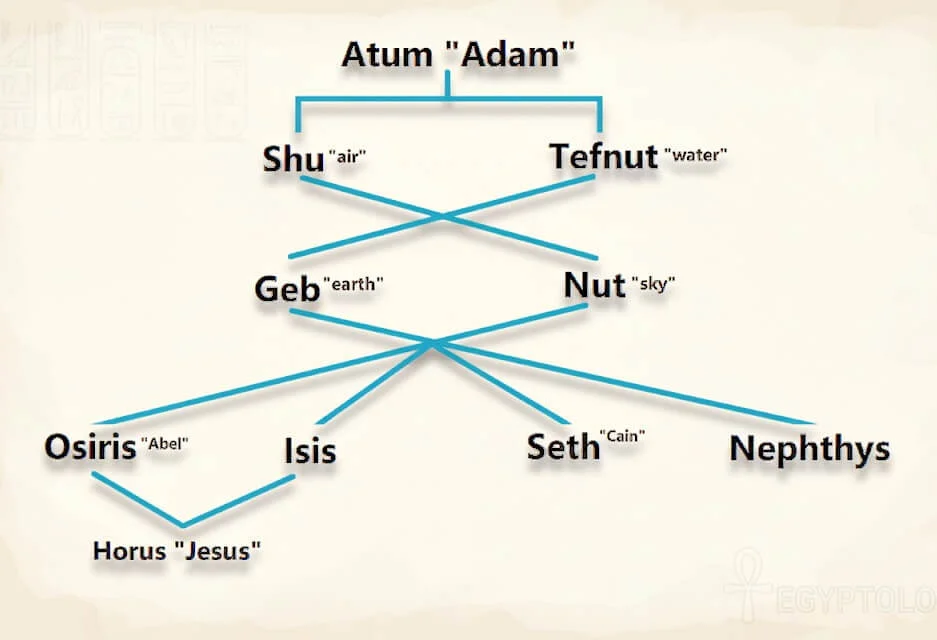
Having created himself and the foundational earth mound (Benben), Atum’s next task was to populate the universe and establish the fundamental elements of the cosmos. This act resulted in the Ennead—the grouping of nine major deities central to the Heliopolitan theology.

The First Generation: Shu and Tefnut

From his own substance (whether by spitting or generation), Atum created the first divine couple:

  1. Shu (Air): The god of air and space.
  2. Tefnut (Moisture): The goddess of moisture and water, distinct from the primordial waters of Nu.

This first separation was critical because it introduced the elements of life and space into the world. Shu and Tefnut created the atmosphere and humidity necessary for subsequent creation to occur.

The Second Generation: Earth and Sky

Shu and Tefnut, in turn, produced the next divine pair:

  1. Geb (Earth): The god of the earth.
  2. Nut (Sky): The goddess of the sky.

Geb and Nut were originally inseparable, lying in a continuous embrace. Atum, or Shu, separated them, with Shu holding Nut aloft from Geb. This separation created the world as the Egyptians knew it—the earth is Geb, and the arched sky is Nut, held apart by the air, Shu.

The Third Generation: The Mortal Cycle

Geb and Nut produced the final four gods of the Ennead, who govern the aspects of life, death, and conflict:

  1. Osiris: God of the afterlife, fertility, and resurrection.
  2. Isis: Goddess of magic, motherhood, and healing.
  3. Seth: God of chaos, storms, and the desert.
  4. Nephthys: Goddess associated with the dead and the protection of the home.

Through this carefully orchestrated chain of nine deities, Atum established everything. This chain included Atum, Shu, Tefnut, Geb, and Nut. It also included Osiris, Isis, Seth, and Nephthys. Atum established the gods and the elements. He defined the cycle of kingship, life, and death. This cycle defined Egyptian religion.

Egyptian Phoenix Bennu: Myth, Symbolism, and Legacy

Forget the fire. The original legend is even better. Meet the Bennu, the Egyptian Phoenix....
Related post
FUN

Iconography and Role: The Merging with Ra

Iconography and Role; The Merging with Ra

While Atum initiated the cosmos, his role was later modified and absorbed by the dominant solar theology. He retained his status as a creator but became inextricably linked to the sun god, Ra.

Atum’s Classic Depiction

Atum’s iconography is generally straightforward, reflecting his status as the foundational source of order:

  • The Man with the Double Crown: His most frequent depiction shows him as a dignified man, sometimes bearded, wearing the Double Crown of Egypt. This crown combined the white crown of Upper Egypt and the red crown of Lower Egypt. By wearing this unified symbol, Atum emphasized his control and mastery over the entire land from the moment of creation.

  • The Serpent (Later Period): In some later funerary texts, particularly those dealing with the end of time, Atum is depicted as a colossal serpent. This form represents his return to the primordial state.

The Syncretism with the Sun: Ra-Atum

The Egyptians synthesized Atum’s role with that of Ra, the omnipresent solar deity. This created the powerful composite god, Ra-Atum (or Atum-Ra). This syncretism explained the journey of the sun across the sky and reinforced Atum’s imperial status.

  • The Setting Sun: Ra was the morning sun, reborn each dawn. Atum, however, was associated with the setting sun—the moment the sun sank beneath the western horizon and entered the Duat (the underworld). This completed the solar cycle, as Ra-Atum began his nighttime journey through the underworld before his rebirth the next morning.

This linkage connected the pharaoh, the son of Ra, to Atum, reinforcing the king’s divine right and his role as the bringer of order and stability, thereby echoing Atum’s original act on the Benben mound.

Hathor, Sekhmet, and the Volatile Eye of Ra: Dual Power for Political Control

The pharaohs used the terrifying dual nature of the Volatile Eye of Ra as a...
Related post
FUN

Atum’s Unique Place: The End of Time

Luxor Museum Statuen Haremhab Atum 04

While Atum is revered as the god who ushered in order (Ma’at), his theological significance extends to the very end of time. Unlike other gods who maintain their roles indefinitely, Atum alone possesses the unique power to undo his own creation.

The Prophecy of Finality

The Egyptians believed that the cosmos existed within cycles, but they also conceived of a final, definitive end. The Book of the Dead (specifically Chapter 175) most clearly articulates this concept: there, the god declares his ultimate intention to dissolve creation.

“I shall destroy all that I made. This land will return to the Nun, to the flood, as it was in its first state. I am the sole survivor… I shall become a serpent.”

This apocalyptic prophecy emphasizes Atum’s immense power. He is the self-created origin point who will return the world to its original state of chaotic water. The universe will cease to exist, and Atum will revert to the form of a solitary serpent floating in the primordial dark.

The Symbol of the Serpent

This final form—the serpent—contrasts sharply with his regal human depiction. The serpent symbolized both renewal and primeval existence. By reverting to the serpent in the waters of Nu, Atum completes the cycle of existence, underscoring that creation is fundamentally dependent upon him for its existence and its continuation. He holds the absolute power of creation and uncreation.

Geb: The Ancient Egyptian God of Earth, Fertility, and the Pharaoh’s Throne

God Geb is the Ancient Egyptian deity of the Earth, who, along with his sister-wife...
Related post
FUN

The Enduring Authority of Atum

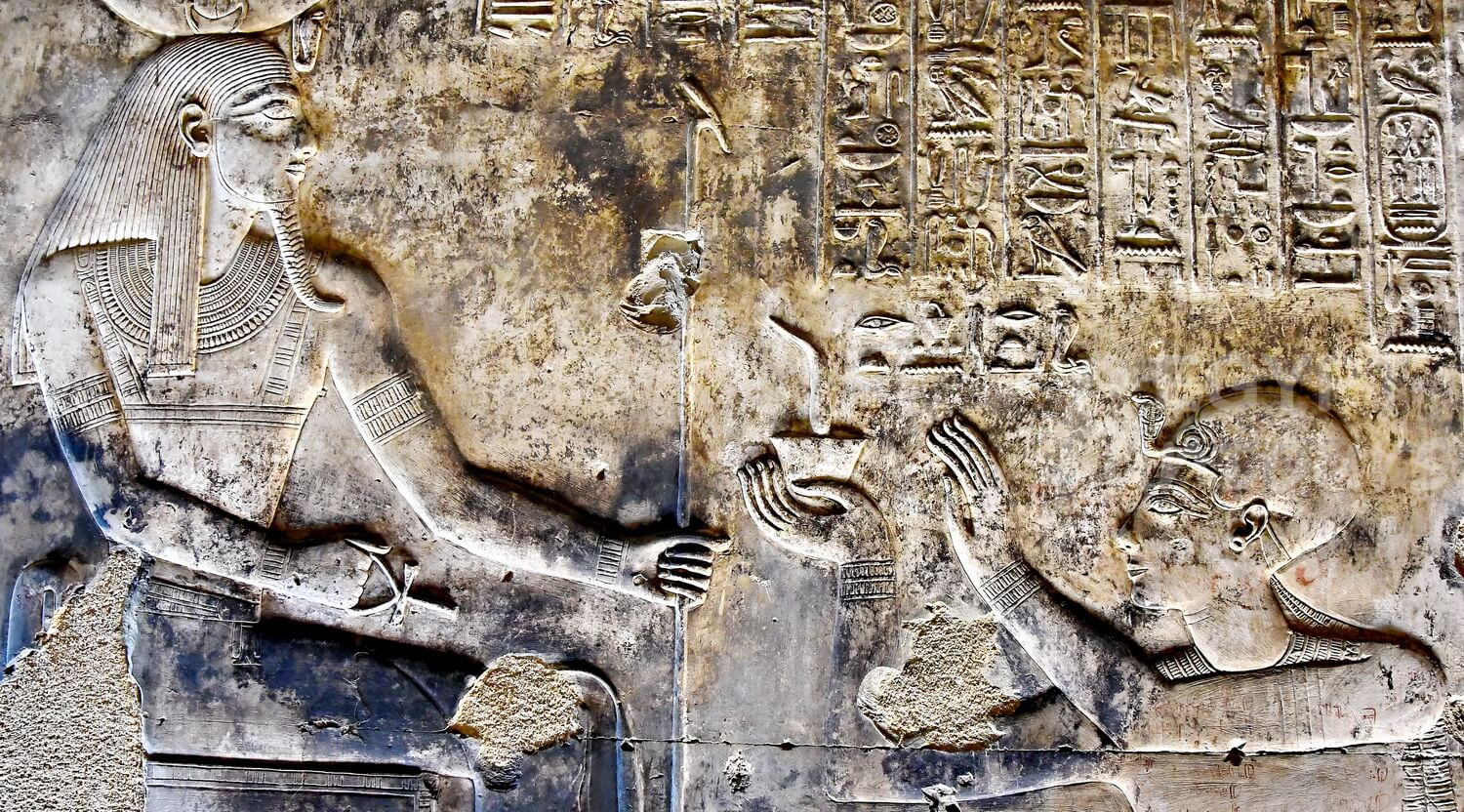
king ramses with god atum

God Atum truly stands as the silent authority of Egyptian theology. He is the solitary force who willed consciousness from the void, established the nine gods of the Ennead—the foundation of all life—and presided over the setting sun as Ra-Atum. Though the Egyptians dedicated the massive temples of Karnak to Amun, the philosophical foundation of their religion rests on Atum’s singular act of self-creation upon the primordial mound. He is the ultimate beginning and the ultimate end.

Current weather in Egypt

Explore the charming wonders of ancient and modern Egypt....
Explore the wonders of Egypt in this classic tour package...

2 week group private tour – Egypt and Jordan

Our US-based agency takes small groups of experienced travelers to the most beautiful and exotic places in the world. In Dec ’19 – Jan ’20, we used the services of Egypt Fun Tours to plan, organize, and conduct an amazing trip to Cairo, Giza, Saqqara, Luxor, and Aswan. The New

More »

Islamic cairo and khan el khalili- great tour

Wonderful tour with the guide Hamada. I did not feel rushed at all. He explained a lot of facts about the city, the mosque, the water storage room, and also brought me to no-hassle shops. He picked a great place to eat and have Turkish coffee and a cold lemon

More »
13-day Egypt guided tour package - Egypt Fun Tours

Easily the best two days of the year!

We were doing the 14-day Mediterranean cruise and were in Egypt for two days. I was searching the internet for about 4 days and finally found Egypt Fun Tours as my guide in Egypt. It ended up being the best 2 days of the entire cruise trip. Since this is

More »

Transit Stopover in Cairo

We have just returned from a two week holiday in Cape Town. On the way out our airline schedule meant that we had a 15 hour stop in Cairo. We decided to arrange a tour of the city and after asking for quotes/itineraries we chose Egypt Fun Tours. This worked

More »

7 night Egypt Experience Cairo, Aswan, Luxor

Trip of a lifetime!! COVID SAFE!! Knowledgeable guide who loves to share the magic of Egypt with tourists. Friendly and accommodating. This company goes to the extreme to make clients feel welcome and help them. A family company that takes good care of its support staff. Must book the 7-night

More »
Isis with wings

Top-rated Tour Packages

Isis with wings