The Legend of the Shipwrecked Sailor: Ancient Egypt’s First Great Masterpiece

The Legend of the Shipwrecked Sailor is a Middle Kingdom masterpiece that follows a lone survivor cast upon the mythical Island of the Ka after a catastrophic storm destroys his ship and crew. In this lush, liminal paradise, the sailor encounters a colossal, benevolent serpent with golden scales and lapis lazuli eyebrows who, instead of harming him, offers divine wisdom and comfort by sharing his own tragic history of loss. The story serves as a profound meditation on resilience and the power of eloquence, concluding with the serpent's prophecy of the sailor’s safe return to Egypt before the magical island vanishes forever beneath the waves.

The Legend of the Shipwrecked Sailor is a profound work of fiction from Ancient Egypt’s Middle Kingdom. It is preserved on a single papyrus (Papyrus Leningrad 1115) and serves as a masterclass in “story-within-a-story” narration. Unlike the terrifying Apophis, the serpent in this tale is a figure of wisdom, divinity, and surprising empathy.

The story begins with a high-ranking official returning from a failed mission. He is despondent, fearing the Pharaoh’s wrath. To comfort him, his attendant—the sailor—tells a story of his own past disaster. He aims to prove that even the most hopeless shipwreck can lead to divine grace and a triumphant homecoming.

In this guide, you will discover the secrets of the “Island of the Ka,” the identity of the Golden Serpent, and the enduring lessons of this 4,000-year-old adventure.

FUN

The Survival: Shipwreck on the Island of the Ka

The Survival Shipwreck on the Island of the Ka

The sailor’s story begins with a voyage to the royal mines. He is part of a crew of 120 elite sailors. They are brave and experienced, yet they cannot foresee the “perfect storm” that awaits them.

The Storm and the Wreck

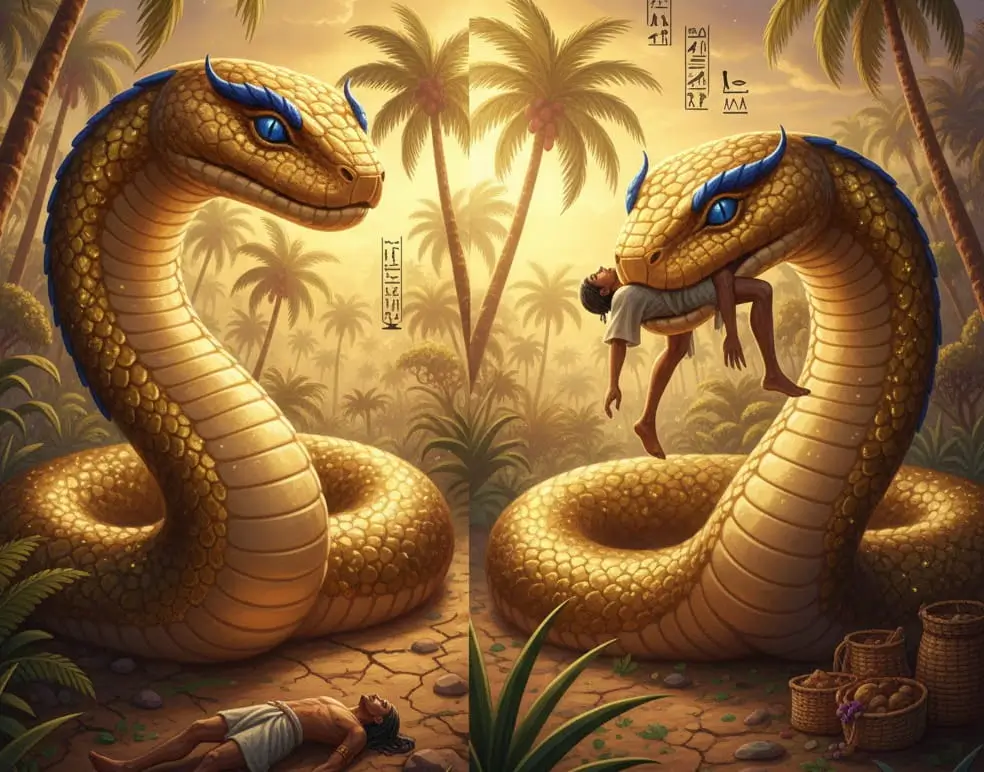
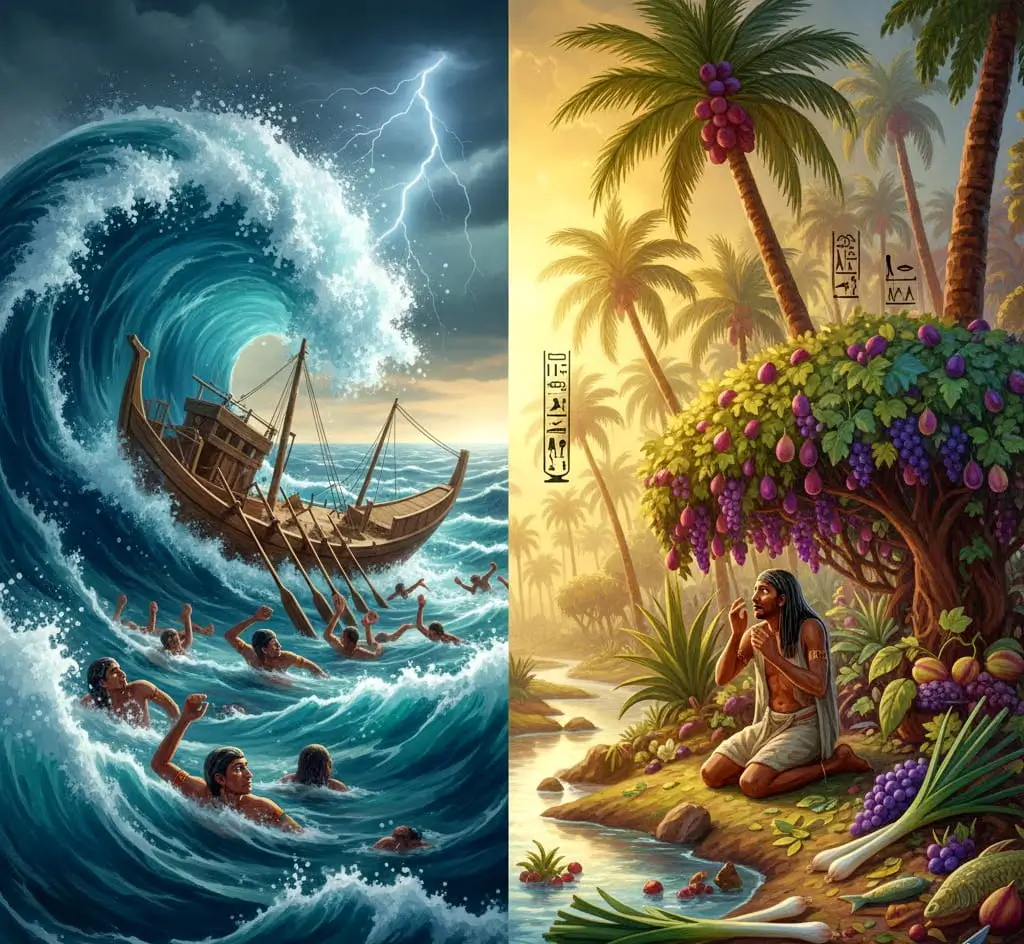
A massive wave, eight cubits high, strikes the ship. The vessel is shattered, and every man on board perishes—except for the narrator. He is cast onto the shores of a mysterious island. For three days, he remains in a state of shock, sheltered by the “shade of a thicket.”

A Land of Plenty

When the sailor finally explores the island, he discovers a paradise. He finds figs, grapes, leeks, berries, and fish. It is a place of infinite abundance. The sailor realizes he has landed on the Island of the Ka (Pa-ka). In Egyptian thought, the Ka is the life force. Therefore, this is not a physical land, but a liminal space between the world of the living and the divine.

FUN

The Encounter: The Giant Serpent of Sais

The Encounter The Giant Serpent of Sais

The peace of the island is suddenly shattered by a sound like thunder. The trees tremble, and the earth shakes. Out of the forest emerges the island’s ruler: a giant serpent.

Description of the Serpent

This creature is the antithesis of the chaotic Apophis. The sailor describes him in vivid detail:

  • Size: He is thirty cubits long (approx. 45 feet).
  • Appearance: His body is overlaid with gold, and his eyebrows are made of real lapis lazuli.
  • Nature: He is regal, divine, and speaks with the authority of a king.

The Serpent’s Compassion

The serpent demands to know who brought the sailor to his island. Terrified, the sailor faints. However, rather than devouring him, the serpent carries the sailor in his mouth to his resting place. He reassures the man, telling him: “Fear not, little one… God has protected your life and brought you to this Island of the Ka.”

Ma’at: Harmony, Order, and Cosmic Balance in Ancient Egypt

To stand amidst the wonders of Egypt is to encounter an entire civilization rooted in...
Related post
FUN

The Prophecy and the History of the Island

The Prophecy and the History of the Island

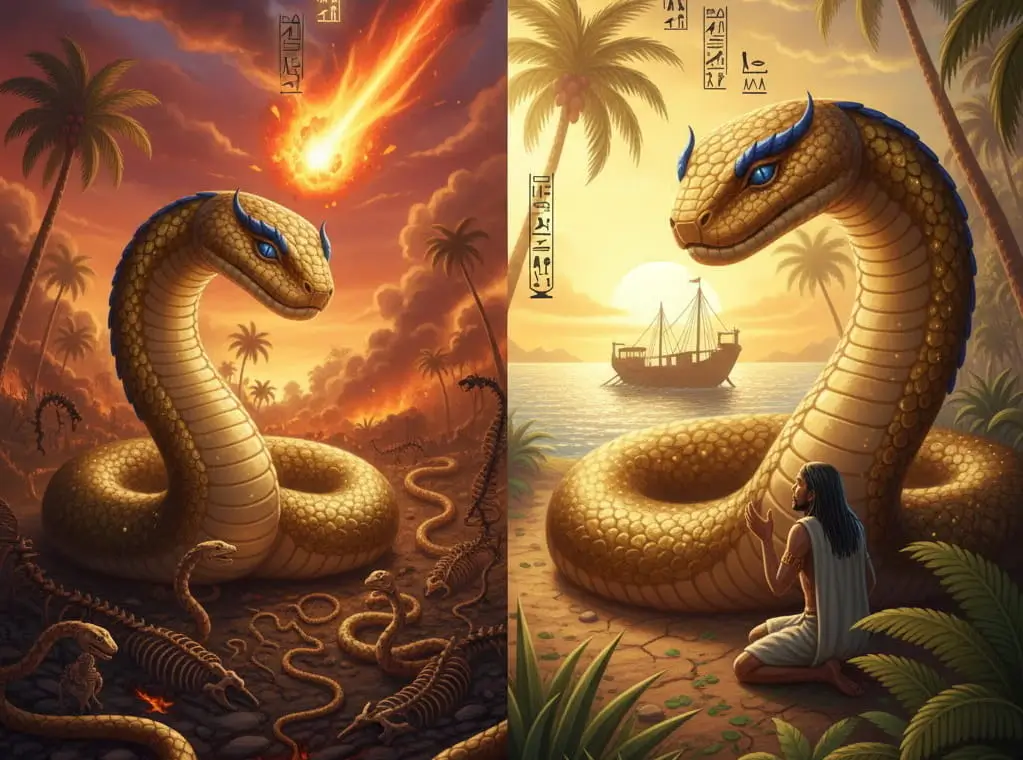
The serpent shares his own tragic history to comfort the sailor. He reveals that he once lived on the island with 75 of his kinsmen and a young daughter. One day, a “star fell from the sky,” and a fire consumed everyone he loved. He was the sole survivor.

The Message of Resilience

By sharing his grief, the serpent teaches the sailor a vital lesson: Suffering is universal, but endurance is a choice. He prophesies that in four months, a ship from Egypt will arrive. The sailor will return home, embrace his children, and “rest in his tomb.”

Horus vs Seth: The Epic 80-Year Battle for the Throne of Egypt

The Horus vs Seth saga represents the ultimate legal and cosmic struggle of Ancient Egypt,...
Related post
FUN

The Departure and the Moral of the Tale

True to the prophecy, a ship arrives. Before the sailor leaves, the serpent loads his boat with precious gifts: myrrh, incense, elephant tusks, greyhounds, and baboons.

The Serpent’s Final Secret

As the sailor prepares to leave, he promises to build temples in the serpent’s honor. The serpent laughs. He reveals that he is the Lord of Punt, the legendary land of incense. He tells the sailor that once he leaves, the island will vanish beneath the waves, never to be seen again. It was a temporary sanctuary, a divine intervention meant only for him.

The Conclusion of the Frame Story

The sailor finishes his tale, hoping to cheer up his master. However, the master remains cynical. He famously replies: “Do not play the part of the clever man, my friend. Who gives water to a bird at dawn when it is to be slaughtered in the morning?” This dark, realistic ending suggests that while the sailor found grace in his miracle, the harsh reality of the Pharaoh’s court remains unchanged.

Goddess Meret: Egyptian Goddess of Music, Joy, and the Nile’s Rhythm

Meret (meaning "the beloved") is the ancient Egyptian goddess who embodies the vibrant spirit of...
Related post
FUN

Why This Legend Matters

The Legend of the Shipwrecked Sailor is more than just an adventure. It represents several key Egyptian values:

  1. Eloquence: The ability to speak well was a sign of a noble soul.
  2. Divine Providence: The belief that “God” (the divine force) intervenes in the lives of the humble.
  3. The Mystery of the Serpent: It shows that serpents in Egypt were not always evil; they could be protectors and teachers of wisdom.

FAQs: The Shipwrecked Sailor

1. What is the main theme of The Legend of the Shipwrecked Sailor?

The primary themes are resilience, the power of eloquence, and divine providence. The story serves as a moral lesson: no matter how dire a situation seems, “heka” (magic) and a “steady heart” can lead to a triumphant return. It also emphasizes that a person’s ability to tell their story well is a mark of their character and worth.

2. When was The Legend of the Shipwrecked Sailor written?

Scribes composed this story during the Middle Kingdom of Egypt, specifically during the 12th Dynasty (approximately 2000–1700 BC). It utilizes Middle Egyptian, the “classical” stage of the language reserved for high-quality literary masterpieces.

3. Is the serpent in this story the same as Apophis?

No. While both are giant serpents, they represent opposite forces. Apophis is the embodiment of Isfet (chaos) and seeks to destroy the world. The serpent on the Island of the Ka is a benevolent, divine being who represents the Lord of Punt. He is a protector and a source of wisdom, proving that serpents in Egyptian mythology could be symbols of royalty and divinity as well as danger.

4. What is the “Island of the Ka”?

The Island of the Ka (Pa-ka) is a mythical, liminal space. In Ancient Egyptian belief, the Ka is the vital life force of a human or god. The island is a “spirit land” filled with abundance that cannot be found in the physical world. Its disappearance at the end of the story suggests it was a temporary manifestation of the divine.

5. Where is the original manuscript located?

The only surviving copy of the story is the Papyrus Leningrad 1115. It was discovered in the late 19th century and is currently housed in the State Hermitage Museum in St. Petersburg, Russia.

6. Why does the story end on a sad note?

The “frame story” ends with the master rejecting the sailor’s comfort. This reflects the Egyptian literary tradition of realism. While the sailor experienced a miracle, the master faced the very real political danger of the Pharaoh’s court. It serves as a reminder to the reader that divine grace does not always exempt one from the harsh realities of life.

Explore the Pyramids, Abu Simbel, and more....
Make every moment count. A trip to remember....
Amazing Egypt Tours Vacations in December Egypt Fun Tours

Amazing trip with Egypt Fun Tours

We had the time of our lives on a trip to Egypt and the Bahariya/White Desert with Egypt Fun Tours, too. I would highly recommend this company. They are very familiar with organizing this trip, and this means they are well-connected in the desert area. This was invaluable to us

More »
6 Days Elegence of Egypt Group Tour - Cairo and nile cruise affordable tour

Superbly organized

I can’t recommend them enough. I got into Cairo on a 12-hour layover at 2:00 AM. By 3:15 Hani and his driver were meeting me at the airport. For the next five hours we strolled through lovely downtown Cairo & over the Nile, wandered through (friendly, well-organized) Tahrir Square, toured

More »
Memnon colossi of king amenophis III 4 min

Book with them, they are Professionals

It has always been my dream to visit Egypt. This was a beautiful tour, almost two years later, I can’t stop thinking about my time in Egypt, Valley of the Kings, Temple of Kom Ombo, Edfu, Luxor! I was able to add an eighth day to see Abu Simbel (a

More »

Amazing Experience

Hamada was incredible! So knowledgeable and kind. He had information about every item, street corner, and relic we looked at. Any questions we had, he had answers! He even made sure to give us tips while walking through the crowds so that we would feel more comfortable when being approached

More »
Isis with wings

Top-rated Tour Packages

Isis with wings