Offerings in Ancient Egypt: The Sacred Art of Sustaining the Divine

Discover the sacred art of giving in ancient Egypt, where offerings were the literal fuel for the afterlife. This guide explores the vital practice of presenting bread, beer, incense, and Ma’at to the gods and the deceased. Learn how these rituals maintained cosmic order, fed the Ka (soul) for eternity, and transformed simple food into divine sustenance through the power of the "Voice Offering."

Fuel for the Cosmos: Why Offerings Mattered

In the ancient Egyptian mind, the gods were not self-sufficient. They believed the universe was a fragile machine that required constant maintenance. If humans stopped feeding the gods, the sun might not rise, the Nile might not flood, and chaos would swallow the world.

This concept is Do ut des (“I give so that you may give”). Offerings were not simply gifts; they were a transaction to maintain Ma’at (cosmic order). This guide explores the complex system of Ancient Egyptian Offerings, from the daily bread given to Amun to the magical “Voice Offerings” carved on tomb walls that fed the dead forever.

Key Takeaways

  • The Purpose: Offerings maintained Ma’at and fed the Ka (spirit).
  • The “Reversion”: Food was not wasted; after the god “consumed” the essence, priests and staff ate the physical food.
  • The Magic: Spells like the “Voice Offering” could turn written words into food for the afterlife.
  • Key Items: Bread, beer, oxen, geese, incense, and the ultimate offering: Ma’at itself.

Here are the next sections of your pillar page, Part 3 and Part 4, which explore the logistics and specific items of the offering rituals.

FUN

Divine Leftovers: The “Reversion of Offerings”

offerings in ancient Egypt

You might wonder: if the Egyptians offered thousands of loaves of bread and jars of beer to the gods every day, did all that food just go to waste? The answer is a resounding no.

The ancient Egyptians were incredibly practical. They developed a system known as the “Reversion of Offerings” (Wahn-Ikh). This theological loophole sustained the entire temple economy.

How It Worked

First, the high priest placed the food before the god’s statue in the inner sanctuary. Once the god had spiritually “consumed” the essence of the meal, the food became “reverted.” Priests then removed it from the altar and offered it a second time to the statues of deceased kings or nobles.

Finally, after serving the spiritual realm, the temple distributed the physical food to the staff—priests, scribes, doorkeepers, and artisans—as their daily wages. In this way, ancient Egyptian offerings served a dual purpose: they satisfied the gods and fed the living workforce.

FUN

Bread, Beer, and Truth: The Nature of Offerings

Bread, Beer, and Truth; What Was Offered

The offering lists found on temple walls are vast, but they generally fall into specific categories. The standard menu for a god or a deceased soul was extensive.

The Staples: Bread and Beer

The foundation of every offering was bread and beer. These were the caloric staples of the Egyptian diet. Texts often recite the formula: “A thousand of bread, a thousand of beer.” Different types of loaves (some conical, some round) and various strengths of beer were prepared daily in massive temple bakeries and breweries.

Luxury and Sensory Items

Livestock offerings in ancient Egypt

Beyond the basics, the elite and the gods received:

  • Meat: Oxen, geese, and ducks were slaughtered for special festivals.
  • Drinks: Wine and milk.
  • Scent: Incense was crucial. Egyptians believed the smoke carried the offering up to the nostrils of the gods, purifying the air and creating a divine atmosphere.

The Ultimate Offering: Ma’at

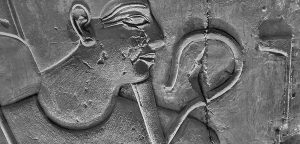
However, the most important offering wasn’t food at all. In temple reliefs, you will often see the Pharaoh holding out a tiny statue of a crouching woman with a feather on her head. This is Ma’at—the goddess of Truth, Justice, and Order.

By offering Ma’at to the gods, the Pharaoh was saying, “I have maintained order in your world.” The gods fed on Ma’at just as they fed on bread; it was the spiritual sustenance that kept chaos at bay.

Ancient Egyptian Economy

The existence of the Nile River, which was one of the factors of the ancient...

Related post
FUN

Feeding the Ancestors: Offerings to the Dead

Feeding the Ancestors; Offerings to the Dead

While the gods received offerings in temples, the ancient Egyptian offerings made to deceased family members were equally vital. The survival of a loved one’s soul depended entirely on the memory and generosity of the living.

The False Door

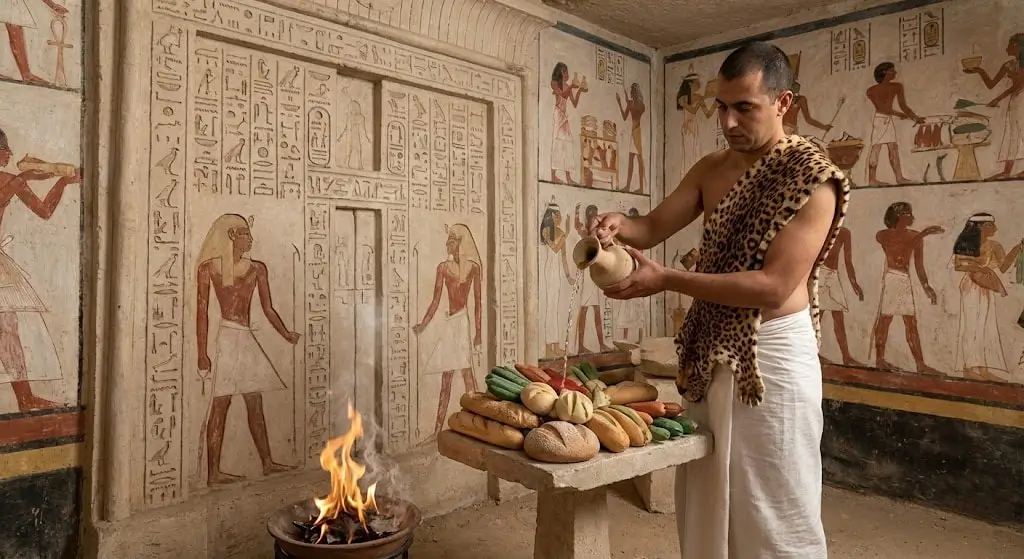
The focal point of any tomb chapel was the False Door. This was a stone niche carved to look like a door, but solid. Egyptians believed it was a magical portal between the worlds. The Ka of the deceased could pass through the solid stone from the burial chamber to the chapel to receive food, then return.

The Offering Table and the Ka-Priest

In front of the False Door stood the Offering Table. This stone slab was often carved in the shape of the hetep symbol (meaning “offering” or “peace”) and depicted loaves of bread. Family members would place real food here on feast days.

However, families knew they wouldn’t live forever. To ensure the offerings continued, they hired a Ka-priest (often funded by an endowment of land). His sole job was to visit the tomb daily, pour water, and recite the necessary spells to keep the soul alive for eternity.

Memphis Open Air Museum: Guide to the Colossus and Ruins of Mit Rahina

The Memphis Open Air Museum (Mit Rahina) is a small but essential stop on any...
Related post
FUN

Magic Substitutes: The “Voice Offering”

Magic Substitutes; The Voice Offering

What happened if a family died out, the Ka-priest quit, or the endowment ran dry? The ancient Egyptians had a brilliant failsafe: magic.

The Hete-di-Nesu Formula

They carved a specific spell onto almost every tomb wall and false door, known as the Offering Formula or Hete-di-Nesu (meaning “A boon which the king gives”). This spell called upon the gods (usually Osiris or Anubis) to provide “a thousand of bread, a thousand of beer, a thousand of oxen and fowl” to the deceased.

The Power of the Word

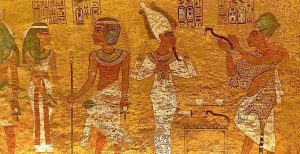
Egyptians believed in the creative power of the word. Simply by reading this formula aloud—or even just having it written on the wall—the text became reality in the spirit world. The painted food on the walls would magically become real sustenance for the Ka, ensuring the soul would never starve, even if the living forgot them.

Ancient Egyptian Architecture: History, Characteristics, and Examples

Ancient Egyptian architecture is defined by its eternal monuments—pyramids and temples. Driven by religious belief...
Related post
FUN

A Civilization Built on Gratitude

Types of offerings in ancient Egypt- Egpy fun tours

Ultimately, the system of Ancient Egyptian Offerings was the glue that held their society—and the cosmos—together. It was a profound expression of gratitude and interdependence. By feeding the gods, the Egyptians believed they maintained the order of the universe. By feeding their ancestors, they conquered death itself. It was an eternal cycle of giving and receiving that connected the living, the dead, and the divine in a single, unbroken chain.

Common Questions About Offerings

Here are the quick answers to the most common questions about these ancient rituals.

Q: Did the Egyptians burn their food offerings?

A: Generally, no. Unlike some cultures that burnt sacrifices to ash, Egyptians presented the food to the god’s statue. After the ritual, the food was removed and eaten by the priests and staff. They believed the god consumed the spiritual “essence,” leaving the physical food for humans.

Q: What is a “votive offering”?

A: A votive offering is a permanent gift left for a god, rather than daily food. These included small statues, steles, jewelry, or mummified animals (like the millions of ibises for Thoth) given by pilgrims to ask for a favor or give thanks.

Q: What is the Offering Formula?

A: It is a standard prayer (Hete-di-Nesu). It asks the king to intercede with a god (usually Osiris) to grant the deceased a share of the divine offerings, ensuring they have bread, beer, and all good things in the afterlife forever.

Current weather in Egypt

Discover the best of Egypt exploring the iconic attractions and enjoying desert safari adventure....
DIscover the Nile River and the Red Sea Charming activities....

Great guided tour of pyramids

We travelled to Cairo on Friday, May 3, 2019, from Toronto. We landed at 0530 and were met by a representative of Fun Tours at the departure gate. We were only on a layover of 6 hours, and the tour company came with a private van, water, a driver, and

More »

Day Trip to Alexandria

An enjoyable drive from Cairo to Alexandria. It was an enriching trip. I learnt so much history about the ancient civilisation. The tour guide explained the history of each site we visited. There is so much to see. I would definitely highly recommend visiting Alexandria. It’s rich in history. The

More »

Lenka Traverlers

Egypt Fun Tours was contracted by our travel agency, Lenka Travelers, to arrange and guide us through parts of Egypt and Jordon. They did a fabulous job. The hotels, restaurants, places we visited, and transportation were the best. Our guide in Egypt, Mohammad, was very knowledgeable, spoke perfect English, and

More »

Excellent Tour

Really excellent tour from Mohamed, and we learned so much about Egypt and went to places we never would have found as tourists at home. My girlfriend had a 12 hour stop over on the way to Ethiopia and it was the perfect way to see Cairo. I hope people

More »

AMAZING Layover Tour

We had the MOST amazing layover tour with Egypt Fun Tours. Hanni was amazing, and we loved every moment. Pyramids, authentic food, and Islamic Cairo – amazing!

More »
Isis with wings

Top-rated Tour Packages

Isis with wings