Nectanebo II: The Final Native Pharaoh of Ancient Egypt

Nectanebo II ruled as the final native pharaoh of ancient Egypt, leading the Thirtieth Dynasty through a period of remarkable cultural and religious revival. Despite launching massive building projects across Egypt and initially repelling Persian forces, a final betrayal at the Battle of Pelusium in 343 BCE forced him to flee into exile. Though his defeat ended over two thousand years of independent pharaonic rule, his artistic legacy survived through the Ptolemaic era, and his memory endured in legend as the mythic father of Alexander the Great.
The eye of Horus
WhatsApp
Email
Print

The Final Native Pharaoh: Nectanebo II

The reign of Nectanebo II (c. 358–342/341 BCE) serves as a monumental chapter in ancient history. He was the last native ruler of the Thirtieth Dynasty. During his time, he governed a land caught between a glorious past and growing threats from the Achaemenid Empire. Nectanebo II faced deep internal instability when he took the throne. Despite this, he ignited a remarkable revival of religious tradition. He showed deep devotion to the gods throughout his life. The pharaoh launched ambitious architectural projects to prove his authority. He built the first foundations at Philae and expanded the Karnak Temple Complex. By doing this, he aimed to maintain Ma’at, or cosmic balance. Nectanebo II is remembered for his brave resistance against Persian conquest. Though his fight was difficult, his cultural legacy endured. He helped Egypt remain a spiritual beacon long after his rule ended.
Divider

Rise to Power: The Coup Against Teos

Rise to Power The Coup Against Teos

Nectanebo II did not ascend the throne through traditional succession. Instead, he gained power during a military campaign in the Levant around 358 BCE. His predecessor and uncle, King Teos, had launched an aggressive war against the Persian Empire. To fund this massive military campaign, Teos imposed heavy taxes on the Egyptian people and stripped the wealthy temples of their gold and silver.

These severe economic policies sparked immense anger throughout Egypt. The powerful priesthood and local nobles openly turned against Teos. Seeing this internal political pressure, Nectanebo II seized his opportunity. While serving as a high-ranking military commander in the field, he chose to revolt against his uncle’s authority.

To secure his crown, Nectanebo II needed the support of Egypt’s foreign allies. He successfully negotiated with the vital Greek and Spartan mercenaries fighting for the Egyptian army. He promised higher pay and better rewards to their legendary commander, King Agesilaus II of Sparta. These elite mercenary forces abandoned Teos and shifted their loyalty to Nectanebo II, ensuring his successful rise to power. Teos was forced to flee to Persia, leaving Nectanebo II as the undisputed ruler of a fragile kingdom.

Golden Scarab

A Revival of Piety: Rebuilding the Temples of Egypt

A Revival of Piety Rebuilding the Temples of Egypt

Upon taking the throne, Nectanebo II immediately sought to heal the rift between the monarchy and the divine order. He quickly reversed the unpopular economic policies of his predecessor. The new pharaoh restored lost lands, riches, and tax exemptions to the powerful priesthood. By presenting himself as a true champion of Ma’at—the cosmic balance of truth and justice—he gained the deep loyalty of spiritual leaders across the country.

This renewed devotion sparked one of the most extraordinary building booms in the Late Period of ancient Egypt. Nectanebo II funded extensive construction and restoration projects at over 30 distinct archaeological sites. His architectural footprint stretched from the northern towns of the Nile Delta all the way south to the island of Elephantine.

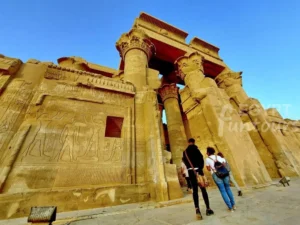
  • The Temple of Isis at Philae: He constructed the very first sacred shrine dedicated to Isis on this island, initiating a temple complex that would remain a vital pilgrimage site for centuries.
  • The Karnak Temple Complex: He built a massive sandstone enclosure wall around the grand precinct, securing and enhancing the sacred heart of Thebes.
  • Sanctuaries of the Delta and Beyond: He raised beautiful monuments in Heliopolis, Hermopolis, and Abydos, using high-quality materials to honor local deities.

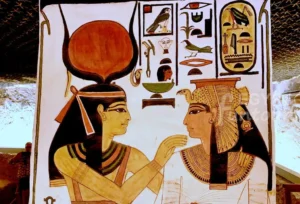
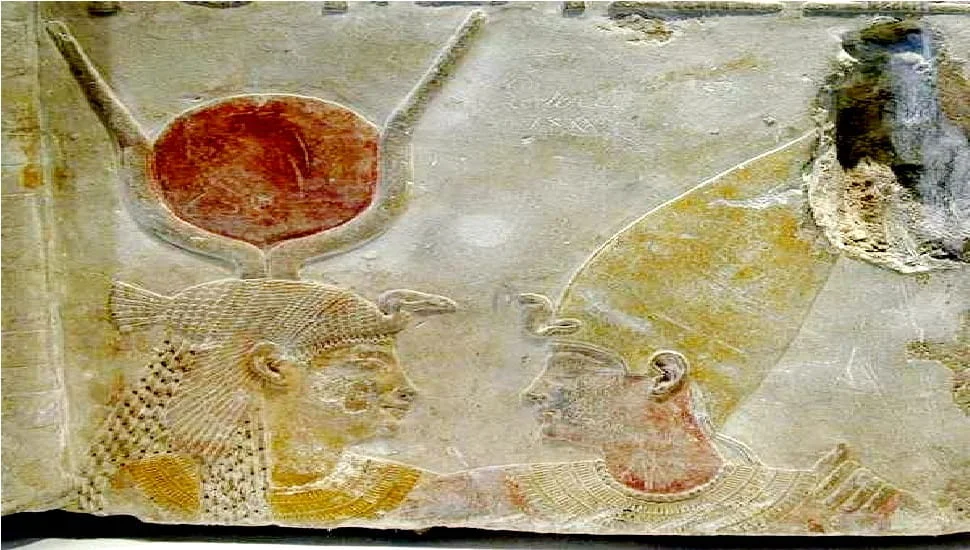
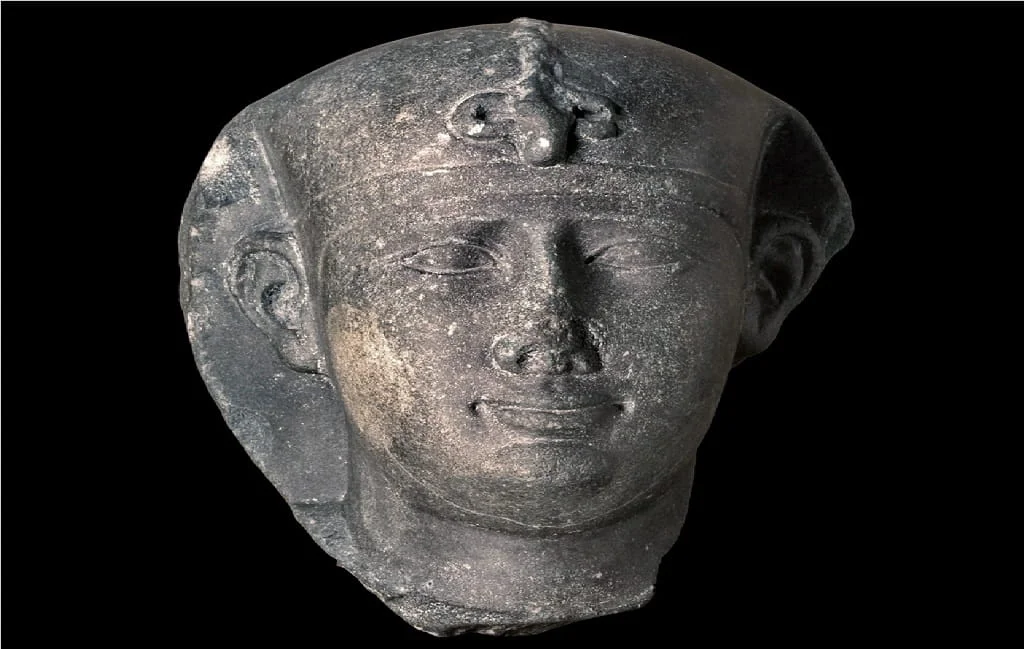
The artistic style developed during his reign introduced a refined softness and elegance to royal reliefs. Sculptors carved soft features and smooth lines into hard stone. This distinct artistic renaissance did not disappear with his reign. Instead, it served as the direct aesthetic blueprint for the grand temple reliefs of the subsequent Ptolemaic Kingdom.

The eye of Horus

The Final Clash: The Persian Invasion and Defeat

The Final Clash The Persian Invasion and Defeat

Despite his grand domestic achievements, Nectanebo II spent his entire reign under the shadow of the Achaemenid Empire. The Persians desperately wanted to reconquer Egypt and bring the Nile Valley back under imperial control. Nectanebo II prepared heavily for this existential threat, reinforcing his borders and hiring top-tier military talent.

His efforts initially brought spectacular success. In 351 BCE, the Persian King Artaxerxes III launched a massive invasion force to crush the rebellious Egyptian state. Nectanebo II met the invaders at the border with a well-organized army, bolstered by elite Greek mercenaries. Through superior strategy and fierce fighting, the Egyptian forces completely repelled the Persian onslaught, inflicting a humiliating defeat on Artaxerxes III.

This glorious victory, however, only delayed the inevitable. Determined to avenge his defeat, Artaxerxes III spent several years assembling an even more overwhelming invasion force. In 343 BCE, the Persian army returned, striking at the strategic fortress town of Pelusium in the eastern Nile Delta.

The ensuing Battle of Pelusium proved disastrous for Egypt. Crucially, betrayal from within shattered Nectanebo II’s defense strategy. Mentor of Rhodes, a brilliant and high-ranking Greek mercenary commander fighting for the pharaoh, defected to the Persian side. Mentor shared vital tactical knowledge of Egypt’s defensive lines, allowing the Persian forces to outmaneuver the pharaoh’s army.

With his frontline defenses broken and his troops retreating, Nectanebo II realized the situation was hopeless. He abandoned the capital city of Memphis and fled south toward Upper Egypt and Nubia, taking what treasures he could salvage. His ultimate fate remains shrouded in mystery, as he completely disappeared from the historical record, leaving Egypt without a native ruler.

Divider

The Mythic Legacy: The Alexander the Great Connection

The Mythic Legacy The Alexander the Great Connection

The disappearance of Nectanebo II from the battlefield did not end his story. Instead, he entered the realm of folklore and myth. The Egyptian people, deeply unwilling to accept permanent foreign Persian rule, kept the memory of their last native pharaoh alive through oral traditions. Over time, these stories evolved into a famous collection of legends known as the Alexander Romance. This literary tradition completely rewrote historical events, transforming Nectanebo II from a defeated fleeing monarch into a powerful, wise sorcerer.

  • The Flight to Macedonia: The legend claimed that Nectanebo II did not flee to Nubia, but instead traveled to the royal court of Macedonia in disguise.
  • The Divine Conception: According to the myth, he used advanced Egyptian magic and astrology to seduce Queen Olympias, the wife of King Philip II.
  • The Father of Alexander: Through this mystical union, Nectanebo II supposedly fathered Alexander the Great, passing down the divine pharaonic bloodline.

This sophisticated mythological narrative served a brilliant political purpose. When Alexander the Great marched into Egypt in 332 BCE to expel the Persians, the Egyptian people welcomed him as a liberator. By viewing Alexander as the literal son of Nectanebo II, the population easily accepted him as a legitimate pharaoh. Through this legendary connection, the line of independent Egyptian monarchs found a symbolic, unbroken bridge into the Hellenistic era.

The eye of Horus

Nectanebo II: The End of an Era

The departure of Nectanebo II marked more than just the end of a single reign; it closed the final chapter on thousands of years of native pharaonic rule. For over two millennia following his flight from Memphis, foreign dynasties would govern the Nile Valley. Yet, his structural and artistic choices ensured that Egyptian identity did not fade under foreign occupation.

By leaving behind a deeply revived religious infrastructure and a distinct, refined aesthetic, Nectanebo II provided the cultural survival kit that Egypt needed. When the Ptolemaic kings later took control, they did not erase his work. Instead, they adopted his artistic style and rebuilt temples using his exact architectural blueprints.

Today, Nectanebo II stands as a symbol of resilience. He was a ruler who fought fiercely to defend his homeland’s borders, preserve its sacred traditions, and safeguard its timeless heritage until the very end.


Divider
hani ahmed 1

Hani Was our Awesome Tour Guide!

We had an 11-hour layover in Cairo on 12/15/2011. We wanted to go to see the Pyramids, Tahrir Square, and possibly the museum. We were so lucky to have a guide, Hani from Egypt Fun Tour, who made it possible to see all the above, plus the Bazaar, and time

More »

Excellent Tour

Really excellent tour from Mohamed, and we learned so much about Egypt and went to places we never would have found as tourists at home. My girlfriend had a 12 hour stop over on the way to Ethiopia and it was the perfect way to see Cairo. I hope people

More »

Great one day tour in Cairo

My husband and I had a long layover in Cairo on our way to Kenya in 2010. Since we had never been to Egypt, we decided to sign up for a one-day tour with Egypt Fun Tours Day Trips. Our guide was there when we arrived and quickly guided us

More »

Cairo Day Trip

Great trip organised. I had a 12-hour layover in Cairo and had a great time with Sherif, who answered every question I had on ancient Egypt. Highly recommend.

More »

Layover Tour in Cairo

This August, my boyfriend and I had quite a long layover in Cairo, 9 hours to be exact. Instead of wasting our time at the airport, we decided to do a layover tour of the city. I had been before, but my boyfriend hadn’t, so we wanted to hit the

More »
God_Anubis_Icon

Top-rated Tour Packages

God_Anubis_Icon
WhatsApp
Email
Print