
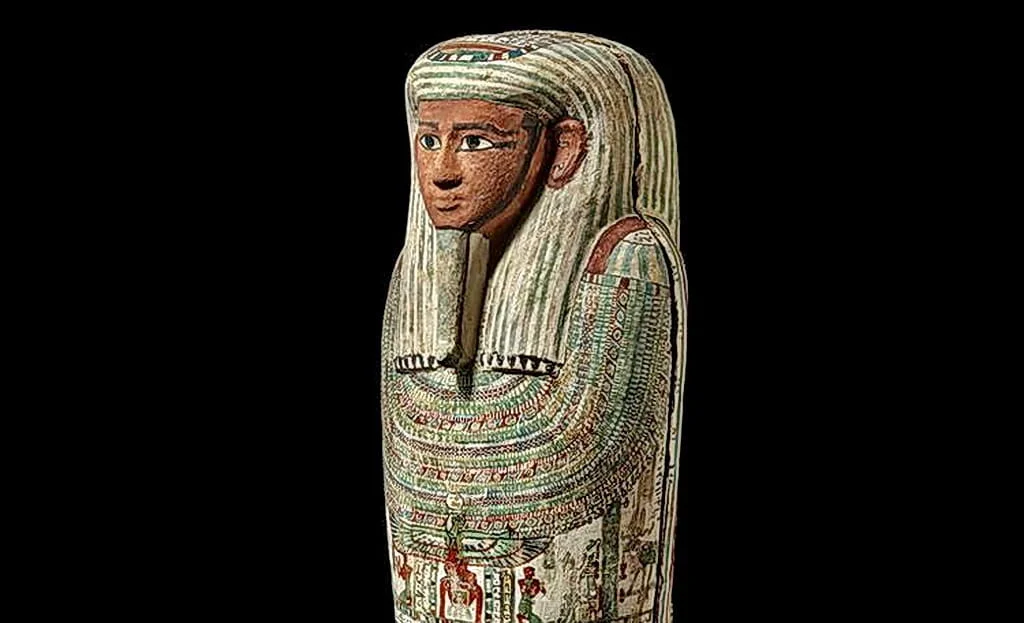
Pharaoh Psamtik I: The Ultimate Guide to The Savior of Ancient Egypt

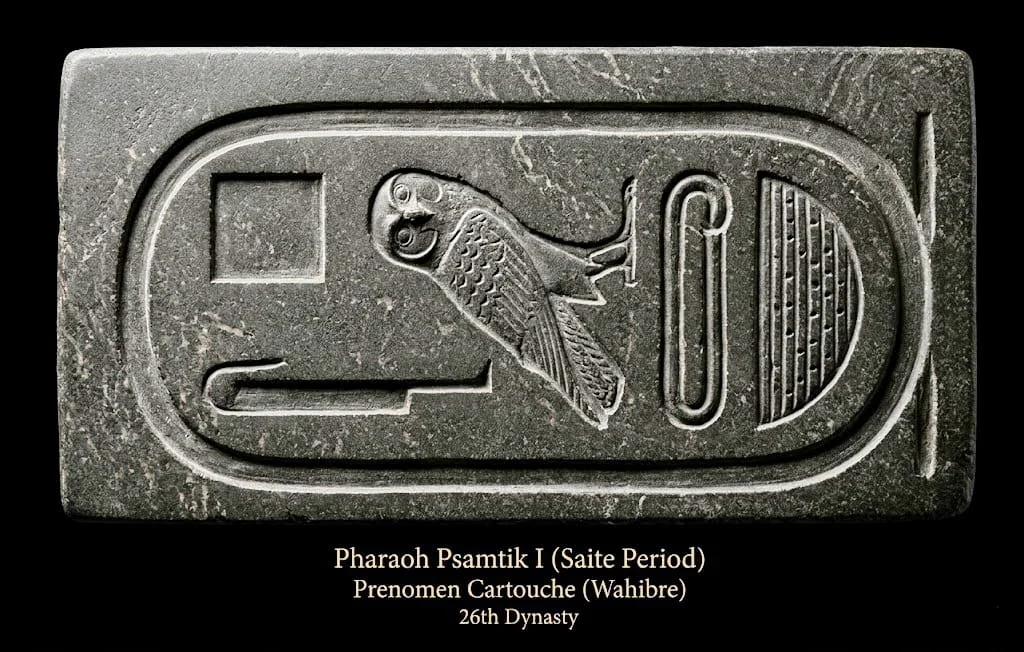
This comprehensive guide explores the extraordinary 54-year reign of Pharaoh Psamtik I, the strategic visionary who rescued ancient Egypt from foreign Neo-Assyrian occupation and internal collapse. Discover how he utilized elite Mediterranean mercenaries to liberate the Delta, engineered brilliant diplomatic alliances to peacefully reunite Upper and Lower Egypt without bloodshed, and ignited the magnificent "Saite Renaissance"—a profound cultural, linguistic, and economic revival that restored classic pharaonic glory and ushered in a final, vibrant golden age of independent global trade.
The eye of Horus
WhatsApp
Email
Print

The Fragmented Horizon (Egypt Before Psamtik I)

To understand the monumental achievements of Psamtik I, one must first look at the shattered world of his birth. The mid-seventh century BC marked the lowest point of the Third Intermediate Period. During this era, Egypt suffered from a fractured landscape, political fragility, and constant foreign intervention. For centuries, the ancient authority of the double crown had vanished. In its place, local rulers, competing dynasties, and a devastating loss of national sovereignty defined the country.

The Fallout of the Third Intermediate Period

By the twilight of the eighth century BC, Egypt was no longer a unified superpower. The central authority of the Pharaoh had dissolved into a patchwork of competing principalities. Consequently, regional divides split the nation down the middle. In the south, the Kushite kings of the 25th Dynasty ruled from the sacred city of Thebes. They viewed themselves as the true guardians of traditional pharaonic culture and the cult of Amun. Meanwhile, a series of local Libyan chieftains, meshwesh rulers, and petty kings carved up the northern Delta. These local factions constantly vied for territory and commercial dominance.

Unfortunately, this deep regional divide left the country utterly vulnerable to external aggression. The expanding Neo-Assyrian Empire—the military juggernaut of the Near East—soon clashed with the Kushite rulers. As a result, this catastrophic collision turned Egyptian soil into a bloody geopolitical battleground.

The Assyrian Shadow and the Dodecarchy

The conflict reached its peak under the Assyrian kings Esarhaddon and Ashurbanipal. Through successive, brutal invasions, the Assyrian war machine marched down the Nile. They successfully sacked Memphis and eventually unleashed devastating destruction upon Thebes. Because of this overwhelming force, the invaders permanently drove the Kushite pharaohs south. The defeated kings retreated past the cataracts and back into Nubia.

Rather than ruling Egypt directly, Ashurbanipal established a clever vassal system to keep the country divided and weak. Specifically, he recognized a network of twelve local Delta lords. The Greek historian Herodotus later famously dubbed this governing coalition the Dodecarchy. These petty rulers bound themselves by oaths of loyalty to Nineveh. Furthermore, they paid heavy tributes and lived under the constant monitoring of Assyrian garrisons.

Among these local principalities, however, one city began to rise rapidly above the rest: Sais (modern Sa el-Hagar) in the Western Delta.

Psamtik I: The Strategic Rise of Sais
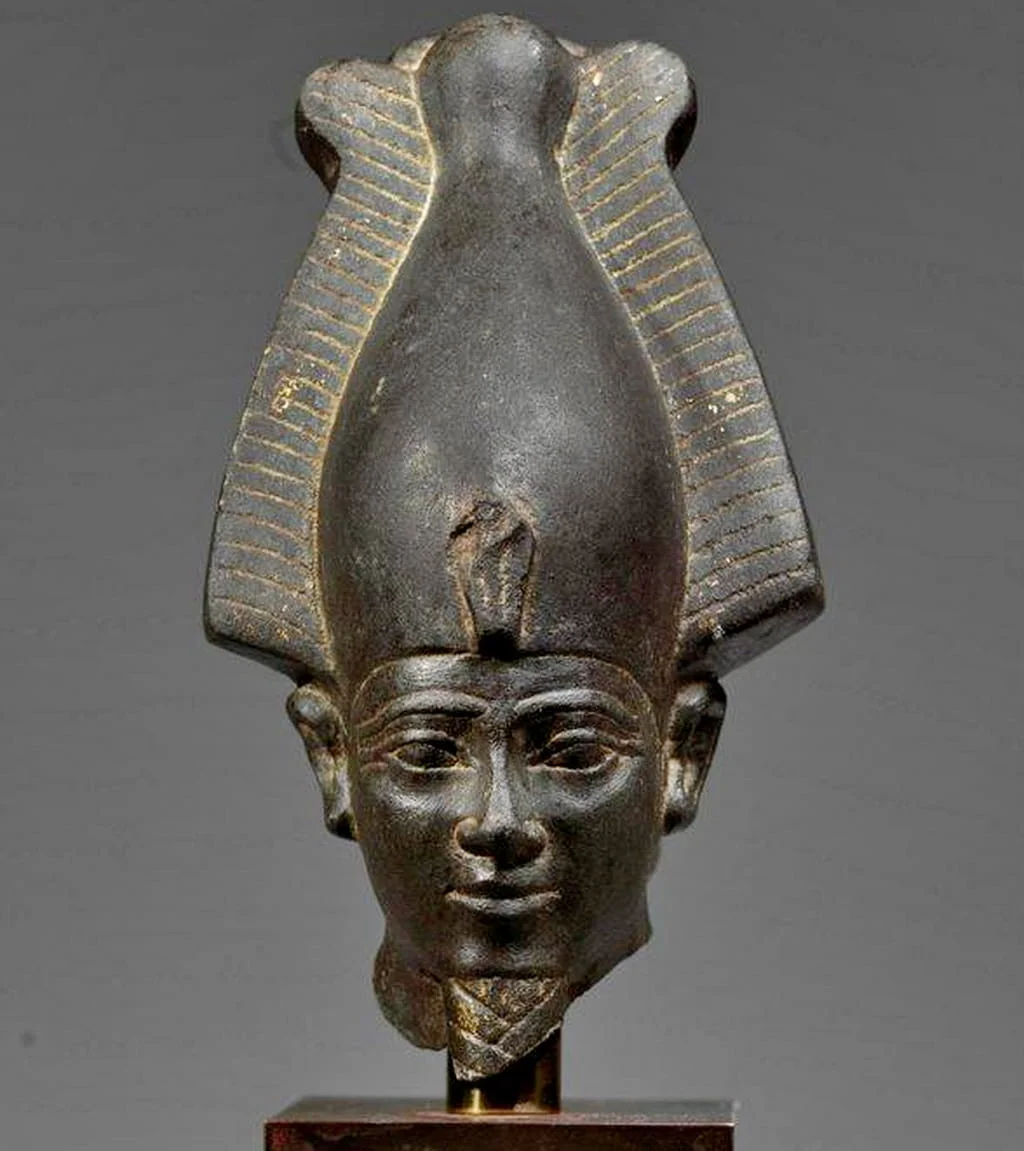
Psamtik I The Strategic Rise of Sais

Sais occupied a brilliant strategic position. Because it sat directly on the Canopic branch of the Nile, the city perfectly controlled both domestic river trade and maritime commerce with the Mediterranean. Therefore, the rulers of Sais grew into astute politicians. They quickly understood that survival required playing a dangerous double game.

Psamtik’s father, Necho I, initially secured a powerful position when the Assyrians appointed him as the chief vassal ruler of Sais and Memphis. Necho I proved his loyalty to Ashurbanipal by fighting alongside Assyrian forces against Kushite counter-offensives. However, this dangerous alliance ultimately cost Necho his life.

Following his father’s tragic death, young Psamtik inherited a bitter legacy. He faced a nation occupied by a foreign empire, a Delta divided by jealous rival lords, and a family name deeply entangled with the conquerors of Nineveh. Yet, from this weak position of apparent submission, Psamtik I would mastermind one of the most brilliant campaigns of national liberation in ancient history.
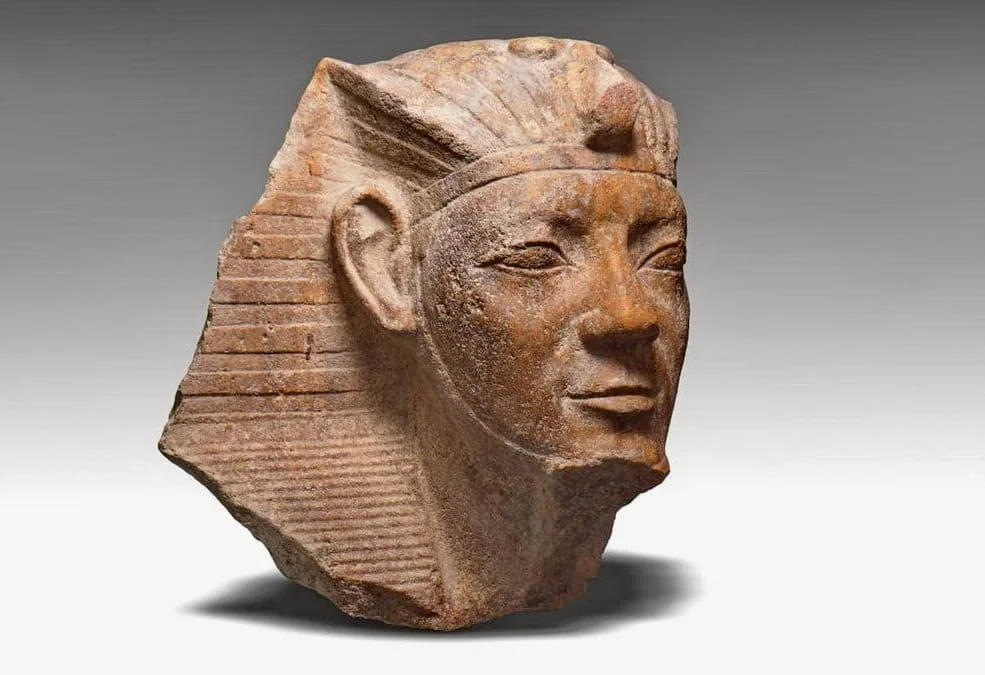
Divider

The Rise of Psamtik I and the Liberation of Egypt

The Rise of Psamtik I and the Liberation of Egypt

To free a broken nation, a leader must possess both military might and extraordinary political cunning. Psamtik I possessed both. When he assumed power over the principality of Sais, he did not launch an immediate, reckless rebellion against the Neo-Assyrian Empire. Instead, he bided his time, consolidated his local resources, and quietly formulated a master plan to completely break the foreign yoke.

The Dangerous Diplomacy of Psamtik I

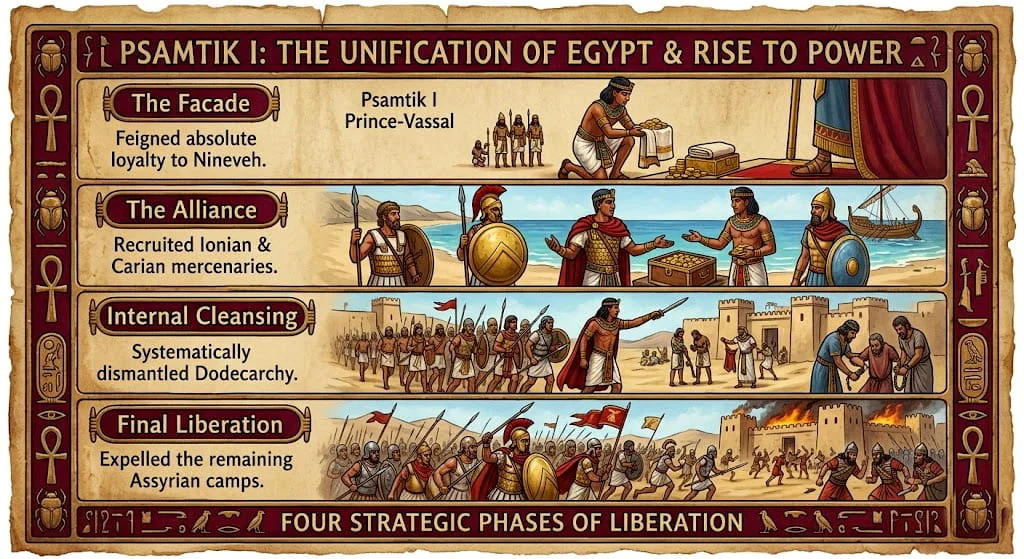
Initially, the young ruler maintained a facade of absolute loyalty to his Assyrian overlords. He paid his tributes promptly to Nineveh and avoided open conflict with the surrounding Delta lords of the Dodecarchy. By doing this, he lulled King Ashurbanipal into a false sense of security. The Assyrians viewed the Saite prince merely as a useful regional buffer against the southern Kushites.

However, beneath this submissive exterior, Psamtik I was actively seeking a way to build an independent military force. He knew that native Egyptian levies alone could not match the heavily armored, iron-wielding Assyrian war machine. To defeat a global superpower, he needed elite, professional warriors who possessed no local political ties or tribal loyalties.

The Focus Keyword Strategy: Recruiting the “Bronze Men”

The turning point came around 658 BC through an unexpected connection across the Mediterranean Sea. According to historical accounts, a sudden wave of Ionian and Carian pirates from Asia Minor arrived on the coast of the Nile Delta. These foreign warriors wore heavy bronze armor and carried massive shields, a sight completely unfamiliar to the local populations.

"Behold, the prophecy is fulfilled: bronze men from the sea shall bring deliverance."
— Ancient Egyptian oracle attributed to the goddess Wadjet

Psamtik I immediately recognized the immense strategic value of these travelers. Rather than fighting them, he offered them lucrative contracts to serve as his elite mercenary core. He gave them land, wealth, and permanent bases along the Pelusiac branch of the Nile. With these highly disciplined Greek forces at his back, the secret rebellion of Psamtik I officially began.

Breaking the Dodecarchy and Expelling Assyria

First, the Saite prince turned his formidable new army against his closest rivals—the eleven other petty kings of the Delta. One by one, he marched through the marshlands, defeating the local chieftains and absorbing their territories into his growing domain. Some lords submitted peacefully, while others were forcefully crushed by the unstoppable advance of the Carian and Ionian phalanx.

Breaking the Dodecarchy and Expelling Assyria

As his internal power grew, a fortunate geopolitical shift favored his cause. Deep troubles at home began to distract the Neo-Assyrian Empire. Civil war broke out between Ashurbanipal and his brother in Babylon, forcing Nineveh to recall its frontline troops from the western edges of the empire.

Psamtik I seized this golden opportunity instantly. He cut off all tribute payments, declared absolute sovereignty, and easily overwhelmed the isolated Assyrian garrisons left behind in Egypt. By roughly 656 BC, his armies marched into the ancient capital of Memphis. Through patience, brilliant foreign alliances, and decisive military action, Psamtik I had successfully reunited Upper and Lower Egypt under a single, independent crown.

Golden Scarab

Consolidating the Realm and the Politics of Unity

Consolidating the Realm and the Politics of Unity

Unifying a divided nation through military force is a monumental task, but maintaining that unity requires profound political genius. After securing the Delta and capturing Memphis, Psamtik I faced a critical challenge. The southern regions of Egypt, centered around the ancient religious capital of Thebes, remained deeply suspicious of northern Delta rulers.

For generations, the powerful priesthood of Amun and the remaining elite families in the south had looked toward Kush for leadership. To truly cement his rule, the young pharaoh needed to bind Upper and Lower Egypt together permanently. Remarkably, he achieved this crucial consolidation without shedding a single drop of blood.

The Problem of the Southern Priesthood

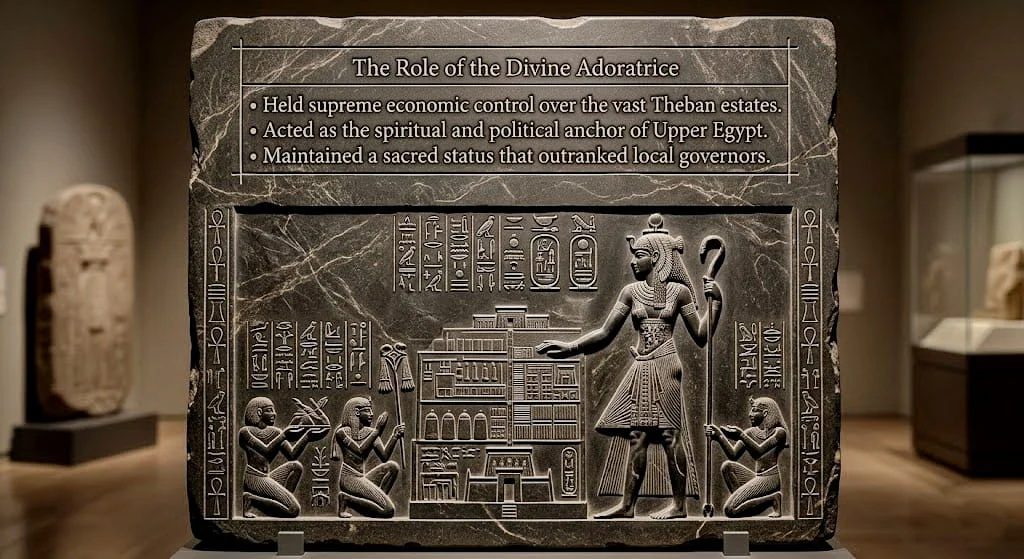
Thebes was practically an autonomous state within Egypt. The high priests controlled vast wealth, massive tracts of agricultural land, and immense spiritual authority over the population. Furthermore, the political centerpiece of this southern powerhouse was a powerful religious office: the “Divine Adoratrice of Amun” (also known as the God’s Wife of Amun).

The Problem of the Southern Priesthood

At the time, this influential position was occupied by Shepenupet II, a princess of Kushite descent. As long as a Kushite loyalist held the keys to the southern treasury and the hearts of the people, the throne of Psamtik I in Sais would never be secure. A military invasion of Thebes would risk tearing the newly unified country apart in a bloody civil war. Therefore, the pharaoh engineered a masterpiece of peaceful diplomacy.

The Diplomatic Masterstroke: Nitocris I and the Adoption Stele

In 656 BC, Psamtik I sent a spectacular naval flotilla sailing south down the Nile toward Thebes. The fleet did not carry a conquering army. Instead, it carried his young daughter, Princess Nitocris I, along with a massive retinue of northern officials, exquisite treasures, and a brilliant legal proposition.

The pharaoh negotiated a peaceful transfer of power directly with the Theban elite. He used his immense political leverage to convince the existing Divine Adoratrice to officially adopt Princess Nitocris I as her legal daughter and designated successor. This historic event was immortalized on a massive granite monument known today as the Adoption Stele.

"I have given to him my daughter to be a God's Wife... 
I will not do what should not be done, nor drive out the one who is in office... 
But I shall give her to be adopted."
— Excerpt from the Adoption Stele of Nitocris I

By placing his daughter at the absolute peak of the southern religious hierarchy, Psamtik I achieved several brilliant objectives simultaneously:

  • Financial Control: He seamlessly transferred the immense wealth and tax revenues of the Theban temples directly into the royal coffers of Sais.
  • Political Legitimacy: He secured the total ideological loyalty of the Amun priesthood without firing a single arrow.
  • Total Unification: He knit Upper and Lower Egypt into a single, cohesive political entity, officially ending centuries of regional fragmentation.

Reorganizing the Provincial Government

With the south securely under royal influence, the pharaoh immediately turned his attention to internal administrative reform. During the chaotic centuries of the Third Intermediate Period, local governors (nomarchs) had grown incredibly corrupt, acting like independent kings within their respective provinces.

Psamtik I systematically dismantled this decentralized system. He carefully stripped these hereditary lords of their independent military commands and replaced them with fiercely loyal royal administrators dispatched directly from Sais. He centralized the judicial system, overhauled the tax collection networks, and established a direct line of communication between the provinces and the royal court. Through this thorough administrative cleansing, he ensured that no regional lord could ever gather enough localized power to challenge the authority of the central crown again.

The eye of Horus

The Saite Renaissance (Art, Architecture, and Language)

The Saite Renaissance (Art, Architecture, and Language)

When political stability returns to a nation, culture flourishes. After successfully unifying the realm, Psamtik I did not merely focus on military and administrative control. Instead, he launched a magnificent cultural revival that modern historians call the Saite Renaissance.

This movement was unique because it was deliberately nostalgic. After centuries of foreign occupation and internal decay, the pharaoh and his court sought to restore Egypt’s pride by looking directly back to the nation’s greatest golden ages: the Old and Middle Kingdoms.

The Conscious Revival of Classic Pharaonic Forms

Under the patronage of the royal court at Sais, artists and sculptors received explicit instructions to reject the artistic styles of the recent chaotic centuries. Instead, they traveled across the country to ancient tombs, temples, and monuments in Memphis, Saqqara, and Giza. They meticulously studied the wall reliefs and statues built during the pyramid-building eras of kings like Djoser, Khufu, and Khafre.

+------------------------------------+---------------------------------------+
| Third Intermediate Period Art      | Saite Renaissance Style               |
+------------------------------------+---------------------------------------+
| • Stylistic influence from abroad  | • Strict return to classic proportions|
| • Often rushed or lower quality    | • Incredible mastery over hard stone  |
| • Focused on immediate rulers      | • Imitated Old Kingdom idealism       |
+------------------------------------+---------------------------------------+

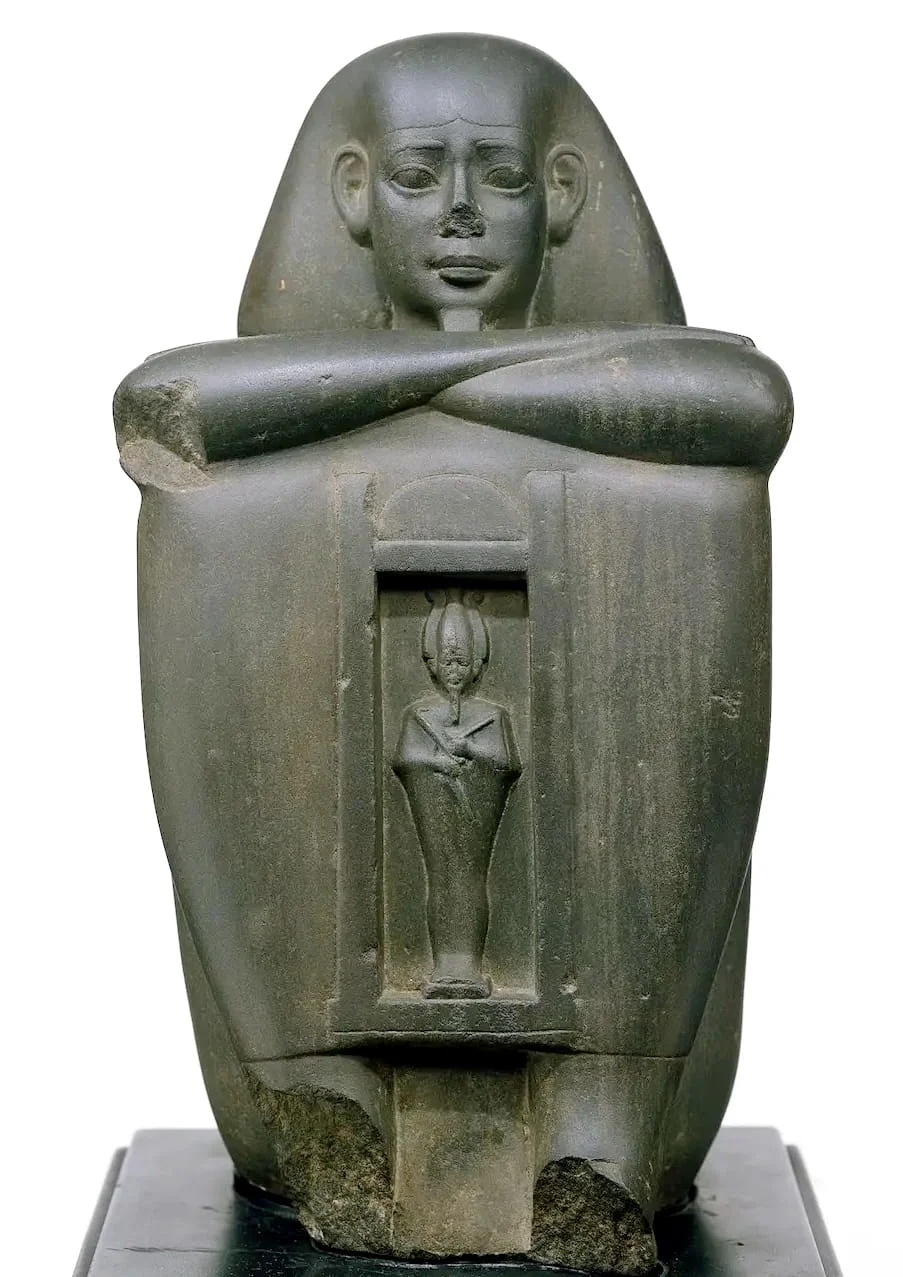
Consequently, Saite art achieved an astonishing level of execution. Sculptors mastered the carving of incredibly hard stones like green graywacke, basalt, and dark granite. Statues from this era feature smooth, polished surfaces, ideal athletic proportions, and serene, youthful facial expressions that directly mimic the styles of two thousand years prior. This archaizing trend was a powerful propaganda tool; by dressing and depicting themselves like the grand pyramid builders, the Saite rulers legitimized their right to rule an independent, glorious Egypt.

The Rise of Demotic Script and Administrative Literacy

A true renaissance requires an efficient way to communicate and document the affairs of the state. Before the reign of Psamtik I, the administrative language of Egypt relied on Hieratic—a cursive form of hieroglyphs that had become cumbersome and inconsistent across different regions.

To streamline his newly centralized government, the pharaoh oversaw the formal codification and widespread adoption of Demotic script.

[Hieroglyphs] -> Used for sacred temple walls and monumental stone inscriptions.
      ↓
[Demotic Script] -> Used for daily government contracts, trade, law, and literature.

Demotic was a highly cursive, rapid form of writing that allowed royal scribes to draft documents at unprecedented speeds. This linguistic revolution had an immense impact on society. It standardized legal contracts, simplified tax collection, and created a highly literate class of professional bureaucrats who could efficiently manage the domestic and international trade networks expanding under the 26th Dynasty.

Architectural Achievements and Religious Restoration

Sais, the proud capital of the 26th Dynasty, was transformed into a dazzling metropolis filled with towering temples, massive obelisks, and sacred lakes. Though the ancient city lies in ruins today near modern Sa el-Hagar, historical accounts from travelers like Herodotus describe the royal palaces and the great Temple of Neith—the patron goddess of Sais—as architectural wonders that rivaled the grandest structures of Luxor.

Beyond building up his own capital, Psamtik I funded massive restoration projects throughout the country:

  • Memphis: He expanded the great Temple of Ptah and built magnificent new galleries for the burial of the sacred Apis bulls in the Serapeum at Saqqara, establishing a tradition of royal devotion that his successors would follow for generations.
  • Heliopolis: He restored the ancient sun temples, reconnecting his dynasty directly to the classic solar cults of the Old Kingdom.
  • Thebes: He funded extensive repairs on the Karnak Temple complex, proving to the southern populations that a northern pharaoh honors the great state god Amun with unmatched generosity.

Through this sweeping cultural rebirth, Psamtik I successfully restored the broken spirit of the Egyptian people, paving the way for an era of unprecedented global influence and economic wealth.

Divider

A New Era of Global Trade and Foreign Policy

A New Era of Global Trade and Foreign Policy

A completely unified and culturally revitalized nation requires a bold stance on the world stage. Having secured his borders and revived the domestic economy, Psamtik I broke away from the traditional, isolationist tendencies of past dynasties. Instead of closing Egypt off from the outside world, he aggressively opened the country’s gates to the Mediterranean, fundamentally transforming the geopolitical and commercial landscape of the ancient Near East.

Opening Egypt’s Gates to the Mediterranean

Before the 26th Dynasty, foreign merchants faced strict limitations and deep suspicion when trying to trade within Egyptian territory. Psamtik I recognized that true economic wealth lay in maritime commerce. Consequently, he granted unprecedented trading privileges to Phoenician sea captains and Greek merchants, particularly those from Miletus, Samos, and Aegina.

This open-door policy laid the direct structural groundwork for his successors to establish Naukratis, which became the premier, highly regulated Greek trading emporium in the Western Delta. Through these bustling maritime channels, Egypt exported vast quantities of grain, fine linen, and papyrus. In return, the country imported critical raw materials that it desperately lacked, such as high-quality olive oil, silver, and premium Aegean wine.

The Military Defensive Network: Securing the Frontiers

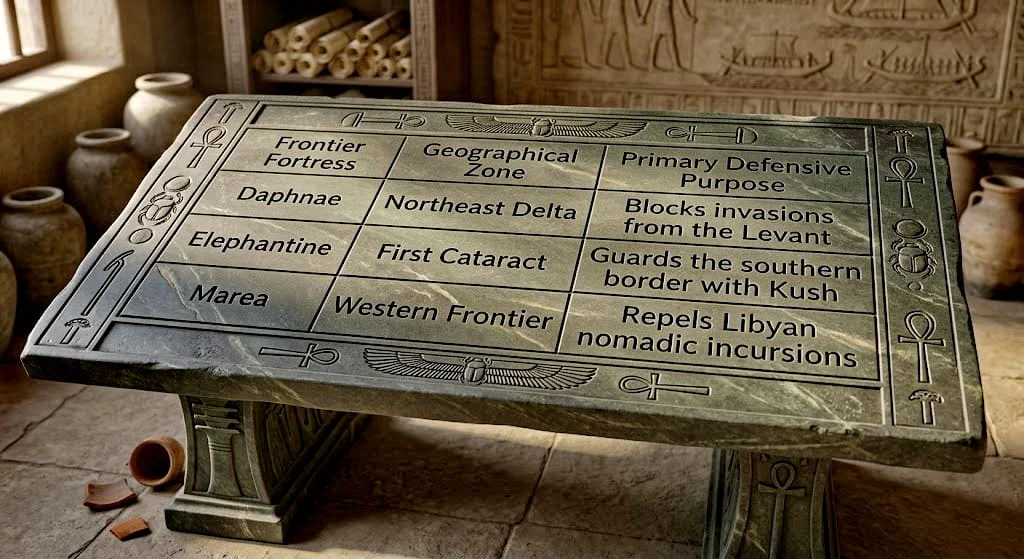
While the pharaoh welcomed international commerce, he remained deeply vigilant about national security. He understood that Egypt’s massive wealth made it a prime target for foreign invasion. To safeguard the realm, he established a sophisticated, tripartite defensive network across the nation’s most vulnerable frontiers:

  • Daphnae (Tahpanhes) in the East: Located in the northeastern Delta, this massive fortress garrisoned a permanent force of Greek and Egyptian troops to monitor the vulnerable desert highways leading into the Levant.
  • Elephantine in the South: Situated at the first cataract of the Nile, this heavily fortified island outpost guarded the southern border against any potential counter-offensives from the Kingdom of Kush.
  • Marea in the West: This strategic stronghold protected the western Delta frontier against invading Libyan nomadic groups.

By utilizing disciplined, professional mercenary garrisons at these key choke points, Psamtik I freed up his native Egyptian troops to focus on internal security and agricultural logistics, creating a highly efficient military-industrial balance.

The Military Defensive Network Securing the Frontiers

Shifting Geopolitics in the Levant: Navigating the Babylonian Rise

During the latter half of his remarkable 54-year reign, the international balance of power shifted dramatically. The Neo-Assyrian Empire—the very juggernaut that Psamtik I had expelled from Egypt—began to collapse under the weight of internal civil wars and relentless pressure from the rising Neo-Babylonian Empire led by Nabopolassar.

In a brilliant, pragmatic twist of foreign policy, Psamtik I completely reversed his geopolitical strategy. Recognizing that a dominant, aggressive Babylonia posed a far greater threat to Egypt than a dying Assyria, the pharaoh launched campaigns into the Levant to support his former Assyrian overlords. By marching into Philistia and laying siege to the strategic city of Ashdod for years, Psamtik I successfully established a crucial geopolitical buffer zone in Palestine. This masterstroke kept the advancing Babylonian armies at a safe distance, brilliantly preserving Egyptian sovereignty during a period of global imperial collapse.

The eye of Horus

Death, Legacy, and Historical Judgment

Death, Legacy, and Historical Judgment

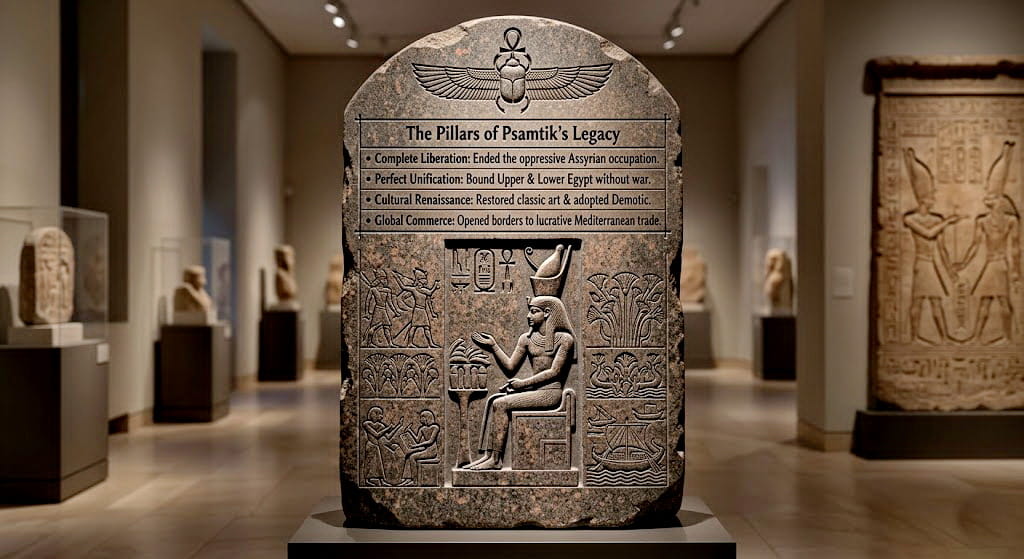
After a monumental and unprecedented 54-year reign, Psamtik I passed away in 610 BC. He left behind an empire that was entirely unrecognizable from the fractured, occupied land of his youth. His death marked the peaceful transition of absolute power to his capable son, Necho II, who inherited a fully unified country, a thriving economy, and a dominant position on the world stage.

The Ultimate Historical Judgment

Both ancient chroniclers and modern archaeologists view the long reign of Psamtik I as a stunning triumph of statecraft. The famous Greek historian Herodotus praised the Saite pharaohs for their openness to the Mediterranean world, tracking the birth of modern international relations directly to this specific era.

"From the time when the Greek settlers came to Egypt, we Greeks have had precise knowledge of all that happened there from the reign of King Psammetichus onwards."
— Herodotus, Histories (Book II)

Before the rise of Sais, Egypt was widely considered a dying civilization, trapped in an endless loop of foreign occupation and internal collapse. Psamtik I rewrote that tragic narrative completely. He proved that the cultural, economic, and military spirit of the Nile could be fully resurrected through adaptability and strategic modernization.

The Lasting Impact of the Saite Legacy

The administrative structures, economic trade networks, and artistic traditions established by Psamtik I sustained the 26th Dynasty for well over a century. By blending traditional Pharaonic identity with a bold, forward-thinking foreign policy, he granted ancient Egypt a magnificent, final golden age of independent sovereignty.

The Lasting Impact of the Saite Legacy

Ultimately, Psamtik I was much more than a mere survivor of the chaotic Third Intermediate Period. He was the brilliant architect of its end, the savior of Egyptian independence, and the visionary who successfully guided his nation into a vibrant, interconnected new world.


Divider

Excellent Adventure

These guys put together an amazing itinerary that allowed me see the sunrise at the sun festival in Abu Simbel, King Tut’s tomb, and mask! That was just the tip of the iceberg. Aswan, Kom Ombo, Edfu and Luxor. So much visited with plenty of rest time. An amazing trip

More »

Great shore excursion of Cairo & Giza

We are glad that we arranged our private shore excursion with Egypt Fun tours in last week of October 2012. Booking process was very easy with Hamada and she took care of all our questions promptly just via E-mail. Our group was little worried about safety in Egypt especially because

More »

Like two days of touring in one day!

I had a 12 hour stay in Cairo- and had made no plans on how to spend it until 8pm the night before departure. I emailed Egypt Fun Tours in a panic and they responded immediately. They made it incredibly easy to arrange a tour and we made arrangements via

More »
9-day tour package - Egypt Fun Tours

You’re in “GREAT HANDS” with Egypt Fun Tours!

We first went to Egypt in July 2010. We were to pass through Cairo on our way to Africa, and we had arranged to be picked up from the Cairo airport and shown around the city during our 6-hour layover. This was arranged through emails with Hamada, of Egypt Fun

More »
God_Anubis_Icon

Top-rated Tour Packages

God_Anubis_Icon
WhatsApp
Email
Print