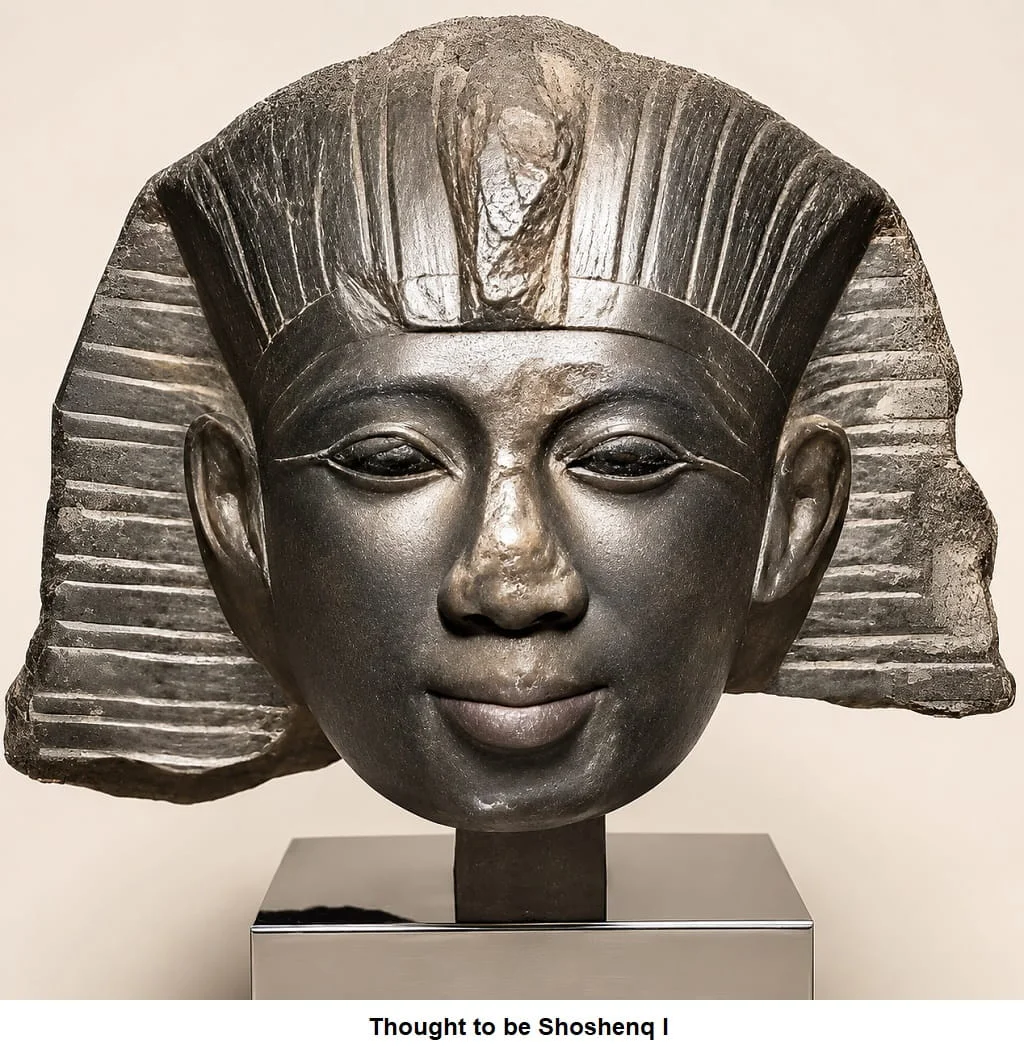

Shoshenq I: The Chieftain Who Forged Egypt’s 22nd Libyan Dynasty

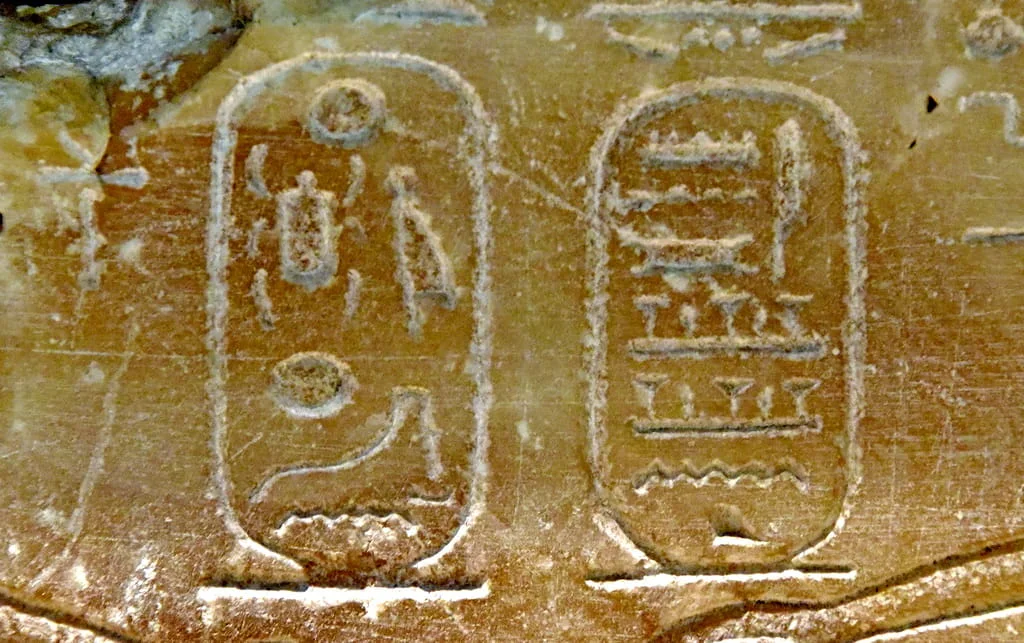
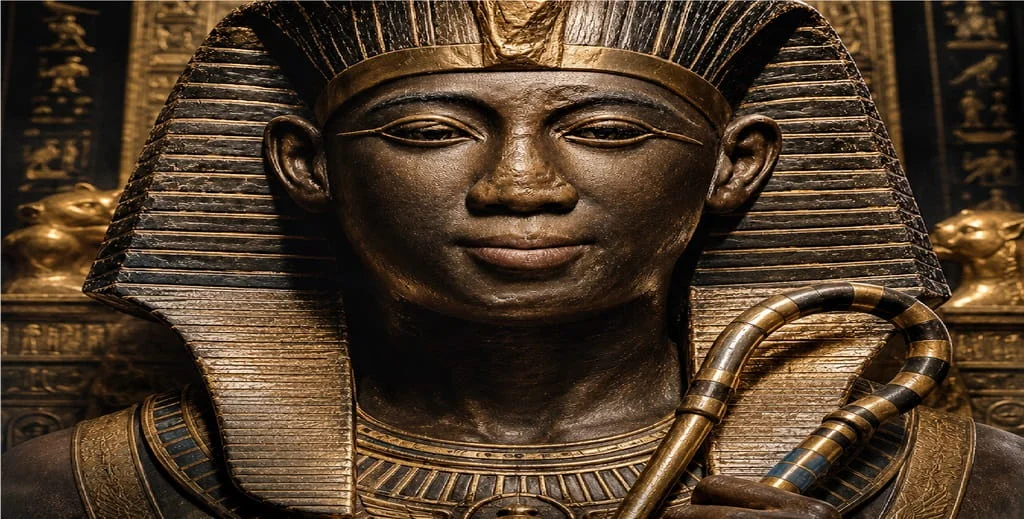
Shoshenq I, the visionary founder of the 22nd Dynasty, expertly stabilized Egypt by centralizing power within his own family and integrating his Libyan heritage with enduring pharaonic traditions. By strategically appointing his sons to critical administrative and religious roles, he effectively neutralized the longstanding influence of the Theban priesthood and created a unified, resilient political structure. His legacy is defined by a massive economic and architectural revival, most notably his grand expansions at Karnak and his decisive military campaign into the Levant, which solidified Egypt’s prestige on the international stage. Through his sophisticated diplomacy and robust state-led building projects, he successfully transformed a fragmented nation into a prosperous, thriving empire.
The eye of Horus
WhatsApp
Email
Print

Shoshenq I: The Libyan Roots and the Meshwesh Rise to Power

To understand the rise of Shoshenq I, you must look beyond the traditional borders of the Nile Valley. You must look toward the vast desert landscapes of ancient Libya. His ascension to the throne did not come from a sudden, violent invasion by a foreign army. Instead, his rise marked the grand climax of a long process. For centuries, a powerful Libyan tribal group known as the Meshwesh quietly migrated, integrated, and maneuvered within Egypt.

The Meshwesh Migration and Egyptian Integration

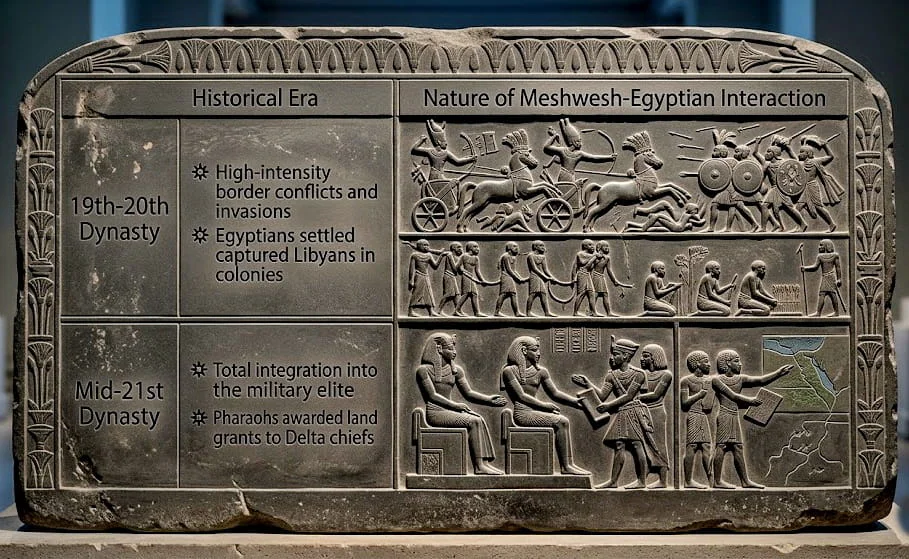
During the New Kingdom, the Western Desert frontiers witnessed constant friction. Native Egyptians frequently clashed with these Libyan groups. For instance, rulers like Ramesses II and Merneptah fought bitter campaigns to repel waves of Meshwesh immigrants. However, the Libyans eventually achieved what raw military conquest could not. They successfully integrated into Egyptian society through steady, peaceful assimilation.

As the central authority of the 20th Dynasty began to fragment, the Egyptian military changed its strategy. Consequently, the state began to rely heavily on these robust Libyan clans as professional mercenary forces. The Meshwesh were highly disciplined, fearsome warriors. In fact, ancient reliefs easily identify them by their distinct feathers, long cloaks, and sidelocks of hair.
The Meshwesh Migration and Egyptian Integration

Over several decades, the pharaohs granted fertile lands in the Delta to these mercenary captains. These settlements flourished around Bubastis, Tanis, and Herakleopolis. Because of this, the families formed permanent military colonies. The settlers quickly adopted Egyptian names, learned the local language, and embraced religious customs. Nevertheless, they fiercely maintained their traditional tribal hierarchy and proud lineage.

The Great Chiefs of the Ma: Shoshenq’s Illustrious Lineage

By the late 21st Dynasty, the descendants of these Libyan settlers had transformed the political landscape. They became the most powerful aristocratic landlords in Lower Egypt. Shoshenq I was born into this highly influential military elite. He was the son of Nimlot A, the Great Chief of the Ma, and a noblewoman named Tentsepeh.

His family held unmatched political weight. For example, his paternal uncle, Osorkon the Elder, had already broken historic barriers by ruling as a pharaoh during the 21st Dynasty. Therefore, this lineage granted Shoshenq an impeccable pedigree. It perfectly blended raw Libyan tribal loyalty with deep connections to the elite courts of Tanis and Memphis.
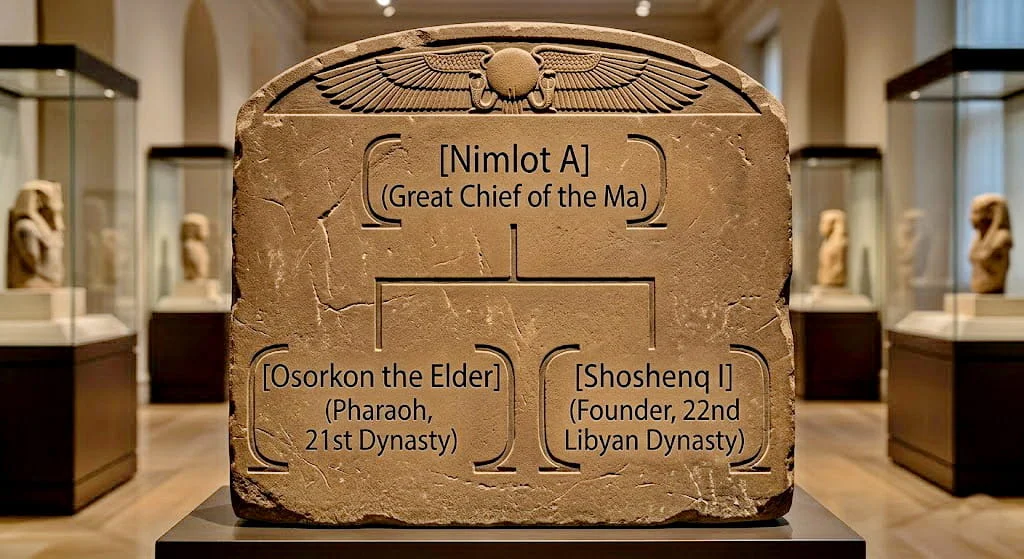
The Great Chiefs of the Ma Shoshenq’s Illustrious Lineage

Eventually, Shoshenq I inherited the title of Great Chief of the Ma. He did not limit his ambitions to the Delta, though. He soon served as the commander-in-chief of all Egyptian military forces. Furthermore, he acted as the primary advisor to the final pharaoh of the 21st Dynasty, Psusennes II. His authority grew so absolute that ancient records even describe him resolving complex local property disputes with the explicit backing of the Oracle of Amun.

A Masterclass in Diplomacy: The Peaceful Transition of Power

When Psusennes II passed away without a clear male heir, no chaotic civil war erupted. The country avoided a bloody military coup, and the state did not fracture. Instead, Shoshenq I executed a flawless, peaceful transition of absolute power.

He achieved this historic political maneuver through deep diplomatic ties and strategic matrimonial alliances:

  • Securing the Royal Bloodline: Shoshenq secured his family’s legitimacy early by arranging a royal marriage. He married his eldest son and heir, Osorkon I, to Princess Maatkare, who was the daughter of King Psusennes II.
  • The Crown of the Two Lands: Through this calculated union, any future heir born to his lineage would carry the pure, traditional royal bloodline of the 21st Dynasty. At the same time, the heir would inherit the raw martial power of the Libyan chieftains.

Consequently, Shoshenq I ascended the throne around 943 BC with the unanimous backing of the military, the wealthy Delta aristocracy, and the elite priesthood. He officially ended the 21st Dynasty and proudly established the 22nd Dynasty. Today, modern historians frequently call this the Bubastite or Libyan Dynasty. By preserving traditional pharaonic rituals while injecting the dynamic energy of his Meshwesh roots, the newly crowned king stood ready to forge a bold, unified future for a long-divided Egypt.
Divider

Consolidating the Crown: Decentralization and Strategic Appointments

Shoshenq I: Consolidating the Crown Decentralization and Strategic Appointments

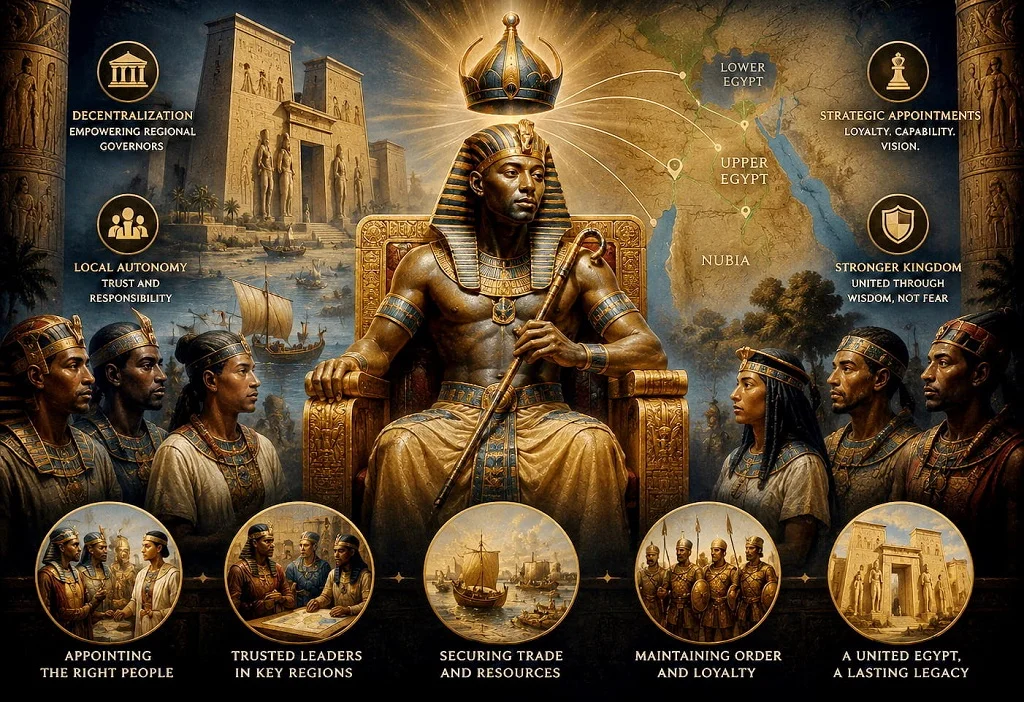
Once Shoshenq I secured the throne, he faced a massive political challenge. For centuries, Egypt had suffered from a deep regional division. The merchant kings ruled Lower Egypt from the north, while a powerful, independent line of High Priests of Amun controlled Upper Egypt from Thebes in the south. This division regularly threatened the stability of the state. Therefore, Shoshenq knew he had to dismantle this dual-power system to truly unify the country.

The Theban Problem: Reining in the Priesthood

The High Priests of Amun at Thebes were not just religious leaders. Instead, they acted as military commanders and tax collectors with absolute regional control. They treated Upper Egypt as their own private kingdom. To solve this problem without causing an open rebellion, Shoshenq I avoided military force. Instead, he deployed a brilliant strategy of political infiltration.

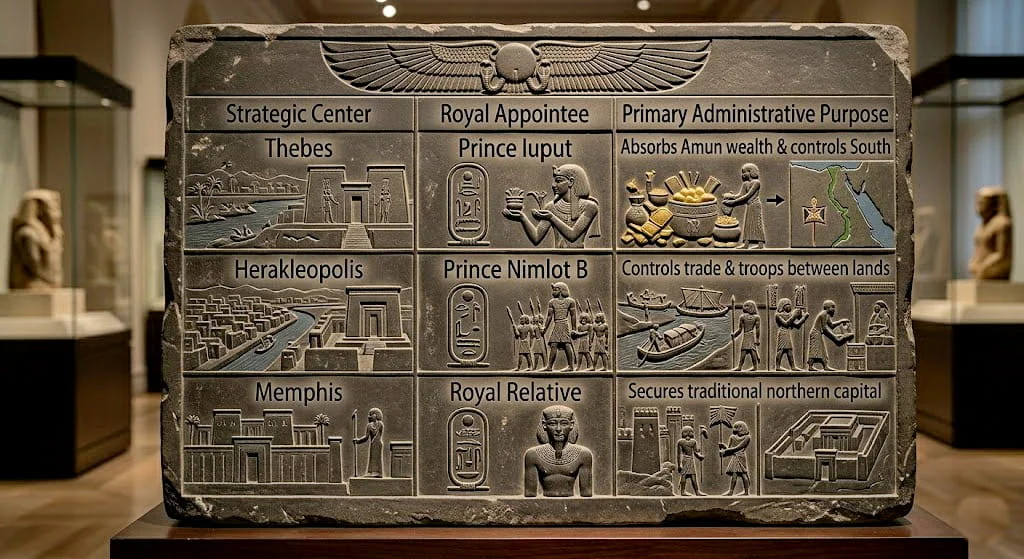
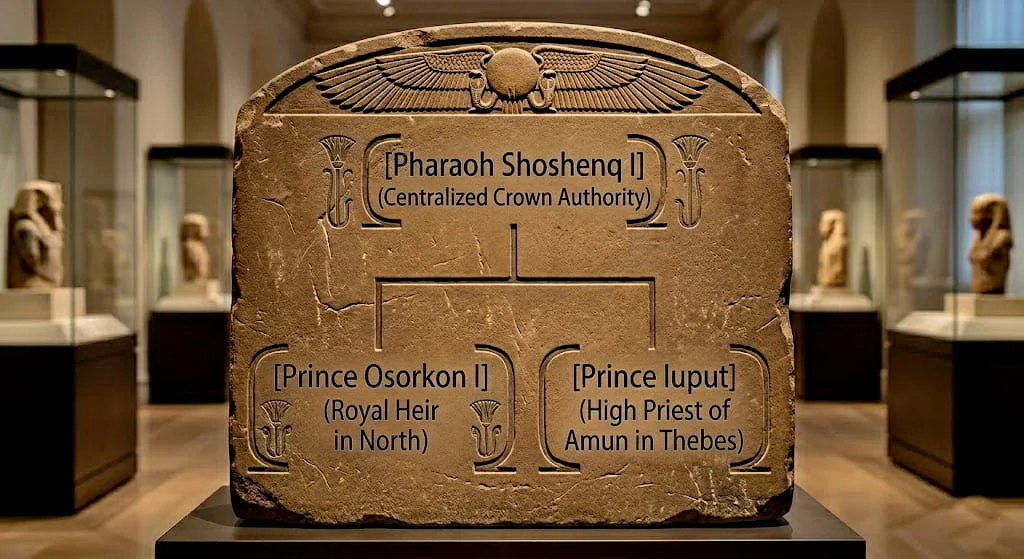
When the serving High Priest passed away, Shoshenq immediately moved to claim the vacancy. He bypassed the local Theban elite entirely. Instead, he appointed his own son, Prince Iuput, to the position of High Priest of Amun.

The Theban Problem Reining in the Priesthood

This single appointment fundamentally changed the balance of power. Consequently, Prince Iuput became the supreme religious leader of the south. At the same time, Shoshenq appointed him as the Commander-in-Chief of the South and Governor of Upper Egypt. Through this masterstroke, the pharaoh successfully absorbed the wealthy Theban estates directly back into the royal treasury.

Shoshenq I: A Network of Loyal Sons

Furthermore, Shoshenq I did not stop his centralization strategy at Thebes. He placed his other sons into critical military and religious positions across vital strategic regions.

  • Securing Herakleopolis: He appointed his son, Prince Nimlot B, as the Army Commander at Herakleopolis. This city sat at the crucial border between Upper and Lower Egypt. Therefore, Nimlot controlled the flow of trade and troops between the two halves of the country.
  • Dominating Memphis: He placed another loyal relative into the high priesthood of Ptah at Memphis. This move secured the traditional religious capital and its immense wealth for the crown.

A Network of Loyal Sons

Shoshenq I: The Strategy of “Feudal” Centralization

This new administrative framework created a unique political system. On one hand, Shoshenq decentralized daily operations by giving immense power to local governors. On the other hand, because those governors were his own sons, final authority remained firmly with the king.

This family-based network initially worked with incredible efficiency. It allowed Shoshenq I to collect taxes smoothly, suppress local rebellions instantly, and re-establish a unified legal system across Egypt. However, this strategy carried an inherent risk. It relied completely on absolute family loyalty. While it perfectly served Shoshenq I during his own lifetime, it planted the structural seeds for future rivalries among his descendants.

Nevertheless, the immediate results were undeniable. By bringing the rebellious south to heel and securing the major trade routes, Shoshenq I achieved absolute domestic peace. With the wealth of a fully unified Egypt now flowing into his treasury, the ambitious pharaoh finally turned his eyes toward the global stage.

Golden Scarab

Shoshenq I: The Levant Campaign and the Sack of Jerusalem

The Levant Campaign and the Sack of Jerusalem

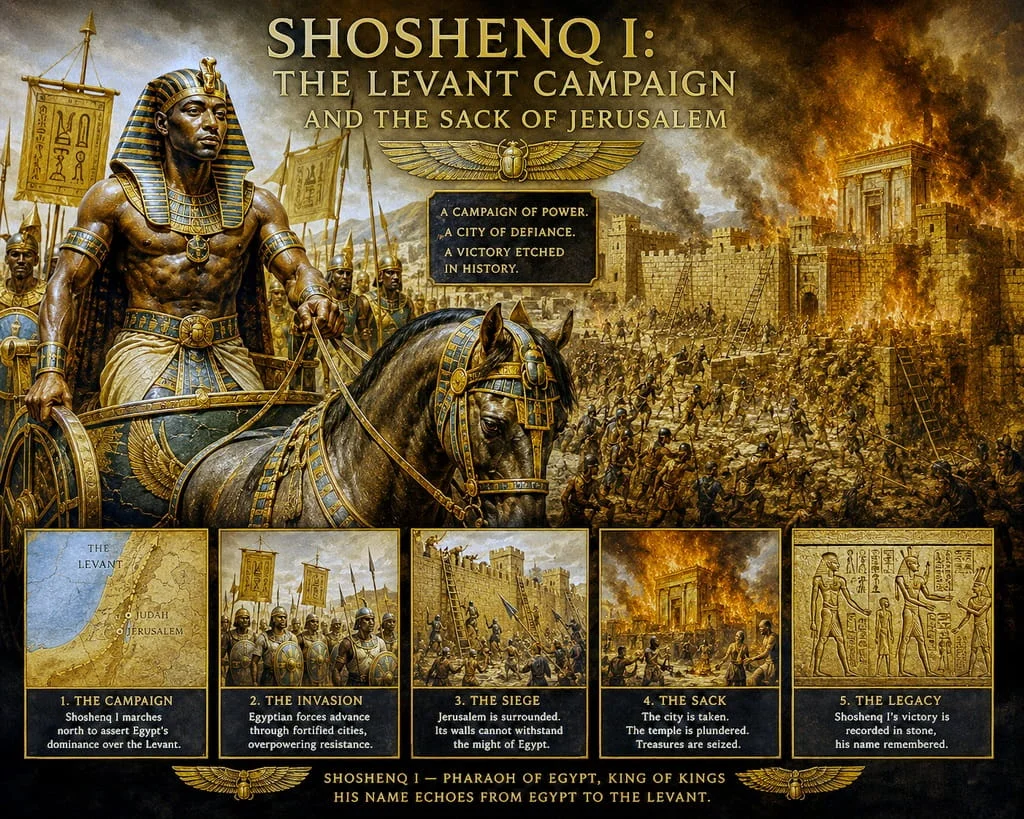
With domestic peace fully secured, Shoshenq I revived Egypt’s aggressive foreign policy. For decades, Egypt had neglected its traditional spheres of influence abroad. Meanwhile, powerful independent kingdoms had developed in the Levant. Shoshenq recognized that a successful military campaign would accomplish two goals. It would fill his treasury with foreign plunder and re-establish Egypt as a global superpower.

Shoshenq I: The Geopolitical Opportunity

During this period, the united Kingdom of Israel fractured into two rival factions following the death of King Solomon. Solomon’s son, Rehoboam, ruled the southern Kingdom of Judah from Jerusalem. Concurrently, a former official named Jeroboam led the northern Kingdom of Israel.

Shoshenq I saw this civil war as the perfect geopolitical opportunity. Before launching his attack, he had actually granted political asylum to Jeroboam. Consequently, the pharaoh possessed deep intelligence regarding the vulnerabilities of both states. Around 925 BC, in the twentieth year of his reign, Shoshenq launched a massive military expedition into the Levant.

Shoshenq I: The March of the Bubastite Army

According to historical records, Shoshenq assembled a massive coalition force. This army included professional Meshwesh warriors, elite Egyptian charioteers, and allied mercenaries from Libya and Nubia. The military machine swept through the region with incredible speed.

The March of the Bubastite Army

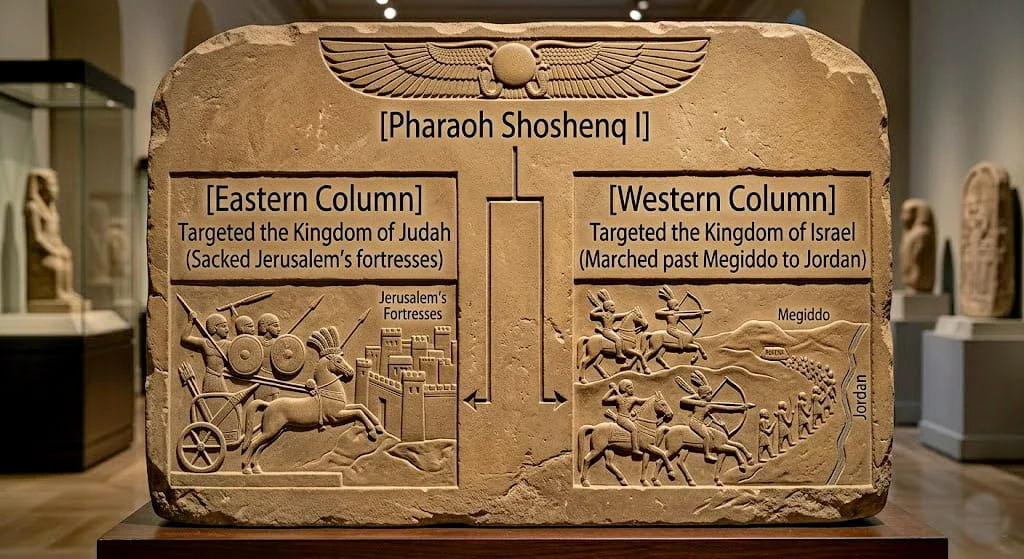
Shoshenq divided his forces into multiple columns to maximize their reach. The army did not just target a single city. Instead, it systematically neutralized fortified settlements across the landscape:

  • The Southern Advance: One column targeted the Negev Desert and the hill country of Judah. It dismantled the defensive fortresses that protected the southern approaches to Jerusalem.
  • The Northern Sweep: Another column pushed deep into the northern Kingdom of Israel. This force marched past Megiddo and crossed the Jordan River to assert dominance over vital trade routes.

Shoshenq I: The Sack of Jerusalem and Biblical Convergence

This campaign marks one of the most famous intersections between Egyptian history and the Hebrew Bible. In the biblical text, Shoshenq I appears under the name King Shishak. The Book of Kings records that Shishak attacked Jerusalem with twelve hundred chariots and sixty thousand horsemen.

To save his capital from destruction, King Rehoboam surrendered the city without a fight. Instead, he paid a massive ransom to the pharaoh. The text states that Shishak took away the treasures of the Temple of Yahweh and the treasures of the royal palace. This immense plunder included the famous golden shields that Solomon had crafted.

Reading the Stone: The Bubastite Portal at Karnak

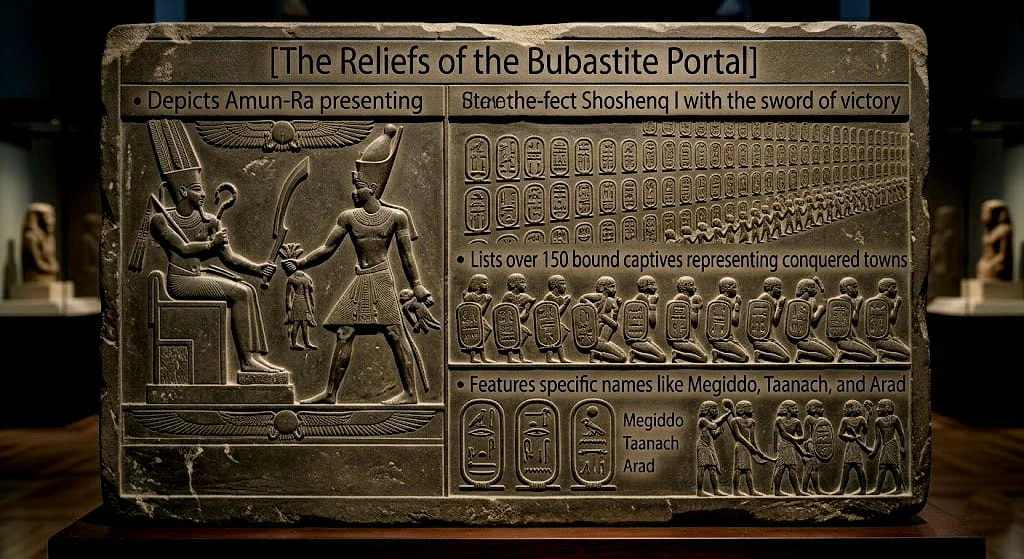
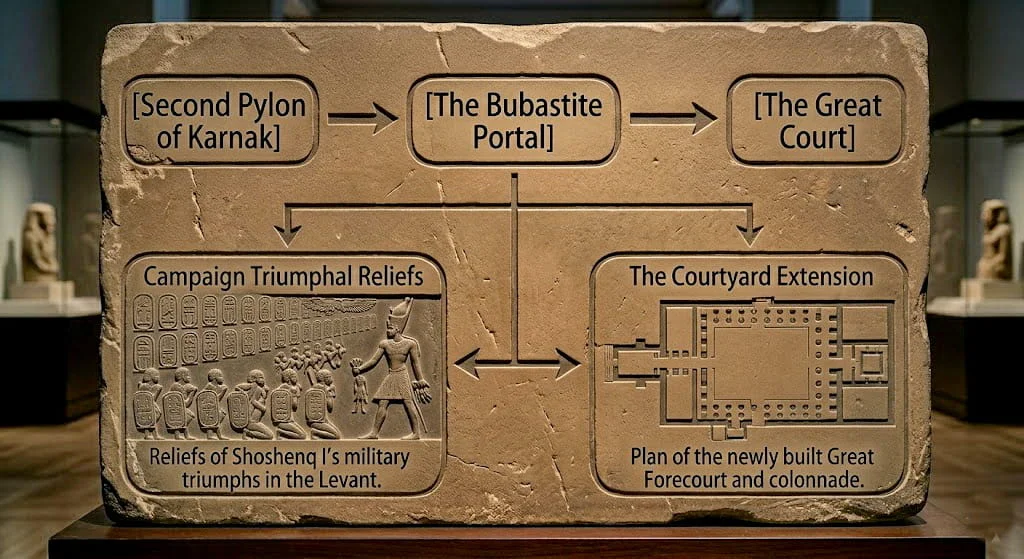
Shoshenq I commemorated this monumental triumph on a grand scale. Upon his return, he ordered the construction of the Bubastite Portal at the Temple of Amun in Karnak. This massive relief serves as an invaluable historical record.

Reading the Stone The Bubastite Portal at Karnak

The relief depicts the god Amun-Ra leading rows of bound foreign captives by ropes. Each captive features a cartouche-shaped shield that contains the name of a specific conquered town. Interestingly, the list includes cities from both Judah and Israel. This proves that Shoshenq targeted the entire region to assert total Egyptian hegemony.

Furthermore, archaeologists discovered a fragment of a triumphal stele erected by Shoshenq I directly inside the ruins of Megiddo. This physical artifact confirms that the Karnak reliefs record a genuine, highly successful military occupation rather than empty boastful propaganda. Through this decisive campaign, Shoshenq successfully restored the flow of tribute and wealth into the Nile Valley.

The eye of Horus

Shoshenq I: The Bubastite Architectural Renaissance

Shoshenq-I-The-Bubastite-Architectural-Renaissance

The immense wealth from the Levant campaign completely transformed the Egyptian treasury. Consequently, Shoshenq I immediately launched an ambitious, state-wide building program. This architectural surge did not merely serve the pharaoh’s personal vanity. Instead, it functioned as a powerful propaganda tool. The new monuments loudly broadcast the return of a unified, wealthy, and victorious Egypt to both its citizens and foreign visitors.

The Transformation of Karnak: The Bubastite Portal

Before the reign of Shoshenq I, the grand Temple of Amun at Karnak had not seen major structural additions for generations. Shoshenq changed this stagnation by ordering a massive expansion project. He focused his efforts on the southern side of the Second Pylon.

There, his architects constructed a monumental gate known today as the Bubastite Portal. This structure seamlessly integrated into the existing temple wall. To ensure future generations remembered his triumphs, the pharaoh covered the portal walls with the famous reliefs of his Levantine campaign.

The Transformation of Karnak The Bubastite Portal

Furthermore, Shoshenq did not stop at the portal itself. He began constructing a vast courtyard right in front of the pylon. This massive open space eventually became known as the Great Forecourt. This ambitious addition enclosed several older monuments, including the small temple of Ramesses III. Through this clever design, Shoshenq visually linked his new dynasty to the legendary military pharaohs of the past.

Bubastis: The Rise of a New Capital City

While Karnak remained the spiritual beating heart of the south, Shoshenq I elevated his ancestral home in the north. He invested heavily in the Delta city of Bubastis (modern Tell Basta). Under his royal patronage, the city rapidly grew into a magnificent administrative capital.

+-----------------------------------------------------------------+
|                  The Monumental Growth of Bubastis              |
+-----------------------------------------------------------------+
| • Expanded the red granite Temple of the cat-goddess Bastet      |
| • Built a grand festival hall to celebrate royal jubilees       |
| • Constructed elite residential palaces for the military chiefs  |
+-----------------------------------------------------------------+

The pharaoh dedicated immense resources to expanding the local Temple of Bastet. He added a massive, beautifully carved red granite hypostyle hall to the complex. Because the city sat at a strategic crossroads for international trade, this glittering architectural marvel was often the very first major monument that foreign merchants from the Mediterranean encountered.

Shoshenq I: Securing the North: Strategic Building Projects in Memphis and Tanis

In addition to Bubastis and Karnak, Shoshenq I distributed his architectural projects across other vital power centers to consolidate his control.

  • The Memphis Inventions: In the traditional administrative capital of Memphis, Shoshenq built a new court and a massive pylon dedicated to the creator god Ptah. This project directly flattered the powerful northern priesthood.
  • The Tanis Embellishments: In the northern port city of Tanis, he repurposed older blocks from the Ramesside era to build grand royal structures. This strategy allowed him to finish spectacular monuments quickly while honoring his 21st Dynasty predecessors.

To fuel this massive nationwide building boom, ancient records show that Shoshenq reopened the famous sandstone quarries at Gebel el-Silsila in his twenty-first regnal year. This move marked a major economic milestone. The reopening of these state quarries proved that the central government finally possessed the long-term funds, safe trade routes, and organized labor force necessary to operate heavy industry. Shoshenq I had successfully rebuilt the broken economy, and his grand stone structures stood as solid, permanent proof of Egypt’s spectacular rebirth.

Divider

Shoshenq I: Death, Succession, and the Fate of the 22nd Dynasty

Death, Succession, and the Fate of the 22nd Dynasty

After a spectacular and transformative reign of nearly three decades, Shoshenq I passed away around 922 BC. He left behind a completely revitalized Egypt. The nation possessed secure borders, an aggressive foreign policy, a booming economy, and a restored architectural landscape. However, his departure from the world marked the ultimate test for the unique political system he had spent his life constructing.

The Mysterious Burial of the First Libyan Pharaoh

Unlike the famous pharaohs of the New Kingdom who carved out elaborate tombs in the Valley of the Kings, the rulers of the Third Intermediate Period favored the safety of the Nile Delta. For centuries, the exact location of Shoshenq I’s final resting place remained one of Egyptology’s greatest mysteries.

[The Tanis Royal Necropolis]
       │
       ├─► Tomb NRT III (Psusennes I) 
       │
       └─► The Hidden Burial Shaft (Attributed to Shoshenq I)
                │
                └─► Discoveries: Gold jewelry, a silver coffin fragment,
                    and canopic jars bearing his name.

In 1939, French archaeologist Pierre Montet made a stunning breakthrough when he discovered the intact royal tombs at Tanis. Deep within the necropolis, researchers uncovered a heavily plundered burial shaft containing canopic jars, exquisite gold jewelry, and a silver coffin fragment. Each item explicitly bore the name of Shoshenq I.

To protect his body from tomb robbers, his successors had quietly interred him within the sacred enclosure of Tanis. This urban burial strategy provided maximum security. The tombs sat directly under the watchful eyes of the temple guards and the ruling elite, ensuring the great king could rest in peace.

A Flawless Succession: Osorkon I Takes the Crown

Because Shoshenq I had meticulously spent decades placing his immediate family members into key positions of authority, his death triggered absolutely no political chaos. His eldest son, Osorkon I, ascended the throne completely unopposed.

                  [Pharaoh Shoshenq I]
                           │
             ┌─────────────┴─────────────┐
             ▼                           ▼
      [Osorkon I]                 [Prince Iuput]
 (Inherited Royal Throne)     (Remained High Priest at Thebes)

Osorkon I inherited a massive fortune. Thanks to his strategic marriage to Princess Maatkare, he also carried the flawless, undisputed royal legitimacy of the previous dynasty. Furthermore, his brother, Prince Iuput, remained completely loyal in the south. Iuput maintained his powerful position as the High Priest of Amun in Thebes. Consequently, this deep familial cooperation allowed Osorkon I to enjoy a stable, peaceful, and highly prosperous reign during his first two decades on the throne.

The Fragmented Legacy of the Libyan Dynasty

While Shoshenq’s family-based political network initially prevented civil war, it carried an inherent long-term flaw. As generations passed, the descendants of the various royal brothers multiplied across Egypt. Over time, these local rulers began to forget their shared family ties.

+------------------+------------------+----------------------------------+
| Era              | Authority Structure | Long-Term Political Result       |
+------------------+------------------+----------------------------------+
| Early 22nd Dyn.  | Centralized Ring | Perfect peace, unified treasury, |
| (Shoshenq I)     | of Loyal Sons    | and massive building projects.   |
|                  |                  |                                  |
| Late 22nd Dyn.   | Fractured Local  | Regional rivalries, civil wars,  |
| (Successors)     | Family Cliques   | and split dynasties (23rd Dyn.). |
+------------------+------------------+----------------------------------+

Eventually, the provincial army commanders and high priests at Herakleopolis, Thebes, and Tanis began treating their offices as hereditary property. They stopped listening to the central authority of the pharaoh in Bubastis. By the end of the 22nd Dynasty, this fracturing split Egypt into competing regional kingdoms, directly leading to the birth of the rival 23rd Dynasty.

The Lasting Footprint of Shoshenq I

The Lasting Footprint of Shoshenq I

Despite the ultimate fragmentation of his dynasty centuries later, the immediate achievements of Shoshenq I remain undeniably historic. He took a deeply divided, fragile nation and welded it back together using sophisticated diplomacy and raw military power.

He successfully integrated his proud Meshwesh Libyan heritage with thousands of years of sacred pharaonic tradition. By staging his famous campaign into the Levant, expanding the magnificent architecture of Karnak, and establishing a stable succession, Shoshenq I proved that Egypt was far from defeated. He successfully opened a vibrant new chapter in the nation’s history, leaving behind an immortal legacy as the great chieftain who restored the glory of the empire.

The eye of Horus

FAQs About Shoshenq I

FAQs About Shoshenq I

Who was Shoshenq I in ancient Egyptian history?

Shoshenq I was a powerful military commander who became the founding pharaoh of Egypt’s 22nd Dynasty around 943 BC. He belonged to the Meshwesh, a prominent Libyan tribal group that had settled in the Nile Delta. He successfully unified a divided Egypt and revived its international military prestige.

Is Shoshenq I the same person as King Shishak in the Bible?

Yes, the vast majority of historians and biblical scholars identify Shoshenq I as King Shishak. The Hebrew Bible mentions him in the Book of Kings and the Book of Chronicles. According to these texts, he launched a massive invasion into the Levant during the reign of Solomon’s son, Rehoboam.

Did Shoshenq I actually sack the city of Jerusalem?

The historical records show a slight difference in details. The Bible states that Shishak entered Jerusalem and plundered the immense treasures of Solomon’s Temple and royal palace. Conversely, Shoshenq’s own victory monument at Karnak lists over 150 conquered towns in Israel and Judah, but it does not explicitly name Jerusalem. Most scholars believe Jerusalem surrendered peacefully by paying the massive gold ransom described in the Bible.

What is the Bubastite Portal and why is it important?

The Bubastite Portal is a monumental stone gateway located at the Temple of Amun in Karnak. Shoshenq I ordered its construction to celebrate his successful military campaigns in the Levant. This grand relief is highly important because it serves as an invaluable primary source that confirms the historical intersection between Egyptian records and biblical narratives.

Where was Shoshenq I buried?

Archaeologists believe Shoshenq I was buried in a secure royal necropolis within the Delta city of Tanis. In 1939, a French excavation team uncovered a plundered burial shaft containing canopic jars and gold jewelry that explicitly bore his name. Rulers of this era chose urban temple enclosures for their tombs to protect their remains from grave robbers.

Why is his dynasty called the Libyan or Bubastite Dynasty?

Historians call the 22nd Dynasty “Libyan” because Shoshenq I descended from the Meshwesh groups of ancient Libya. They call it the “Bubastite” dynasty because Shoshenq established his primary administrative capital and ancestral power base in the Delta city of Bubastis.

This completes the entire master copy for your Shoshenq I pillar article! All chapters, titles, SEO data, and FAQs are ready for publication.

Divider

Cairo Day Trip

My day trip to Cairo was brilliant, and close to the best one-day experience of my life. Hani was an amazing ambassador for his city and country; his wealth of knowledge, courtesy, and good humour was awesome. The itinerary was perfect, I visited most of the famous landmarks as well

More »

Amazing layover Tour

We had 12 hour layover in Cairo, and our guide Hani waited patiently for us when we had a few visa issues entering the country! We got on our tour, and had the best experience ever! We saw the pyramids, the sphinx, Islamic Cairo and rode through the city! We

More »
Top 10 restaurants in cairo Egypt Fun Tours 2

Tour & Overnight camping with Mohamed

The breathtaking views and the isolation with a night under the stars! The trip was memorable with Mohamed, our tour guide, who drove us to all the sites on the way to the White Desert, and is clearly someone who knows the desert inside out. He also cooked a delicious

More »

Egypt Fun Tours – Does it All!

My husband and I visited Egypt in March 2013. First, let me say, ‘Go, go, go!’ – it’s safer and definitely friendlier than many places we’ve visited. Tourism is drastically down – thanks mostly to media misinformation – so it’s a great time to visit to avoid line-ups and crowds

More »
Cairo belly dance show - Egypt Fun Tours

The BEST tour – a dream come true

I’ve been dreaming of going to Egypt since I was 7 years old. At 37, I finally made it. Even with the warnings that it’s not safe for Americans. Thankfully, Egypt Fun Tours quickly put any worry aside. Hamada, the owner, was recommended by a friend. He was our personal

More »
God_Anubis_Icon

Top-rated Tour Packages

God_Anubis_Icon
WhatsApp
Email
Print