The Two Ladies (Nebty): Unveiling Wadjet and Nekhbet

The Two Ladies (Nebty) form the essential foundation of Ancient Egyptian royalty, embodying the political and spiritual unity of the entire civilization. Represented by the fierce cobra goddess Wadjet of Lower Egypt and the protective vulture goddess Nekhbet of Upper Egypt, their sacred union created the Nebty name, one of the most vital titles a pharaoh possessed. This dual title was a mandatory declaration of sovereignty, explicitly confirming the ruler's divine right to control all of Egypt in harmony, thereby establishing the principle of cosmic order (Ma'at) and serving as the most potent symbol of national legitimacy from the earliest dynasties to the time of the Ptolemies.

The rise of Ancient Egypt was a monumental achievement. It involved the unification of two distinct and powerful kingdoms. This political merger demanded a strong, spiritual foundation. Consequently, two powerful female deities created this national fusion. This dual entity is known as the “Two Ladies,” or Nebty.

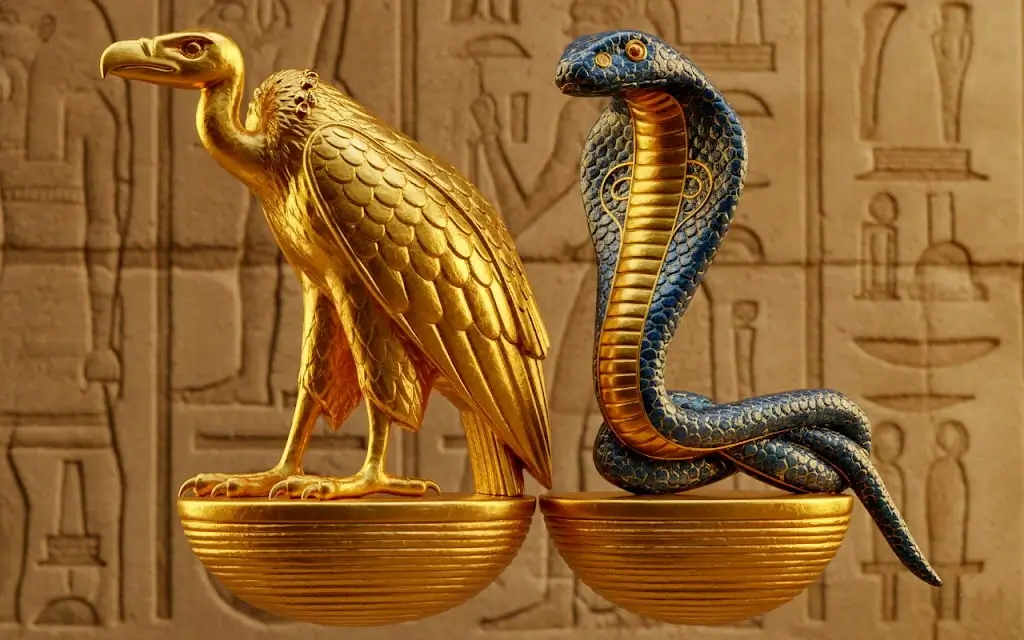
The Two Ladies are the cobra goddess Wadjet of the North and the vulture goddess Nekhbet of the South. They are more than just protectors. They are the political architects of the Egyptian state. Furthermore, their combined image was so crucial that it became one of the essential titles for every single pharaoh. This title confirmed the ruler’s divine legitimacy over the whole land.

We will comprehensively explore the origins, individual powers, and profound political role of the Two Ladies. We will examine how Wadjet and Nekhbet shaped the concept of Egyptian kingship. Ultimately, you will understand why the Nebty title was the symbolic heartbeat of the Egyptian throne. We must first look at the goddesses individually to understand their combined power.

FUN

The Deities: Wadjet and Nekhbet

The Deities; Wadjet and Nekhbet

The power of the Two Ladies stems from their ancient roles as regional patronesses. Their authority stood firm long before the nation received central governance.

Wadjet: The Fiery Cobra of the North

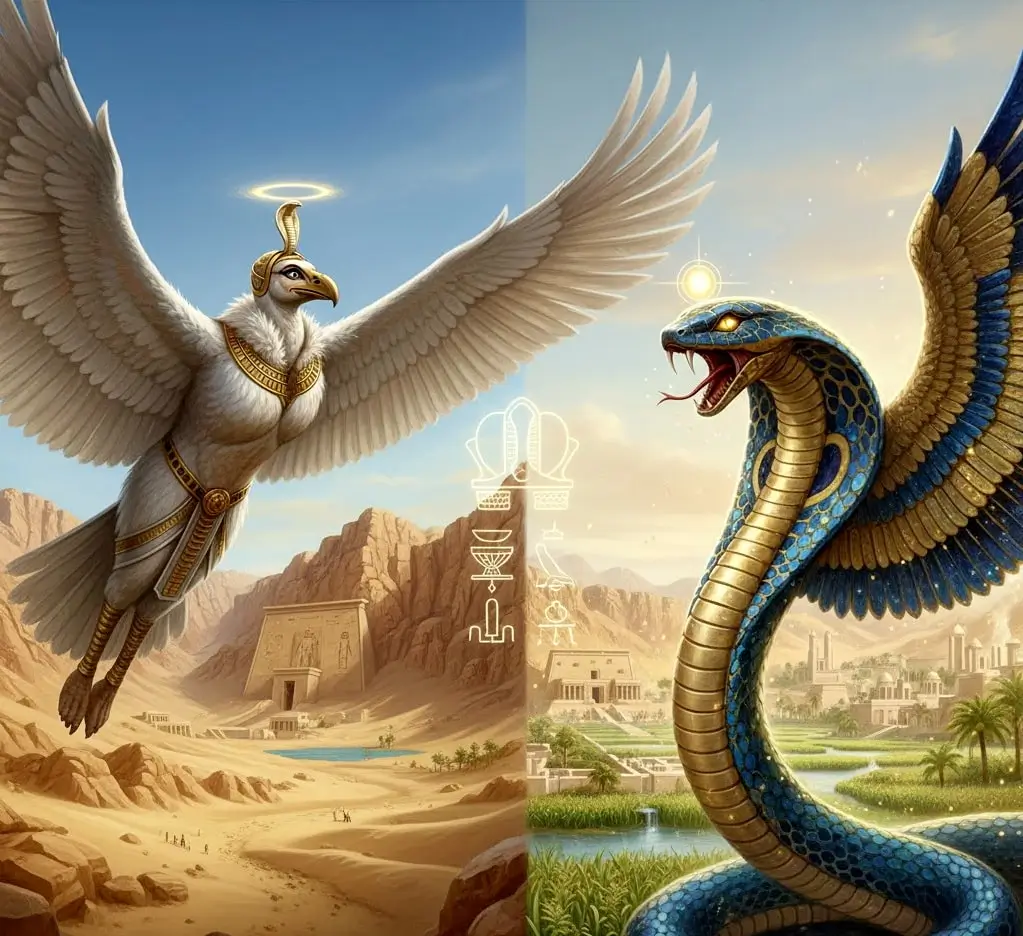
Wadjet was the ancient patron deity of Lower Egypt, the area known as the Delta. Her primary cult center was the city of Per-Wadjet, which the Greeks later called Buto.

She typically appears as a rearing Egyptian cobra (Naja haje). Therefore, she is the direct source of the powerful Uraeus symbol that the pharaoh wore. Wadjet embodied the fierce, fiery defense of the king and the fertile northern lands. Her venom represented divine judgment. In essence, she functioned as the protective eye of the sun god Ra. She enforced the cosmic order. Her power was balanced by the ancient protector of the South.

Nekhbet: The Vulture of the South

Nekhbet was the equally ancient patron deity of Upper Egypt, the long stretch of the Nile Valley. Her main cult center was the city of Nekheb, now known as Elkab.

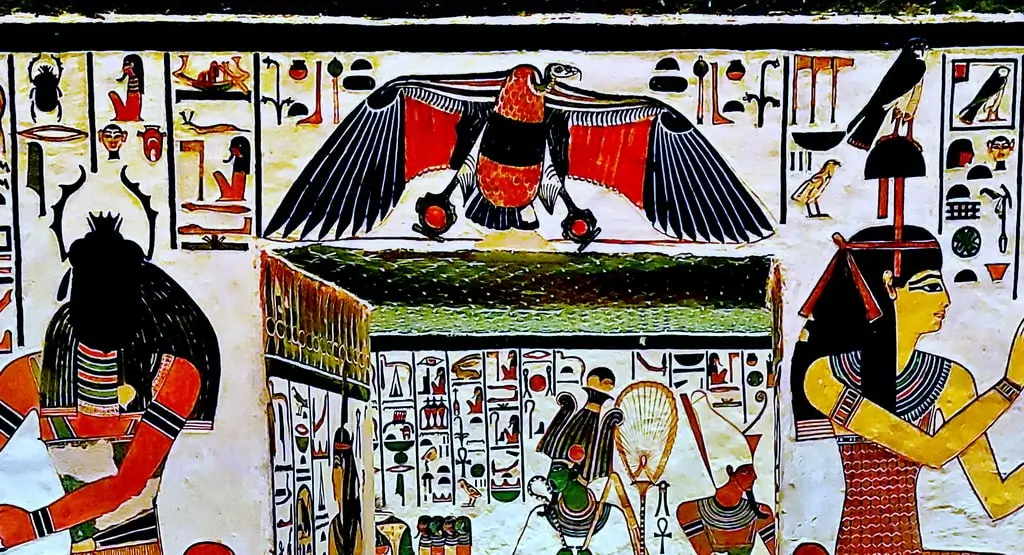
She usually appears as a vulture. This majestic bird symbolized a nurturing and maternal figure. Unlike the fierce Wadjet, Nekhbet’s protection often involved an enveloping, motherly embrace. She frequently hovers above the pharaoh with her wings outstretched. She provided a divine canopy over the ruler. The true power emerged when these two distinct figures became one symbolic unit.

FUN

The Nebty Name: Political and Religious Unification

The Nebty Name Political and Religious Unification - The Two Ladies

The “Two Ladies” were not merely figures in local mythology. They formed essential components of the centralized Egyptian state. Their dual identity created the basis of one of the most ancient royal titles.

The Fivefold Titulary: Kingship Defined

Every Egyptian pharaoh held a complex set of five official names. This system, known as the Royal Titulary, defined their authority, lineage, and cosmic function. The Nebty name occupied the second most important title, following the Horus name.

Significantly, the Nebty Name or Two Ladies Name served a singular purpose. It explicitly declared the pharaoh’s political dominion over the entire, unified nation.

  • Horus Name: Linked the King to the celestial god Horus.
  • Nebty Name: Linked the King to the territorial goddesses of North and South.
  • Golden Horus Name: Symbolized the king’s triumph and divinity.
  • Prenomen (Throne Name): The King of Upper and Lower Egypt (inside a cartouche).
  • Nomen (Birth Name): The Son of Ra (inside a cartouche).

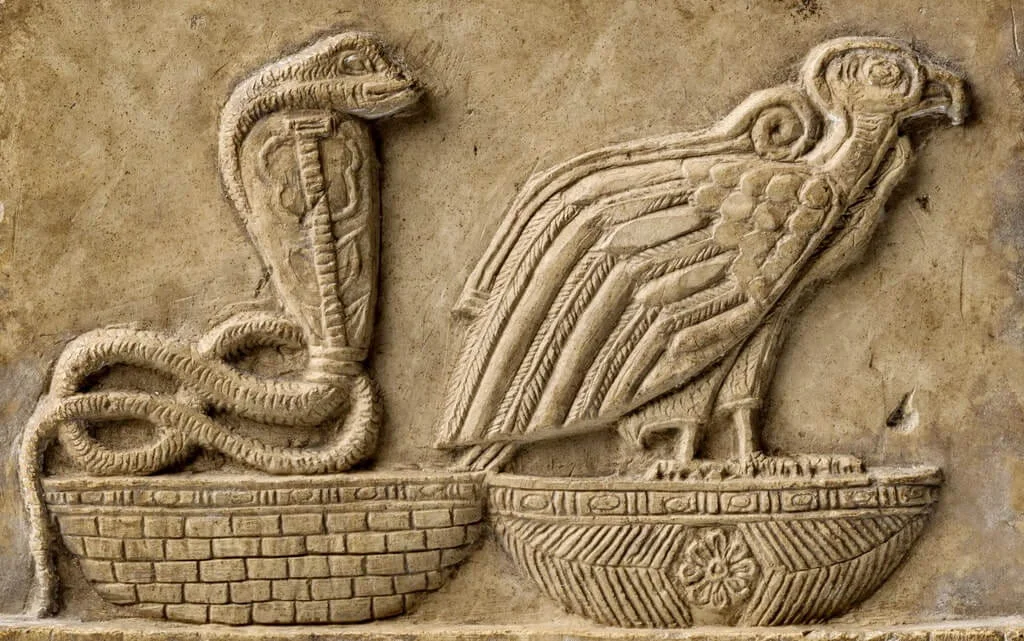
The Nebty name always begins with the hieroglyphs of the vulture (Nekhbet) and the cobra (Wadjet) sitting on baskets, which represent the dual noun nebty (“the two ladies”). This symbol never went into a cartouche.

Symbolism of Duality (Ma’at)

The power of the Two Ladies originates in the Egyptian obsession with Ma’at, or cosmic balance and order. Wadjet and Nekhbet embody this concept of complementary opposites. They functioned as distinct forces working toward a singular goal: the preservation of Egypt.

  • The Cobra and Vulture: One strikes from the ground; the other protects from the air.
  • The Crown: Wadjet represented the Red Crown of the North; Nekhbet represented the White Crown of the South. Their unification created the Double Crown (Pschent).

Therefore, the pharaoh wearing the Nebty title declared himself the pivotal point of balance between these opposing, but necessary, forces. He was the Lord who brought harmony. The Nebty title did not remain static; it changed over time, reflecting the ruler’s political achievements.

Historical Development of the Name

The Nebty name is one of the oldest titles, appearing as early as the First Dynasty with King Aha. Its use instantly symbolized the successful unification that the dynastic founder, Menes (Narmer), achieved.

Over time, pharaohs customized their Nebty name. They used it as a sort of mission statement for their reign. This allowed them to communicate their specific political goals through divine language.

Pharaoh Nebty Name Translation Significance
Amenhotep III “Who has established laws and pacified the Two Lands?” Emphasizes internal stability and the creation of order (laws).
Thutmose III “Enduring in kingship like Re in heaven.” Links his military rule directly to the eternal, cosmic power of the Sun God.
Hatshepsut “She of the Two Ladies, Flourishing of Years” A female pharaoh emphasizing stability and continuity of the divine mandate.

In conclusion, the Nebty name was a powerful, condensed piece of royal propaganda. It guaranteed the pharaoh’s legitimacy by invoking the divine patronesses of every corner of the land.

Ma’at: Harmony, Order, and Cosmic Balance in Ancient Egypt

To stand amidst the wonders of Egypt is to encounter an entire civilization rooted in...
Related post
FUN

The Two Ladies in Art and Architecture

The Two Ladies in Art and Architecture

The ubiquity of Wadjet and Nekhbet in royal art reinforced their profound importance. Their presence turned ordinary royal objects into sacred regalia and architecture into protective temples.

Royal Regalia and Crowns

The visual presence of the Two Ladies on the pharaoh’s regalia was absolute. They nearly always appear side-by-side to visually cement the union.

  • The Nemes Headdress: The vulture and cobra famously stand guard over the ruler’s forehead. This protected the most vulnerable point of the pharaoh’s head.
  • The Double Crown: The Pschent crown itself represents a physical expression of the Two Ladies’ political success. The crown’s fusion of Red and White represented the fusion of Wadjet and Nekhbet’s territories.

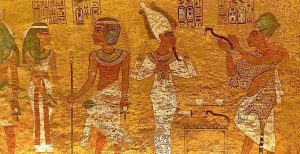
Furthermore, they appear to be guarding the most sacred royal relics. The colossal golden shrines of Tutankhamun’s burial chamber show images of the two goddesses. They stand with outstretched wings and hoods, ensuring the eternal protection of the King in the afterlife. Even when foreigners ruled Egypt, the power of the Two Ladies endured.

Foreign Rulers and Legitimacy

The political power of the Nebty title was so strong that even non-Egyptian rulers adopted it. They understood the ancient traditions of kingship.

  • The Kushite Pharaohs: Rulers from Nubia (Kush) adopted the full fivefold titulary, including the Nebty name. They did this to gain acceptance as genuine pharaohs from the powerful Egyptian priesthood.
  • The Ptolemies: The Greek dynasty founded by Ptolemy I, especially Cleopatra VII, embraced the traditional Egyptian titles. They strategically used the Nebty title in public inscriptions. This act was necessary to demonstrate their respect for the established order and to solidify their local control.

Consequently, the Nebty title survived the entire span of Egyptian independence. It endured because it was the non-negotiable symbol of a united Egypt.

The Winged Sun Disk: Meaning, History, and Supreme Power

The Winged Sun Disk is Ancient Egypt's most powerful symbol, merging the protective might of...
Related post
FUN

The Two Ladies: The Eternal Balance

The Nebty Name The Two Ladies

The Two Ladies (Nebty) form the essential foundation of Ancient Egyptian royalty. They are the religious and political framework upon which the greatest civilization of the ancient world built itself. To summarize, this dual goddess concept established three principles of Egyptian rule:

  1. Dual Authority: It ratified the merger of Upper and Lower Egypt into one political entity.
  2. Divine Legitimacy: It provided the pharaoh with an ancient, undeniable claim to the throne under the protection of both regional goddesses.
  3. Cosmic Balance: It visually represented the principle of Ma’at, showing the harmony of complementary protective forces.

The Nebty title was more than just a name. It was an ideological declaration that formed a potent message inscribed on temples, tombs, and scrolls for over three thousand years. It guaranteed the pharaoh’s unquestionable power and the continuity of the Egyptian state.

Ultimately, the story of the Two Ladies is the story of Egypt itself: a story of powerful duality forged into an eternal, successful unity.

The Flower of Life Symbol: Meaning, Origins & Sacred Geometry

The Flower of Life is a potent symbol in sacred geometry, composed of multiple evenly-spaced,...
Related post
FUN
Older people Tour to Glorious Egypt...
Admire the Egyptian Marvels in 6 Days during Xmas and New Year Holidays....

Islamic cairo and khan el khalili- great tour

Wonderful tour with the guide Hamada. I did not feel rushed at all. He explained a lot of facts about the city, the mosque, the water storage room, and also brought me to no-hassle shops. He picked a great place to eat and have Turkish coffee and a cold lemon

More »

Great one day tour in Cairo

My husband and I had a long layover in Cairo on our way to Kenya in 2010. Since we had never been to Egypt, we decided to sign up for a one-day tour with Egypt Fun Tours Day Trips. Our guide was there when we arrived and quickly guided us

More »

Alexandria! Wow!

Muhammad is the best! He showed me a world I never thought possible! The tombs in Alexandria, by far, were my favorite! I never knew there was a place on earth that contained both Greek and Egyptian carvings in the same tombs! The history and culture of Egypt is so

More »
3-day desert safari trip from Cairo—Egypt Fun Tours

Book with Egypt Fun Tours!!

In April 2011, my husband and I, after great debate, took a trip to Egypt. Because of the political situation, we decided to book a tour for our time in Cairo and Luxor. We are very happy that we did, since these are two cities that should not be missed.

More »

Cairo Day Trip

My day trip to Cairo was brilliant, and close to the best one-day experience of my life. Hani was an amazing ambassador for his city and country; his wealth of knowledge, courtesy, and good humour was awesome. The itinerary was perfect, I visited most of the famous landmarks as well

More »
Isis with wings

Top-rated Tour Packages

Isis with wings