Muhammad Ali Pasha: The Founder of Modern Egypt and His Legacy

Meet Muhammad Ali Pasha, the Albanian commander who arrived in the chaos following Napoleon's exit and rose to become the "Father of Modern Egypt." This guide chronicles his dramatic seizure of power—including the infamous Massacre of the Mamluks at the Citadel—and his revolutionary reforms that introduced cotton, industry, and a modern army. Explore the legacy of the man who founded a dynasty that ruled for 150 years and built the iconic Alabaster Mosque that dominates the Cairo skyline today.

The Albanian Who Remade Egypt

History is often shaped by the unlikeliest of figures. The father of modern Egypt was not a pharaoh, nor was he even Egyptian. He was an Albanian tobacco merchant turned commander, sent by the Ottoman Empire to restore order, who instead ended up stealing the country for himself. This man was Muhammad Ali Pasha. Emerging from the power vacuum left by Napoleon’s departure in 1801, he navigated a chaotic three-way struggle for control. Through brilliance, ruthlessness, and sheer force of will, he transformed Egypt from a medieval Ottoman province into a modern regional empire.

This guide explores the dramatic life of Muhammad Ali Pasha. We will detail his ruthless rise to power, including the infamous massacre that secured his throne, his revolutionary reforms that built a modern army and economy, and his architectural legacy that still crowns the Cairo skyline today.

Key Takeaways

  • The Founder: He is universally recognized as the “Father of Modern Egypt” for his sweeping modernization programs.
  • The Ruthless Tactician: He consolidated absolute power by famously massacring the Mamluk leaders at the Citadel in 1811.
  • The Reformer: He introduced long-staple cotton, modernized the army with European training, and built a state-run industrial economy.
  • The Builder: His Alabaster Mosque (Mosque of Muhammad Ali) at the Citadel is the most visible landmark in Cairo today.
FUN

The Rise to Power: Chaos and Opportunity

The Rise to Powerك Chaos and Opportunity

Following the withdrawal of Napoleon’s French forces in 1801, Egypt fell into a dangerous power vacuum. The country became a battleground for three distinct factions, each vying for total control.

A Three-Way Struggle for Control

First, there were the Ottomans, the official imperial rulers who sought to reassert their authority over the province. Second, the Mamluks, a feudal warrior caste who had dominated Egypt for centuries, returned from hiding to reclaim their lands and power. Finally, there was the Egyptian populace, tired of foreign occupation and chaos, led by influential religious scholars (the Ulama).

The Strategy: Divide and Conquer

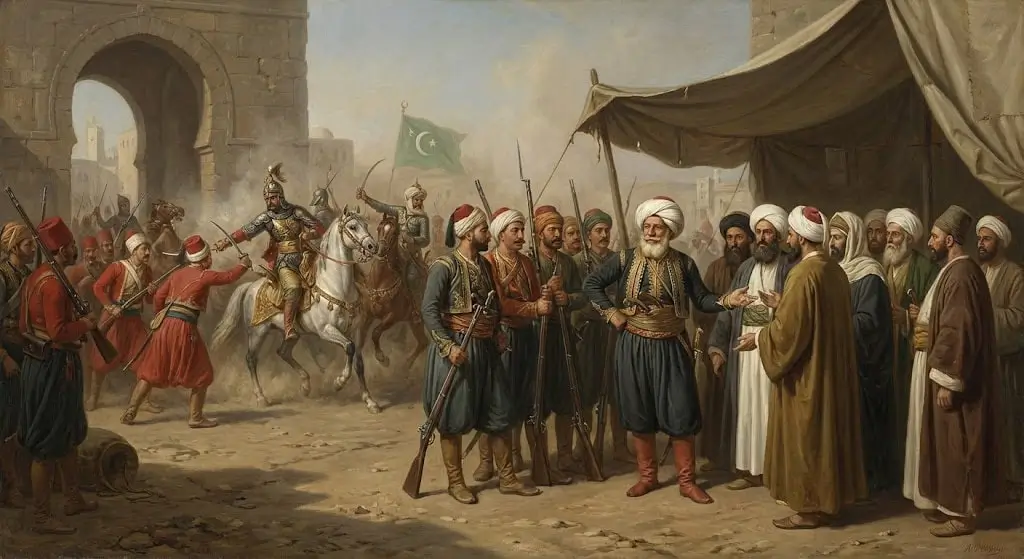
Into this chaos stepped Muhammad Ali. He commanded a regiment of Albanian mercenaries sent by the Ottoman Sultan. However, instead of blindly serving the empire, he played a brilliant and dangerous game. He initially aligned himself with the Mamluk leaders against the unpopular Ottoman governor. Then, sensing the tide turning, he switched sides, championing the rights of the common Egyptian people against the Mamluks’ brutality.

This populist move won him the support of the powerful Ulama. In a historic moment in 1805, the people of Cairo rose up and demanded that the Ottoman Sultan appoint Muhammad Ali as their Wali (Governor). The Sultan, facing a unified front, had no choice but to agree. Muhammad Ali had won the throne, but to keep it, he would need to eliminate his rivals permanently.

FUN

The Citadel Massacre: The Bloody Banquet

The Citadel Massacre; The Bloody Banquet - Muhamed Ali Pasha

While Muhammad Ali was now the governor, he was not yet secure. The Mamluks still controlled vast swathes of farmland and tax revenues, blocking his plans for modernization. In 1811, he decided to solve the problem with a single, brutal stroke.

The Trap

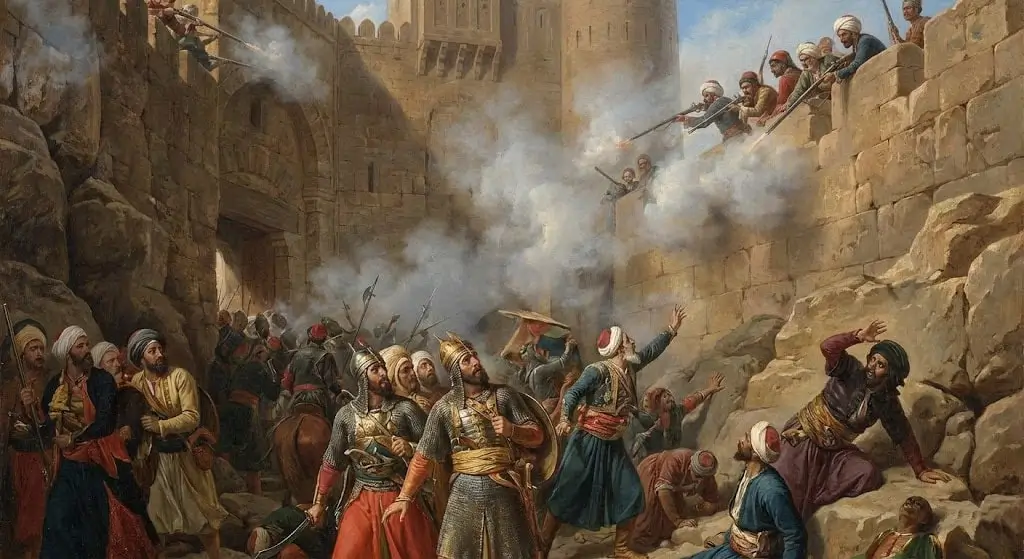
He invited 470 Mamluk princes to the Citadel of Saladin for a grand feast to celebrate his son’s appointment as the commander of an army bound for Arabia. The Mamluks, believing they were being honored, arrived in their finest ceremonial armor.

The Ambush

After the banquet, as the procession of Mamluks wound its way down the narrow, rocky passage known as Bab al-Azab, the gates suddenly slammed shut at both ends. Trapped between high walls with no escape, the Mamluks looked up to see Muhammad Ali’s Albanian soldiers lining the ramparts.

The soldiers opened fire. It was a slaughter, not a battle. Within minutes, the entire Mamluk leadership was dead. This massacre ended centuries of Mamluk rule in a single afternoon and left Muhammad Ali with absolute, unchallenged power over Egypt.

Alexander the Great: Travel the Path of a Pharaoh-King

Alexander the Great became Pharaoh in Egypt (332 BC). He founded Alexandria, a world capital,...
Related post
FUN

Building a Modern State: Cotton, Canals, and Conscription
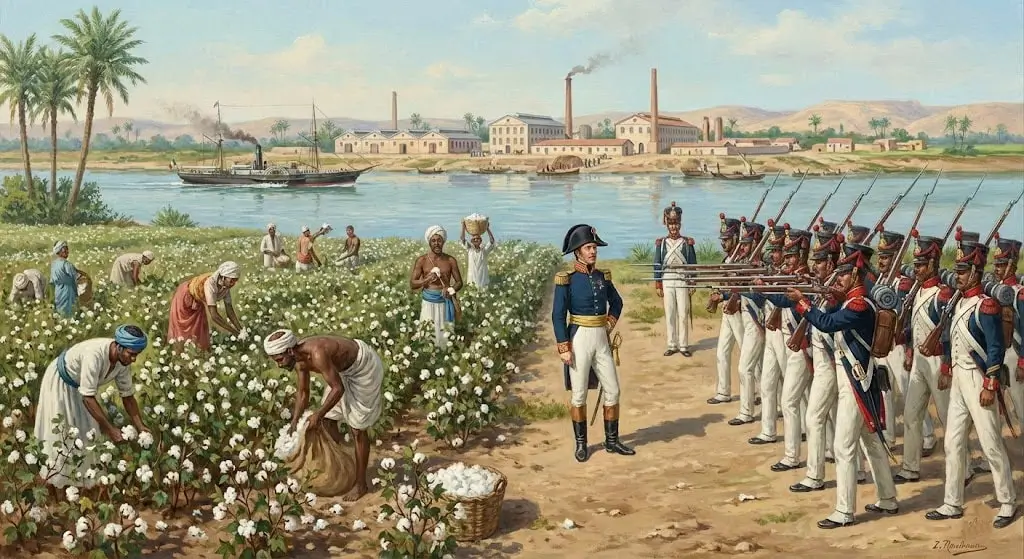
Building a Modern State; Cotton, Canals, and Conscription

With his enemies destroyed, Muhammad Ali turned his ruthless efficiency toward a new goal: building a modern empire. He realized that to survive against European powers, Egypt needed a strong economy and a western-style military.

The Cotton Revolution

His most lasting economic reform was the introduction of long-staple cotton. Recognizing its value in European textile mills, he ordered farmers to switch from subsistence crops to cotton. He then monopolized the trade, buying the cotton at fixed low prices and selling it abroad at a massive profit. This “white gold” generated the immense wealth needed to fund his other ambitions.

The New Army (Nizam al-Jadid)

To protect his wealth, he needed a new kind of army. He abandoned the old system of unruly mercenaries. Instead, he instituted conscription, forcing Egyptian peasants into service. He hired veteran French officers from Napoleon’s army to train them in modern tactics. This created the Nizam al-Jadid (New Order), a disciplined, professional fighting force that would soon terrorize the Ottoman Sultan himself.

Education and Industry

Finally, he knew he needed knowledge. He sent missions of Egyptian students to France and Italy to study engineering, medicine, and military science. Simultaneously, he built factories to produce weapons, textiles, and ships locally, aiming to make Egypt entirely self-sufficient.

The Empire Builder: Expanding the Borders
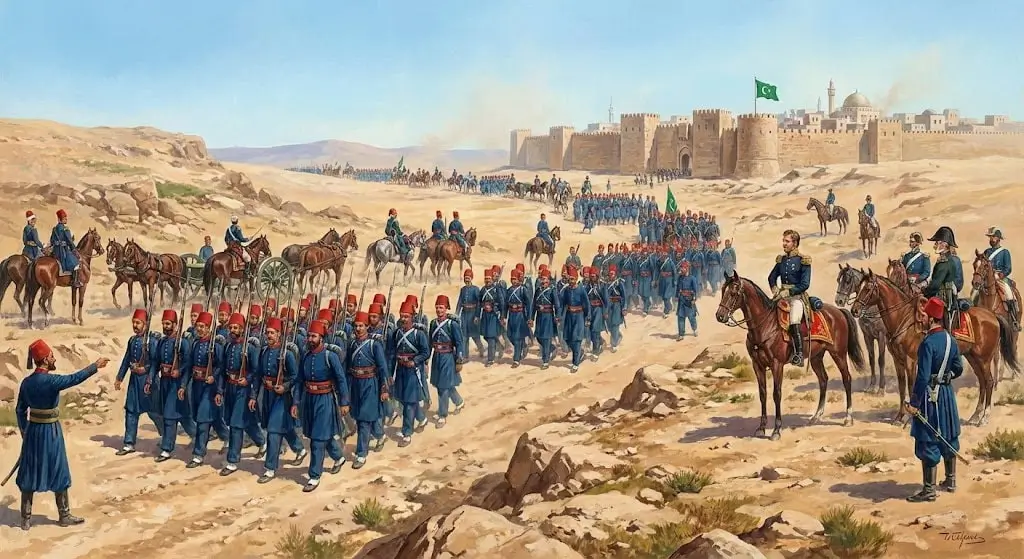
The Empire; Builder Expanding the Borders - Muhamed Ali Pasha
The Empire; Builder Expanding the Borders – Muhamed Ali Pasha

With a modern army at his command and a booming economy fueling his ambitions, Muhammad Ali Pasha looked beyond Egypt’s borders. He was not content to remain a mere governor; he wanted to build an empire that rivaled the Ottomans themselves.

The Arabian and Sudanese Campaigns

Initially, he fought on behalf of the Ottoman Sultan. His forces marched into the Arabian Peninsula to crush the Wahhabi rebellion, successfully recapturing the holy cities of Mecca and Medina. This victory granted him immense prestige in the Islamic world.

Next, he looked south. Seeking gold and recruits for his army, he invaded Sudan in 1820. Although he did not find the mountains of gold he hoped for, he established the city of Khartoum and brought the vast Sudanese territories under Egyptian control for the first time in centuries.

Challenging the Sultan: The Invasion of Syria

His most audacious move, however, was turning against his own master. Feeling that the Ottoman Sultan had not rewarded him sufficiently, Muhammad Ali sent his brilliant son, Ibrahim Pasha, to invade Syria (modern-day Syria, Lebanon, and Palestine).

The Egyptian army was unstoppable. They swept through the Levant and marched deep into Turkey, reaching within a few days’ march of Istanbul itself. The Ottoman Empire was on the brink of collapse. Only the intervention of European powers (Britain and France), who feared a powerful new Egyptian empire would destabilize the region, forced Muhammad Ali to stop. He settled for hereditary rule over Egypt, securing his dynasty’s future.

The Black Pharaohs: The Kushite Kings of Nubia’s 25th Dynasty

For nearly a century, the Kushite Kings from Nubia, known as the Black Pharaohs, established...
Related post
FUN

The Architectural Legacy: The Alabaster Mosque

saladin citadel muhamed ali mosque

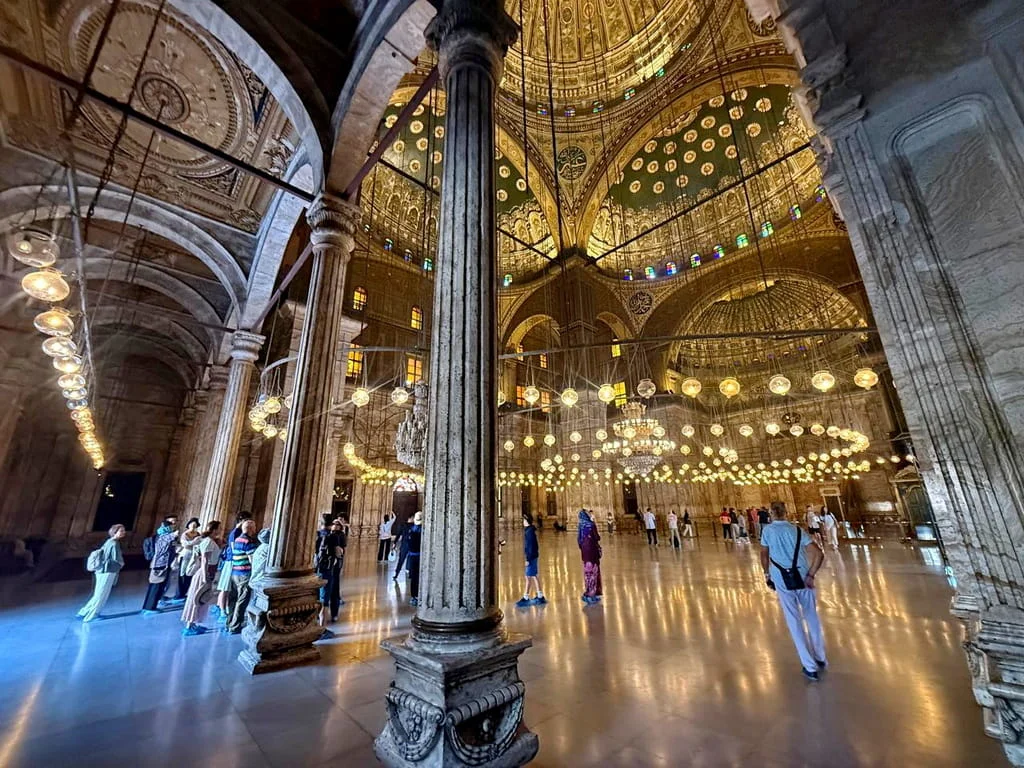
While his empire eventually shrank back to Egypt, Muhammad Ali’s architectural legacy stands tall on the Cairo skyline. The Mosque of Muhammad Ali, often called the Alabaster Mosque, is the most visible symbol of his reign.

A Turkish Delight in Cairo

Built between 1830 and 1848, the mosque marks a dramatic departure from traditional Egyptian Islamic architecture. Instead of the flat-roofed, Mamluk-style mosques common in Cairo, Muhammad Ali chose a purely Ottoman style, modeled after the famous Blue Mosque in Istanbul.

With its soaring central dome, pencil-thin minarets, and cascading semi-domes, it was a deliberate statement. It declared that Cairo was now a rival to Istanbul itself.

The Tomb of the Pasha

Fittingly, the mosque also serves as his final resting place. Inside the vast, glittering prayer hall, to the right of the entrance, lies the white marble tomb of Muhammad Ali Pasha. He died in 1849, but even today, visitors can stand beside his grave in the heart of the citadel he transformed, looking out over the modern city he created.

Ptolemy I Soter: From Macedonian General to Pharaoh of Egypt

Ptolemy I Soter was one of Alexander the Great's generals who founded the Ptolemaic Dynasty...
Related post
FUN

The Dynasty That Lasted a Century

Al-Qanater-Al-Khayreyya - Muhammad Ali Pasha - Egypt Fun Tours

Though he was a ruthless tyrant, Muhammad Ali Pasha was also a visionary. He dragged Egypt out of the Middle Ages and into the modern world. His dynasty, founded in blood and gunpowder, would rule Egypt for nearly 150 years, ending only with the revolution of 1952. Every modern institution in Egypt—from the army to the irrigation system—traces its roots back to the ambitious Albanian soldier who seized a kingdom.

Common Questions About Muhammad Ali Pasha

Here are the quick answers to the most common questions about the Father of Modern Egypt.

Q: Was Muhammad Ali Egyptian?

A: No. He was an Albanian commander sent by the Ot

toman Empire. He did not speak Arabic fluently and surrounded himself with a Turkish-speaking elite, though he ruled as an independent Egyptian monarch.

Q: Why is he called the Father of Modern Egypt?

A: Because he instituted massive reforms that modernized the country. He created a professional army, introduced industrial agriculture (cotton), built modern infrastructure, and established a secular education system.

Q: Can you visit his palace?

A: Yes. The Gawhara Palace (Jewel Palace), located in the Citadel near his mosque, is open to visitors. It offers a glimpse into the opulent lifestyle of the Pasha and his court.

Weather in Egypt

Discover Egypt's Hidden Wonders in the magical oases....
Discover the wonders of ancient and modern Egypt through this Cairo Tour Package....
cairo layover tours - Pyramids and GEM Tour from Cairo Airport

Great layover tour

First things first…I was in Cairo about a week before the protests of 2011 started. As far as the tour was concerned, I was very pleased. I was met at the airport by a knowledgeable guide (Sara) who spoke great English and a driver. They took me to Giza first,

More »

7 night Egypt Experience Cairo, Aswan, Luxor

Trip of a lifetime!! COVID SAFE!! Knowledgeable guide who loves to share the magic of Egypt with tourists. Friendly and accommodating. This company goes to the extreme to make clients feel welcome and help them. A family company that takes good care of its support staff. Must book the 7-night

More »
Cairo layover tour - pyramids tour from the airport - Pyramids and GEM Tour from Cairo Airport

Layover tour of Cairo Pyramids

On a recent trip, I had 8 hours from the time I landed in Cairo to when my next flight was scheduled to leave. Luckily, I arrived in the morning and left in the afternoon, so, not being one to sit around an airport for 8 hours, I visited the

More »

The best holiday ever!

The Nile cruise, Luxor, and Aswan were amazing sites to see, especially when you have the best tour guide in Egypt. Hamada was absolutely fantastic, lots of information, and some of it not spoken by others. This guy was not only a simple tour guide for us, but he also

More »
Isis with wings

Top-rated Tour Packages

Isis with wings