
Serapis: The Greco-Egyptian God Who United an Empire

God Serapis was a supreme, composite deity engineered by Ptolemy I Soter to unify Greek and Egyptian cultures. Synthesizing the authority of Zeus, the underworld power of Osiris, and the life of the Apis Bull, Serapis quickly became the patron god of Alexandria and the wider Roman Empire. His main temple, the magnificent Serapeum, was a celebrated intellectual hub. Ultimately, this powerful cult fell in 391 CE when the temple was violently destroyed, marking a symbolic end to classical paganism. The legacy of God Serapis remains key to understanding Greco-Roman Egyptian history, connecting the tombs of Saqqara with the intellectual ruins of Alexandria.

History records countless powerful deities. However, few gods emerged from a political blueprint. God Serapis came into existence through deliberate, calculated strategy. In fact, he represents the pinnacle of religious syncretism. His purpose was monumental: to bridge the vast divide between the Greek world and the ancient Egyptian kingdom.

This powerful figure was a meticulously constructed deity. He was designed as a supreme, composite god. He synthesized the core attributes of multiple supreme powers. For instance, he claimed the authority of Zeus and carried the underworld power of Hades. He embodied the resurrection of Osiris. He held the vitality of the Apis Bull. Therefore, the entire Ptolemaic Dynasty designed him for one purpose: to be the undisputed patron deity of their new empire.

The cult’s influence quickly became global. Nevertheless, its absolute center remained the magnificent Serapeum of Alexandria. This vast temple complex was enormous. It functioned as more than a shrine. Instead, it was a cultural and intellectual institution. It housed the principal shrine of Serapis. Crucially, it also contained the famous “Daughter Library.” This feature linked the god to philosophy and knowledge. Consequently, the new deity became the patron of the intellectual elite.

This guide details the god’s calculated creation. We examine his pervasive Roman following and recount the spectacular grandeur of his temple. We describe the tragic end of his cult. But first, to truly appreciate the power of God Serapis, we must trace his theological roots back to Memphis.

FUN

God Serapis: Egyptian Foundation and the Apis Bull

The Sacred Apis Bull, God Incarnate of Memphis

The powerful story of God Serapis begins not in Alexandria. Rather, it starts with the ritual death and deification of the Sacred Apis Bull. The new Hellenistic god needed ancient authority. Claiming legitimacy required this essential Egyptian foundation.

The Divine Connection and Naming

The Apis Bull served a crucial role. It was the living incarnation of the creator god Ptah. When the bull died, its soul transformed. Instantly, it mystically merged with Osiris, the Egyptian ruler of the afterlife. This sacred union created Osiris-Apis (Oserapis). This Egyptian composite god possessed supreme power. He commanded resurrection and controlled fertility. Ultimately, Oserapis provided the theological core for God Serapis. The Ptolemies merely adopted this existing deity, presenting him with a Greek cultural mask.

The name Serapis itself derives from an ancient Egyptian site. It takes its name from the necropolis. The older Serapeum at Saqqara was an immense subterranean complex. Priests interred the mummified Apis Bulls in massive sarcophagi there. Thus, the Ptolemies deliberately named their new state god after this revered resting place. This action connected God Serapis to millennia of profound Egyptian history. It validated his national authority.

Oserapis provided the theological framework. However, a Macedonian ruler then needed strategic political maneuvering. He shaped the concept into the unifying powerhouse known worldwide as God Serapis. Cultural refinement was the next crucial step.

FUN

God Serapis: Strategic Creation and Iconography

God Serapis Strategic Creation and Iconography

The elevation of God Serapis represents a prime example of political engineering. It was a crucial, intentional move undertaken by Ptolemy I Soter, the founder of the Hellenistic dynasty.

The Necessity for Unity

Ptolemy I Soter faced a huge demographic problem. He needed to govern two distinct, volatile populations. The Greek settlers followed classical Olympian gods. Native Egyptians protected their ancient cults. Clearly, Ptolemy I understood the reality. His kingdom’s stability depended entirely on religious cohesion. He required a single, supreme deity. This god had to feel equally authoritative and familiar to both groups. Indeed, God Serapis was meticulously designed to fill this critical, unifying role.

Cultural Synthesis

Ptolemy I commissioned an elite panel of experts. This group included the authoritative Egyptian high priest Manetho. Furthermore, the Greek scholar Timotheus was also involved. They worked systematically to integrate Oserapis with core Greek deities. They skillfully blended the power of the bull god. Moreover, they added the authority of Zeus and the judicial power of Hades. Consequently, the final result was a supremely powerful, universal god. This was not natural evolution. It was a brilliant, strategic, top-down policy aimed to secure political stability under the divine sanction of God Serapis.

The Definitive Image

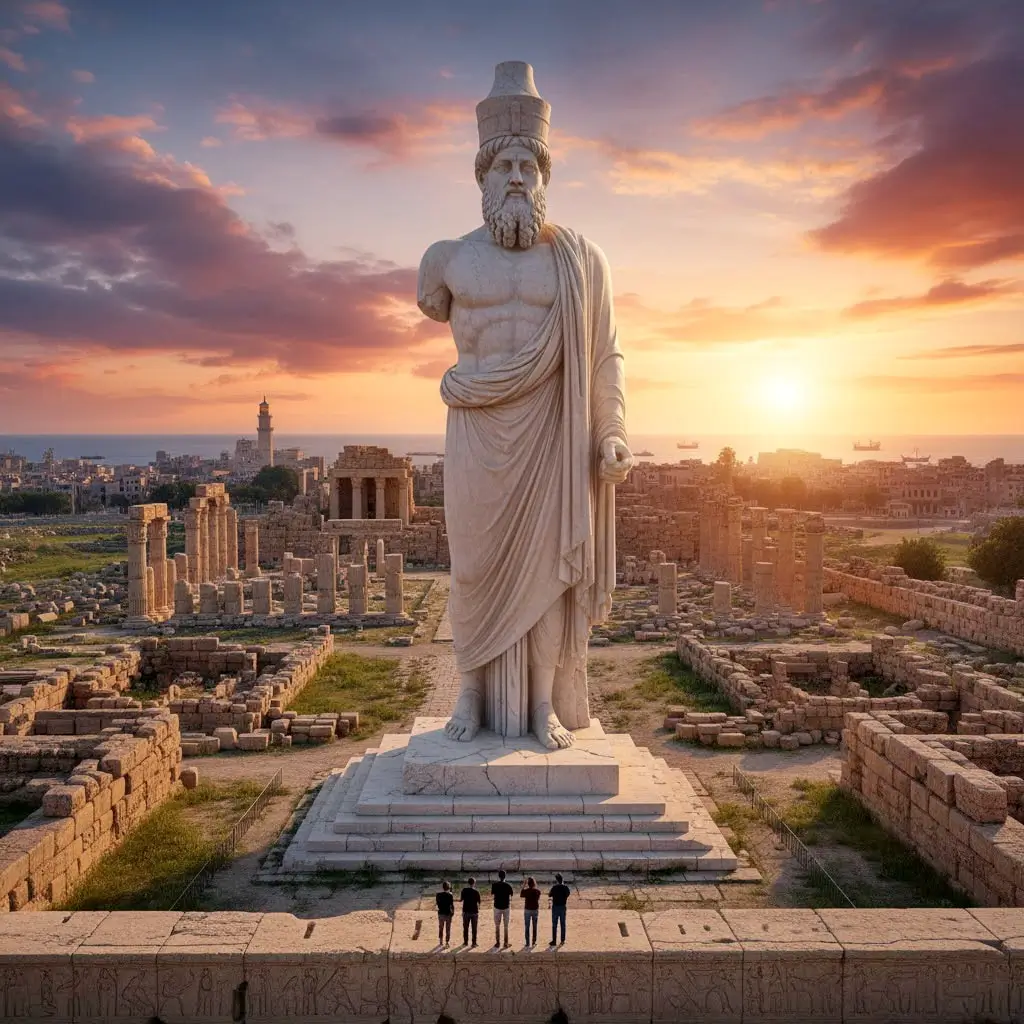
The final, approved image of God Serapis was instantly successful. He was recognizable across the entire Hellenistic sphere. Serapis was depicted as a robust, commanding, mature Greek man. He featured a thick beard, projecting the authority of Zeus. Most importantly, he wore the modius. This large grain measure symbolized abundance and the riches of the underworld. Therefore, the image immediately communicated the powerful, dual identity of God Serapis.

The god’s identity was established. Subsequently, the new deity required a temple worthy of Alexandria.

Egyptian Phoenix Bennu: Myth, Symbolism, and Legacy

Forget the fire. The original legend is even better. Meet the Bennu, the Egyptian Phoenix....
Related post
FUN

God Serapis: The Center of the Cult

Day Trip to Alexandria from Cairo by Car Egypt Fun Tours min 1

The architectural magnificence of the Serapeum of Alexandria cemented the power and prestige of God Serapis. It rapidly became the most important religious site in the Hellenistic world. The structure rivaled the legendary Lighthouse in its scale.

Temple Design and Intellectual Hub

Ptolemy III oversaw the temple’s construction. He spared no expense. The Serapeum was built on the Rhakotis hill. It offered a breathtaking, commanding view of the city. It served as the singular, primary temple for Serapis. Its design was a symbolic blend. It fused Greek monumental styles with Egyptian crypts. Indeed, this fusion was intentional. It made a spectacular statement of Ptolemaic wealth. As a result, it was widely regarded as one of the new Wonders of the Hellenistic Age.

A specific feature contributed significantly to the prestige of the cult. The Serapeum complex contained the “Daughter Library.” This library served an essential function. It acted as an overflow collection for the main Great Library. Furthermore, this intellectual association was vital. It linked the god to philosophy.

Worship and Expansion

Worship performed at the Serapeum showed perfect cultural integration. Priests conducted Greek-style public sacrifices. They held grand festivals. Meanwhile, these events blended seamlessly with Egyptian-style mystery rites. Private healing ceremonies were included. The cult made profound promises. For example, it guaranteed fertility and a blessed afterlife. Ultimately, devotees viewed God Serapis as an omnipotent ruler.

The success of God Serapis in Alexandria was only the beginning. His adoption quickly spread. He moved across the entire Mediterranean world. Inevitably, the powerful Roman Empire readily embraced him.

Hathor, Sekhmet, and the Volatile Eye of Ra: Dual Power for Political Control

The pharaohs used the terrifying dual nature of the Volatile Eye of Ra as a...
Related post
FUN

God Serapis: Roman Expansion and Final Destruction

The inclusive appeal of God Serapis was too robust to remain confined to Egypt. After the Roman military conquered the Ptolemies, the god rapidly became ubiquitous. He quickly rose to become one of the most influential deities throughout the vast Roman Empire.

Roman Popularity and Imperial Support

The cult achieved incredible popularity in the city of Rome itself. It successfully appealed to diverse segments of the population. Consequently, the construction of the monumental Iseum and Serapeum complex in Rome proved his major status. Shrines dedicated to Serapis soon appeared everywhere. Rulers like Hadrian actively promoted the cult. His universal nature was ideal. His strong association with destiny made him perfect for the multi-ethnic empire. Imperial coin mints frequently featured the majestic head of God Serapis.

The deity was renowned above all as a great healer. He was also a vital source of divine prophecy. Devotees often performed the ritual practice of incubation. Then, they firmly believed the god would appear to them in a dream state. He would directly offer a cure. This personal interaction cemented the intimate influence of the cult.

The End of the Temple

The enduring power of God Serapis was ultimately linked to the fate of the old pagan world. Conflict with the rising tide of Christianity was approaching. The crucial turning point occurred in 391 CE. Emperor Theodosius I, deeply committed to Christianity, issued uncompromising edicts. He commanded the systematic destruction of pagan temples. This action provided the legal pretext for the temple’s ultimate destruction.

A violent Christian mob acted on the decree. The mob besieged the complex. Next, they ruthlessly stormed the vast temple grounds. They systematically vandalized the shrines. They deliberately destroyed the precious library contents. Finally, the mob viciously toppled the gigantic cult statue of God Serapis. They shattered and dismembered the iconic idol. Historians frequently cite this brutal, decisive moment. In summary, the ancient, classical world definitively yielded to the new Christian order.

The temple vanished completely. However, the immense cultural influence of God Serapis persisted.

Osiris: Unlocking the Ancient Egyptian God of Resurrection

Gods and goddesses are the heart of ancient Egyptian history, and few are as central...
Related post
FUN

God Serapis: Legacy and Tour Relevance

Though the magnificent temple of God Serapis now lies in silent ruins, the god’s cultural impact remains profound. His powerful historical presence continues to inform modern archaeological and historical explorations.

Enduring Influence

The state cult of God Serapis was formally suppressed. Nevertheless, the worship of his popular consort, the goddess Isis, proved remarkably durable. Moreover, the distinctive, majestic iconography of the deity—the powerful, benevolent, bearded ruler—unquestionably influenced subsequent artistic representations. His image subtly found echoes in early Christian depictions.

Key Tour Sites

The compelling story of God Serapis offers an invaluable window into a pivotal era. This history directly impacts the routes and points of interest on any modern tour of Egypt. This powerful historical journey offers two interconnected sites. Specifically, both are absolutely essential for any comprehensive historical tour:

  1. Saqqara: Travelers explore the god’s theological origin. They visit the older, profound Serapeum. Here, the original Apis Bulls lie entombed, having become Oserapis.
  2. Alexandria: Visitors experience the imperial center of the cult. They stand on the Serapeum Hill, marked by the towering Pillar of Diocletian. They explore local museums and visit Roman-era catacombs that preserve the physical evidence of the cult of God Serapis.

The complex, enduring legacy of God Serapis provides the perfect historical bridge. It is a fusion of ancient Egyptian tradition and powerful new imperial necessity. His story provides essential, vivid context for tracing the evolution of power.

Ready to trace the profound legacy of the Ptolemies and the grand cult of God Serapis? Book your specialized Greco-Roman Egypt tour today!

Let's have a fantastic journey to Cairo to view the most famous historical locations from the era of the Pharaohs. Also, we shall discover modern...
Private guided tours of Cairo, Alexandria, and White Desert camping....
12 Days Solo Woman Tour Package (Queen Cleopatra)

Mohamed is Very Kind Person

Mohamed. I just want to thank you again for your kindness. You made our trip memorable. Give your family and the Egypt Fun Tours crew all my love and thank them again for me. Take care. Enjoy the season! Love. Linda

More »
Amazing Egypt Tours Vacations in December Egypt Fun Tours

Amazing trip with Egypt Fun Tours

We had the time of our lives on a trip to Egypt and the Bahariya/White Desert with Egypt Fun Tours, too. I would highly recommend this company. They are very familiar with organizing this trip, and this means they are well-connected in the desert area. This was invaluable to us

More »

Day trip to Wadi el Hitan and Wadi el Rayan

We went on a full-day trip to Wadi el Hitan and Wadi el Rayan with Mohamed (Hamada). Mohamed was a wonderful guide, always making sure we had plenty of water and enough to eat, and providing us with information about the area and Egypt more generally. He also gave us

More »

Pyramids in the Mist, Egypt Adventure

Our long drive from Cairo turned into a terrifying flight through Alexandria’s impossibly crowded streets. Our minivan miraculously avoided hitting pedestrians, donkey carts, and old Lada cars. We arrived at the port gates with only 10 minutes to spare. But the guards ignored our U.S. passports, and they refused to

More »

Very Considerate and Helpful

Guide and driver were on time, open to my requests and took care that I felt safe and saw the Pyramids and parts of old cairo during my less than 24 hour stay between flights. Office staff were great in communicating by email before and during the trip.

More »
Isis with wings

Top-rated Tour Packages

Isis with wings