
The Mastaba of Shepseskaf: A Deep Dive into Egypt’s Most Unique Royal Monument

The Mastaba of Shepseskaf is a unique royal monument in South Saqqara that marks the end of the 4th Dynasty. By rejecting the traditional pyramid shape for a massive, sarcophagus-style mastaba, King Shepseskaf signaled a major shift in Old Kingdom religion and politics. This colossal structure combines Giza-style engineering with archaic traditions, serving as a powerful architectural bridge between the age of the great pyramid builders and the dynasties that followed.

The Enigma of the Mastaba of Shepseskaf

Ancient Egypt’s Fourth Dynasty is world-famous for the soaring peaks of the Giza Plateau, yet its final ruler chose a strikingly different path through the construction of the Mastaba of Shepseskaf. While his predecessors spent decades perfecting the pyramid as a solar ramp to the heavens, King Shepseskaf intentionally abandoned this tradition. Instead, he commissioned a massive, rectangular monument in South Saqqara that locals today call Mastabat al-Fira’un, or the “Bench of the Pharaoh.” This structural departure represents one of the most intriguing pivots in royal funerary history.

A Bold Architectural Break

By the time Shepseskaf ascended the throne, the pyramid had served as the standard royal tomb for over a century. However, this king decided to return to the archaic mastaba form, though he executed it on a colossal scale. He designed the monument to resemble a giant sarcophagus resting on a high platform, measuring nearly 100 meters in length. Consequently, the site stands out as a unique architectural outlier that challenges our understanding of Old Kingdom royal priorities.

The Mystery of the King’s Choice

Historians continue to debate why Shepseskaf rejected the pyramid shape during such a stable era of construction. Some scholars suggest a religious revolution, arguing that the king sought to distance himself from the growing political power of the Sun God Ra’s priesthood. Furthermore, others point to the practical constraints of his short reign, noting that a mastaba was far more efficient to complete than a mountain of stone. Regardless of the motive, his choice created a fascinating bridge between the early dynastic styles and the grand engineering of the pyramid age.

Engineering a Royal Legacy

Despite its unconventional shape, the construction quality of the Mastaba of Shepseskaf rivals the great monuments of Giza. Builders utilized massive limestone blocks for the core and encased the lower levels in expensive red granite from Aswan. Additionally, the internal layout features a sophisticated system of granite portcullises and a magnificent gabled burial chamber. This guide explores the technical brilliance of the site and investigates the latest archaeological theories regarding the man who ended the Fourth Dynasty with an architectural statement of defiance.

FUN

Historical Context: The 4th Dynasty in Transition

Historical Context, The 4th Dynasty in Transition

The construction of the Mastaba of Shepseskaf occurred during a period of profound social and political transformation. As the final legitimate ruler of the Fourth Dynasty, Shepseskaf inherited a kingdom that had been pushed to its limits by the massive architectural projects of his ancestors. While the Great Pyramids of Giza symbolized the height of royal power, they also placed an immense strain on the state’s resources. Consequently, the shift toward a mastaba-style tomb may reflect a pragmatic response to a changing Egyptian landscape.

The Religious Conflict Theory

One of the most compelling theories regarding this monument involves a major religious schism. During the reigns of Khufu and Khafre, the solar cult of the Sun God, Ra, gained unprecedented influence at Heliopolis. This led to the “pyramid” becoming the ultimate solar symbol. However, many scholars believe that Shepseskaf sought to break away from the priesthood’s growing political dominance. By choosing a rectangular mastaba—a form associated with the primeval mound and the earlier Thinite kings—he likely attempted to reassert his independent authority over the religious elite.

Economic Strains and Political Stability

Beyond religion, the sheer economic cost of the Fourth Dynasty’s building spree cannot be ignored. Decades of diverting labor, food, and materials to Giza and Dahshur likely drained the royal treasury. Therefore, Shepseskaf may have chosen a mastaba because it allowed for a shorter construction timeline without sacrificing royal prestige. This decision suggests a king who was focused on stabilizing the state rather than competing with the vertical heights of his predecessors. Furthermore, his choice of South Saqqara for the site indicates a strategic move to distance his legacy from the Giza plateau.

Succession and the End of an Era

The Mastaba of Shepseskaf serves as the final architectural bookend to the Fourth Dynasty. Following his death, the throne eventually passed to Userkaf, the first king of the Fifth Dynasty, who resumed pyramid building but on a much smaller scale. Interestingly, Shepseskaf’s choice to build a mastaba remained a unique event, as his successors continued to favor the pyramid form. Ultimately, this monument stands as a testament to a king who dared to challenge a century of tradition during a pivotal moment of transition in Ancient Egyptian history.

FUN

Architectural Design: The “Giant Sarcophagus” Structure

Architectural Design; The Giant Sarcophagus Structure

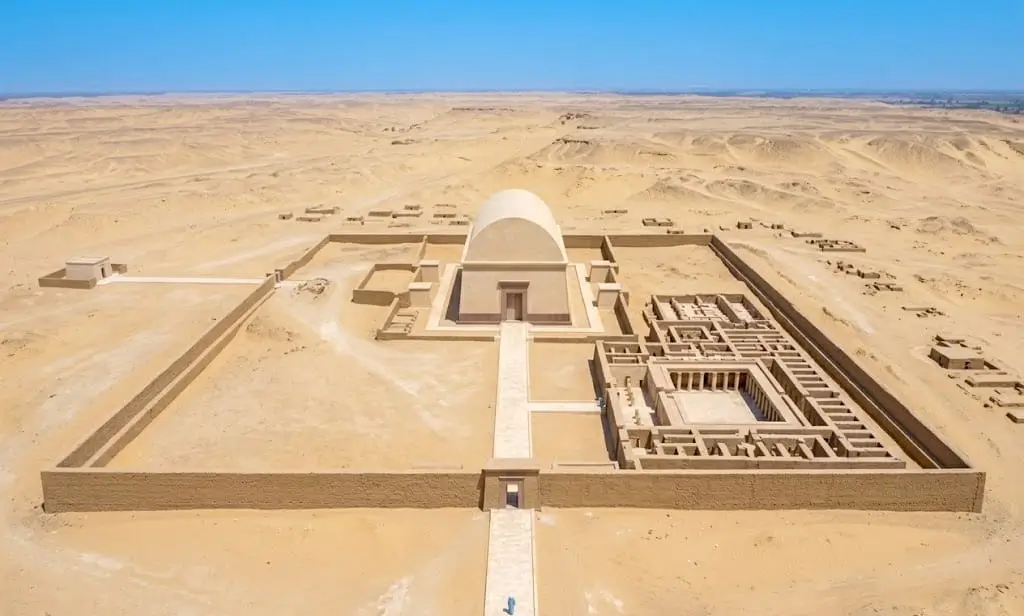
The Mastaba of Shepseskaf stands as a unique masterpiece of engineering that defies the traditional verticality of the Old Kingdom. Builders designed the monument to resemble a massive, vaulted sarcophagus resting on a high rectangular base. This specific shape, known as a cuneiform or shrine-shaped tomb, significantly differs from the pointed peaks of Giza. By adopting this form, the architects created a structure that is nearly 100 meters long and 75 meters wide, asserting a sense of grounded, eternal stability rather than celestial reach.

Innovative Masonry and Material Use

The construction process utilized a combination of local and exotic materials to ensure both durability and royal splendor. Laborers carved massive blocks of local limestone to form the thick core of the monument. However, to maintain the prestige of the Fourth Dynasty, the king ordered the lower course to be encased in high-quality red granite brought from Aswan. Furthermore, the upper sections originally featured a coating of fine Tura limestone. This dual-tone casing would have made the monument shimmer in the desert sun, creating a visual bridge between the rustic Saqqara landscape and the refined luxury of the royal court.

The Complex Substructure and Corridors

Beneath the massive stone exterior lies a sophisticated network of passages designed to protect the king’s remains. The entrance, located on the north side, leads into a steep descending corridor that drops at an angle of over 23 degrees. To prevent unauthorized access, the architects integrated a series of three massive granite portcullises within the passage. These sliding stone barriers acted as a high-security locking mechanism. Consequently, the internal layout demonstrates that while the exterior shape changed, the fundamental royal requirement for a secure, hidden burial remained a top priority.

The Burial Chamber and Gabled Ceiling

At the heart of the structure, the burial chamber serves as the ultimate sanctuary for the deceased monarch. The room is oriented east-west and features a magnificent gabled ceiling composed of massive granite beams. These beams are ingeniously carved into an internal arch, which effectively distributes the immense weight of the masonry above. Additionally, archaeologists discovered remnants of a dark basalt or schist sarcophagus within this chamber. This discovery confirms that despite the unusual exterior, the internal rituals and burial preparations followed the highest standards of the Fourth Dynasty elite.

The Catacombs of Kom Esh-Shokafa: Roman-Egyptian Underworld

Descend into one of the "Seven Wonders of the Middle Ages" at the Catacombs of...
Related post
FUN

The Mortuary Complex and External Enclosure

The Mortuary Complex and External Enclosure

Beyond the central tomb, the Mastaba of Shepseskaf was once the heart of a vast, functioning ritual landscape. Ancient architects did not leave the monument standing in isolation; instead, they surrounded it with a series of walls and religious buildings essential for the King’s afterlife. These structures transformed the site from a simple grave into a perpetual center of worship, ensuring that the spirit of Shepseskaf received offerings for eternity.

The Dual Enclosure Walls

To protect the sanctity of the royal space, the builders constructed two massive mud-brick enclosure walls. The inner wall tightly hugged the perimeter of the mastaba, creating a private courtyard for priests and officials. Meanwhile, a second, outer wall encompassed a much larger area, separating the sacred ground from the surrounding desert. This double-layered defense served both a practical purpose for security and a symbolic one, acting as a boundary between the chaotic world of the living and the ordered world of the dead.

The Eastern Mortuary Temple

On the eastern side of the mastaba, facing the rising sun, lie the ruins of a sophisticated mortuary temple. Unlike the stone temples of Giza, Shepseskaf’s temple was primarily built of mud-brick, though it was finished with limestone floors and wooden columns. This temple acted as the main stage for daily offerings and funerary rites. Archaeologists have identified a central courtyard, several offering halls, and storage magazines where ritual tools and food were kept. Consequently, the temple remains provide vital clues about the transition from the stone-heavy Fourth Dynasty to the brick-based Fifth Dynasty.

The Causeway and Valley Temple

While much of it has been lost to time and sand, a long causeway once connected the high desert site to a valley temple located near the edge of the cultivation. This causeway served as the ceremonial path for the king’s funeral procession. Although the valley temple has not been fully excavated or preserved, its existence is inferred from the standard layout of royal complexes from this era. Therefore, the presence of these elements proves that while Shepseskaf changed the shape of his tomb, he strictly maintained the traditional “Royal Funerary Suite” required of a Pharaoh.

The Mastaba of Ti: A Masterpiece of Old Kingdom Art and Life

The Mastaba of Ti is an architectural and artistic masterpiece of the Old Kingdom, serving...
Related post
FUN

Legacy and Archaeological Discovery

The Mastaba of Shepseskaf remained largely forgotten by the modern world until the 19th century. Early explorers initially mistook the massive, sand-covered mound for a natural hill or a ruined, unfinished pyramid. However, when pioneering Egyptologists began to excavate the site, they realized that the “Bench of the Pharaoh” was actually a highly sophisticated royal monument. These discoveries forever changed our understanding of the Fourth Dynasty’s final years and the flexibility of Old Kingdom royal architecture.

Mariette and Jequier’s Excavations

The first formal investigation of the site began with Auguste Mariette in 1858, who successfully identified the structure as a royal tomb. Decades later, between 1924 and 1925, the Swiss Egyptologist Gustave Jéquier conducted a more thorough excavation of the interior and the surrounding temple complex. Jéquier’s work was instrumental in uncovering the granite portcullises and the unique gabled ceiling of the burial chamber. His findings confirmed that Shepseskaf had not simply built a “cheap” tomb, but had invested heavily in high-quality materials and innovative engineering.

The Tomb’s Place in Egyptology

Today, the Mastaba of Shepseskaf serves as a critical case study for researchers studying the evolution of ancient Egyptian religion and politics. It proves that the “Pyramid Age” was not a period of rigid, unchanging tradition, but rather one of experimentation and occasional defiance. Furthermore, the monument’s location in South Saqqara paved the way for future kings, such as Pepi II, to choose this area for their own burials. Consequently, the site acts as a bridge between the Giza-centric Fourth Dynasty and the Saqqara-focused Fifth and Sixth Dynasties.

Visiting the Mastaba of Shepseskaf Today

For modern travelers and scholars, the site offers a rare opportunity to witness a royal monument that breaks all the rules. While it is less famous than the Great Pyramid, its massive scale and “giant sarcophagus” design provide a powerful sense of the Pharaoh’s enduring authority. Standing before its red granite base, one can still feel the weight of history and the mystery of a king who chose to be remembered differently. Therefore, the Mastaba of Shepseskaf remains an essential stop for anyone seeking to understand the full complexity of Ancient Egypt’s Old Kingdom.

The Intact Egyptian Royal Tombs: Egypt’s Ultimate Secret

While many believe Tutankhamun's tomb was the only intact royal burial discovered, this guide reveals...
Related post
FUN

Comparative Analysis: Shepseskaf vs. The Giza Giants

Understanding the scale and intent of the Mastaba of Shepseskaf requires comparing it to the traditional pyramids of his predecessors. While it lacks the height of Khufu’s monument, its mass and material quality remain remarkably high.

Feature Mastaba of Shepseskaf Great Pyramid of Khufu Pyramid of Menkaure
Shape Rectangular Mastaba True Pyramid True Pyramid
Original Height ~18 Meters ~146.6 Meters ~65 Meters
Base Length ~99.6 Meters ~230.3 Meters ~103.4 Meters
Primary Material Limestone & Red Granite Limestone & Granite Limestone & Granite
Location South Saqqara Giza Plateau Giza Plateau
Theological Focus Primeval Mound / Osiris Solar / Ra Solar / Ra

Frequently Asked Questions about the Mastaba of Shepseskaf

To help readers quickly find specific information, we have compiled the most common questions regarding this unique South Saqqara monument.

Why is it called Mastabat al-Fira’un?

The name Mastabat al-Fira’un translates to “Bench of the Pharaoh” in Arabic. Local populations gave it this name because its massive, flat-topped rectangular shape resembles the traditional benches (mastabas) found outside Egyptian homes.

Is the Mastaba of Shepseskaf open to the public?

Yes, the site is accessible to visitors, though it is located in the more remote South Saqqara region. Because it receives fewer tourists than Giza or North Saqqara, it offers a much quieter and more atmospheric experience for those interested in archeology.

Who was King Shepseskaf?

Shepseskaf was the sixth and final legitimate ruler of the Fourth Dynasty during the Old Kingdom. His reign was relatively short, likely lasting between 4 to 7 years. He is most famous for breaking the tradition of pyramid-building that defined his family line.

Was the tomb ever finished?

Evidence suggests the tomb was completed, including the complex internal chambers and the mortuary temple. However, because the temple was built largely of mud-brick rather than stone, it has suffered more significantly from erosion over the millennia than the mastaba itself.

What was found inside the burial chamber?

Archaeologists discovered the remains of a dark basalt sarcophagus. While the tomb had been looted in antiquity, the presence of this high-quality sarcophagus and the sophisticated portcullis system confirms that it was used for a royal burial.

Enjoy 8 / days Nile River cruises from Hurghada to Luxor and Aswan to visit Luxor and Aswan attractions, then back to your hotel Hurghada....
Discover the mesmerizing Egypt where the wonders live....
God_Anubis_Icon
3-day desert safari trip from Cairo—Egypt Fun Tours

Book with Egypt Fun Tours!!

In April 2011, my husband and I, after great debate, took a trip to Egypt. Because of the political situation, we decided to book a tour for our time in Cairo and Luxor. We are very happy that we did, since these are two cities that should not be missed.

More »
Ancient Egyptian Sarcophagus - Egypt Fun Tours

Unforgettable experience with Fun Tours – Highly recommended!

Hello everyone! We would like to share our extremely positive experience with Fun Tours. Our tour was a complete success thanks to our guide, Osama, and our driver Hassan. Osama proved to be an enthusiastic and knowledgeable guide who answered all of our questions and catered to our individual wishes

More »
9-day tour package - Egypt Fun Tours

You’re in “GREAT HANDS” with Egypt Fun Tours!

We first went to Egypt in July 2010. We were to pass through Cairo on our way to Africa, and we had arranged to be picked up from the Cairo airport and shown around the city during our 6-hour layover. This was arranged through emails with Hamada, of Egypt Fun

More »

2 week group private tour – Egypt and Jordan

Our US-based agency takes small groups of experienced travelers to the most beautiful and exotic places in the world. In Dec ’19 – Jan ’20, we used the services of Egypt Fun Tours to plan, organize, and conduct an amazing trip to Cairo, Giza, Saqqara, Luxor, and Aswan. The New

More »
15-Day Historical Egypt Tour Package

all good!

we took pyramid and Cairo city tours and all went smoothly. The were very flexible to adapt to our requirements. Car, car driver and guide were great. very knowledgable and professional tour. Very recommendable

More »
God_Anubis_Icon

Top-rated Tour Packages

God_Anubis_Icon