The First Dynasty of Ancient Egypt: The Dawn of a Unified Kingdom

The First Dynasty of Ancient Egypt, beginning around 3100 BCE, marked the formal unification of Upper and Lower Egypt into a single state, often credited to King Narmer. Originating from the region of Thinis, these early rulers established the foundations of the pharaonic system, including a centralized bureaucracy, defined religious institutions, and the development of hieroglyphic writing. Their reign initiated the Early Dynastic Period and set the political and cultural templates that would characterize Egyptian civilization for millennia.
The eye of Horus
WhatsApp
Email
Print

The First Dynasty of Ancient Egypt (c. 3100–2900 BCE) marks a turning point in human history. During this era, small tribal groups in the Nile Valley joined together to form the world’s first nation-state. This period is known as the Early Dynastic Period. It established the divine rule that defined Egyptian culture for 3,000 years.

The kings of this era centered their power in Thinis and later in Memphis. They successfully merged Upper and Lower Egypt. This union, known as the Sema-Tawy, created a powerful, unified country. The pharaohs built a strong government and a shared religious identity. These early leaders created the blueprints for the administration and architecture that allowed Ancient Egypt to thrive. Explore how the First Dynasty rose to become the first dominant force in the ancient world.

Historical Context: From Tribalism to Theocracy

Before the First Dynasty, Egypt was not a single country. It consisted of independent regions called “nomes.” These areas had their own local leaders, unique customs, and separate gods. For centuries, these groups fought for control of the fertile Nile Valley.

The shift toward a unified state began in the late Predynastic Period. Powerful elites from Hierakonpolis in the south began to assert dominance over the northern Delta. This struggle for power ended with the victory of a single ruler. Most historians credit this achievement to King Narmer.

The First Dynasty successfully blended these regional identities. They created a single, national story. The pharaohs adopted the Double Crown, known as the Pschent. This crown combined the white Hedjet of the south with the red Deshret of the north. Wearing both crowns was a powerful visual message. It showed that the pharaoh ruled both lands.

This act was not just political. It was also deeply religious. The pharaoh acted as the mediator between the gods and the people. His main job was to maintain Ma’at. This concept represented universal order, balance, and truth. By upholding Ma’at, the king ensured that the Nile flooded properly and that society remained stable.

This period moved Egypt from simple tribal leadership to a complex, divine government. The pharaoh was no longer just a chief; he was a god on earth. This change gave the government total control over resources, labor, and the lives of the people. It set the stage for thousands of years of stability.

The eye of Horus

Key Pharaohs of the First Dynasty of Ancient Egypt

Key Pharaohs of the First Dynasty of Ancient Egypt

The leaders of the First Dynasty of Ancient Egypt faced a massive challenge. They had to govern a newly united country that stretched hundreds of miles. To succeed, these kings needed to manage irrigation, collect taxes, and maintain religious harmony.

Narmer: The Founder of the First Dynasty of Ancient Egypt

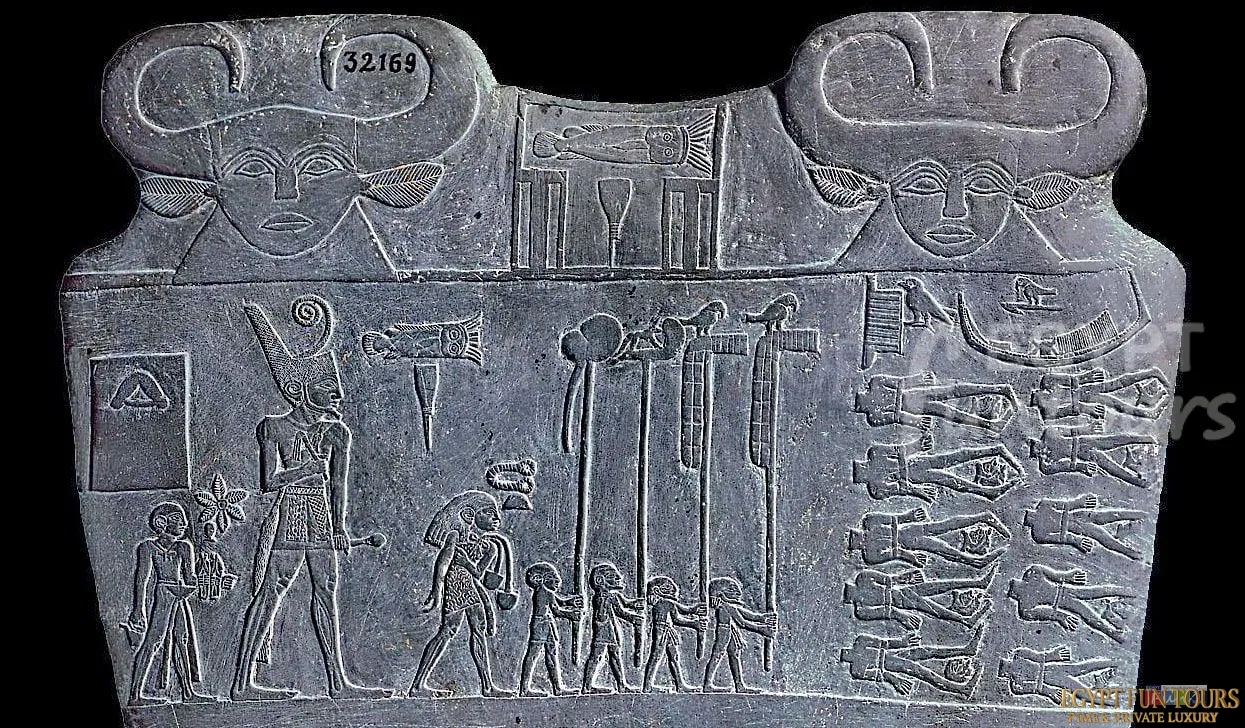
Most historians identify Narmer as the legendary king Menes. He is the first ruler credited with the final military victory that united the country. Furthermore, he established the city of Memphis as the administrative capital. We know much about him because of the Narmer Palette. This famous artifact serves as early state propaganda. It depicts the king triumphing over his northern rivals, signaling the beginning of the dynastic era.

Hor-Aha: The Builder of the First Dynasty of Ancient Egypt

Hor-Aha followed Narmer as the second king. He focused on consolidating the state. Additionally, he likely led military missions into Nubia to secure borders. He also expanded the power of the state-controlled economy. Through his efforts, he helped solidify the administrative grip that his father had initiated.

Den: The Reformer of the First Dynasty of Ancient Egypt

Den is arguably one of the most vital figures of the era. He was the first to use the royal title “King of Upper and Lower Egypt.” Moreover, he introduced significant innovations to the government bureaucracy. He created a new dating system based on regnal years to track time more accurately. Because of these changes, the central government became much more efficient.

Merneith: The Queen of the First Dynasty of Ancient Egypt

Merneith remains a fascinating figure in early history. Archaeological evidence confirms she held immense political power. She likely ruled as a regent or perhaps as a sovereign queen between the reigns of her husband and her son, Den. Her elaborate, massive tomb at Abydos signifies her status. Consequently, historians view her as a crucial leader who maintained stability during a delicate period of transition.

Golden Scarab

Architectural and Cultural Innovations of the First Dynasty of Ancient Egypt

Architectural and Cultural Innovations

Although the massive stone pyramids of the Giza Plateau were still centuries away, the First Dynasty of Ancient Egypt pioneered the structural blueprints for Egyptian monumentalism. During this era, architects and artisans developed the foundations for both royal burials and administrative life.

The Development of the Mastaba

The royal tomb of this period was the mastaba. This was a flat-roofed, rectangular structure with slanted walls. Typically, builders constructed these tombs using sun-dried mud bricks. The mastaba served as a symbolic house for the deceased. Furthermore, it contained deep, subterranean chambers filled with prestige goods. These items were essential for the king’s journey into the afterlife.

Writing and Bureaucratic Records

The First Dynasty of Ancient Egypt also witnessed a major leap in human communication. Scholars see the clear development of the Egyptian hieroglyphic script during this time. Earlier records from the Predynastic Period were simple, but these new notations were complex. Officials used small ivory and wood tags to label goods. Consequently, the state could track grain taxes, record royal annals, and manage the economy across the entire Nile Valley.

Artistic Canon and Iconography

During this period, artists established the visual rules that would define Egyptian art for thousands of years. They created specific symbols of power that became standard. For instance, the image of the king striking an enemy became a classic theme. Additionally, the use of the falcon to represent the god Horus became common. These artistic choices were not just decorative. Instead, they served as powerful tools to communicate the king’s divine role and his absolute authority over the Two Lands.

Early Tools and Craftsmanship

The artisans of the First Dynasty of Ancient Egypt possessed remarkable technical skills. They crafted beautiful alabaster vessels with incredible precision. Moreover, they utilized sophisticated copper tools for cutting and shaping stone. These items have been found in royal tombs at Abydos and Saqqara. As a result, we know that this society supported a large class of highly trained specialists. These craftsmen ensured that the king’s court remained the center of luxury and technological advancement.

The eye of Horus

Religion, Society, and the Concept of Kingship in the First Dynasty of Ancient Egypt

Religion, Society, and the Concept of Kingship

The First Dynasty of Ancient Egypt established the religious principles that would anchor Egyptian society for millennia. During this formative era, the pharaoh became more than a political leader. He emerged as the earthly embodiment of the god Horus. This transformation fundamentally altered the relationship between the ruler and his subjects.

The Divine Role of the Pharaoh

The kings of the First Dynasty of Ancient Egypt claimed a direct link to the divine. By positioning himself as the living Horus, the pharaoh gained immense authority. His primary duty was to maintain Ma’at. This concept stood for balance, order, and cosmic truth. Because the people believed the pharaoh’s actions directly impacted the annual flooding of the Nile, they viewed his rule as vital to their own survival. Consequently, the king held absolute control over the state.

Funerary Rites and Social Hierarchy

Archaeologists have uncovered fascinating details regarding burial practices at the royal necropolis in Abydos. The earliest pharaohs practiced a ritual known as “retainer sacrifice.” Hundreds of courtiers and servants were buried in smaller tombs surrounding the king’s central monument. This practice reflected a strong belief in the afterlife. It signaled that these individuals would continue to serve their ruler in the next world. Moreover, it emphasized the extreme power dynamic of the First Dynasty of Ancient Egypt, where the king’s status transcended even death.

Building the State Apparatus

To govern a kingdom stretching over 700 miles, the pharaohs created a new, complex bureaucracy. They needed to manage resources effectively. Therefore, they appointed high-ranking officials to oversee state interests. These officials were often members of the royal family or trusted nobles. Their duties included:

  • Supervising the collection of grain taxes from local provinces.
  • Managing the labor force required for royal construction projects.
  • Ensuring the distribution of goods through state-controlled trade routes.

Daily Life and Social Structure

Society during this period became increasingly stratified. At the top stood the pharaoh and his royal court. Below them, a growing class of administrators and scribes managed the daily operations of the state. Furthermore, a highly skilled class of artisans and craftsmen supported the royal lifestyle by creating luxury goods and monumental architecture. While the common people were primarily farmers, they were connected to the center through the state’s irrigation systems and religious festivals. This structure provided the stability necessary for the First Dynasty of Ancient Egypt to thrive.

Golden Scarab

Daily Life in the First Dynasty of Ancient Egypt

Daily Life in the First Dynasty of Ancient Egypt

This section humanizes the history, moving beyond just kings and monuments.

“While the pharaohs focused on consolidating power, the rhythm of life for the average person in the First Dynasty of Ancient Egypt was dictated by the annual flooding of the Nile. Most citizens were farmers who lived in small villages made of mud-brick huts. They cultivated emmer wheat and barley, which formed the caloric backbone of the Egyptian diet.

Furthermore, life was not merely about subsistence. Archaeological evidence from sites like Helwan suggests a growing class of skilled laborers. These individuals worked as potters, weavers, and metalworkers, creating goods for both local trade and the royal court. Daily life revolved around the agricultural calendar—the Akhet (inundation), Peret (growing), and Shemu (harvest). Because the state managed the irrigation channels, farmers were effectively part of a grand, coordinated national effort. This shared dependency on the Nile helped cement the cultural unity of the new nation.”

The Evolution of Burial Customs (Comparative Analysis)

mastaba egypt

This demonstrates deep historical knowledge by showing the transition of ideas.

“Understanding the First Dynasty of Ancient Egypt requires looking at how burial customs evolved from the Predynastic era. In earlier times, the deceased were typically buried in simple, shallow pit graves. However, the First Dynasty introduced the monumental mastaba.

This shift reflected a profound change in the Egyptian worldview. The tomb was no longer just a resting place; it was a transition zone to the afterlife. By comparing these early mastabas to the later, more complex tombs of the Second Dynasty, we see a clear trend toward increasing exclusivity and complexity. The First Dynasty burial sites, such as the tombs at Abydos, show the early development of royal funerary cults. This tradition of monumental burial reached its zenith in the Old Kingdom, but its roots were firmly planted here. This evolution shows that Egyptian religious thought was not static; it was a living, breathing tradition that gained depth with every passing generation.”

The First Dynasty of Ancient Egypt: Gallery of Key Artifacts

The First Dynasty of Ancient Egypt Gallery of Key Artifacts

This is excellent for SEO, as it targets specific “what is this?” search queries.

“The material culture of the First Dynasty of Ancient Egypt serves as our primary record of their sophistication. Several key artifacts stand out:

  • The Narmer Palette: This ceremonial palette is the quintessential document of unification. It features the king wearing both the white and red crowns, providing the earliest visual evidence of the Sema-Tawy.
  • Ivory Labels from Abydos: These small, etched tags are arguably the most important administrative artifacts. They allowed the royal court to track tax payments, including oil, cloth, and grain. They are early proof of the state’s advanced record-keeping.
  • Cylinder Seals: Used to mark ownership of goods, these seals confirm that the First Dynasty had established clear systems of property and administration.
  • Alabaster Vessels: These were luxury items used in royal funerary rites. The precision required to carve them suggests that the First Dynasty possessed a highly specialized workforce dedicated to serving the pharaoh’s needs.
The eye of Horus

Legacy and Archaeological Evidence of the First Dynasty of Ancient Egypt

Legacy and Archaeological Evidence

The First Dynasty of Ancient Egypt did more than unite the Nile; it created a template for civilization that lasted for three millennia. By embedding the concept of divine rule so deeply into the culture, these early kings ensured the longevity of the Egyptian state. Today, we rely on a blend of ancient king lists and modern excavation to understand this pivotal era.

Unlocking the Past Through Archaeology

Much of our knowledge comes from the royal cemeteries at Abydos and Saqqara. These sites provide a physical record of the dynasty’s growth. For instance, the transition from simple burials to complex mastabas shows how the kings increased their influence over time. Additionally, the artifacts recovered from these tombs tell a vivid story. We have found beautiful alabaster vessels, intricate cylinder seals, and ivory labels. These items prove that the First Dynasty of Ancient Egypt supported highly skilled artisans and maintained sophisticated trade networks. Furthermore, these networks reached as far as the Levant and across the Eastern Desert.

The Reliability of Historical Records

Historians also use ancient documents to piece together this era. Key sources include the Abydos King List and the Turin Papyrus. These documents provide the names and regnal years of the pharaohs. Although these lists were written centuries later, they align well with modern archaeological findings. Consequently, researchers can confidently map the progression of the dynasty. These records help us understand not just the names of the kings, but also the order of events that shaped the early state.

The Lasting Impact of the First Dynasty

Unfication battle by king narmer egypt fun tours

Ultimately, the greatest legacy of the First Dynasty of Ancient Egypt is the concept of a unified nation. The early pharaohs created an identity that surpassed regional loyalties. They turned a collection of nomes into a single, cohesive power. This period established the bureaucratic and religious foundations that defined the country’s future. Because they built these strong systems, Egypt remained a dominant force in the ancient world for centuries to come.

Further Reading

To continue your study of this fascinating period, consider these reputable sources:

The First Dynasty of Ancient Egypt: (FAQs)

Adding an FAQ section is a “must” for SEO; it often helps you win “Featured Snippets” on Google.

Frequently Asked Questions about the First Dynasty of Ancient Egypt

Was the First Dynasty truly the first time Egypt was united? While regional leaders existed earlier, the First Dynasty is the first time we see evidence of a centralized government ruling the entire length of the Nile under a single, recognized royal title.

What language did they speak during the First Dynasty? They spoke Early Egyptian, a language that eventually evolved into the scripts seen in later periods. While hieroglyphs were still in their infancy, they were already being used for administrative record-keeping.

Why did they practice ‘retainer sacrifice’? Archaeologists believe it was a way for the king to ensure he was surrounded by his essential court members in the afterlife. However, this practice was abandoned in later dynasties as the Egyptian view of the afterlife became more inclusive.

How did the First Dynasty manage such a large territory? They utilized a system of ‘nomes’ (districts), each governed by an official loyal to the pharaoh. This allowed them to collect taxes and mobilize labor from as far as the Delta to the southern borders.”

God_Anubis_Icon
A Royal Commission The History of Al-Rifa'i Mosque

Highly recommended

Salam, This company is very responsive and accommodating. From the moment we started to chat via email, to the moment we left Egypt at the airport, these fellows were very professional. The tour covered most of what we wanted to see! We customized it to our needs and added some

More »

What an amazing day!

I had a 12 hour layover on my way to Dar es Salaam and wanted to take full advantage of my time in Cairo. After researching for many hours, I came across Egypt Fun Tours and emailed for more information. I received a prompt reply with full details of several

More »

Great layover tour

First things first…I was in Cairo about a week before the protests of 2011 started. As far as the tour was concerned, I was very pleased. I was met at the airport by a knowledgeable guide (Sara) who spoke great English and a driver. They took me to Giza first,

More »

Valley of Whales – Wadi El Hitan and Wadi El Rayan

What a blast! It was an amazing day and a 5-star day trip. Everything was organised from A to Z by Hamada and Mohamed at Egypt Fun Tours in a timely manner. Pick up/drop off from/to the hotel, exquisite lunch and snacks, 4×4 jeep. Everything was as advertised. Also, the

More »
God_Anubis_Icon

Top-rated Tour Packages

God_Anubis_Icon
WhatsApp
Email
Print