The Twenty-Third Dynasty of Egypt: Guide to a Fractured Empire

The Twenty-third Dynasty of Egypt (c. 837–728 BCE) represents the peak of political fragmentation during the Third Intermediate Period, characterized by decentralized rule under elite families of Meshwesh Libyan origin. Triggered by the devastating Theban Civil War, this era witnessed the rise of autonomous regional power centers—such as Leontopolis and Thebes—where pharaohs relied on powerful religious institutions like the God's Wife of Amun to maintain local control. Despite old narratives dismissing this as a cultural dark age, the dynasty experienced a vibrant artistic revival marked by masterful bronze casting and archaistic design. Ultimately, this systemic division left the country vulnerable, culminating in the invasion of the Kushite King Piye, who forced the fractured Delta monarchs into submission and absorbed the remnants of the dynasty into the unified Twenty-fifth Dynasty.
The eye of Horus
WhatsApp
Email
Print

The Third Intermediate Period breakdown represents one of the most volatile eras in the Nile Valley. Far from a uniform kingdom governed by a single divine ruler, this era reached its fractured climax during the Twenty-third Dynasty of Egypt (c. 837–728 BCE). For decades, outdated historical narratives dismissed this period as a mere dark age of cultural collapse and political decay. Modern Egyptological scholarship, however, reveals a starkly different reality. Instead, it shows a dynamic arena of competing principalities, intense religious devotion, and a sophisticated system of divided rule. To understand the 23rd Dynasty of Egypt, one must abandon the traditional concept of unified pharaonic rule. This period showcases a crowded geopolitical chessboard. Consequently, multiple contemporary lines of kings coexisted, bargained, and fought for legitimacy across a fragmented landscape.

Divider

Twenty-third Dynasty of Egypt: The Anatomy of a Divided Egypt

The Libyan Roots of the Dynasty

The Libyan Roots of the Dynasty

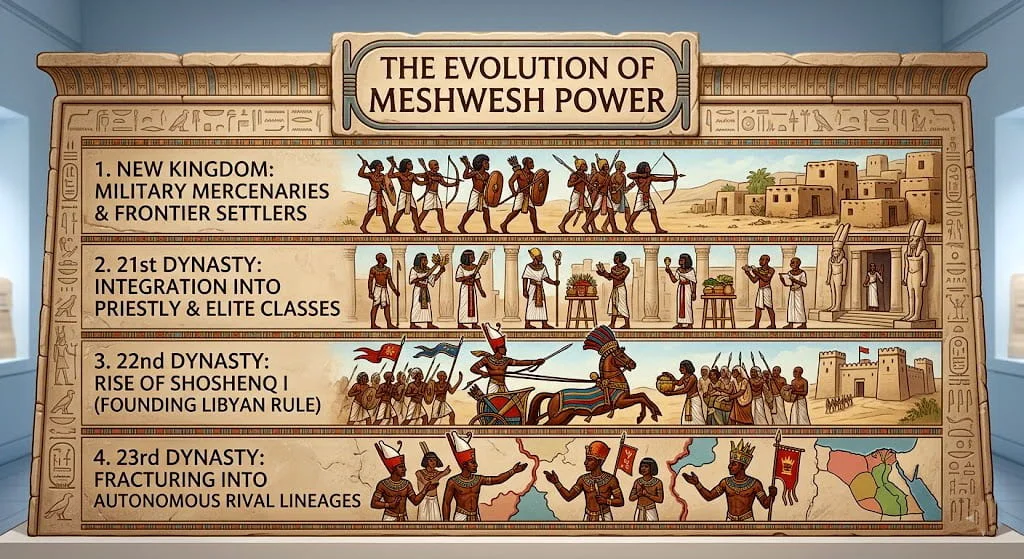
We cannot separate the genesis of the Twenty-third Dynasty of Egypt from the broader realities of Libyan rule in ancient Egypt. Centuries before the New Kingdom collapsed, various Libyco-Berber groups entered the Egyptian Nile Delta. These groups included the Meshwesh and the Libu. Initially, these communities arrived as prisoners of war, seasonal laborers, or mercenary forces under Ramesside pharaohs. Over time, these populations gradually integrated into the fabric of northeastern African society.

By the dawn of the 21st Dynasty, these acclimated populations had established deep roots. They transformed into a powerful military aristocracy. Furthermore, they were not foreign invaders overrunning the borders by sudden force. Rather, they were thoroughly Egyptianized elites who worshipped traditional gods like Amun-Ra. They adopted pharaonic titles and held the highest administrative and military offices in the land.

The Shift to Decentralized Rule

The political framework of Meshwesh Libyan pharaohs was fundamentally decentralized. Unlike native Egyptian concepts of absolute, centralized monarchy, the Libyan ruling ethos relied on a feudalistic network. This network linked federations, chiefdoms, and semi-independent city-states through delicate family alliances.

This systemic regionalism triggered the birth of the Twenty-third Dynasty. Around 837 BCE, deep-seated internal tensions erupted during the twilight of the 22nd Dynasty under Shoshenq III. Regional factions in both Upper Egypt and parts of the Delta grew weary of centralized northern taxation from the capital of Tanis. Seizing upon this discontent, a rival lineage broke away to establish what historians now classify as the 23rd Dynasty. This act initiated a complex era of overlapping reigns that permanently shattered the political unity of the Nile.

Golden Scarab

Geopolitical Reality: Mapping the Fractured Realm (Twenty-third Dynasty of Egypt)

Geopolitical Reality Mapping the Fractured Realm

A Constellation of Power Centers

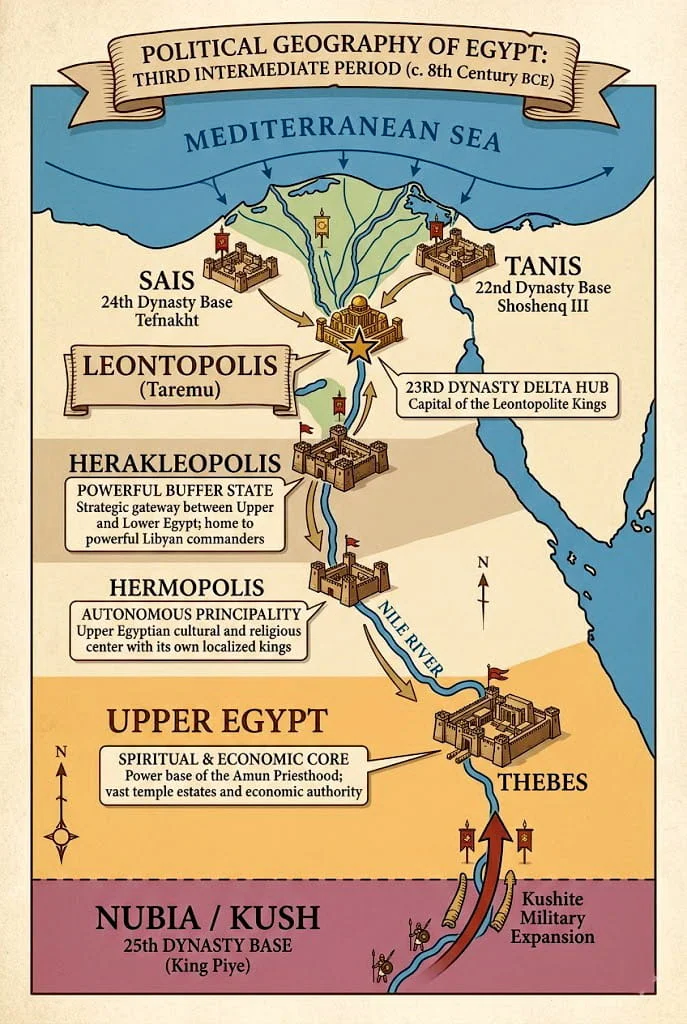
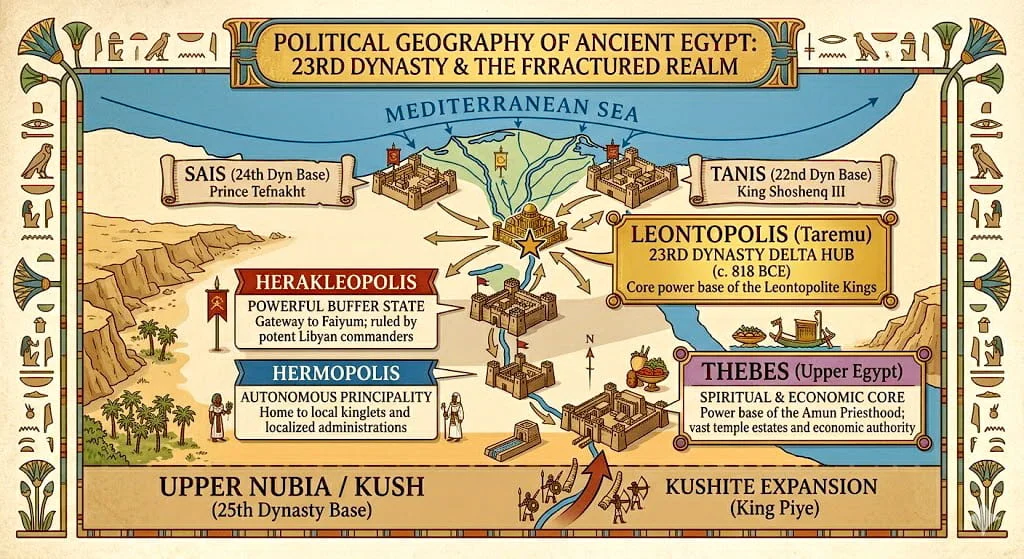
To trace the narrative of the 23rd Dynasty, we must analyze its geography. The dynasty did not control a singular state. Instead, it was a shifting constellation of regional principalities centered primarily in Upper Egypt and the Delta. While the 22nd Dynasty held onto its northern stronghold at Tanis, the 23rd Dynasty carved out a competing sphere of influence. Consequently, this move redrew the administrative borders of the Third Intermediate Period.

The geopolitical map of this era features four major urban centers. Each operated as an autonomous engine of political or religious power:

Northern and Southern Strongholds

  • Leontopolis (Taremu): This city sat in the central Nile Delta. It served as the ancestral and northern power base for the core rulers of the 23rd Dynasty. From this strategic position, Delta monarchs could control vital Mediterranean trade routes. Additionally, they managed agricultural wealth and projected authority toward competing courts.
  • Thebes: This urban center was the absolute spiritual heartland and economic powerhouse of Upper Egypt. The High Priests of Amun at Karnak governed Thebes as a de facto theological state. Therefore, the vast temple estates of Amun controlled massive tracts of fertile land, gold mines, and labor forces. For any 23rd Dynasty pharaoh, securing the loyalty of the Theban priesthood was essential for spiritual legitimacy.

The Buffer States of Middle Egypt

  • Herakleopolis Magna: Situated near the entrance to the Faiyum Oasis, Herakleopolis functioned as an indispensable military and logistical buffer state. Powerful, independent Libyan commanders ruled this zone and frequently claimed royal titles. As a result, Herakleopolis held the balance of power. It constantly switched its allegiances between rival dynasties depending on military momentum.
  • Hermopolis Magna: Further south in Middle Egypt, Hermopolis operated under its own autonomous line of rulers, such as King Nimlot. Like Herakleopolis, it acted as a semi-independent marcher state. It extracted political concessions from both northern and southern pharaohs while maintaining its own regional courts, standing armies, and artistic traditions.

Key Takeaway for Researchers: The fragmented nature of these power centers means that an inscription dating to “Year 5” of a pharaoh in Thebes might run parallel to “Year 22” of a completely different monarch ruling from Tanis. Therefore, cross-referencing primary sources like Nilometer inscriptions, temple block reliefs, and burial stelae is critical for reconstructive chronology.

The eye of Horus

Chronological Framework: Chronos and the Kings of the Twenty-third Dynasty of Egypt

The Challenges of Successive Reigns

The timeline and succession of the Twenty-third Dynasty of Egypt remain among the most fiercely debated subjects in modern academic Egyptology. Scholars must constantly reconcile conflicting evidence between the monumental records of the Nile and classical king lists like those of Manetho.

The primary historical challenge stems from the proliferation of coregencies, which means overlapping co-rules. Furthermore, rival lineages frequently repeated royal names like Takelot, Osorkon, and Shoshenq, which complicates the data.

The Great Chronological Debate

For decades, Kenneth Kitchen established the foundational framework for this era in his seminal work, The Third Intermediate Period in Egypt. Kitchen argued for a highly structured, sequential line of Leontopolite kings that ran parallel to the 22nd Dynasty.

However, subsequent archaeological discoveries have fundamentally challenged this model. Scholars such as David Aston, Rolf Krauss, and Claus Jurman have reevaluated the evidence. Current consensus suggests that many kings previously assigned to a single line were actually local rulers reigning simultaneously. To provide clear, scannable clarity for researchers and students, the following table outlines the consensus sequence of the primary monarchs.

King / Pharaoh Est. Regnal Dates (BCE) Primary Seat of Power Key Historical Significance
Takelot II c. 840–815 Thebes / Middle Egypt The transitional patriarch; his attempts to assert northern control over Upper Egypt triggered the monumental Theban Civil War.
Pedubast I c. 823–798 Thebes / Leontopolis The primary rebel king who established an independent 23rd Dynasty lineage, openly defying the 22nd Dynasty.
Shoshenq VI c. 798–793 Upper Egypt A poorly documented successor to Pedubast I who struggled to maintain structural cohesion amid shifting regional allegiances.
Osorkon III c. 793–765 Thebes / Middle Egypt The most powerful monarch of the dynasty. He successfully stabilized Upper Egypt and launched major construction at Karnak.
Takelot III c. 765–759 Thebes Co-ruled alongside his father Osorkon III before taking the throne; he served as High Priest of Amun before elevating to king.
Rudamun c. 759–755 Thebes The younger son of Osorkon III; his brief reign witnessed a rapid shrinking of territorial authority across Egypt.
Iuput II c. 754–720 Leontopolis Ruled from the Delta capital during the twilight of the dynasty, ultimately facing the unstoppable advance of the Kushite empire.
Divider

The Theban Civil War: The Chronicle of Prince Osorkon

The Catalyst of Southern Rebellion

The true narrative and political engine of the 23rd Dynasty is a dramatic, multi-decade struggle known as the Theban Civil War. This brutal conflict is vividly documented on the walls of the Bubastite Portal at the Temple of Karnak. The details survive in a lengthy, vital primary inscription known to historians as the Chronicle of Prince Osorkon.

The war erupted during the reign of Takelot II. In an attempt to tighten his grip on the wealthy and rebellious south, Takelot II appointed his own son, Prince Osorkon, to the supreme office of High Priest of Amun at Thebes. However, the local Theban military aristocracy and priestly families viewed this move as an intolerable act of imperial overreach. Consequently, Thebes revolted and refused to acknowledge the prince’s religious or administrative authority.

Twenty-third Dynasty of Egypt: Chronology of a War of Attrition

The Chronicle describes a vicious cycle of military campaigns, temporary truces, and sudden betrayals that lasted for nearly three decades:

  • The Initial Crackdown: Prince Osorkon marched south with a substantial military force and successfully captured Thebes. He instituted a brutal purge of the rebel leadership. He executed the ringleaders and burned their bodies. This act was a terrifying punishment in ancient Egypt because it denied the deceased an afterlife.
  • The Counter-Coup: The peace was short-lived. A rival faction backed a competitor named Pedubast I. Pedubast promptly declared himself pharaoh, establishing the independent 23rd Dynasty line. This move drove Osorkon out of Thebes, forcing his retreat into the fortresses of Middle Egypt.
  • The Pendulum of Power: For over twenty years, control of Thebes swung back and forth between the factions. Armies desecrated temples, and agricultural trade along the Nile ground to a halt. As a result, the civil war severely diminished the prestige of the pharaonic office.

The Theban Civil War The Chronicle of Prince Osorkon

The Enduring Impact of Strife

Prince Osorkon ultimately outlasted his primary rivals. Eventually, he claimed full pharaonic titles as King Osorkon III. However, the victory was pyrrhic. The decades of relentless civil strife had permanently broken the political framework of Egypt. The unified state created by the New Kingdom was gone. It was replaced by an irreversible fragmentation that left the country highly vulnerable to foreign intervention.

Religious Geopolitics: The Rise of the Divine Adoratrice

Twenty-third Dynasty of Egypt: A New Strategy for Theban Control

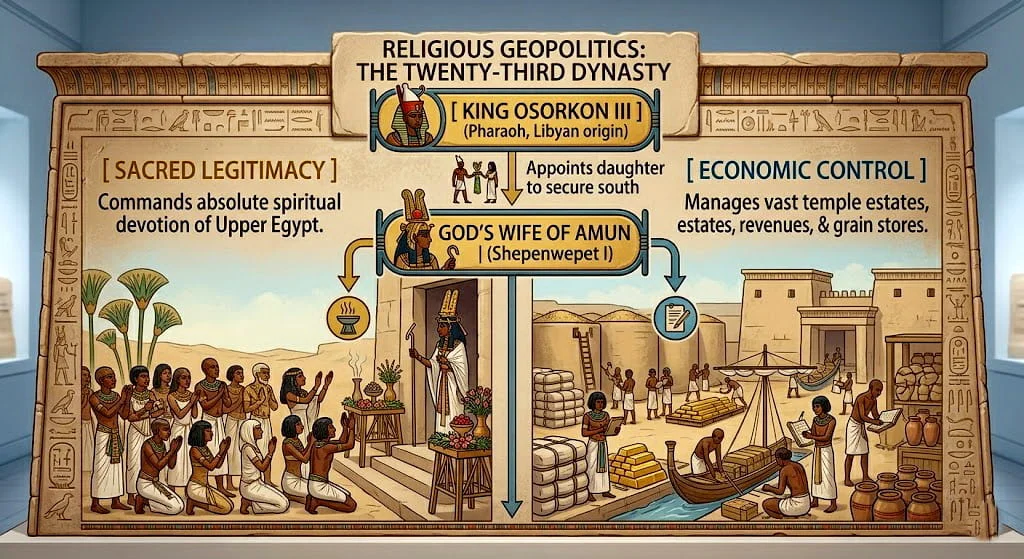
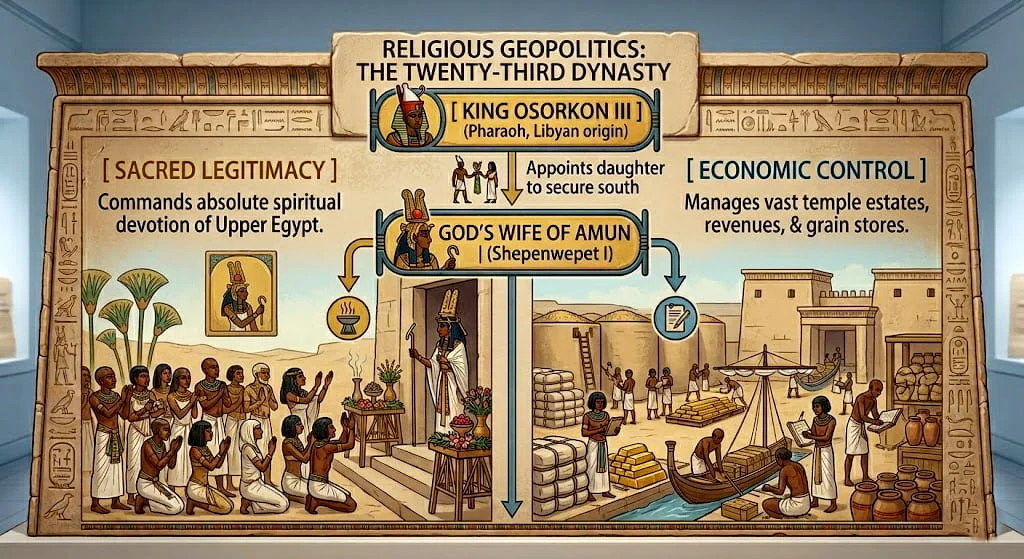
Following the devastation of the Theban Civil War, the rulers of the Twenty-third Dynasty of Egypt realized a critical truth. They could not control the rebellious south through military power alone. Therefore, King Osorkon III initiated a brilliant diplomatic strategy. Instead of installing volatile male High Priests who might rebel against the crown, he focused on a powerful religious office. He elevated the position of the God’s Wife of Amun (also known as the Divine Adoratrice).

Consequently, Osorkon III appointed his own daughter, Shepenwepet I, to this sacred position. The office required absolute celibacy. To ensure continuity of royal control, each incumbent adopted a successor from the reigning pharaoh’s lineage. This institutional change fundamentally altered the power dynamics of Upper Egypt during the Third Intermediate Period.

Religious Geopolitics The Rise of the Divine Adoratrice

Twenty-third Dynasty of Egypt: The Economic and Spiritual Monopoly

The God’s Wife of Amun was not just a religious figurehead. On the contrary, she wielded immense political and economic power. By serving as the earthly consort of the god Amun-Ra, she commanded absolute spiritual devotion from the populace. Furthermore, she assumed direct control over the vast wealth of the Karnak temple estates.

This financial monopoly allowed the female line of the 23rd Dynasty to manage local revenues, agricultural land, and trade routes. As a result, the male High Priests were effectively bypassed. This masterstroke created a stable, loyal administrative anchor in the south that preserved the dynasty’s influence for decades.

The eye of Horus

Twenty-third Dynasty of Egypt: Art, Architecture, and Culture

The Myth of Cultural Decay

Many traditional histories mistakenly classify the Third Intermediate Period as a cultural wasteland. However, archaeological discoveries from the Twenty-third Dynasty challenge this outdated narrative. While monumental stone architecture declined due to political fragmentation, portable arts reached unprecedented heights of sophistication. The era was, in fact, a golden age for metallurgy and specialized elite craftsmanship.

Masterpieces in Bronze and Precious Metals

During this period, royal workshops revolutionized the art of complex bronze casting. Metalsmiths mastered the lost-wax technique. They created highly detailed, lifelike statuettes of deities, pharaohs, and elite women. Furthermore, these artisans decorated the bronzes with intricate wire inlays of gold, silver, and electrum.
Masterpieces in Bronze and Precious Metals

These masterpieces served dual purposes. They demonstrated royal prestige and acted as lavish votive offerings in major temples. The exceptional quality of these pieces proved that highly organized, wealthy artistic networks thrived despite the political division of the country.

The Rise of Archaism and Funerary Innovation

Architecturally, the 23rd Dynasty favored a style called archaism. Artists deliberately studied and copied the proportions, relief styles, and iconography of the Old and Middle Kingdoms. This stylistic revival allowed the Libyan pharaohs to visually connect themselves to the glorious rulers of Egypt’s past.

Simultaneously, funerary culture adapted to changing economic realities. Because building massive royal pyramids was no longer feasible, the elite invested in beautifully painted wooden stelae, highly detailed coffins, and compact, beautifully illustrated funerary papyri. Therefore, religious devotion remained vibrant, creative, and accessible.

The Twilight of the Twenty-third Dynasty of Egypt: The Victory Stela of Piye

The Gathering Storm from the South

By the late eighth century BCE, the systemic fragmentation of the Twenty-third Dynasty of Egypt had reached a critical breaking point. Overlapping reigns, independent regional warlords, and petty Delta kings had completely drained the military strength of the Nile Valley. This internal weakness did not escape notice. To the south, in modern-day Sudan, a powerful and deeply pious Nubian kingdom was rising at Napata. Under the brilliant leadership of King Piye (25th Dynasty), the Kushites watched Egypt’s division with growing concern.

Piye did not view himself as a foreign conqueror. On the contrary, he considered himself a true worshipper of Amun-Ra, chosen by the god to rescue Egypt from its own political anarchy. Consequently, when a powerful northern coalition began marching south to swallow up Middle Egypt, Piye launched a massive, decisive military intervention.
The Twilight of the Dynasty The Victory Stela of Piye

The Unstoppable Kushite Advance

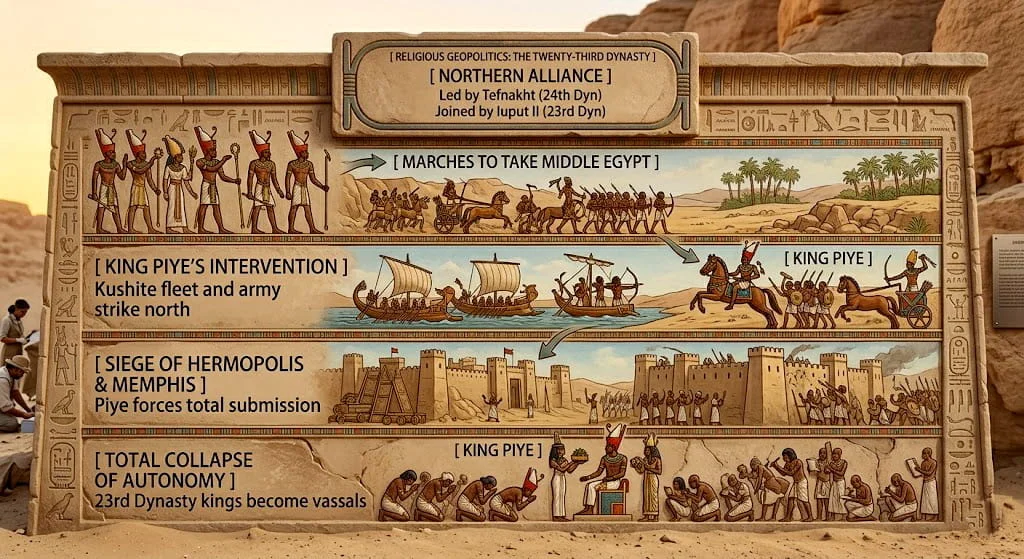
The main threat to regional balance came from Tefnakht, a powerful prince of Sais (24th Dynasty). He had successfully forced many Delta rulers into a military alliance to capture the whole country. King Iuput II, ruling from the fading 23rd Dynasty capital at Leontopolis, quickly joined this coalition. The combined northern forces swept southward, besieging vital buffer states like Herakleopolis and Hermopolis.

However, Piye responded with overwhelming military speed. He dispatched an advanced fleet and a massive infantry force up the Nile. According to primary accounts, the Kushite troops advanced like a storm, completely routing the northern alliance in successive naval and land battles. Piye himself then traveled north to lead the grand siege of Hermopolis. He forced its ruler, King Nimlot, to surrender in absolute humiliation.

The Capitulation and Legacy of the Vassal Kings

The dramatic climax of this campaign survives on a magnificent granite monument known as the Victory Stela of Piye, discovered at Jebel Barkal. The detailed relief carvings at the top of the stela provide an invaluable visual record of this historic submission. The carving depicts King Piye standing tall and majestic as a supreme ruler. Beneath him, the defeated pharaohs of the 22nd and 23rd Dynasties—including a humbled Iuput II—are shown prostrating themselves, literally kissing the ground at the feet of the Nubian monarch.

Piye accepted their formal surrenders but chose not to strip them of their regional administrative titles. Instead, he allowed Iuput II and his contemporary rulers to return to their respective capitals. However, they were stripped of all true political autonomy. They returned to their palaces not as independent pharaohs, but as heavily taxed vassal kings serving the newly established Kushite Empire. Consequently, this decisive campaign brought a definitive end to the independent political trajectory of the Twenty-third Dynasty, absorbing its remnants into a newly unified, Nubian-led Egyptian state.

Divider

Big tick off our bucket list!

Booked the evening before and were able to do everything we hoped to in a day, with a knowledgeable guide & at a reasonable price! Lunch was included and absolutely delicious! Learnt about the history of Egypt, which was the most important part of sightseeing in Cairo/Giza. Hamada also gave

More »

Layover Tour in Cairo

This August, my boyfriend and I had quite a long layover in Cairo, 9 hours to be exact. Instead of wasting our time at the airport, we decided to do a layover tour of the city. I had been before, but my boyfriend hadn’t, so we wanted to hit the

More »

Tour of Cairo

Despite a late start due to car trouble, Mohamed more than made up for it with his incredible knowledge and dedication. His explanations were detailed and thoughtful, and he went above and beyond to make sure we had a great experience. A memorable and informative tour, thanks to Mohamed’s hard

More »

Islamic cairo and khan el khalili- great tour

Wonderful tour with the guide Hamada. I did not feel rushed at all. He explained a lot of facts about the city, the mosque, the water storage room, and also brought me to no-hassle shops. He picked a great place to eat and have Turkish coffee and a cold lemon

More »
6 Days Luxury Tour {Egypt Treasures} - Cairo and Nile Cruise Affordable Tour Package

A trip of a lifetime in a 10 hour layover!

We recently scheduled a layover tour in Cairo through Egypt Fun Tours. Our layover was 10 hours and we scheduled the tour just about a day and a half before our arrival. When we arrived in Cairo we very easily made our way out of the airport (after getting our

More »
God_Anubis_Icon

Top-rated Tour Packages

God_Anubis_Icon
WhatsApp
Email
Print