Monumental Defiance: The Architectural Transformation of Tanis
Shoshenq III faced a rapidly shrinking kingdom. He also lost access to the sacred southern temples of Luxor and Karnak. Because of this, the king turned his focus entirely toward his northern capital, Tanis. Today, we know this site as modern San el-Hagar.
The king could not physically rule over the ancient monuments of the south. Therefore, he chose to use monumental architecture at home. He wanted to transform Tanis into a spectacular theological mirror of Thebes.
Shoshenq III: The Great Pylon of Amun-Ra
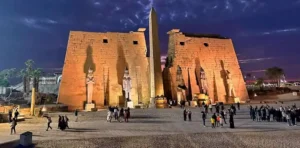
The crown jewel of this architectural campaign was a massive, monumental granite pylon gateway. Workers built it directly into the colossal mudbrick enclosure wall of the great Temple of Amun-Ra at Tanis. Architects designed this pylon to serve as a stunning visual statement of the king’s enduring cosmic authority.
However, a major logistical problem stood in the way. The 22nd Dynasty lacked direct access to the famous red granite quarries of Aswan. His southern rivals controlled that entire region. Because of this obstacle, Shoshenq III’s engineers had to innovate. They launched one of the most extensive architectural recycling programs in human history.
The engineers marched to the nearby, abandoned New Kingdom capital of Pi-Ramesses. The great Pharaoh Ramesses II had built this city centuries earlier. The team systematically dismantled its towering temples, giant triumphal stelae, and monolithic obelisks. They transported thousands of tons of this second-hand stone down the Pelusiac branch of the Nile to Tanis.
Once the stone arrived, craftsmen re-carved the ancient granite blocks to feature Shoshenq III’s own names and titles. French Egyptologist Pierre Montet excavated the gateway in the 20th century. He discovered with absolute astonishment that builders had literally constructed the entire monumental gate out of the broken, reassembled bodies of Ramesses II’s ancient obelisks.
Shoshenq III: Localized Temple Building
Beyond the capital, Shoshenq III’s name appears on smaller temple foundations and donation stelae throughout Lower Egypt. Notable examples include:
- Tell Umm Harb: The king funded local expansions here to honor regional agricultural deities.
- Bubastis: This city was the ancestral home of the 22nd Dynasty. The king made lavish offerings to the cat-goddess Bastet to secure her divine protection over his fractured lineage.
- Mendes: Massive limestone blocks bear his throne name here. These stones commemorate his patron contributions to the local ram-god Banebdjedet.
Through these widespread building projects, Shoshenq III aimed to prove a point. He wanted to show that his court still commanded immense wealth and exquisite artistic talent. Even during an era of political fracture, the Delta craftsmen maintained a breathtaking level of skill. They produced crisp, deeply carved relief work that brilliantly emulated the grand styles of the New Kingdom.
Death of a Monarch: The Archaeology of Tomb NRT V
Shoshenq III enjoyed an extraordinary reign lasting between 39 and 42 years. The king finally died around 786 BCE. His long survival meant that he tragically outlived his first five elder sons. This painful reality left his sixth son, Shoshenq IV, to inherit a deeply fragile northern crown.
Shoshenq III: The Discovery of NRT V
In the late 1930s, Pierre Montet successfully located the royal burial ground of the 22nd Dynasty. The ancient tombs sat buried deep beneath the heavy sand at Tanis. Hidden away from the world for millennia, Montet uncovered Tomb NRT V. This structure served as the final resting place of Shoshenq III.
The deep, sprawling valley tombs of the New Kingdom pharaohs looked very different from this structure. Instead, NRT V was a compact, subterranean stone chamber. Builders constructed it completely out of reused limestone blocks and sandstone slabs. They gathered these materials directly from nearby Ramesside ruins.
The interior design of the tomb was highly functional yet deeply spiritual. Intricate, painted reliefs adorned the walls of the burial chamber. These decorations featured critical defensive spells from the Book of the Dead and the Book of Night. Scribes designed these inscriptions to guide the pharaoh’s soul past the dangerous demons of the underworld. The spells helped the king achieve eternal life alongside the sun god Ra.
Shoshenq III: The Reality of Ancient Plundering
The structural architecture of the tomb survived intact, but the treasures inside did not. Professional grave robbers ruthlessly targeted NRT V during antiquity. The thieves easily smashed through the ancient roof seals. They stripped the pharaoh’s mummy of its golden amulets and plundered the precious grave goods.
When Montet’s team finally cleared the debris of the violated chamber, they made a poignant discovery. Shoshenq III rested inside a massive, heavy grey granite sarcophagus. Close forensic inspection revealed that an artisan had carved this second-hand sarcophagus centuries earlier for a wealthy New Kingdom court official.
Ancient thieves stripped the long-ruling pharaoh of his gold and silver. They left behind only fragments of his original funeral equipment, a few shattered canopic jars, and a collection of ceramic ushabti figurines. Priests placed these small servant statues in the tomb to magically awaken in the afterlife. Once awake, they would perform manual labor for the king.