The Bent Pyramid: A Masterpiece of Ancient Engineering and Evolution

The Bent Pyramid Dahshur represents a definitive turning point in the history of Egyptian architecture. It stands as a physical record of the transition from step pyramids to smooth-sided structures. By adjusting the slope from 54 to 43 degrees, ancient engineers saved the monument from structural failure. Consequently, the pyramid remains one of the best-preserved examples of Old Kingdom construction. Furthermore, its surviving limestone casing offers a rare look at the original splendor of royal tombs. Therefore, the Bent Pyramid Dahshur is a vital destination for any traveler seeking to understand the ingenuity of the Fourth Dynasty.

The Architectural Mystery of the Bent Pyramid

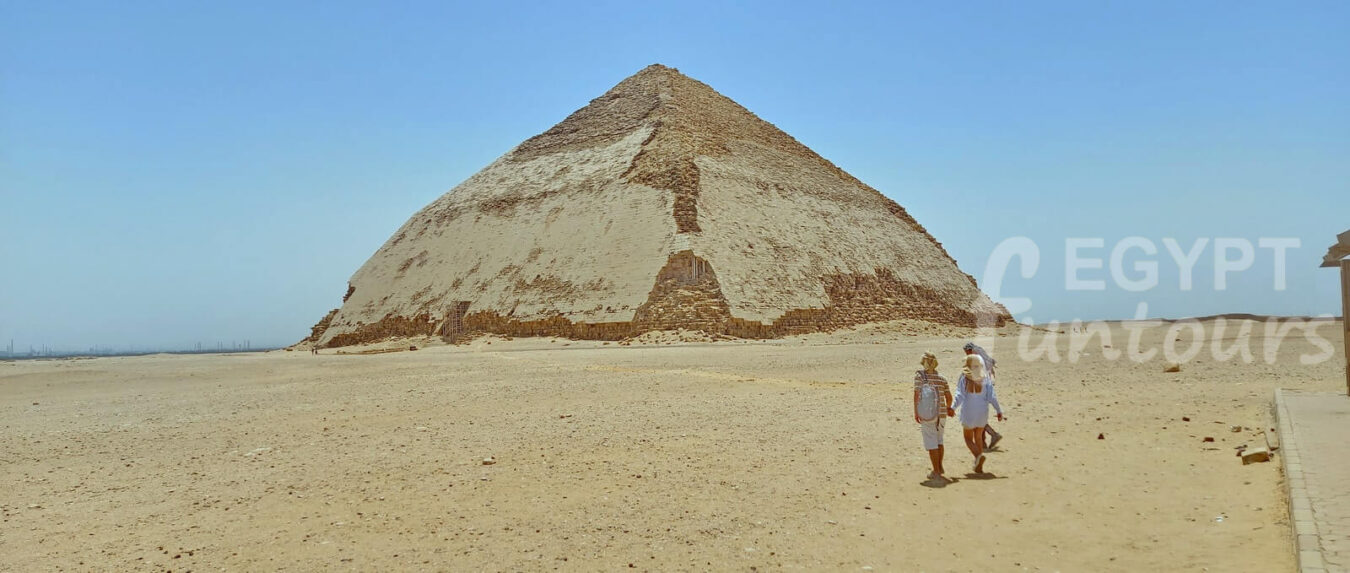
The Bent Pyramid represents a pivotal moment in ancient Egyptian history. King Sneferu commissioned this massive tomb during the Fourth Dynasty. Specifically, it marks a daring attempt to move beyond the traditional step pyramid design. Because the builders aimed for a smooth-sided finish, the structure stands as a bold architectural experiment. Consequently, the Bent Pyramid is a unique bridge between two eras of construction. Therefore, historians consider it an essential landmark for understanding the evolution of the Old Kingdom.

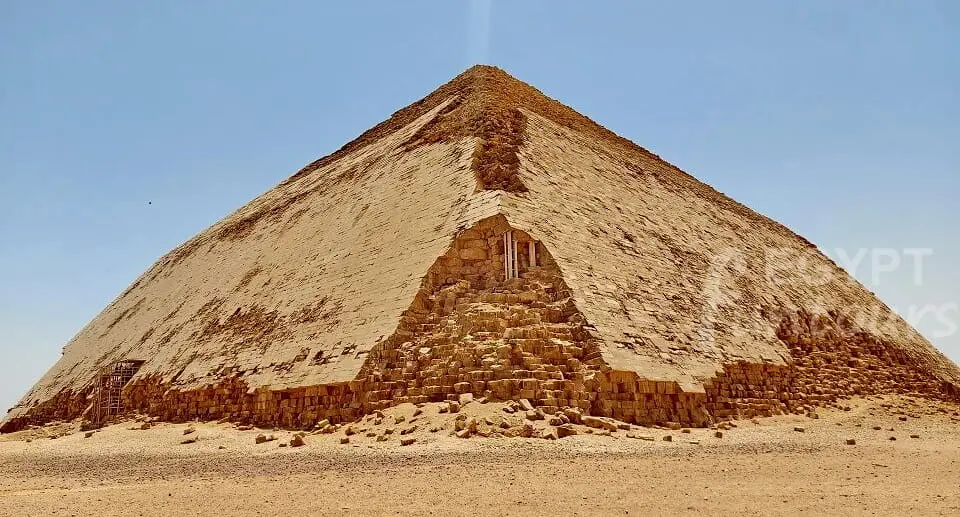
The pyramid sits in the desert necropolis of Dahshur, south of Saqqara. Most notably, its silhouette changes angle halfway up the structure. This distinct “bent” appearance resulted from a sudden adjustment during construction. Specifically, the architects feared the weight of the stone would cause a total collapse. For this reason, they reduced the slope from 54 degrees to 43 degrees. Therefore, the Bent Pyramid is a physical record of ancient trial and error. It showcases the resilience and ingenuity of the early Egyptian engineers.

FUN

The Strategic Significance of the Bent Pyramid

Private-Tour-to-Dahshur-Bent-and-Red-pyramids - 3-Day Cairo Tour Package Pyramids, Saqqara, GEM & Old Cairo

The Bent Pyramid serves as the foundation for all future pyramid building. Before its construction, architects struggled with the immense pressure of limestone blocks. Specifically, the soft clay ground at Dahshur proved to be a major challenge. Consequently, the builders had to invent new techniques to stabilize the foundation. Furthermore, this site provided the necessary lessons for the construction of the Great Pyramid of Giza. Without the mistakes made at the Bent Pyramid, the “true” pyramids might never have existed.

Today, the site remains one of the best-preserved examples of Old Kingdom architecture. Specifically, much of its original outer casing remains intact. Unlike the pyramids at Giza, you can see the smooth, polished limestone that once covered the entire surface. This preservation offers a rare glimpse into the original splendor of these royal tombs. Furthermore, the Bent Pyramid sits in a quiet, isolated location. Consequently, it provides a more authentic experience for travelers in 2026. By visiting this site, you witness the birth of a structural revolution.

The Internal Chambers and Cedar Beams of the Bent Pyramid

The interior of the Bent Pyramid is a labyrinth of ancient engineering. Specifically, the structure features two separate entrance systems. One tunnel begins on the north side, which is standard for most pyramids. However, a second entrance opens on the western face. This dual-entrance design is incredibly rare in the Old Kingdom. Consequently, the Bent Pyramid offers a complex internal map that fascinates modern archaeologists. Therefore, entering the pyramid provides a unique perspective on royal burial customs.

Inside the western chamber, visitors can see original cedar wood beams. These massive timbers came from the mountains of Lebanon nearly 4,600 years ago. Specifically, the architects used the wood to reinforce the stone walls during construction. Because the environment inside the pyramid is so dry, the wood remains in excellent condition today. Furthermore, the scent of the ancient cedar still lingers in the air. For this reason, the Bent Pyramid feels more “alive” than many other stone monuments. It serves as a direct link to the international trade routes of the Fourth Dynasty.

FUN

The Innovation of Corbelled Ceilings in the Bent Pyramid

trip to giza pyramids

The architects of the Bent Pyramid faced a massive structural problem. Specifically, they had to prevent the ceiling of the burial chamber from collapsing under millions of tons of stone. To solve this, they invented the corbelled ceiling. In this design, each layer of stone sits slightly inward compared to the layer below. Consequently, the weight of the pyramid pushes outward rather than straight down. This technique allowed for much larger and taller internal rooms.

This breakthrough changed the future of Egyptian architecture. Specifically, the builders used these same corbelling techniques in the Red Pyramid and the Great Pyramid.

  • Structural Stability: The stepped ceiling prevents the roof from cracking.
  • Height: It allowed the burial chamber to reach impressive vertical heights.
  • Acoustics: The stone layers create a unique echoing effect inside the room.

Therefore, the Bent Pyramid was a laboratory for architectural ideas. Without these internal innovations, the grand chambers at Giza would have been impossible to build. Moreover, the preservation of these rooms allows travelers in 2026 to see the raw stones exactly as the builders left them. By exploring the interior, you witness the moment ancient architects mastered the physics of heavy stone.

Comparing the Bent Pyramid to the Red Pyramid

Just a short distance away, the Red Pyramid stands as the final success of King Sneferu. Specifically, it represents the first successful “true” pyramid ever built. Because the Bent Pyramid showed the dangers of steep angles, the builders chose a consistent 43-degree slope for the Red Pyramid. This lower angle ensured the structure remained stable from base to tip. Consequently, the two pyramids together show the entire learning curve of the Fourth Dynasty.

Travelers should visit both sites to appreciate this evolution. While the Bent Pyramid shows the struggle of invention, the Red Pyramid shows the perfection of the form. Furthermore, the two pyramids create a stunning visual contrast against the Dahshur horizon. For this reason, historians often refer to Dahshur as the “Pyramid Workshop” of Egypt. Therefore, the Bent Pyramid is not a failure. Instead, it is a necessary step toward the perfection of the ancient world.

Dahshur Pyramids: Where Pyramids Were Perfected

Escape the crowds at the Dahshur Pyramids, a true "hidden gem" just south of Saqqara....
Related post
FUN

The Valley Temple of the Bent Pyramid

The Valley Temple of the Bent Pyramid

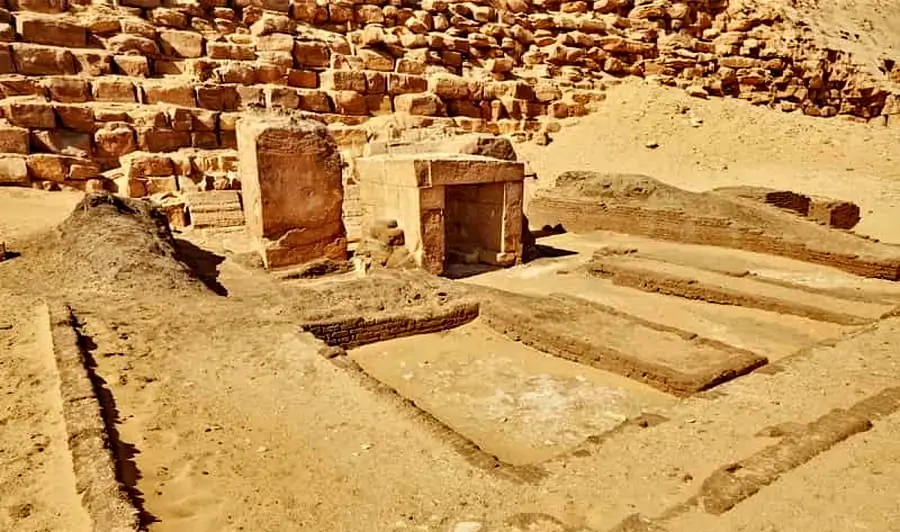
The Bent Pyramid is not just a single stone structure. Instead, it sits at the heart of a massive religious complex. Specifically, the Valley Temple is one of the most important parts of this layout. It stands at the edge of the cultivated land, away from the desert plateau. Archeologists discovered this temple in 1951. It is the oldest known valley temple that features elaborate wall carvings. Consequently, the Bent Pyramid provides a rare look at the artistic style of the early Fourth Dynasty.

The temple served as the starting point for royal funeral processions. Specifically, priests used the space to perform sacred rituals for King Sneferu.

  • The Entrance Porch: Two rows of pillars greeted visitors as they entered.
  • The Open Court: This area allowed natural light to illuminate the limestone walls.
  • The Statues: Six deep niches once held life-sized statues of the king.

Therefore, the Valley Temple connected the living world of the Nile to the eternal world of the pyramid. Furthermore, the walls featured relief carvings of the king visiting various regions of Egypt. These images symbolized the unity of the country under his rule. For this reason, the Bent Pyramid complex is a vital site for studying ancient Egyptian politics. By exploring the temple ruins, you see how Sneferu used architecture to project his power.

The Causeway and the Satellite Pyramid

A long stone causeway links the Valley Temple to the Bent Pyramid. Specifically, this path is over 200 meters long and features high stone walls. It served as a symbolic bridge for the king’s soul. Because the ground is uneven, the builders had to level the terrain with massive limestone blocks. Consequently, the causeway itself is a significant engineering feat. Moreover, it guided the funerary party directly to the base of the mountain of stone.

Just south of the main structure sits the Satellite Pyramid. This smaller building stands about 26 meters tall. Specifically, it mirrors the design of its larger neighbor.

  1. Ritual Purpose: Most Egyptologists believe this pyramid held the king’s ka, or spiritual double.
  2. Internal Passage: It features its own descending tunnel and burial chamber.
  3. Casing Stones: Like the Bent Pyramid, it still retains much of its smooth casing.

Therefore, the Satellite Pyramid completes the site’s spiritual landscape. It shows that the builders viewed the area as a unified “city for the dead.” Furthermore, the presence of these additional structures increases the site’s complexity. Consequently, travelers in 2026 should walk the full length of the causeway to appreciate the scale. This journey allows you to experience the Bent Pyramid exactly as the ancient priests did.

The Step Pyramid Complex: A Revolution in Stone

The Step Pyramid Complex of King Djoser, built around 2670 BCE by the architect Imhotep,...
Related post
FUN

Artistic Reliefs and the “Southern Shining Pyramid”

The Bent Pyramid originally carried a poetic name. The ancient Egyptians called it “Sneferu is Shining in the South.” Specifically, the polished Tura limestone reflected the sun’s rays across the valley. Because the casing is so well-preserved, we can still imagine this brilliant effect today. Furthermore, the carvings found in the Valley Temple represent the earliest known “Nome” lists. These are lists of the administrative districts of ancient Egypt.

Consequently, the Bent Pyramid acted as a central archive for the kingdom. It recorded the wealth and resources of every province. Therefore, the structure was more than a tomb. It was a monument to the organization of the entire Egyptian state. Moreover, these reliefs provide a timeline of how art evolved before the Giza period. For this reason, the site attracts both historians and art lovers alike. Standing in the shadow of the Bent Pyramid, you witness the dawn of a civilization’s golden age.

The Lessons of Meidum: Paving the Way for Dahshur

Before the Bent Pyramid, King Sneferu worked on a massive project at Meidum. Specifically, the Meidum Pyramid began as a traditional step pyramid. However, the king eventually ordered his architects to fill in the steps with limestone. This was the first attempt to create a “true” smooth-sided pyramid. Because the builders added the casing as an external layer, the bond was weak. Consequently, much of the outer structure eventually collapsed into a massive mound of rubble. Therefore, Meidum served as a vital, albeit difficult, lesson for the royal architects.

The failure at Meidum directly influenced the Bent Pyramid. Specifically, the builders realized they needed a more integrated internal core.

  • Internal Bonding: They began using horizontal masonry layers instead of leaning accretion layers.
  • Foundation Choice: The collapse at Meidum made architects more sensitive to the stability of the desert floor.
  • Angle Selection: The steep slope at Meidum proved that a lower angle was necessary for long-term safety.

Furthermore, the Bent Pyramid was built almost immediately after the experiments at Meidum. It represents the “second draft” of the smooth-sided pyramid concept. For this reason, you cannot fully understand one without studying the other. The two sites together tell the story of a civilization learning to master gravity. By comparing these monuments, you see the rapid evolution of engineering in the Fourth Dynasty.

The Pyramid of Menkaure: Unlocking the Mystery of Giza’s Third Wonder

The Pyramid of Menkaure proves that true greatness does not always require record-breaking height. By...
Related post
FUN

Logistics and Planning for Dahshur

Visiting the Bent Pyramid requires a bit of preparation. Because the site is less commercial than Giza, amenities are limited. Specifically, there are a few shops or restaurants near the pyramid itself. Consequently, you should bring your own water and snacks for the trip. Furthermore, the desert wind can be quite strong on the Dahshur plateau. For this reason, we recommend visiting during the early morning hours to enjoy the best weather.

Final Travel Checklist

  • Transportation: Most travelers hire a car from October Gardens or Cairo for the full day.
  • Tickets: You can purchase tickets at the main entrance gate near the Red Pyramid.
  • Footwear: Wear sturdy hiking boots. Specifically, the ground near the Valley Temple is rocky and uneven.
  • Safety: The descent into the Bent Pyramid is steep. If you have claustrophobia or heart issues, view the chambers through virtual tours instead.

The Enduring Mystery of the Bent Pyramid

The Bent Pyramid remains a masterpiece of ancient resilience. It is a structure that refused to fall, even when the physics of its design failed. Specifically, it marks the exact moment that Egyptian architects transitioned from guesswork to precision. Because of its unique shape and preserved casing, it offers a visual experience like no other tomb in the world. Furthermore, it serves as a bridge between the failures of Meidum and the perfection of the Red Pyramid.

In summary, the Bent Pyramid is a monument to the spirit of innovation. It proves that even the greatest builders must learn from their mistakes. Consequently, the site inspires every traveler who stands before its towering limestone walls. Therefore, as you plan your 2026 Egyptian adventure, make Dahshur a priority. Experience the “Southern Shining Pyramid” for yourself and witness the birth of the world’s most iconic architectural form.

Deluxe Tour that takes you on an extraordinary journey through some of the most breathtaking destinations in Egypt....
Discover the wonders of ancient and modern Egypt through this magical Dahabiya The Orient from Aswan to Esna for 3 nights....
FUN
God_Anubis_Icon

Egypt Fun Tours – Does it All!

My husband and I visited Egypt in March 2013. First, let me say, ‘Go, go, go!’ – it’s safer and definitely friendlier than many places we’ve visited. Tourism is drastically down – thanks mostly to media misinformation – so it’s a great time to visit to avoid line-ups and crowds

More »

Highly Recommend Egypt Fun Tours!

Several weeks ago, I reached out to Egypt Fun Tours regarding a 9-hour layover in Cairo. From the very beginning, Hani Ahmed was responsive and professional, quickly providing a well-organized itinerary tailored to our limited time. The itinerary included a visit to the pyramids, other historical sites, a delicious dinner,

More »

Good but did not get what I paid for…

I had an 11 hour layover in Cairo. I wrote to them based on recent reviews for them on this site. After a few email exchanges with Hati, who I think is one of the owners, I was ready to get there. I was greeted by Hatem, a very good

More »

7 night Egypt Experience Cairo, Aswan, Luxor

Trip of a lifetime!! COVID SAFE!! Knowledgeable guide who loves to share the magic of Egypt with tourists. Friendly and accommodating. This company goes to the extreme to make clients feel welcome and help them. A family company that takes good care of its support staff. Must book the 7-night

More »

Outstanding layover tour

I had the opportunity to do a layover tour with Egypt Fun Tours this Friday, and it was amazing. I had a 10-hour layover tour in Cairo, and I was met by Mohamed on time at the airport. He picked me up in a clean, new, safe, and comfortable van.

More »
God_Anubis_Icon

Top-rated Tour Packages

God_Anubis_Icon