🐑 God Khnum: The Definitive Guide to the Egyptian Creator God

Khnum is the ancient Egyptian ram-headed creator god and master artisan. Known as "the divine potter," he famously fashioned the bodies of humans and their life-force (ka) on his potter's wheel using the clay of the Nile. His primary cult center was Elephantine, situated at the First Cataract. Therefore, he was revered as the absolute controller of the Nile River, responsible for releasing the life-giving annual flood. Khnum’s powerful ram symbolism represents fertility and virility, cementing his role as both the supreme originator of life and the divine sustainer of Egypt.

God Khnum, a ram-headed deity, was one of the most significant creator gods in ancient Egyptian mythology. His name means “the divine potter,” a title that perfectly encapsulates his primary role. Egyptians believed he fashioned both humans and other gods on his potter’s wheel from the clay of the Nile. Khnum’s domain extended beyond creation to include the crucial flow of the Nile River, making him a god of immense importance for a civilization entirely dependent on its annual flood. Therefore, he was not just a creator; he was a sustainer. This comprehensive guide explores his origins, his diverse and essential roles, and his enduring legacy.

Origin and Early Worship: The Potter of the Cataracts

The worship of Khnum dates back to the Old Kingdom (c. 2686–2181 BCE). His cult established itself early, reflecting his fundamental role in the Egyptian worldview. Specifically, people recognized his power at the very beginning of the life-giving Nile.

Elephantine: The Sacred Island

Khnum’s primary cult was centered in Elephantine, an island at the First Cataract of the Nile. This geographic location was highly significant. It marked the southern boundary of Egypt. More importantly, the Egyptians believed it was the place where the Nile emerged from the underworld (Nun).

  • Geographic Significance: The Cataract, a series of rocky rapids, represented the mysterious source of the river. Thus, it was the perfect home for a creator god who controlled the waters.
  • Titles: As the guardian of the Nile’s source, Khnum ensured the annual inundation. This flood brought fertile black silt to the fields and sustained all life. Consequently, this vital function earned him powerful titles like “Lord of the Cataracts” and the “Guardian of the River.”

Khnum and the Inundation (Akhet)

The annual flooding of the Nile, known as Akhet, was the most important event of the Egyptian calendar. Khnum was the divine controller of this event. Egyptians believed he kept the floodwaters locked away in underground caverns near the First Cataract.

Therefore, priests at Elephantine continuously monitored the Nile’s water level using a Nilometer. This stone gauge provided crucial warnings. It helped priests determine if Khnum was preparing to release a beneficial flood. A flood that was too high meant destruction. A flood that was too low meant famine. Khnum’s priests were responsible for placating him to ensure a perfect flood level every year. This role made his priesthood one of the most powerful and politically significant in the entire kingdom.

FUN

Shaping Life on the Potter’s Wheel

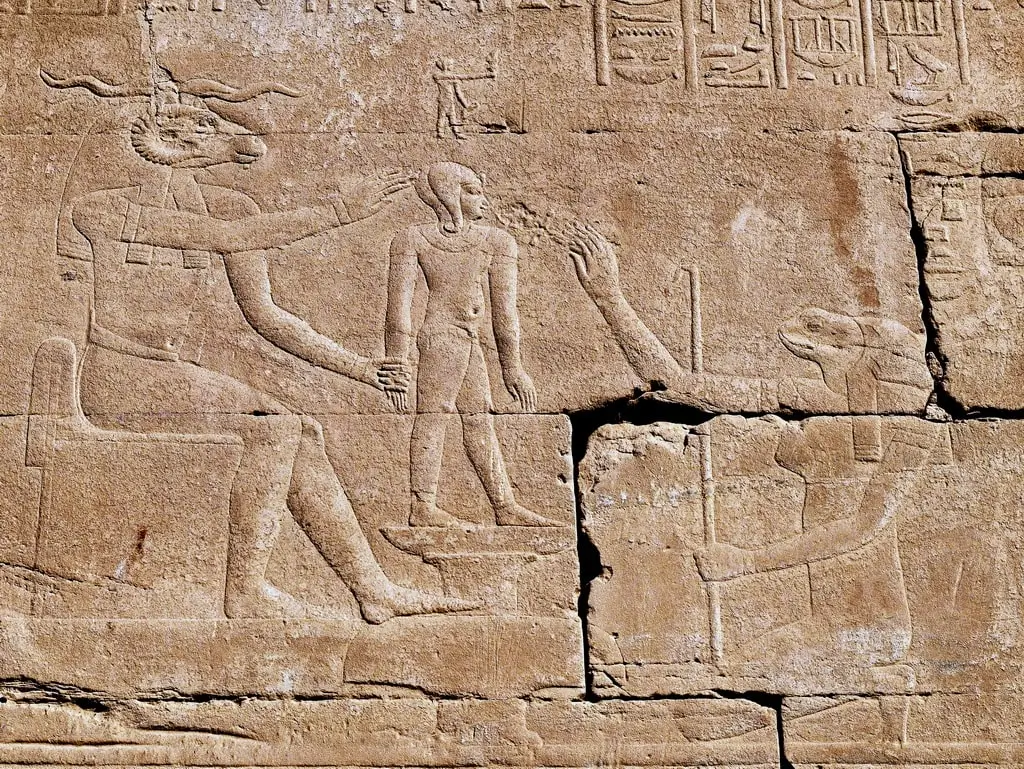
God khnum Shaping Life on the Potter's Wheel

Khnum’s most celebrated and unique role was that of the master creator god. He shaped existence itself.

The Divine Potter and the Clay of the Nile

His name, “the divine potter,” perfectly described his creative methodology. Egyptian mythology tells us Khnum created the physical bodies of all living things on his potter’s wheel. This wheel, representing the cyclical nature of creation and destruction, was known as Sa-qad.

  • The Material: He used the clay of the Nile for his work. This clay was the fertile, dark silt brought by the annual flood. In essence, he used the very material that defined Egyptian life to create life.
  • The Act of Creation: Khnum meticulously fashioned the bodies of children. Furthermore, he created their ka (life-force or spirit-double) simultaneously. He then placed both the body and the ka inside the mother’s womb. Ultimately, every child born in Egypt was literally considered a masterpiece of God Khnum.

Creator of Gods and Pharaohs

Khnum’s creative power did not limit itself to humanity. In some accounts, he even created other deities. This solidified his status as a progenitor god, a divine source preceding many other gods.

The Temple of Hatshepsut at Deir el-Bahari holds the most famous depiction of this divine creation. Here, a series of reliefs depicts Pharaoh Hatshepsut’s divine birth. Khnum appears on his wheel, carefully forming the infant queen’s body and ka. This scene reinforced the pharaoh’s unique divine status. It established the rulers as being intentionally created by a god, not merely conceived by a human. Thus, Khnum guaranteed the royal lineage itself.

FUN

The Ram Symbolism: A God of Strength and Fertility

The Ram Symbolism; A God of Strength and Fertility

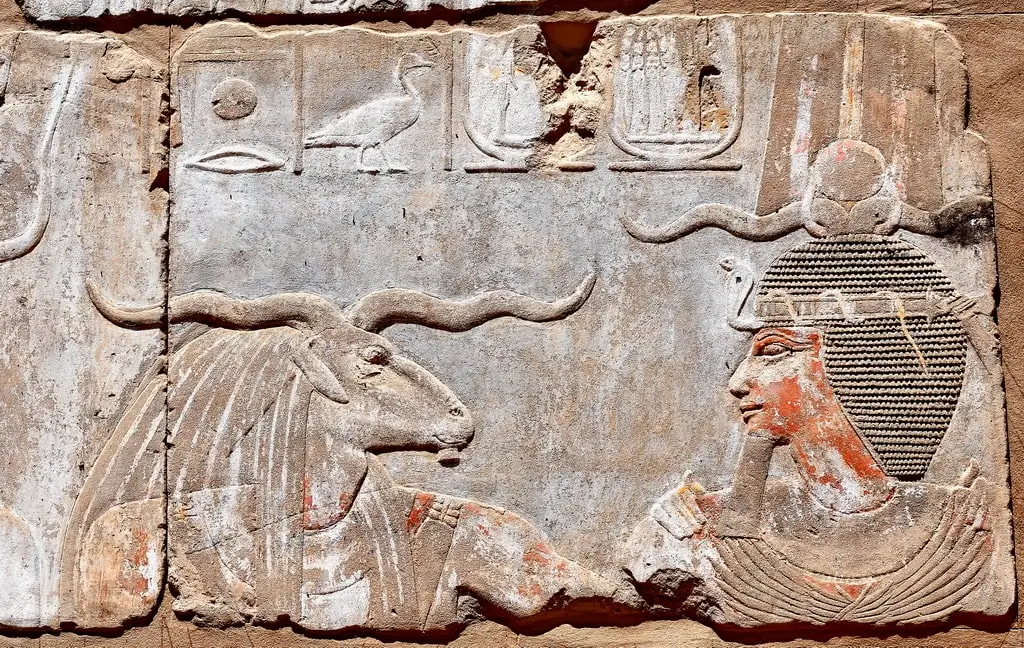
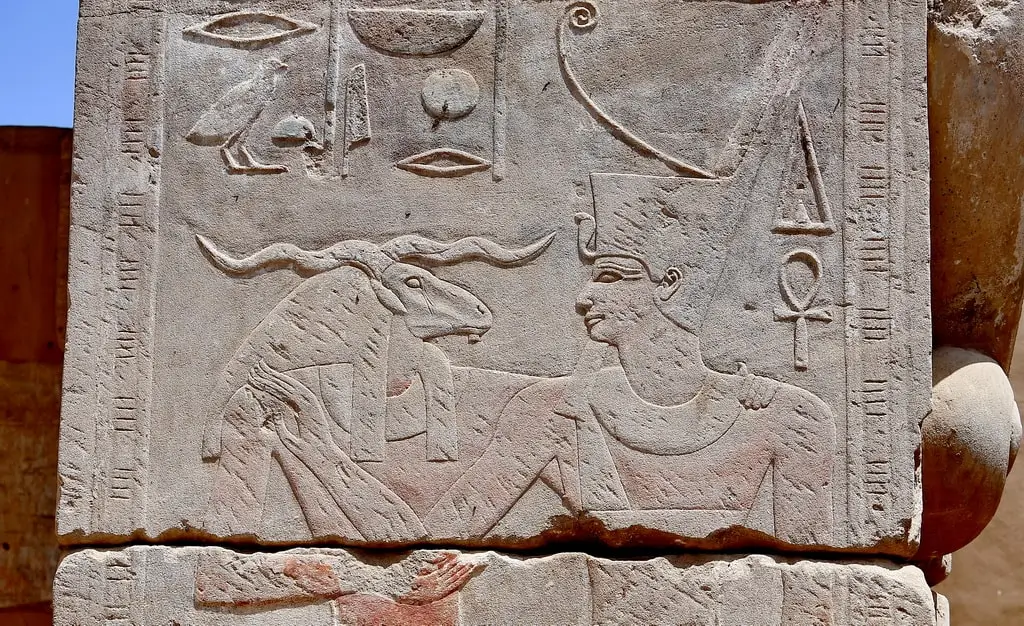
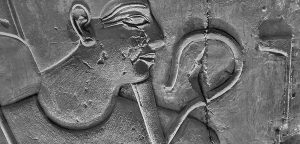
God Khnum was consistently depicted as a man with the head of a ram. This iconography was deeply symbolic and deliberate.

The Ram’s Virility and Power

The specific ram breed associated with Khnum was the Ovis longipes (long-horned, spiraled ram). The ram, with its curved, horizontal horns, symbolized potent virility and fertility.

  • Connection to the Nile: This association was logical. Khnum was the god responsible for the fertile Nile flood, which impregnated the land with life-giving silt. He was also responsible for creating human life. Consequently, the ram represented the raw, procreative power inherent in the universe.
  • Distinction: Khnum’s ram-head set him apart from other deities. Other ram-headed gods, like Amun, often featured vertical or curved-down horns. Khnum’s unique horizontal horns highlighted his specific role as a life-giver and potter.

Khnum and the Egyptian Soul

The ram was also closely associated with the Ba—the aspect of the Egyptian soul that represented personality, movement, and the ability to travel between the worlds. Therefore, Khnum’s ram form subtly connected him to the spiritual dimensions of existence. He was the creator of the body and the source of the life-force (ka) that animated the body and the mobile soul (Ba).

Egyptian Phoenix Bennu: Myth, Symbolism, and Legacy

Forget the fire. The original legend is even better. Meet the Bennu, the Egyptian Phoenix....
Related post
FUN

Divine Triads and Theological Context

elephantine island aswan 1

Khnum was a foundational deity, and his importance people often expressed through his inclusion in regional divine families, known as triads.

The Elephantine Triad

At Elephantine, Khnum formed a powerful triad with his female counterparts. This family unit protected the First Cataract and ensured the steady, life-sustaining flow of the Nile.

  • Consort: Satis (or Satet): Satis was a goddess of the Nile’s inundation and the goddess of the hunt. Importantly, she was often depicted shooting arrows to ward off Egypt’s enemies from the southern border.
  • Daughter: Anuket (or Anukis): Anuket was the goddess of the cataracts themselves. She represented the fierce speed and energy of the water flowing between the rocks.

Collectively, this triad represented the three aspects of the Nile at the border: the source (Khnum), the power of the flood (Satis), and the cataract itself (Anuket). This local theology made Khnum the undisputed patriarch of the lifeblood of Egypt.

Khnum at Esna

Khnum achieved an even more profound, universal status in the city of Esna, further north. Here, he was associated with other creator deities.

  • The Esna Triad: Khnum formed a triad with his consort, Neith, and their son, Heka (the god of magic).
  • At Esna, Khnum rose to the highest rank. People revered him as the primeval god who created everything: not just humans and gods, but also the heavens, the earth, and the waters. Consequently, the temple at Esna features complex hymns dedicating the creation of the entire cosmos to the efforts of Khnum on his potter’s wheel.

God Thoth: The Egyptian God of Wisdom, Writing, and the Moon

Thoth (or Djehuty) is one of the most important and powerful ancient Egyptian gods. He...
Related post
FUN

The Famine Stele: A Tale of Divine Power

The Famine Stele; A Tale of Divine Power

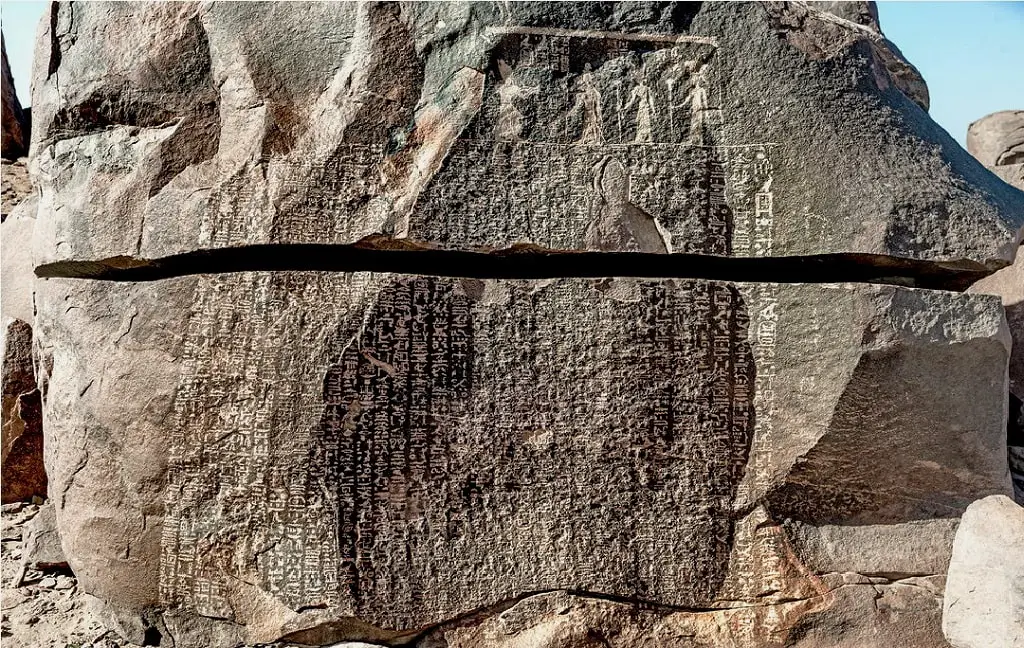
One famous historical inscription powerfully demonstrates Khnum’s critical importance and authority: the Famine Stele. This tale solidified Khnum’s reputation as the ultimate controller of the river.

A Seven-Year Drought

The stele, inscribed on a large rock on Sehel Island near Elephantine, recounts a period of immense suffering. It describes a disastrous seven-year famine during the reign of King Djoser (Old Kingdom). The famine occurred because the Nile failed to flood adequately for seven consecutive years.

  • The Crisis: The lack of Akhet meant no fertile silt and no water for irrigation. Therefore, the kingdom faced starvation, despair, and economic collapse.
  • The Appeal: King Djoser, in desperation, appeals to the gods. He seeks to understand why the vital flood is being held back.

Khnum’s Revelation and the Vow

In a dream, the distressed pharaoh sees the benevolent yet powerful God Khnum. Khnum appears and reveals the truth. He states that he is personally responsible for holding back the floodwaters from his caverns. The reason? The pharaohs had neglected their temple and their priests at Elephantine.

  • The Bargain: Djoser immediately vowed to restore Khnum’s neglected temple. He promised to dedicate a substantial portion of the taxes, tithes, and fishing catches from the surrounding lands directly to Khnum’s priesthood.
  • The Restoration: Khnum, satisfied with the pharaoh’s penitence and pledge, promises to release the floodwaters once more. Immediately, the Nile’s flood returns to the perfect level, and the seven-year famine ends.

Ultimately, the Famine Stele served a powerful purpose. It was a clear political and religious text that documented the divine power of Khnum. Moreover, it justified the economic and political wealth held by the priesthood of Khnum at Elephantine. Thus, Khnum’s power was written into history.

Syncretism and Enduring Worshipping Sites

Khnum’s status as a creator god inevitably led to connections with other major deities, illustrating the adaptable nature of Egyptian religion.

Khnum and Other Creator Gods

  • Ptah: People often linked Khnum with Ptah, the patron god of artisans, craftspeople, and architects from Memphis. Both gods shared the concept of creation. However, Ptah created through thought and command, whereas Khnum created through manual, physical labor on the wheel.

  • Ra: He connected to Ra, the supreme sun god. Both were foundational creators. The association of Khnum with Ra-Horakhty (a form of the sun god) underscored the belief that Khnum’s creative force was as eternal and essential as the sun’s daily journey. Hence, people sometimes referred to him as the sun setting, symbolizing his role in the cyclical creation of life.

Major Cult Centers: A Hub of Power

The temples dedicated to Khnum were not just religious sites. They were economic and political hubs.

  • Elephantine: The earliest and most important center. The priesthood here was responsible for the critical task of monitoring the Nile’s height.
  • Esna: The magnificent temple here, dating largely to the Greco-Roman period, provides the most detailed theological texts regarding Khnum’s role as the universal creator. Consequently, the reliefs at Esna show Khnum shaping gods on his wheel, reinforcing his comprehensive authority.

God Thoth: The Egyptian God of Wisdom, Writing, and the Moon

Thoth (or Djehuty) is one of the most important and powerful ancient Egyptian gods. He...
Related post
FUN

Legacy Beyond Egypt

Legacy Beyond Egypt; God Khnum

The worship of Khnum, while rooted in the Nile Valley, had a lasting theological and visual impact that transcended the decline of the pharaohs.

Hellenistic and Roman Absorption

As Egypt became part of the larger Hellenistic and Roman worlds, Khnum’s worship continued, though often under different guises. For example, he was occasionally syncretized with the Greek god Chronos (Time) due to the similarity in names. However, his image as the ram-headed potter remained distinct.

  • Protection and Fertility: Roman soldiers and local populations continued to revere him for his powers of protection and fertility. His water connection meant he was an appealing figure for sailors and merchants.
  • Enduring Imagery: The powerful imagery of the potter shaping human destiny was preserved in Hellenistic and Gnostic texts. Thus, the motif of the divine artisan continued to inspire philosophical and religious thought long after the temples closed.

The Khnum Motif in Modern Thought

Ultimately, the image of Khnum as the divine potter remains a profound symbol.

  • Connection to Nature: He symbolizes the fundamental connection between life, creation, and the Earth’s natural resources—specifically, the Nile River. Khnum’s story teaches that the land and water literally made the land.
  • Creation and Destiny: The potter’s wheel serves as a powerful metaphor for human existence. It suggests that while Khnum creates the form, the ka he places within gives that form its unique destiny. This belief provided a profound insight into how the ancient Egyptians viewed the origins of life and the divine forces that governed their existence.

Therefore, God Khnum remains a powerful symbol of creation, cyclical renewal, and the indispensable power of the natural world.

Current weather in Egypt

12 Days Solo Woman Tour Package (Queen Cleopatra)...
Discover the secrets of ancient Egypt while exploring its magical wonders....

Early Layover Tour in Cairo

My husband, 2 sons – aged 9 & 11 – and I landed in Cairo at 5:15am on Saturday 12 January 2013. We had booked an early layover tour with Egypt Fun Tours after reading the great reviews in TripAdvisor. As promised he and his driver awaited us in a

More »

Day trip to Wadi el Hitan and Wadi el Rayan

We went on a full-day trip to Wadi el Hitan and Wadi el Rayan with Mohamed (Hamada). Mohamed was a wonderful guide, always making sure we had plenty of water and enough to eat, and providing us with information about the area and Egypt more generally. He also gave us

More »

The best holiday ever!

The Nile cruise, Luxor, and Aswan were amazing sites to see, especially when you have the best tour guide in Egypt. Hamada was absolutely fantastic, lots of information, and some of it not spoken by others. This guy was not only a simple tour guide for us, but he also

More »

Like two days of touring in one day!

I had a 12 hour stay in Cairo- and had made no plans on how to spend it until 8pm the night before departure. I emailed Egypt Fun Tours in a panic and they responded immediately. They made it incredibly easy to arrange a tour and we made arrangements via

More »

AMAZING Layover Tour

We had the MOST amazing layover tour with Egypt Fun Tours. Hanni was amazing, and we loved every moment. Pyramids, authentic food, and Islamic Cairo – amazing!

More »
Isis with wings

Top-rated Tour Packages

Isis with wings