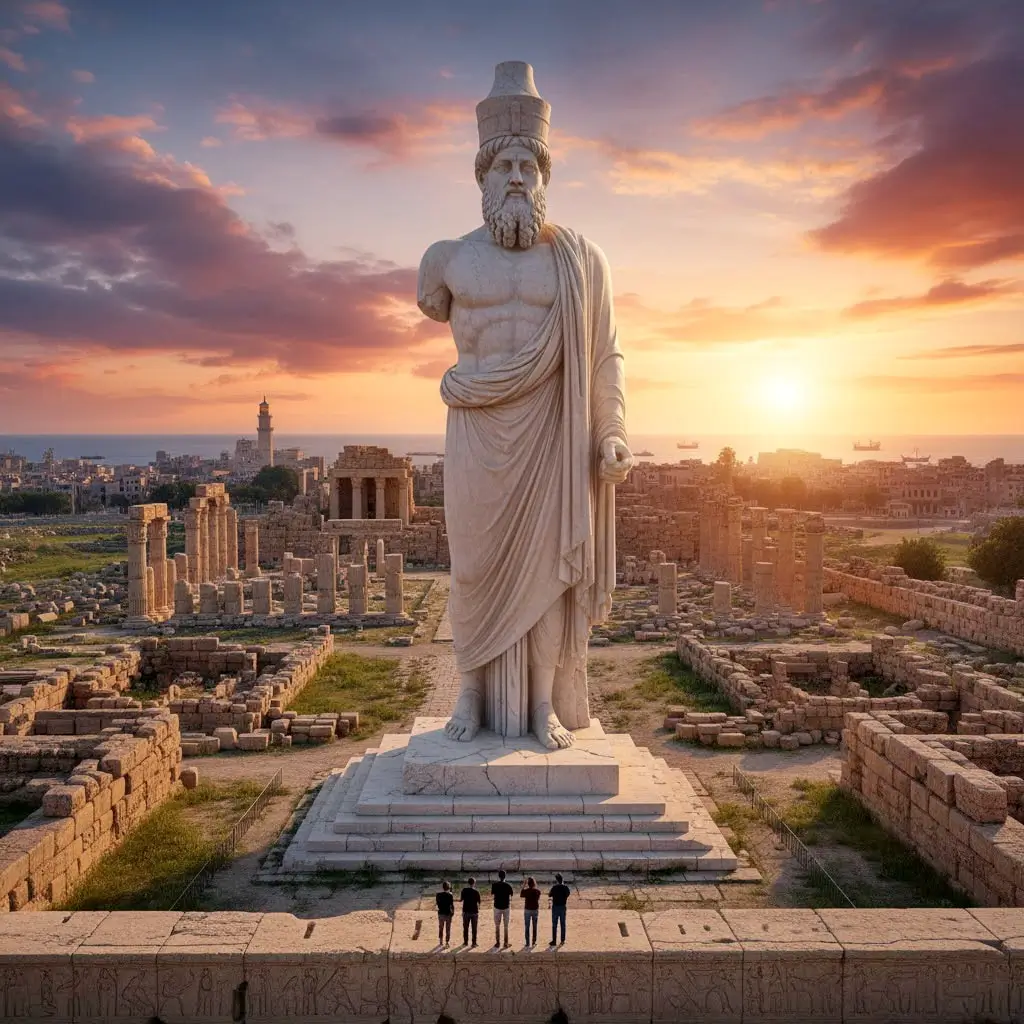
History records countless powerful deities. However, few gods emerged from a political blueprint. God Serapis came into existence through deliberate, calculated strategy. In fact, he represents the pinnacle of religious syncretism. His purpose was monumental: to bridge the vast divide between the Greek world and the ancient Egyptian kingdom.
This powerful figure was a meticulously constructed deity. He was designed as a supreme, composite god. He synthesized the core attributes of multiple supreme powers. For instance, he claimed the authority of Zeus and carried the underworld power of Hades. He embodied the resurrection of Osiris. He held the vitality of the Apis Bull. Therefore, the entire Ptolemaic Dynasty designed him for one purpose: to be the undisputed patron deity of their new empire.
The cult’s influence quickly became global. Nevertheless, its absolute center remained the magnificent Serapeum of Alexandria. This vast temple complex was enormous. It functioned as more than a shrine. Instead, it was a cultural and intellectual institution. It housed the principal shrine of Serapis. Crucially, it also contained the famous “Daughter Library.” This feature linked the god to philosophy and knowledge. Consequently, the new deity became the patron of the intellectual elite.
This guide details the god’s calculated creation. We examine his pervasive Roman following and recount the spectacular grandeur of his temple. We describe the tragic end of his cult. But first, to truly appreciate the power of God Serapis, we must trace his theological roots back to Memphis.