Goddess Nut: The Egyptian Sky, Mother of Stars, and Mistress of the Dead

Step into a millennium of artistry. This comprehensive guide unveils the extraordinary legacy of Islamic Art in Egypt, starting with the earliest mosques built in Fustat. Journey through the centuries as you discover how the Fatimid rulers planned Cairo with geometric precision, how the Ayyubids fortified the Citadel, and why the Mamluks defined monumental architecture with breathtaking Muqarnas ceilings and spectacular calligraphy. We decode the core principles—from aniconism to the arabesque—and show you exactly where to find these masterpieces on Al-Moez Street and in the Museum of Islamic Art. Prepare to see Cairo as a living exhibition of divine pattern and light.

Goddess Nut: The Vast Dome

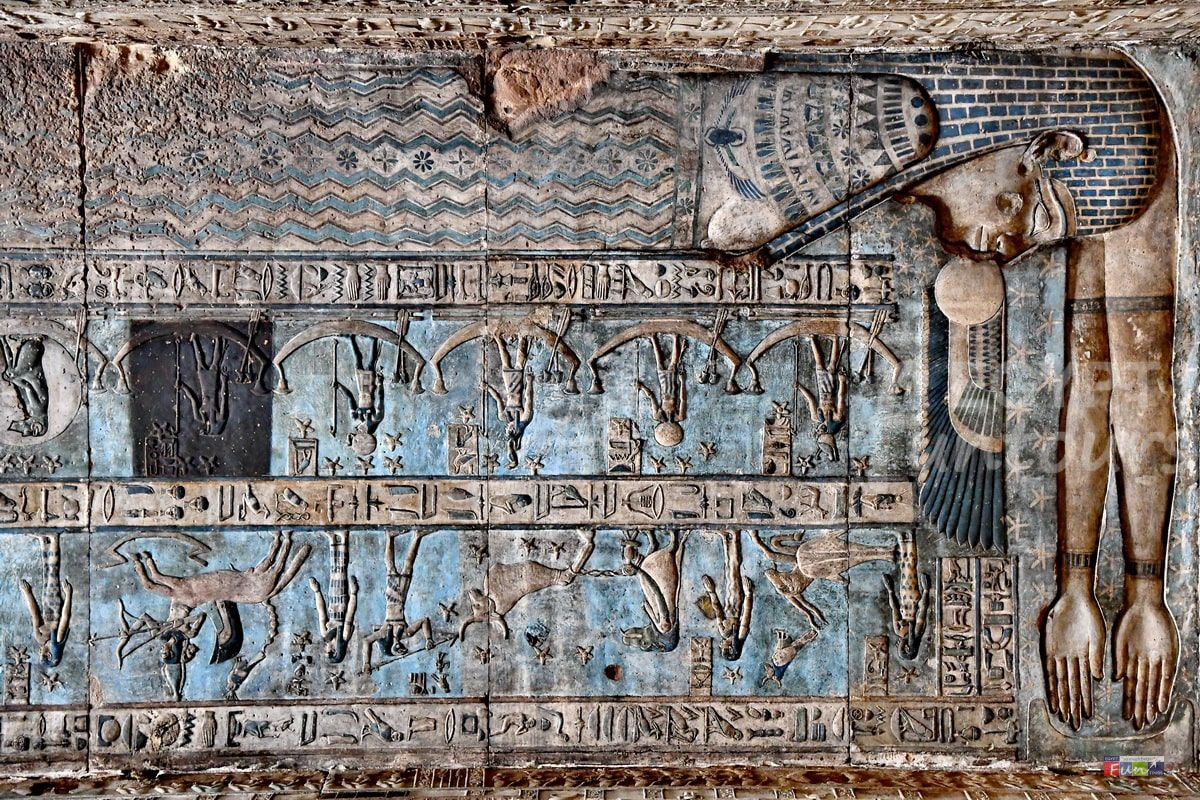
Understand this: Goddess Nut is the physical barrier between chaos and creation. She is the sky itself. Her iconography immediately captures attention—a woman arching her body over the earth. Unlike many sky deities in other cultures, she is female, emphasizing her role as the ultimate mother. Egyptians saw her not just as the dome overhead, but as the cosmic protector who holds the chaotic waters of Nun at bay.

Her function transcended the simple weather.  Goddess Nut literally governs time, determining the path of the sun, moon, and stars. This guide will fully explore Nut’s role, starting with her place in the great creation myth. You will learn her tumultuous relationship with Geb, her function in the celestial cycle, and her indispensable role in ensuring pharaonic rebirth in the afterlife. To understand her power, we must begin with the beginning of the world.

FUN

Birth of the Cosmos: Nut in the Ennead

The Great Divorce; Unpacking Geb and Nut Mythology of Earth and Sky - The Breath of Creation: Shu, God of Air and Cosmic Separation

The Goddess Nut occupies a central place in the Heliopolitan Ennead, the group of nine gods who formed the foundation of the Egyptian creation myth. She descends directly from the very elements of creation. She is the daughter of Shu (air) and Tefnut (moisture). Shu and Tefnut created her, and the earth god Geb became her brother and consort.

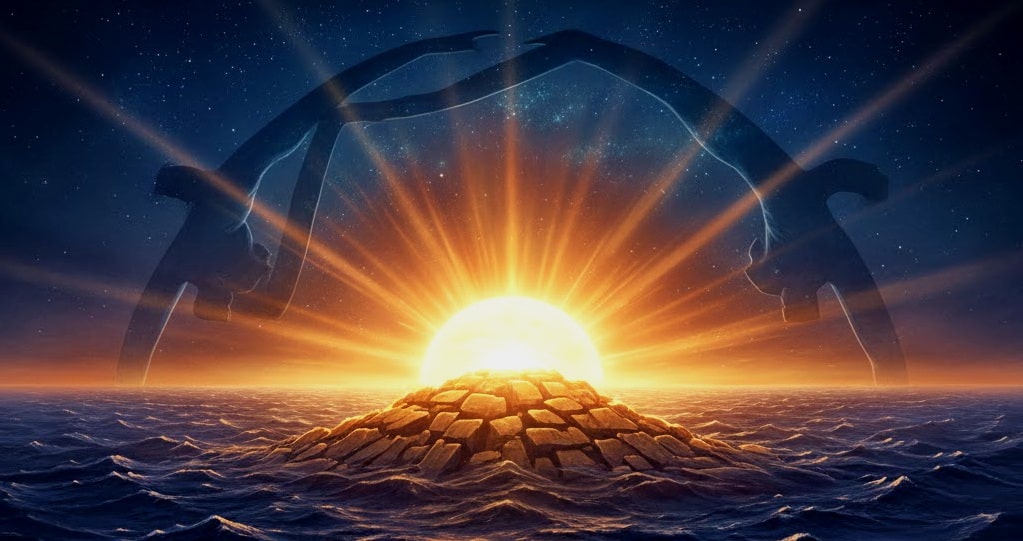
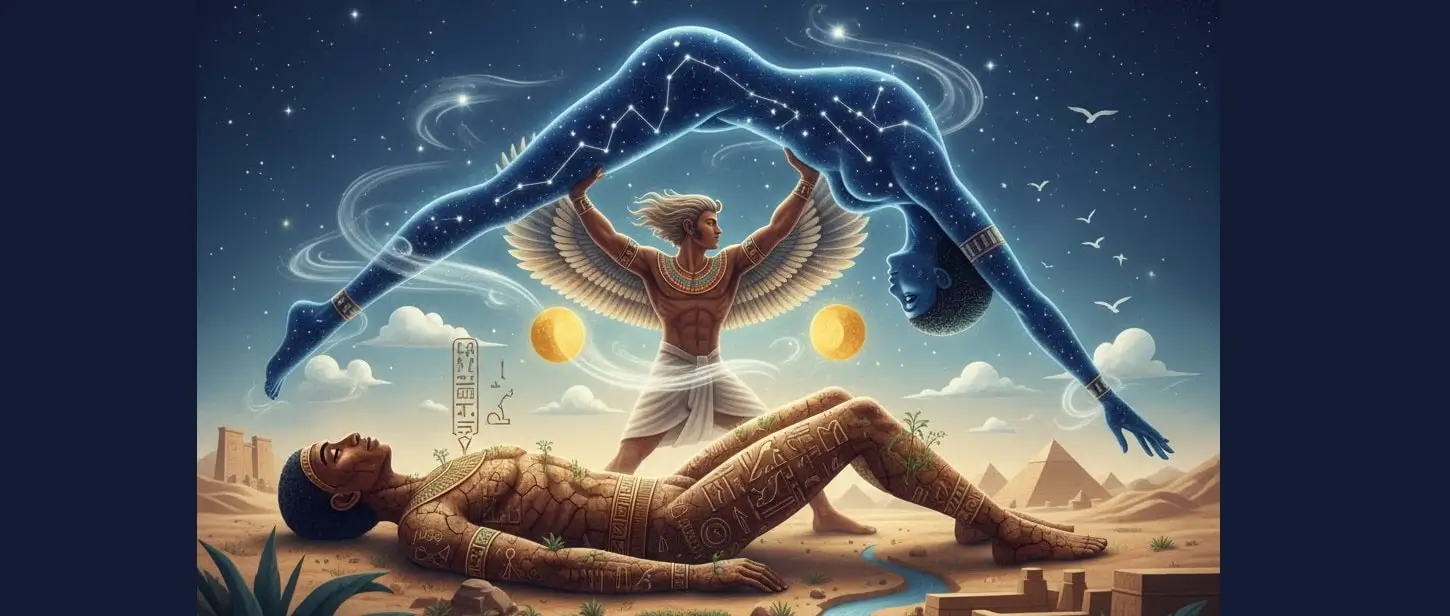
The most iconic moment of the creation myth involves Geb and Nut. They were originally locked in a passionate embrace that covered the entire earth. Shu, their father (Air), separated them. He lifted Nut high above Geb (Earth), thus creating the necessary space for life and breathable air below. The famous depictions show Shu supporting Nut with his arms.

This position defines Nut’s power. She represents the boundary of the created world. Her body protects everything below her from the chaotic, unformed waters that surround the cosmos. She becomes the ceiling of the world, making her the active engine that drives time and light across the heavens.

FUN

The Daily Cycle: Swallowing the Sun

Nut sky goddess ancient egypt gods and goddesses egypt fun tours

Nut’s position as the celestial dome makes her the direct engine of time, governing the daily cycle of light and darkness. The movement of the Sun God, Ra (or Re), depends entirely on her body. This solar journey forms the most powerful and visible act in the Egyptian religious calendar.

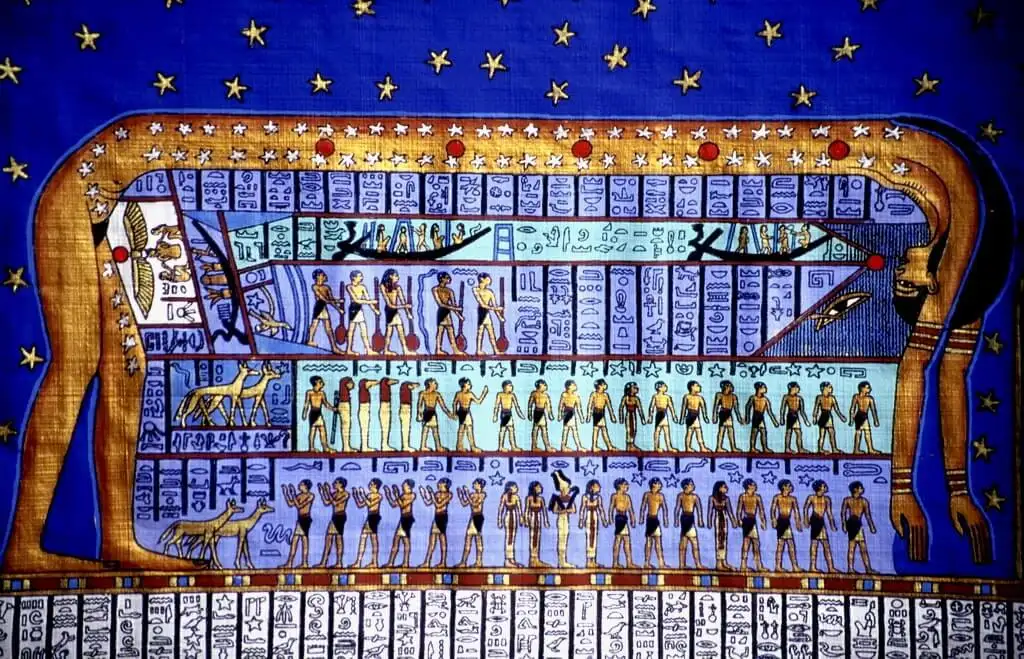
Every evening, the Sun God Ra enters Nut’s mouth in the west. He then begins his treacherous journey through the darkness of her body. This internal route represents the Duat, or the underworld, which the sun travels during the night. In the deepest part of the night, Ra fights the forces of chaos, primarily the serpent Apophis, before emerging victorious. Every morning, the Sun God is miraculously rebirthed from her womb (or sometimes her vulva) in the east. This act completes the cycle, reaffirming creation and defeating chaos daily. She also controls the moon, which she similarly swallows and rebirths, showing her mastery over all celestial bodies.

Nut’s generative power caused a major mythological conflict that resulted in the calendar we know today. According to the myth, the great creator god Ra cursed Nut. He forbade her from giving birth on any of the 360 days of the established year. However, the god of wisdom, Thoth, intervened for her. Thoth gambled with the Moon (Iah) and won five extra days (epagomenal days). Because these days fell outside the original 360-day calendar, Nut used them to give birth to her famous children, bypassing Ra’s curse.

Ma’at: Harmony, Order, and Cosmic Balance in Ancient Egypt

To stand amidst the wonders of Egypt is to encounter an entire civilization rooted in...
Related post
FUN

The Royal Offspring: Mother of the Gods

Ennead of Heliopolis; Nine Deities at the Heart of Ancient Egyptian Creation

Nut’s ability to conceive and give birth outside the established calendar secured her place as the ultimate divine mother. Her five extraordinary children formed the foundation of the royal lineage and the primary Osiris-Isis myth cycle. She gave birth to each of these crucial gods on the five epagomenal days, fundamentally shaping the destiny of Egypt itself.

Nut bore Osiris, the god of the dead, rebirth, and fertility, who later became the first mythological ruler of Egypt. She also gave birth to Seth, the powerful god of chaos, storms, and war, who challenged his brother, Osiris. The three remaining children were Isis, the great mother goddess of magic and the embodiment of the royal throne; Nephthys, the goddess of the dead and protection; and Horus the Elder (Haroeris), an early sky deity.

These five deities formed a critical link between the cosmos and the kingship on Earth. Their stories of conflict and succession established the mythological right for the earthly Pharaoh to rule. Every Pharaoh inherited the legacy of Osiris’s authority and Horus’s kingship. Nut’s generative act thus provided the divine justification for Egypt’s entire political structure. Furthermore, the Celestial Cow Myth also features Nut. In this story, she lifts the rebellious elements of humanity into the sky, sometimes appearing in the form of a celestial cow to protect the sun god Ra.

Nephthys: The Egyptian Goddess of Funerals, Night, and Protection

Nephthys (meaning "Mistress of the House" or "Lady of the Enclosure") is an essential ancient...
Related post
FUN

Mistress of the Sarcophagus: Funerary Iconography

The-goddess-of-the-sky-Nut-inside-the-sarcophagus-of-King-Merneptah-19th-dynasty

Given her function in rebirthing the sun every morning, the Goddess Nut naturally became an indispensable figure in the Egyptian funerary cult. Her promise of cyclical renewal made her the primary cosmic agent ensuring the deceased’s passage to the afterlife.

The most common and significant depiction of Nut graces the inside lid of the pharaoh’s sarcophagus. The deceased lies directly beneath the sky goddess. This placement symbolically ensures that Nut swallows the deceased at night, just as she swallows the sun. In turn, she promises to rebirth them alongside Ra in the morning, granting them eternal life. The texts accompanying her often reinforced this promise, quoting the Book of the Dead or Pyramid Texts with phrases like: “May you be placed amongst the imperishable stars which are in her.”

Nut also appears on the ceilings of tombs and temples, directly representing the actual night sky. Her body is typically covered in stars, confirming her majestic title, “Mistress of the Stars.” In this role, she gives the deceased eternal access to the heavens, allowing them to become one of the imperishable stars that never set. This architectural placement reinforced the idea that the tomb was not a final resting place, but a cosmic womb awaiting renewal.

Nut in the Book of the Dead

The power of the sky goddess extended directly into the magical spells and ritual texts meant to guide the deceased through the underworld. These funerary texts, collectively often known as the Book of the Dead, feature Nut prominently, invoking her strength and maternal protection.

The deceased often relied on the belief that Nut offered them physical and spiritual nourishment immediately upon their arrival in the tomb. This divine offering of food and water symbolizes the sustenance only the cosmic mother could provide, ensuring the newly departed spirit retained the energy necessary for the journey ahead. Specific spells in the Book of the Dead, such as Spell 17, invoke Nut’s power directly. These spells ask her to grant the deceased the ability to become a powerful spirit (Akh), or even to join her celestial body as an imperishable star. The ultimate goal remained the cyclical rebirth that the sun experienced every morning.

Furthermore, ritual implements and amulets reinforced her protection. Mourners often placed the Nut amulet (typically a small tablet or a star effigy) on the deceased. This amulet served as a physical contract, ensuring the deceased received her divine favor and was indeed swallowed and rebirthed correctly. Through these texts and objects, Nut effectively guaranteed the deceased’s ultimate transformation from a mere body into a fully realized celestial being.

Goddess Sekhmet: The Complete Guide to the Lioness of War and Healing

Goddess Sekhmet is the most terrifying figure in the Ancient Egyptian pantheon. Depicted as a...
Related post
FUN

Iconography and Depiction

Goddess Nut and God Geb-origins-and-family-ties

The Egyptian belief system depended heavily on visible, consistent imagery, and the Goddess Nut possessed some of the most enduring iconography in the pantheon. Her depictions immediately convey her cosmic power and maternal role.

Her most iconic form shows her as a naked woman arched over the earth. She touches the ground with her fingertips and toes, effectively forming the physical sky dome. Her body is typically covered in stars, visually reinforcing her title, “Mistress of the Stars,” and demonstrating the path of all celestial bodies. This posture recreates the moment of creation, where her father, Shu, separated her from Geb (the earth).

Nut sometimes also appears in animal form. She occasionally manifests as a celestial cow. This reflects her protective role in the Myth of the Celestial Cow. There, she lifted the sun god Ra into the sky. Furthermore, Egyptians often associated Nut with the Sycamore tree. The tree symbolized life and sustenance. She sometimes emerged from its branches. She offered food and cool water to the deceased. This symbolically fulfilled her role as the divine mother. She sustains life even after death. Her name (Nwt) came from a hieroglyphic symbol. That symbol was the water-pot or jar. It was a simple yet profound sign of sustenance and femininity.

The Eternal Sky

The Goddess Nut stands as one of the most fundamental and profound deities in the Egyptian pantheon. She literally defines the universe, acting as both the boundary of creation and the dynamic engine of all life and time. Egyptians saw her not just as the visible sky, but as the cosmic mother whose body held the cycle of existence.

Her legacy rests on three immutable pillars:

  1. Creation: She separated heaven from earth, creating the habitable world.
  2. Renewal: She governed the daily solar journey, swallowing the aging sun in the west and rebirthing it fresh in the east.
  3. The Afterlife: She promised rebirth, turning the coffin into a womb where the deceased waited to emerge as an eternal star.

Her presence ensures that every sunset is a promise, every night is a journey through transformation, and every tomb functions as a protective womb. The Goddess Nut thus embodies the core Egyptian belief in cyclical creation and the guaranteed renewal of life after death. She remains the majestic, star-covered dome that protects the fragile world beneath.

Weather in Egypt

Embark on a luxurious voyage to discover the amazing wonders of Cairo and Luxor....
Explore Egypt's Metropolitan Cities: 4-Day Private Tour of Cairo & Alexandria...

Amazing one day tour

Fantastic tour. We were picked up at the airport early in the morning (6 am), and were dropped off in the evening after discovering amazing Cairo. The guide was knowledgeable and took us to many hidden places, which we wouldn’t have found without him. Thank you!

More »

Alexandria! Wow!

Muhammad is the best! He showed me a world I never thought possible! The tombs in Alexandria, by far, were my favorite! I never knew there was a place on earth that contained both Greek and Egyptian carvings in the same tombs! The history and culture of Egypt is so

More »

Tour of Cairo

Despite a late start due to car trouble, Mohamed more than made up for it with his incredible knowledge and dedication. His explanations were detailed and thoughtful, and he went above and beyond to make sure we had a great experience. A memorable and informative tour, thanks to Mohamed’s hard

More »

Valley of the Kings, Hepchepsut

I never had a more positive experience and educational time than this tours. Learning about a variety of kings and queens was amazing! The tour guide was super nice and helped me and my friend every step of the way! Including bargaining for a few souvenirs! I will never forget

More »
Isis with wings

Top-rated Tour Packages

Isis with wings