Hemiunu: The Vizier and Architect Who Built the Great Pyramid of Khufu

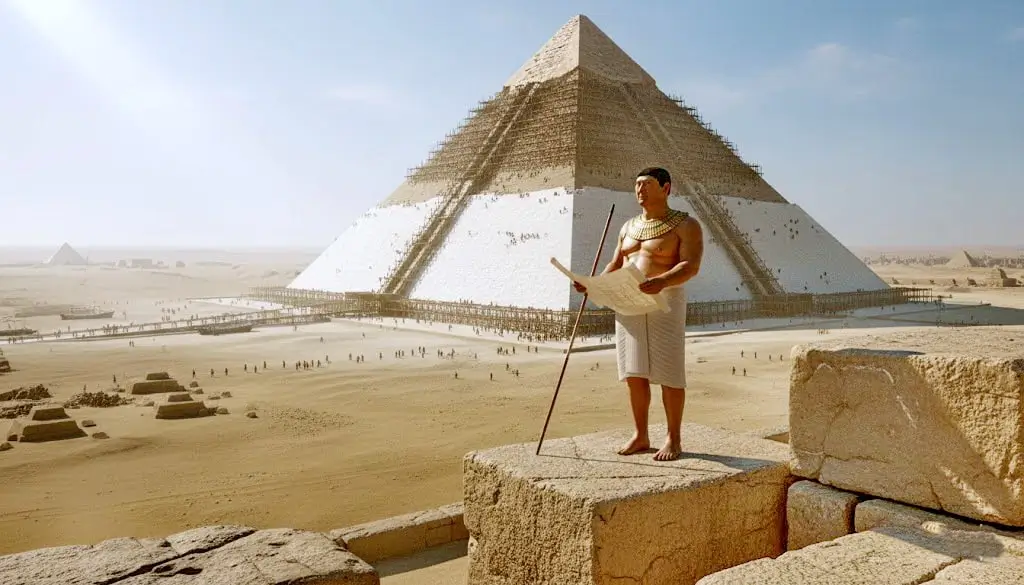
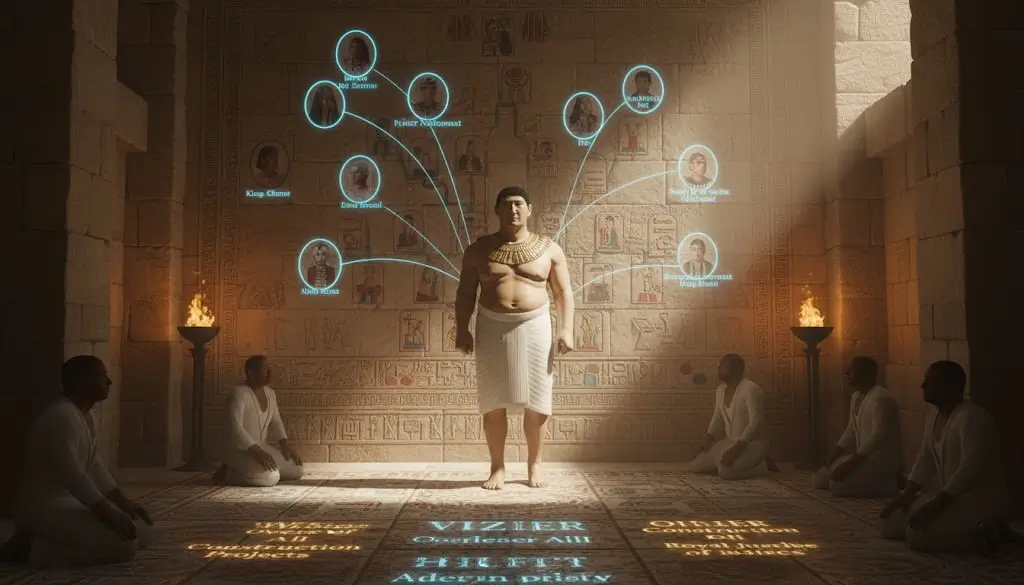
Hemiunu was the powerful Vizier and Overseer of All Construction Projects for Pharaoh Khufu, a role that made him the functional chief architect of the Great Pyramid of Giza. A member of the royal family, Hemiunu managed the entire national logistical effort—from securing materials to organizing the massive labor force—required for the monumental project. His status is evidenced by his prominent Mastaba G 4000 at Giza and his unique, realistic statue, which together confirm his role as the administrative and engineering genius who realized the grandest architectural ambition of the Old Kingdom.

The Great Pyramid of Giza commands immediate awe. It is a staggering testament to human ingenuity, precision, and colossal mobilization. Consequently, the question remains: Who held the genius and the administrative power to turn four billion pounds of stone into the most geometrically perfect structure of the ancient world? We directly identify that genius as Hemiunu, the Vizier and Overseer of All Construction Projects for King Khufu (4th Dynasty). He was the man who translated Khufu’s ambition into architectural reality.

Hemiunu was not simply the chief architect. He was the most powerful administrative official in Egypt, whose career epitomized the ruthless efficiency, precision, and centralized authority of the Old Kingdom state. His management of justice, treasury, and the entire national labor force culminated in the construction of the Great Pyramid. The evidence of his life—a unique, realistic statue and a massive mastaba tomb—ensures his legacy endures alongside his King’s monument.

We will analyze Hemiunu’s royal family ties, his monumental administrative titles, the physical evidence linking him to the Great Pyramid, and the lasting insight provided by his famous, realistic statue. To understand Hemiunu’s power, we must first look at his divine lineage.

FUN

Family, Titles, and Identity

Family, Titles, and Identity

Hemiunu’s monumental power originated not just from talent but from his direct, crucial ties to the royal family. His lineage secured his absolute authority within the 4th Dynasty court.

1. Royal Lineage

Hemiunu’s background placed him squarely at the center of the royal elite. His parents were:

  • Father: Prince Nefermaat. Nefermaat was a powerful figure, serving as Vizier and possibly as an architect during the reign of Khufu’s predecessor, King Sneferu.
  • Mother: Itet.

Crucially, Nefermaat was the son of Sneferu, the pharaoh who initiated the pyramid-building age. This lineage made Hemiunu either Khufu’s nephew or cousin, ensuring a relationship of profound trust and placing him in the highest tier of the court.

2. The Bureaucratic Pyramid (Titles)

Hemiunu’s impressive list of titles reflects the central role he played in running the state. He held the highest civil and architectural titles simultaneously. His most crucial titles included:

  • Vizier (Chief Minister)
  • Overseer of All Construction Projects (The architectural director)
  • Royal Scribe
  • Chief Justice
  • Eldest King’s Son of His Body (A high honorary title affirming his royal descent)

3. The Office of the Vizier

The title of Vizier during the 4th Dynasty represented absolute administrative power. The Vizier acted as the King’s second-in-command, serving as the link between the divine pharaoh and the mortal administration. Hemiunu effectively managed the national economy, organized the judiciary, supervised the treasury, and, most pertinent to his legacy, mobilized all major state works, including the pyramid project. Hemiunu’s vast administrative power culminated in the greatest construction project of all time.

FUN

The Evidence: Linking Hemiunu to the Great Pyramid

The Evidence; Linking Hemiunu to the Great Pyramid

The connection between Hemiunu and the Great Pyramid is not circumstantial; it is inscribed on the stone of the Giza necropolis itself. The evidence comes directly from the placement and inscriptions of his final resting place.

1. The Architect’s Mandate

Hemiunu’s title, Overseer of All Construction Projects of the King, directly defines his role. He was the supreme manager responsible for every phase of the project:

  • Logistics: Sourcing and transporting millions of tons of stone.
  • Labor Organization: Mobilizing tens of thousands of skilled workers and provisioners.
  • Technical Design: Implementing the complex geometry and astronomy required for the pyramid’s base, its alignment to true North, and its internal chambers.

Furthermore, Hemiunu’s mandate extended beyond the pyramid itself. He oversaw the design and construction of the entire complex, including Khufu’s mortuary temple, the valley temple, and the kilometer-long causeway that connected them.

2. Evidence from the Western Cemetery

The most compelling evidence of Hemiunu’s status and role comes from his tomb, Mastaba G 4000, which sits prominently in the Western Cemetery at Giza.

  • Placement: The tomb’s location immediately signifies his importance. It rests directly east of the Great Pyramid, placed strategically close to the sacred complex and the tombs of other high-ranking royals.
  • The Inscriptions: The inscriptions found inside the mastaba explicitly confirm his key architectural and administrative titles. These titles leave no reasonable doubt that he was the chief director of the monumental construction project that dominated Khufu’s reign.

3. The Papyrus Connection (Wadi al-Jarf)

Recent discoveries reinforce the incredible logistical scale Hemiunu managed. The Diary of Merer, discovered at the Red Sea port of Wadi al-Jarf, details the daily lives of foremen transporting the outer white limestone casing stones from the Tura quarries to Giza via the Nile. This diary, dating to Khufu’s reign, provides a detailed logistical snapshot. While Hemiunu’s name is not on the fragments found so far, the diary confirms the vast, precise logistical chain that only a Vizier with Hemiunu’s absolute authority could have managed.

To further understand his person, scholars turn to the unique artifact discovered within his tomb.

The Profound Egyptian Influence on Greek Civilization

Egypt profoundly influenced ancient Greek civilization in various aspects. Key influences include religious syncretism, with...
Related post
FUN

The Famous Statue: A Masterpiece of Realism

The Famous Statue A Masterpiece of Realism

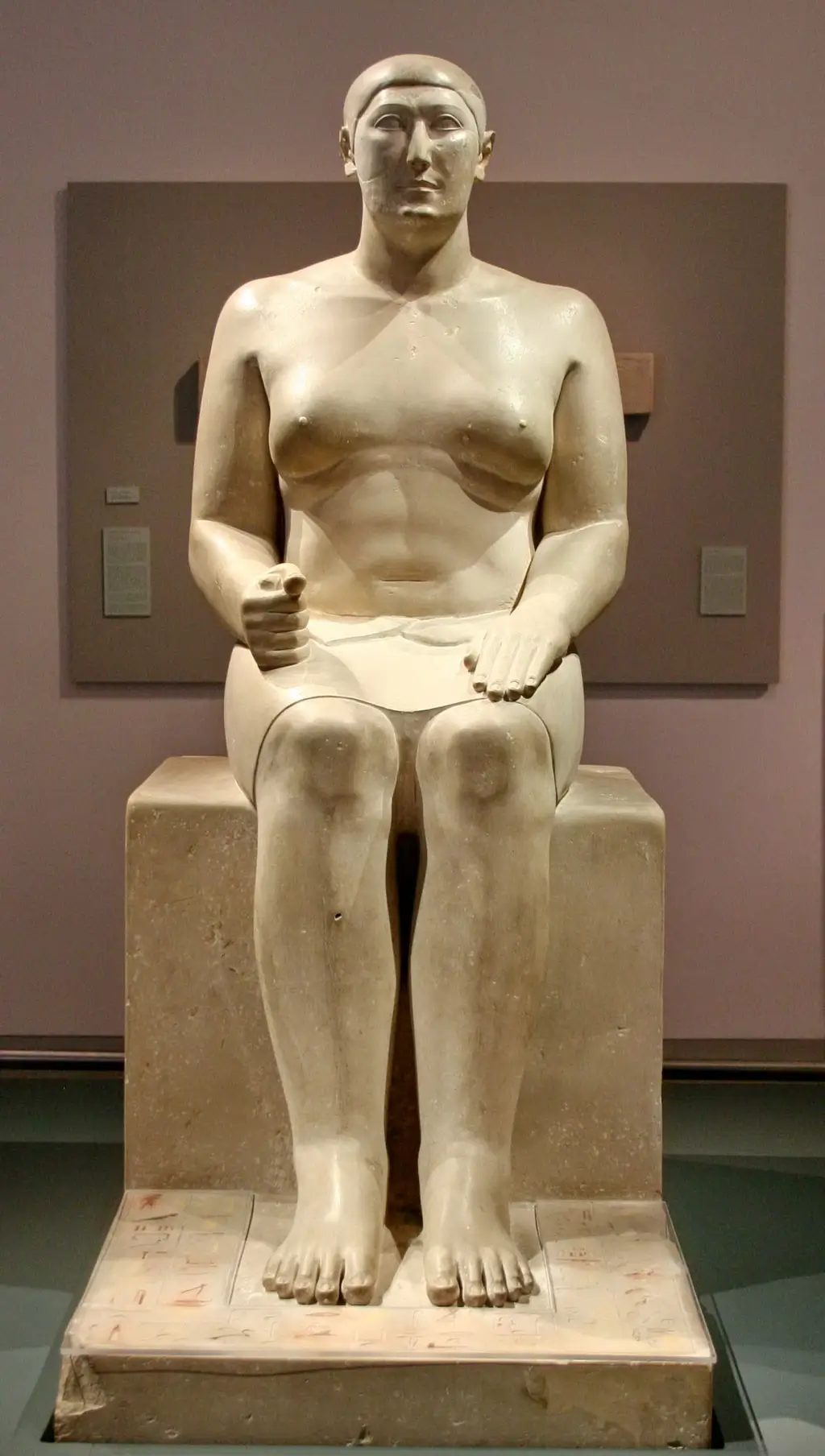
Within the ruins of Mastaba G 4000, Hermann Junker’s team made a profound discovery in 1925. They found a near-life-size statue of Hemiunu. This artifact is more than just a portrait. It is a stunning piece of political and artistic realism. It directly challenges the idealization common in the 4th Dynasty.

1. Discovery and Location

The statue was discovered in the serdab (Arabic for “cellar”), a sealed, hidden chamber within Hemiunu’s mastaba. The serdab was placed above the burial shaft and was intended to house the ka (life force or spirit double) of the deceased, allowing it to observe offerings made in the adjacent chapel. The statue’s location underscores its vital role in Hemiunu’s eternal maintenance.

  • Discovery: Found by the German-Austrian expedition led by Hermann Junker in 1925.
  • Current Location: Pelizaeus Museum, Hildesheim, Germany.

2. Physical Description and Realism

Carved from plain limestone, the statue depicts Hemiunu seated on a simple block-like throne. His hands rest on his thighs, one clenched, one open, a pose signifying control and readiness.

  • The Weight of Power: This is the statue’s most striking feature. It portrays Hemiunu as a heavy-set, middle-aged man, showing the fullness of his chest and belly. In the highly stylized Old Kingdom, most elite male figures were depicted as idealized, eternally young, and athletic. Hemiunu’s realism suggests that his enormous status and wealth were more important than adhering to the artistic canon of ideal physical fitness. This image of corpulence symbolized his success and ability to consume the finest goods, likely a visual boast of his administrative power.
  • Missing Inscription: The statue itself carries no identifying inscription, but its placement within the sealed serdab of Mastaba G 4000 leaves no doubt as to the subject’s identity.

3. The Damage and Its Possible Significance

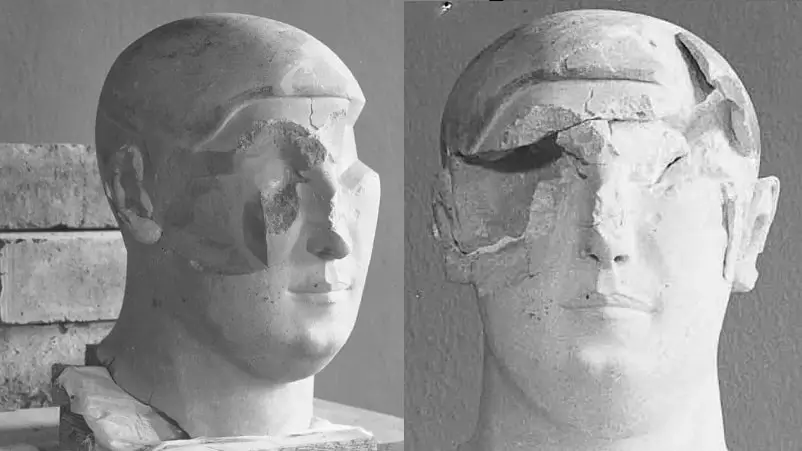
Unfortunately, the statue’s face and eyes were severely damaged at some point in antiquity. This damage has fueled speculation regarding the circumstances of the desecration. The statue may have been damaged by tomb robbers searching for jewels. However, the facial mutilation appears deliberate. This suggests a possible ritualistic or political erasure. Some scholars propose it was an act of damnatio memoriae. A later official may have carried out this act. Their goal was to diminish Hemiunu’s spiritual power in the afterlife.

The colossal work Hemiunu managed required a state bureaucracy built on a foundation of absolute control and staggering logistical capability.

The Sun God Political Role: A 3000-Year History of Kingship and Solar Deities

The Sun God's political role in Ancient Egypt was not static, but a dynamic, 3000-year...
Related post
FUN

Old Kingdom Administration and Logistics

Old Kingdom Administration and Logistics

Hemiunu’s ability to direct the Great Pyramid project—a feat requiring the movement of over 2.3 million stone blocks—demonstrates the pinnacle of the 4th Dynasty administrative state. His titles confirm he was the engine driving the machine.

1. The Vizier’s Total Control in the 4th Dynasty

The office of the Vizier during Khufu’s reign was the centralized hub of government, second only to the King himself. Hemiunu managed all aspects of statecraft essential for mobilizing such a massive project:

  • Taxation and Treasury: He oversaw the collection of all revenue (in goods, not currency), which funded the entire construction effort, including wages and provisions for the workers.
  • Judiciary and Census: Hemiunu was the Chief Justice, meaning he maintained civil order and had the power to mobilize mandatory national labor (corvée labor) based on detailed population censuses.
  • Centralized Resource Management: Every material resource, from cedar logs for sledges to food and beer for the labor force, flowed through Hemiunu’s administrative network.

2. Engineering and Calculation

The fact that the pyramid base is almost perfectly level and oriented to within a fraction of a degree of true North confirms the incredible engineering precision under Hemiunu’s direction.

  • The Architect’s Knowledge: Hemiunu’s title, Overseer of All Construction Projects, strongly suggests he possessed profound knowledge of geometry, astronomy, and advanced surveying techniques. He must have directed the scribes who meticulously calculated the angle of the slope, the placement of the internal chambers, and the precision required for fitting the limestone casing stones.
  • The Labor Force: The laborers were not slaves; they were organized, skilled, and well-provisioned workers mobilized through Hemiunu’s administrative machine. Archaeological evidence of their camps shows a high degree of organization, consistent provisioning, and even medical care—all managed by the Vizier’s staff.

3. Material Sourcing and Transportation

The sheer logistical feat of material sourcing required Hemiunu’s top-level oversight.

  • Local Limestone: The core of the pyramid came from local quarries near Giza.
  • Tura Limestone: The fine white casing stones came from the quarries across the Nile at Tura. These were transported by boat and canal, managed by foremen like the one who wrote the Diary of Merer.
  • Granite: The massive, hard granite blocks used for the burial chamber and relieving chambers were quarried hundreds of miles south at Aswan. These had to be shipped north via the Nile in massive barges. Hemiunu’s administration ensured the flawless coordination of these massive transportation cycles.

Hemiunu’s final resting place provides the most enduring and personal testament to his life and times.

A Millennium of Grandeur: The Islamic History of Cairo

The Islamic history of Cairo began in 641 CE with the founding of Fustat, but...
Related post
FUN

Mastaba G 4000: Hemiunu’s Eternal Home

Hemiunu’s tomb is the final, tangible declaration of his supreme status in the court of Khufu. It is one of the largest mastabas in the Western Cemetery, a final attempt to secure his eternal place near his king.

1. Location, Scale, and Status

Mastaba G 4000 is a tomb of impressive scale, fitting for the Vizier who directed the largest project in Egyptian history.

  • Scale: The mastaba is rectangular, built of massive stone blocks, and originally stood nearly 52 meters long. Its size rivals, and in some cases exceeds, the tombs of the highest princes and princesses.
  • Location: Its prime location in the Western Cemetery, just east of Khufu’s pyramid, underscores the unique honor and closeness Hemiunu enjoyed with the pharaoh. Only the most trusted and powerful officials were granted burial in the Giza necropolis itself.

2. Architectural Features

The structure follows the standard Old Kingdom mastaba design but executed on an elevated scale:

  • Offering Chapel: The tomb included a chapel where family and priests could leave offerings for Hemiunu’s ka.
  • Burial Shaft: A vertical shaft led deep underground to the burial chamber, intended to secure the body and its goods.
  • The Serdab: This sealed chamber, where the famous statue was found, provided the essential spiritual anchor for Hemiunu in the afterlife.

3. Burial and Legacy

The entire architecture of Mastaba G 4000 serves as Hemiunu’s eternal CV. The grandeur, the proximity to the Great Pyramid, and the inscriptions detailing his numerous, supreme titles were not intended for the living, but for the gods. They served as a final declaration of his essential service to the King and his guaranteed path to the blessed afterlife. Ultimately, Hemiunu’s legacy transcends his time, embodying the pinnacle of Old Kingdom ambition.

The Master Builder’s Legacy

Hemiunu’s life offers a rare look into the political, technical, and religious mechanics of the 4th Dynasty Egyptian state. Hemiunu defined Old Kingdom administrative power. He was the genius who translated King Khufu’s absolute will into the Great Pyramid’s physical reality. His career, marked by the titles Vizier and Chief Architect, proves that the pyramid age needed more than faith and labor. It relied on unparalleled organization, engineering skill, and centralized control. Hemiunu’s famous, realistic statue and vast mastaba tomb ensure his name endures, even though he built the pyramid for his king alone. Hemiunu remains the most powerful non-royal figure of the Pyramid Age, embodying the peak of Egyptian ambition and administrative brilliance.

Explore Wonders...
Discover the magic of ancient Egypt and unravel the secrets of civilization....

A great day!!!!

Thank you Hamada for an incredible day! Thank you for the stories and the history, you are so knowledgeable and we didn’t feel rushed at all or like we missed out on things, will definitely be recommending this tour to everyone 🙂

More »

Cairo Day Trip

Great trip organised. I had a 12-hour layover in Cairo and had a great time with Sherif, who answered every question I had on ancient Egypt. Highly recommend.

More »
12 Days Solo Woman Tour Package (Queen Cleopatra)

Mohamed is Very Kind Person

Mohamed. I just want to thank you again for your kindness. You made our trip memorable. Give your family and the Egypt Fun Tours crew all my love and thank them again for me. Take care. Enjoy the season! Love. Linda

More »

Transit Stopover in Cairo

We have just returned from a two week holiday in Cape Town. On the way out our airline schedule meant that we had a 15 hour stop in Cairo. We decided to arrange a tour of the city and after asking for quotes/itineraries we chose Egypt Fun Tours. This worked

More »
Isis with wings

Top-rated Tour Packages

Isis with wings