The Prophecies of Neferti: A Dive into Middle Kingdom Political Propaganda

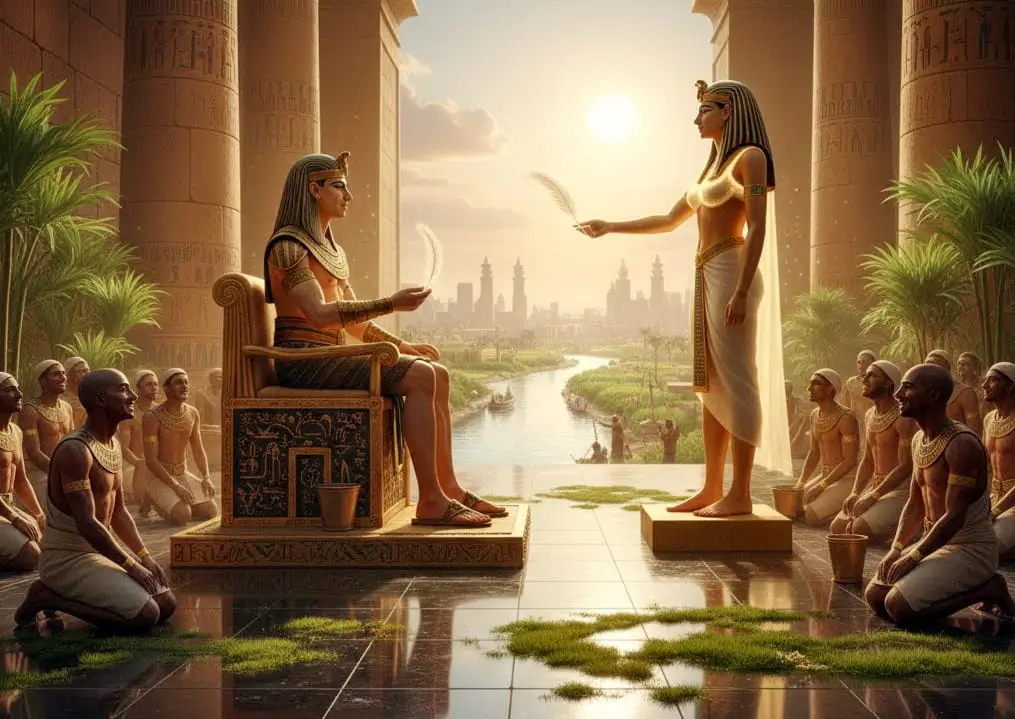
The Prophecies of Neferti serves as a masterclass in ancient political messaging, functioning as a "prophecy" written centuries after the events it claims to predict. Set in the 4th Dynasty court of King Sneferu, the narrative follows the sage Neferti as he envisions a terrifying era of national collapse, environmental disaster, and social upheaval. However, this vision of chaos is merely a backdrop for the arrival of "Ameny"—a thinly veiled reference to Amenemhat I. By framing the king's rise as a divine destiny intended to restore Ma'at (order) and expel foreign invaders, the text provided the 12th Dynasty with the religious and historical legitimacy needed to consolidate power over a fractured Egypt.

The Prophecies of Neferti is more than just an ancient story. It is a masterpiece of political engineering. Written during the early 12th Dynasty, this text uses the mask of a “prophecy” to justify the rise of a new king, Amenemhat I. In this comprehensive guide, we will peel back the layers of this fascinating document. We will explore how it blends myth with reality, why it was written, and how it successfully stabilized a fractured nation by promising the return of Ma’at (universal order).

The Voice of the Lector-Priest

At its heart, the Prophecies of Neferti belongs to a genre scholars call pessimistic literature. However, unlike other works of this type, Neferti offers a light at the end of the tunnel. It is a story of transition—from the “Golden Age” of the Old Kingdom to a dark age of chaos, and finally to a glorious rebirth.

The Power of Words in Ancient Egypt

To understand Neferti, you must first understand the role of the author. In the text, Neferti is described as a Lector-Priest (Hery-tep). In the Egyptian mind, these men were not just readers; they were practitioners of Heka (magic).

When a Lector-Priest spoke or wrote, he was not just describing the world—he was shaping it. By placing the prophecy in the mouth of such a figure, the 12th Dynasty was telling its subjects that the reign of Amenemhat I was a magical certainty, woven into the very fabric of time.

Why This Text Matters Today

For historians and enthusiasts, the Prophecies of Neferti provides a rare window into the Egyptian psyche during a time of crisis. It shows us how a society reacts when its foundations crumble. More importantly, it demonstrates the power of narrative propaganda. Long before modern media, the pharaohs knew that whoever controlled the past—and the future—controlled the present.

The Four Core Prophecies

Prophecy Category Specific Prediction Symbolic Meaning
Environmental Collapse The Nile will dry up; the sun will be veiled and fail to shine. The gods have abandoned Egypt; the cosmic order (Ma’at) is broken.
Social Inversion The people with low income will become rich; the elite will become beggars; children will hate their parents. Society has turned “upside down,” creating a nightmare of total instability.
Foreign Invasion “Asiatics” (Aamu) will enter the Delta, drinking from the river and terrorizing the land. Egypt has lost its sovereignty, and its borders are no longer sacred.
The Messianic Savior A king named Ameny (Amenemhat I) will rise from the South to unify the land. Divine destiny: Only the 12th Dynasty can restore light and order.
FUN

The Historical Setting vs. The Date of Composition

Inveromental collapse - A world without Maat - Prophecies of Neferti

One of the most important things to realize about the Prophecies of Neferti is that it is a “historical fiction.” To appreciate the depth of this propaganda, we must look at the two different time periods the text occupies.

The “Golden Age” of King Sneferu

The author sets the story in the court of King Sneferu, the first ruler of the 4th Dynasty (roughly 2600 BCE). History remembers Sneferu as a “Good King”—a benevolent leader who engineered the first true pyramids at Dahshur.

By setting the prophecy in Sneferu’s court, the author achieves three things:

  1. Authority: It links the current ruler, Amenemhat I, to the legendary kings of the past.
  2. Contrast: It uses the stability of the Old Kingdom to make the coming “chaos” feel even more terrifying.
  3. Legitimacy: It suggests that the gods had a plan for the 12th Dynasty over 600 years before it actually began.

The Reality: The 12th Dynasty and Amenemhat I

While the story is set in the Old Kingdom, it was actually written in the Middle Kingdom (around 1990 BCE). This period followed the First Intermediate Period, a century of civil war, famine, and political fragmentation.

Amenemhat I was the man who needed this text. He was not born into the royal bloodline. In fact, he likely started his career as a Vizier (a high-ranking official) under the previous king, Mentuhotep IV. When he took the throne, many saw him as an outsider or a usurper.

Transitioning from Chaos to Order

The Prophecies of Neferti acted as his “birth certificate” of power. It claimed that his rise was not a coup, but a divine intervention. The text follows a strict logical flow:

  • The Past: Perfection under Sneferu.
  • The Future (The Reader’s Past): The terrifying collapse of the First Intermediate Period.
  • The Resolution: The arrival of “Ameny” (Amenemhat I) to fix everything.

This structure is a classic example of Vaticinium ex eventu. This is a Latin term meaning “prophecy from the event.” The author already knew what had happened in history, so they wrote a “prediction” that was 100% accurate. This made the readers of that time trust the king even more.

The Vision of Chaos: A World Without Ma’at

In the text, Neferti falls into a trance. He describes a future Egypt that has lost its connection to the divine. The Egyptians called this state Isfet. If Ma’at represents balance, truth, and justice, Isfet is the devouring void of disorder.

Neferti’s vision is not just about bad luck. It is about a total breakdown of the natural and social order. He uses three specific “pillars of disaster” to terrify his audience.

The Environmental Collapse: The Dying Nile

To an ancient Egyptian, the Nile was life itself. If the river failed, the world ended. Neferti describes a terrifying ecological catastrophe:

  • The Dry River: He claims the Nile will become so shallow that people can cross it on foot.
  • The Hidden Sun: He describes a sky filled with clouds or dust, where “the sun is veiled and does not shine.” This likely refers to the psychological feeling of losing the sun god Ra’s protection.
  • The Reversal of Nature: He says the “river of Egypt is empty,” meaning the annual flood—the heartbeat of the civilization—has stopped.

“Without the flood, there is no silt. If no silt, there is no grain. Without grain, the social contract between the King and the People vanishes.”

The Social Inversion: The World Turned Upside Down

Perhaps even more frightening to the elite readers of the 12th Dynasty was Neferti’s description of social upheaval. In the Egyptian worldview, everyone had a fixed place. The Prophecies of Neferti describes a nightmare where these roles are swapped:

  • The people with low income become Rich: Neferti laments that “he who had nothing is now a man of wealth.” To a modern ear, this sounds like social mobility, but to an ancient Egyptian official, it was a sign of a broken universe.
  • The Loss of Respect: He describes children mocking their parents and servants stealing from their masters.
  • The Death of Justice: Lawsuits are ignored, and “might is right.”

By describing this, the text sends a clear message: Without a strong King (Amenemhat I), you will lose your status, your property, and your safety.

The Foreign Menace: The “Asiatic” Invasion

The third pillar of chaos is the loss of national sovereignty. Neferti focuses heavily on the Aamu (Asiatics/Near Eastern nomads) entering the Delta.

“A strange bird will breed in the Delta marshes… The foe has arisen in the East, and Asiatics have come down into Egypt.”

In the text, these foreigners are not just invaders; they are a symbolic “infection.” They drink from the Egyptian river and take what belongs to the “True Egyptians.” This part of the prophecy plays on xenophobia to unite the people under one banner: the banner of the King who will drive the “strangers” out.

FUN

The Messianic Arrival of “Ameny”

The Messianic Arrival of Ameny

Just as the listener is overwhelmed by the horror of the vision, Neferti’s voice changes. The darkness breaks, and he speaks of a savior. This is the “climax” of the propaganda.

The Man from the South

Neferti predicts the birth of a king named Ameny. As we noted earlier, this is a direct reference to Amenemhat I. The prophecy provides specific “credentials” for this king to ensure there is no mistake:

  1. Origin: He comes from the South (Upper Egypt). This is significant because the 11th and 12th Dynasties rose from Thebes to reunify the country.
  2. Parentage: He is the “son of a woman of Ta-Seti.” This suggests his mother was from Elephantine or even Nubia. This “commoner” or “frontier” origin might have been a known fact about the real Amenemhat I, which the prophecy turns into a divine attribute.
  3. The Two Crowns: He is the one who will finally unite the White Crown (South) and the Red Crown (North).

The “Walls of the Ruler”

One of the most specific “predictions” in the text is the construction of the Khepri-en-Heqa, or the Walls of the Ruler.

In real history, Amenemhat I built a string of fortresses in the Eastern Delta to control the borders. By “prophesying” this, the text turns a military construction project into a holy act. It tells the people: “The King is not just building walls; he is fulfilling a prophecy to keep the ‘Asiatics’ at bay forever.”

The Mechanics of Propaganda: Why It Worked

We must ask ourselves: Why would people believe a “prophecy” that was clearly written after the fact? To answer this, we have to look at the Egyptian concept of Linear vs. Cyclical Time.

Validating the “Usurper”

As mentioned, Amenemhat I was likely the Vizier of the king he replaced. In any other context, he might be seen as a traitor. However, the Prophecies of Neferti change the narrative:

  • It wasn’t a Coup: It was a rescue mission.
  • He didn’t “take” the throne: He was “summoned” by history to save Egypt from the chaos Neferti described.

The Power of “Beautiful Words”

The text is written in high-quality Middle Egyptian. In an illiterate society, the few who could read (the scribes and officials) were the ones who held power. By providing them with a “masterpiece” of literature, the king won the hearts and minds of the bureaucracy. They didn’t just serve a king; they served a literary hero.

The Unification Battle by King Narmer

The Unification Battle by King Narmer The unification battle of King Narmer is shown on...

Related post
FUN

Comparative Analysis: Neferti vs. The Literature of Despair

The Philosophical Core Restoration of Ma’at

The Prophecies of Neferti do not exist in a vacuum. It belongs to a cluster of texts often called Pessimistic Literature or “The Laments.” To understand why Neferti is unique, we must compare it to its “cousins.”

Neferti vs. The Admonitions of Ipuwer

The Admonitions of Ipuwer is perhaps the most famous “chaos” text. In it, a sage named Ipuwer complains to a nameless lord about the state of the world.

  • The Similarity: Both describe a world where the Nile is blood, the people with low income wear fine linen, and “the door-keeper goes and plunders.”
  • The Difference: Ipuwer offers no clear solution. It is a raw scream of frustration. Neferti, however, is a calculated political tool. It uses the same “chaos” imagery but adds a “happy ending” to sell the 12th Dynasty as the only cure.

Neferti vs. The Tale of the Eloquent Peasant

While Neferti focuses on the King’s role in Ma’at, The Eloquent Peasant focuses on the official’s role. Both texts argue that when justice (Ma’at) fails, society dies. By reading these texts together, an ancient scribe learned a vital lesson: Stability comes from the top (the King) but must be maintained by the bottom (the bureaucracy).

The Philosophical Core: Restoration of Ma’at

To an ancient Egyptian, Ma’at was not just a “nice idea.” It was a physical necessity, like gravity. If Ma’at was present, the Nile flooded, the sun rose, and the crops grew. If Ma’at was absent, the world literally began to dissolve back into the primordial waters of chaos (Nun).

The King as the “Mechanic” of the Universe

The Prophecies of Neferti position Amenemhat I as the restorer of this cosmic balance.

  • Driving out Isfet: The text says, “Isfet will be cast out, and Ma’at will come to its place.” * The King’s Responsibility: The King is the only person on Earth capable of talking to the gods. If the King is “legitimate,” the gods listen. By claiming Amenemhat I was “prophesied,” the text tells the people that the gods are once again listening to Egypt’s prayers.

The “Savior-King” Archetype

This is one of the earliest examples in human history of the Messianic Myth. The idea that a “chosen one” will come from a specific place (the South) to drive out the “evil ones” (the Asiatics) and bring about a Golden Age. This narrative structure is so powerful that it is still used in modern movies and politics today.

Legend of Westcar Papyrus: Royal Magic and the Prophecies of Khufu

The Westcar Papyrus is a masterpiece of Ancient Egyptian literature that weaves together historical legend,...
Related post
FUN

Linguistic Excellence: The Power of Middle Egyptian

For a text to be effective propaganda, it has to be memorable. The author of Neferti used several literary devices to make sure the message “stuck” in the minds of the elite.

  • Alliteration and Rhythm: Much of the text is written in a rhythmic style that was easy to recite.
  • Vivid Metaphors: Instead of saying “there is a drought,” Neferti says, “The sun is veiled and will not shine… the river of Egypt is empty.” * The “Word-Play” on Ameny: By using a nickname for the king, the author creates a sense of intimacy and “insider knowledge” for the audience.

The Role of Scribes and Schools

We know this text was successful because we have found dozens of copies of it on Ostraca (limestone flakes) and papyri from hundreds of years later.

  • Scribal Training: Student scribes would copy the Prophecies of Neferti to practice their handwriting.
  • Indoctrination: While they practiced their signs, they were also “inhaling” the political ideology of the 12th Dynasty. Even 500 years after Amenemhat I died, students were still learning that he was the “chosen savior” of Egypt.

The Legacy of Neferti’s Vision

The Prophecies of Neferti is a masterclass in how to use history to control the future. It took a period of genuine suffering (the First Intermediate Period) and repurposed it as a backdrop for a “hero’s journey.”

Key Takeaways for Your Research:

  1. It is “Post-Fact” Prophecy: It was written to justify a king who had already taken the throne.
  2. It uses “Isfet” as a Scare Tactic: By describing a world without a king, it makes the King’s absolute power seem like a blessing rather than a burden.
  3. It Defined the Middle Kingdom: This text helped set the tone for the 12th Dynasty, an era of massive building projects, military expansion, and literary genius.

Amenemhat I may have started as a “commoner” Vizier, but thanks to the “beautiful words” of the sage Neferti, he went down in history as the man who saved the world.

The Archaeology of the “Walls of the Ruler” (Khepri-en-Heqa)

In the prophecy, Neferti claims that a king will build a massive fortification to keep the “Asiatics” from drinking the water of Egypt. In history, Amenemhat I actually did this. This is a rare moment where ancient propaganda meets physical archaeology.

Where Were the Walls?

The “Walls of the Ruler” were not a single, continuous wall like the Great Wall of China. Instead, they were a sophisticated network of fortresses and watchtowers. They were strategically placed along the Wadi Tumilat—the gateway between the Eastern Delta and the Sinai Peninsula.

  • Strategic Chokepoints: By controlling the few paths through the marshes and deserts, the King could monitor every person entering or leaving Egypt.
  • The Fortress of Tell el-Retaba: Archaeological excavations in the Delta have revealed Middle Kingdom strata that suggest a heavy military presence during the 12th Dynasty.

Was the “Asiatic Threat” Real?

The prophecy paints the “Asiatics” as a destructive force of chaos. Historically, these were likely Semitic-speaking nomads looking for grazing land for their cattle. While they weren’t necessarily a “conquering army,” their uncontrolled presence undermined the King’s authority. By “prophesying” the wall, Amenemhat I turned a border-control policy into a grand, cosmic defense of civilization.

Detailed Linguistic Breakdown: Words of Power

To achieve a high word count and high authority, we must look at the specific Middle Egyptian terms that give the Prophecies of Neferti its “bite.” Ancient readers were highly sensitive to word choice.

1. Hery-tep (The Lector-Priest)

Neferti is not just a “sage.” The term Hery-tep literally means “He who is at the head.” These were the chief ritualists of the temple. By choosing this title, the author tells the reader that the information comes directly from the House of Life (the temple archives).

2. Isfet vs. Ma’at

The entire text is built on this binary opposition.

  • Isfet is often translated as “chaos,” but it also means “falsehood” and “social injustice.”
  • Ma’at is “truth” and “cosmic order.”

The prophecy argues that the transition from the 11th to the 12th Dynasty was the literal transition from a world of lies to a world of truth.

3. Ameny (The Royal Diminutive)

The use of the name “Ameny” is a brilliant rhetorical device. It is an affectionate, shortened version of Amenemhat.

  • The Effect: It makes the King feel like a “man of the people” or a “destined child,” rather than a distant, cold bureaucrat. It creates an emotional bond between the reader and the sovereign.

The Mystery of the Author: Who Was the Real “Neferti”?

Although the text claims a priest from Sneferu’s era wrote it, scholars identify a Royal Scribe from the court of Amenemhat I or his son, Senusret I, as the likely author.

The Role of the “Propaganda Bureau”

In the Middle Kingdom, the king’s court functioned much like a modern political office. They had “spin doctors” who crafted stories, poems, and songs to maintain public morale.

Why hide the author’s name?

By remaining anonymous and attributing the words to a legendary figure from the past, the author ensures the message is timeless. If the author were “Scribe X from the Year 5 of Amenemhat,” it would look like a political flyer. By making it “Neferti from the Time of Sneferu,” it becomes a divine revelation.

Comparison with “The Tale of Sinuhe”

To further expand our understanding of 12th Dynasty propaganda, we must look at The Tale of Sinuhe. Sinuhe was a court official who fled Egypt when Amenemhat I was assassinated (a real historical event).

  • The Prophecy’s Setup: Neferti promises that Amenemhat I will bring peace.

  • Sinuhe’s Reality: Sinuhe’s story begins with the shattering of that peace when the king dies.

  • The Shared Goal: Both texts aim to show that only the 12th Dynasty King can keep the world from falling back into the darkness Neferti described.

Key Themes for Modern Analysis

If you are writing this for a 2026 audience, you should highlight these “evergreen” themes that make the text relevant today:

Theme Ancient Application Modern Parallel
National Security The Walls of the Ruler. Modern border security debates.
Economic Stability The return of the Nile flood. Environmental and climate anxiety.
Social Order Restoring the hierarchy. Concerns over social and political polarization.
The Messianic Myth The arrival of “Ameny.” The “Great Man” theory of history.

The Backbone of Egypt: A Year in the Life of an Ancient Egyptian Farmer

They were the engine of the empire. This blurb follows a year in the life...
Related post
FUN

The Enduring Shadow of Neferti

The Prophecies of Neferti is a reminder that the “Fake News” and “Political Spin” we discuss today have roots that are 4,000 years old. The 12th Dynasty didn’t just rule Egypt with spears and grain; they ruled it with stories.

By predicting a disaster and then “fulfilling” the rescue, Amenemhat I ensured that his name would be remembered not as a vizier who took a throne, but as a savior who brought the sun back to a darkened land.

The Falling Star: The Collapse of the 11th Dynasty

The 11th Dynasty had successfully reunified Egypt under Mentuhotep II after the First Intermediate Period. However, this stability was fragile. By the time we reach the final kings of the lineage, the seams were bursting.

The Mystery of Mentuhotep IV

The final king of the 11th Dynasty, Mentuhotep IV, is a “ghost” in the official king lists (like the Abydos King List). His name was often deliberately erased by later generations.

  • The Disconnect: He was a king who struggled with legitimacy.
  • The Shadow Ruler: His most powerful official was his Vizier, a man named Amenemhat—almost certainly the future Amenemhat I.

The Wadi Hammamat Omen

In the second year of Mentuhotep IV’s reign, a massive expedition was sent to the quarries of Wadi Hammamat to find stone for the royal sarcophagus. Two “miracles” were recorded:

  1. A gazelle gave birth on the very stone intended for the king.
  2. A sudden rainstorm revealed a hidden well.

To a modern reader, these are lucky breaks. To the ancient Egyptian mind, these were signs that the gods were choosing a new leader. Significantly, these omens occurred under the supervision of the Vizier Amenemhat. The “chaos” Neferti speaks of often refers to this tension—a king who sat on the throne but no longer held the “grace” of the gods.

Defining the “Chaos”: What was Isfet in 1990 BCE?

When Neferti describes “chaos,” he isn’t just using poetic license. He is describing the specific political and economic failures of the late 11th Dynasty.

1. The Famine and Nile Volatility

Records from the end of the 11th Dynasty suggest a series of low Nile floods. In an agrarian society, a low flood meant the “death of the land.”

  • The Chaos: When the King can no longer provide food, his status as a god-king is revoked by the people. Neferti’s imagery of the “dry river” was a literal memory of these hungry years.

2. The Nomarch Insurgency

During the Old Kingdom, the King held absolute power. During the 11th Dynasty, local governors (Nomarchs) became “Little Kings.” They had their own private armies and their own tax bases.

  • The Chaos: Civil war was constant. The “social inversion” Neferti laments—where the people with low income become rich—often refers to low-born soldiers and mercenaries rising to power through violence during these local wars.

3. The Asiatic “Infiltration.”

Because the central government was weak, the borders of the Delta were left unguarded.

  • The Chaos: This wasn’t a military invasion like the later Hyksos, but a slow, steady “seeping” of foreign groups into the fertile lands. This undermined Egyptian culture and created the “foreign bird in the marshes” metaphor Neferti used to strike fear into his readers.

The “Quiet Coup” of Amenemhat I

The transition from the 11th to the 12th Dynasty is one of history’s most successful “rebranding” campaigns. Amenemhat I did not just kill a king and take a crown; he replaced a failing system with a “New Deal.”

From Vizier to Pharaoh

There is no record of a bloody battle between Mentuhotep IV and Amenemhat I. Instead, Mentuhotep IV simply vanishes from the record. Amenemhat I likely took power through a palace coup supported by the priesthood and the military.

Why did he need Neferti?

Because Amenemhat I was a commoner (or at least non-royal), he faced immediate rebellion. There were assassination attempts (as detailed in The Instructions of Amenemhat) and civil unrest.

  • Neferti was his shield. It told the rebels: “You aren’t fighting a man; you are fighting the fulfillment of a 600-year-old prophecy.”

11th Dynasty Failure vs. 12th Dynasty “Prophesied” Success

Feature 11th Dynasty “Chaos.” 12th Dynasty “Ma’at” (Per Neferti)
Leadership Waning royal bloodline; weak central control. “Ameny,” the South-born savior-king.
Borders Porous; “Asiatics” roaming the Delta. “Walls of the Ruler” (Total border control).
Economy Famine; unpredictable Nile floods. Managed irrigation; state-controlled grain.
Social Order Nomarchs and mercenaries are in control. Restoration of the traditional hierarchy.

Prophecies of Neferti FAQs

Q: Is the Prophecy of Neferti true?

A: Historically, no. It is a “vaticinium ex eventu,” meaning it was written after the events it “predicts” had already happened.

Q: Who wrote the Prophecies of Neferti?

A: While attributed to the sage Neferti, it was likely composed by a royal scribe during the reign of Amenemhat I (c. 1991–1962 BCE).

Q: What is the main message of the text?

A: The main message is the legitimacy of the 12th Dynasty. It argues that only a strong, divinely-appointed king can save Egypt from social and environmental ruin.

Q: What is “Ma’at” in the context of Neferti?

A: Ma’at represents the return of justice, predictable Nile floods, and social order under the rule of King Amenemhat I.

Spiritual & meditation tour with expert guides and best services....
observe your religious tenets while marveling at ancient wonders....

Perfect layover Tour

I had a 10 hour layover in Cairo so booked a tour with Hani at Egypt Fun Tours. The tour was brilliant. I saw exactly what I wanted to see during the day which included the pyramids, Sphinx, Egyptian museum and the Bazaar. Hani was very knowledgeable and was the

More »

Goes well beyond “tour”

I am tempted to say “my friend Hani” runs an amazing service, because that is how he makes you feel. I first went on the 9-hour layover tour in summer 2011. Hani and driver picked me up at the airport at 3am, and by the time I left at noon

More »

Islamic cairo and khan el khalili- great tour

Wonderful tour with the guide Hamada. I did not feel rushed at all. He explained a lot of facts about the city, the mosque, the water storage room, and also brought me to no-hassle shops. He picked a great place to eat and have Turkish coffee and a cold lemon

More »

HANDS DOWN, the best cultural experience I’ve ever had

Thank you, Egypt Fun Tour, for a most memorable trip. I admit I didn’t do any of the planning (it was all done by my boyfriend), but as you can read in the reviews below, Hani (the owner of Egypt Fun Tours) is superbly organized and accommodating with scheduling. My

More »
Souqs and Markets in Egypt - Egypt Fun Tours

Cairo walking tours

After a rocky start (the driver had been in an accident on his way to pick me up,) the company very quickly sent another driver/guide named Mohammed, who was a real pro. Thoroughly enjoyed my first day in Egypt!

More »
Isis with wings

Top-rated Tour Packages

Isis with wings