Psusennes I: The Silver Pharaoh of Tanis

SUMMARY: King Psusennes I, the "Silver Pharaoh" of the 21st Dynasty, is famed for his intact tomb discovered at Tanis. Buried in a unique solid silver coffin with a stunning gold mask, his unlooted treasures reveal the surprising wealth of the Third Intermediate Period, rivaling Tutankhamun's discovery.
The eye of Horus
WhatsApp
Email
Print
Psusennes I The Silver Pharaoh of Tanis - The Top Sights & Attractions in Cairo

Psusennes I: The Silver Pharaoh of Tanis

Psusennes I was a pharaoh of the 21st Dynasty of ancient Egypt. He ruled from Tanis during the Third Intermediate Period, a time when Egypt was politically divided. Although his reign was not as well-known as those of the great New Kingdom pharaohs, his tomb’s discovery in 1940 revealed him to be one of the wealthiest. This find earned him the nickname, “The Silver Pharaoh.

The eye of Horus

The Historical Context: The Third Intermediate Period

The Historical Context The Third Intermediate Period

The Third Intermediate Period (c. 1070–664 BCE) was a time of political fragmentation in Egypt. The central government had weakened, and the country was effectively split. A king ruled in the north from Tanis, and a high priest of Amun controlled the south from Thebes. Psusennes I ruled from the northern capital, but he also held the title of “High Priest of Amun.” This dual role gave him immense power. He controlled the military, economy, and religious life of Lower Egypt. This strategic blend of political and religious authority allowed him to maintain stability and prosperity in the north despite the chaos elsewhere.

During his reign, Egypt’s international standing was not as dominant as in the New Kingdom. However, Psusennes I successfully managed diplomatic relations with neighboring states, especially in the Levant. This helped secure trade routes and ensure a steady flow of resources into his kingdom.

Golden Scarab

The Discovery of the Royal Tombs at Tanis

The Discovery of the Royal Tombs at Tanis

Archaeologist Pierre Montet made the remarkable discovery of Psusennes I’s tomb in 1940. The tomb was located at Tanis, a city in the Nile Delta. Unlike many tombs in the Valley of the Kings, which tomb robbers had plundered, Psusennes I’s tomb was found almost completely intact. This was an incredible find. However, the outbreak of World War II overshadowed the news of the discovery. This lack of publicity meant that Psusennes I never achieved the same level of fame as King Tutankhamun. Montet’s team had to work quickly and with limited resources due to the war. They discovered several royal tombs, but the burial chamber of Psusennes I was the most spectacular.

The tombs at Tanis were built within the great temple enclosure of Amun. They were not hidden like those in the Valley of the Kings, but they were well-fortified. Psusennes I’s burial chamber was located at the bottom of a deep shaft, and a massive granite slab sealed it. This protection, combined with the tomb’s remote location from the more heavily plundered sites, ensured its survival.

Rule your journey to this destination

The eye of Horus

The Tomb’s Contents and The King’s Burial

The Tomb's Contents and The King's Burial

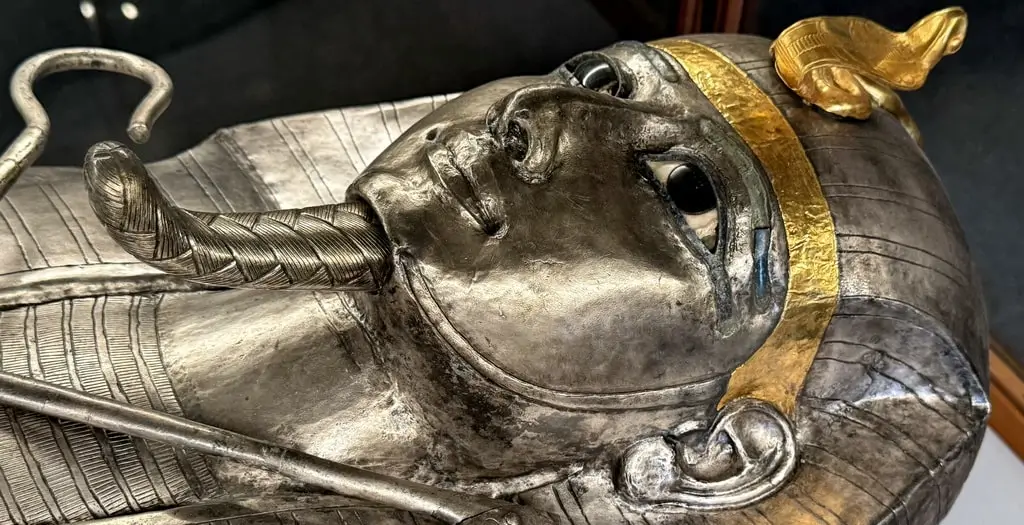
The tomb of Psusennes I was a treasure trove of gold and silver. It contained a solid silver coffin. This was a unique discovery. Silver was rarer and more valuable than gold in ancient Egypt. Egyptians believed gold was the flesh of the gods. Silver represented their bones. The coffin demonstrated the pharaoh’s immense wealth and status. Other treasures found in the tomb included a stunning golden burial mask, jewelry, and numerous funerary items. The richness of these artifacts proved that the rulers of the Third Intermediate Period still commanded vast resources. The discovery provided new insights into the art and funerary practices of a lesser-known era of Egyptian history.

The king’s burial chamber was an elaborate series of nested coffins. The outermost was a sarcophagus of red granite. Inside that lay a black granite sarcophagus, which held a solid silver coffin in the shape of a mummy. This silver coffin contained the king’s mummy, which wore a spectacular golden burial mask. The discovery also included the burials of other family members, including his son and queen, as well as a military commander. This provided a rare glimpse into the complex family dynamics and political structure of the 21st Dynasty.

The eye of Horus

The Legacy of Psusennes I

The Legacy of Psusennes I

Psusennes I left a significant legacy, even if his reign was less celebrated. He was a powerful and influential ruler. He managed to maintain stability in a fractured kingdom. His reign was a time of great prosperity and artistic flourishing in the north. His tomb’s discovery showed that the Third Intermediate Period was not just a time of decline. It was a time when a new class of powerful rulers emerged. They built great monuments and amassed incredible wealth.

The discovery of the royal tombs at Tanis, including that of Psusennes I, changed how scholars viewed this period. They revealed a hidden chapter of Egyptian history and continue to inspire archaeologists and historians today. His reign is a testament to the resilience of ancient Egyptian civilization. It shows its ability to adapt and thrive even in times of political turmoil.

Weather in Egypt

Rule your journey to this destination

The eye of Horus

Need our help for packages? send an enquiry!

Looking for a custom travel plan? Get in touch and we will create your perfect package.
RULE YOUR JOURNEY

Amazing tour to the pyramids of Sakkara and Dahshur

This week we had a great tour with Mohamed to the pyramids of Sakkara and Dahshur, as well as Memphis. He tailored the tour to our preferences, took a lot of time with us, and gave us detailed background information on everything. It was also great that he never tired

More »
Tailored Services for Corporate Business Transportation Needs

On time, adaptable, and fun!

My friend and I planned a whirlwind trip to Dubai, the Dead Sea, Petra, Cairo, Luxor, and Sharm el Sheikh for early November 2011 – 6 cities in 10 days! We allotted one afternoon and evening for Cairo, and we wanted to see as much as we could! We drove

More »

Well Done

All aspects of the experience were considered and well taken care of. Knowledgeable and friendly guide and organized itinerary.

More »
God_Anubis_Icon

Top-rated Tour Packages

God_Anubis_Icon
WhatsApp
Email
Print