The End of the Middle Kingdom
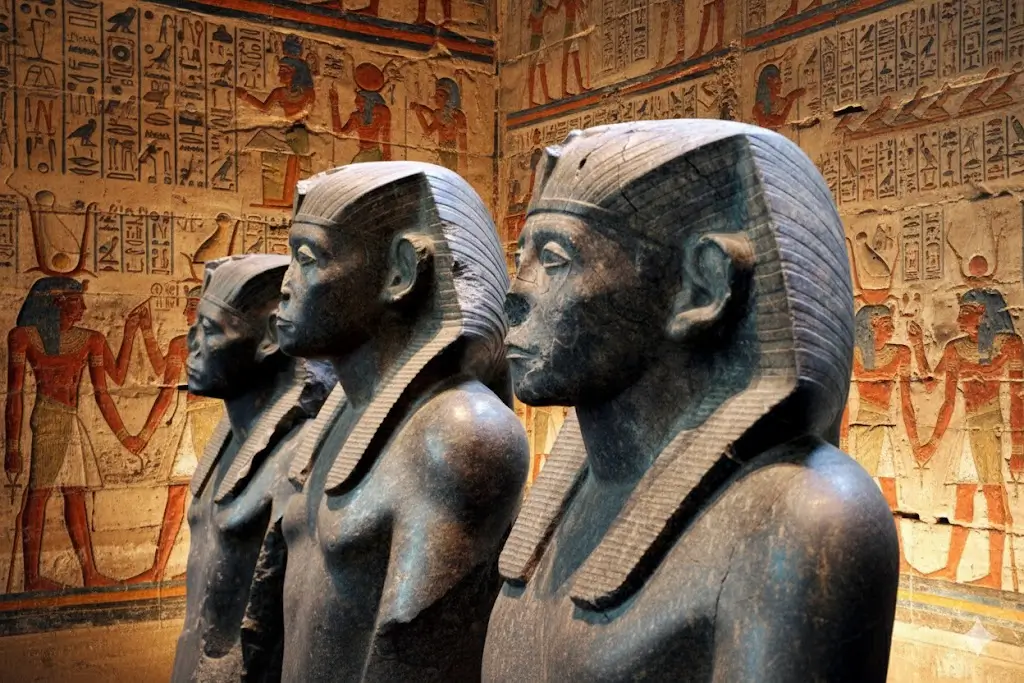
The reigns of Amenemhat III (1860–1815 BCE) and Sobekneferu (1807–1802 BCE), Egypt’s earliest documented female pharaoh, marked the end of the Middle Kingdom. Amenemhat III focused on infrastructure, increasing mining operations, and building monuments like the great mortuary temple at Hawara, known as “The Labyrinth.” Sobekneferu continued urban development, but after her reign, the 13th and 14th Dynasties began a period of decline. During this time, foreign settlers known as the Hyksos gained influence.
The Influence of the First Intermediate Period
The First Intermediate Period (2181–2040 BCE) was a time of decentralization where nomarchs gained power. While this period saw a weakening of central authority, it also influenced the Middle Kingdom by fostering greater social mobility and artistic diversity. The art and literature of the Middle Kingdom reflect a variety of regional styles, which earned it the reputation as the “Classical Age” of Egyptian art.
The Second Intermediate Period and Common Misconceptions
The Second Intermediate Period is often mistakenly seen as a time of complete chaos and cultural collapse. While hieroglyphic script saw a decline, the hieratic script emerged, and art continued to be produced, albeit with some stylistic changes. The rule of the Hyksos was not as chaotic as commonly believed. They respected Egyptian culture and even introduced new technologies and trade practices, contributing to the country’s development.
The 13th Dynasty of ancient Egypt was a period of fragmentation and decline. The Hyksos began establishing a presence in Lower Egypt around 1782 BCE and had secured control by approximately 1720 BCE. This growing foreign influence significantly contributed to the dynasty’s gradual loss of power.
The Historical Record
Historical records for the 13th Dynasty are inconsistent and challenging to interpret. The historian Manetho listed an implausible 60 kings over 453 years. Scholars now believe a more realistic duration was around 153 years. Some kings, like Sobekhotep I, are well-documented on the Turin King List and other inscriptions, but records for his successors become increasingly sparse. Many rulers appear on only one type of source, making it difficult for historians to establish a clear timeline.
Sobekhotep I and 13th Dynasty Policies
Sobekhotep I was a notable pharaoh of the 13th Dynasty. Although he only ruled for about four years, he is one of the best-documented kings of this era. He appears on the Turin King List, and inscriptions and monuments from his reign have been found. The kings of the 13th Dynasty inherited the policies of the 12th Dynasty and attempted to maintain a unified Egypt. However, they lacked the strong leadership of their predecessors and struggled to control emerging political entities like the Hyksos. While they continued to maintain administrative and religious traditions, the momentum and strength of the earlier dynasty had waned.
The Middle Kingdom: Factors of Decline
The decline of the 13th Dynasty was a gradual process. The sporadic documentation of later kings and the inconsistencies between sources indicate a breakdown of central authority. The rising power of the Hyksos in Lower Egypt around the early 18th century BCE was a significant sign of the central government’s weakening control. The 13th Dynasty attempted to follow its predecessors’ successful policies, but weaker leadership and growing internal divisions led to its eventual collapse.
Recommended Readings
To deepen your understanding of this pivotal era, explore these authoritative resources on Middle Kingdom history, literature, and archaeology:
Masterworks on History & Art
-
Arnold, Dieter. The Monument of Mentuhotep II at Deir el-Bahari (Metropolitan Museum of Art). This foundational archaeological study offers an unparalleled, detailed look at the architecture, excavations, and engineering marvels of the Eleventh Dynasty’s premier mortuary complex.
-
Callender, Gae. The Middle Kingdom Renaissance (in The Oxford History of Ancient Egypt, edited by Ian Shaw). An exceptionally scannable yet thorough academic overview tracking the geopolitical shift from the First Intermediate Period into the golden age of reunification.
-
Grajetzki, Wolfram. The Middle Kingdom of Ancient Egypt: History, Archaeology and Society. An excellent, comprehensive resource for understanding the social structures, bureaucratic transitions, and daily lives of ordinary citizens during this period.
Translations of Classical Literature
-
Simpson, William Kelly (Editor). The Literature of Ancient Egypt: An Anthology of Stories, Instructions, Stelae, Autobiographies, and Poetry. A vital reference work compiling primary source texts, including the Instruction for King Merykare and prophetic literature used as political propaganda.
Frequently Asked Questions (FAQs)
What exactly defines the Middle Kingdom of Egypt?
The Middle Kingdom is a glorious period of ancient Egyptian history spanning roughly 2030 to 1650 BCE. It encompasses the latter half of the Eleventh Dynasty and the entirety of the Twelfth and Thirteenth Dynasties. Historians revere it as Egypt’s classical “Golden Age,” characterized by a highly centralized government, massive economic prosperity, immense architectural shifts, and a spectacular explosion of arts and literature.
Who was the pharaoh responsible for reunifying Egypt to launch this era?
Nebhepetre Mentuhotep II of the Eleventh Dynasty is universally recognized as the savior who reunified Egypt. Ruling from the southern stronghold of Thebes (Waset), he launched a decisive military campaign that crushed the northern rulers of Herakleopolis, systematically ended the civil fragmentation of the First Intermediate Period, and took the triumphant title Sematawy—”Binder of the Two Lands.”
Why did Eleventh Dynasty architects abandon the traditional pyramid shape?
Rather than competing with the massive, smooth-sided Old Kingdom pyramids of Memphis, the early Middle Kingdom pharaohs developed a new architectural language rooted in their southern heritage. At Deir el-Bahari, Mentuhotep II’s architects built a revolutionary rock-cut, terraced mortuary temple. This design integrated the monument directly into the sheer limestone cliffs, harmonizing royal power with the sacred natural landscape of western Thebes.
What was the “Tomb of the Slain Warriors” discovered at Deir el-Bahari?
The Tomb of the Slain Warriors is a somber, historically priceless rock-cut mass grave discovered near Mentuhotep II’s complex. It contains the mummified remains of sixty soldiers who show clear evidence of severe, violent battlefield trauma (such as arrow wounds and fractured skulls). Mentuhotep II had them wrapped in royal linen and buried near his own temple, proving they died during the brutal siege of the northern borders during the War of Reunification.
What is the difference between Middle Egyptian and earlier forms of the language?
During the Eleventh and Twelfth Dynasties, the royal scriptoriums at Thebes standardized local civil-war dialects into a highly elegant, structured script known as Middle Egyptian. It became the classical literary language of ancient Egypt. Scribes used it for centuries to draft masterworks of philosophy, poetry, and statecraft, and it remained the preferred language for religious and monumental stone inscriptions until the end of pharaonic history.
How did the Eleventh Dynasty transition into the Twelfth Dynasty?
The transition appears to have been a highly calculated, peaceful political takeover rather than a bloody civil war. The final Eleventh Dynasty pharaoh, Mentuhotep IV, disappeared mysteriously from the historical records without an heir. His highly brilliant Grand Vizier and military commander, Amenemhat I, seized the political vacuum and claimed the double crown, smoothly launching the globally dominant Twelfth Dynasty.