Shoshenq III: The Sovereign of a Fractured Kingdom

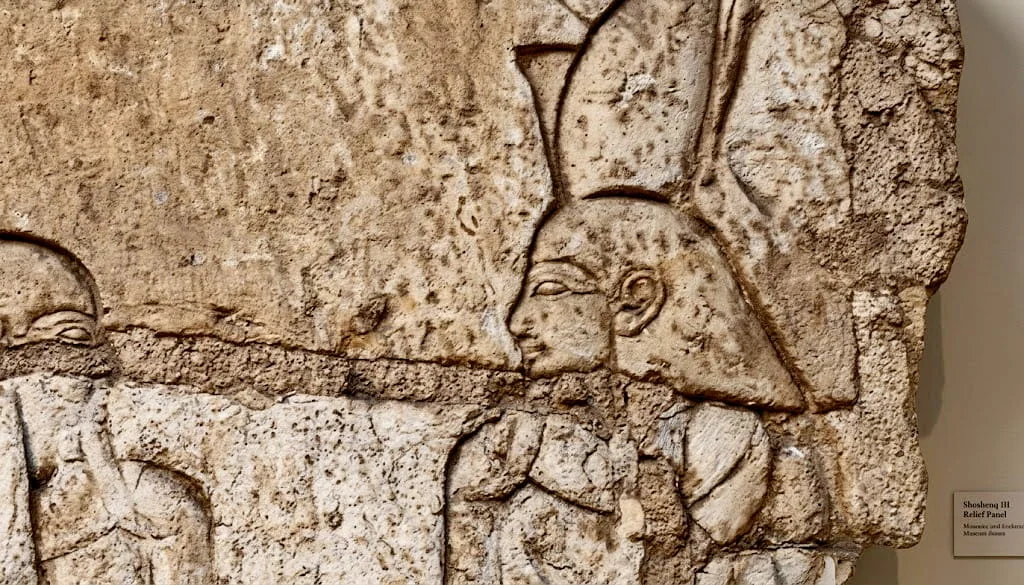
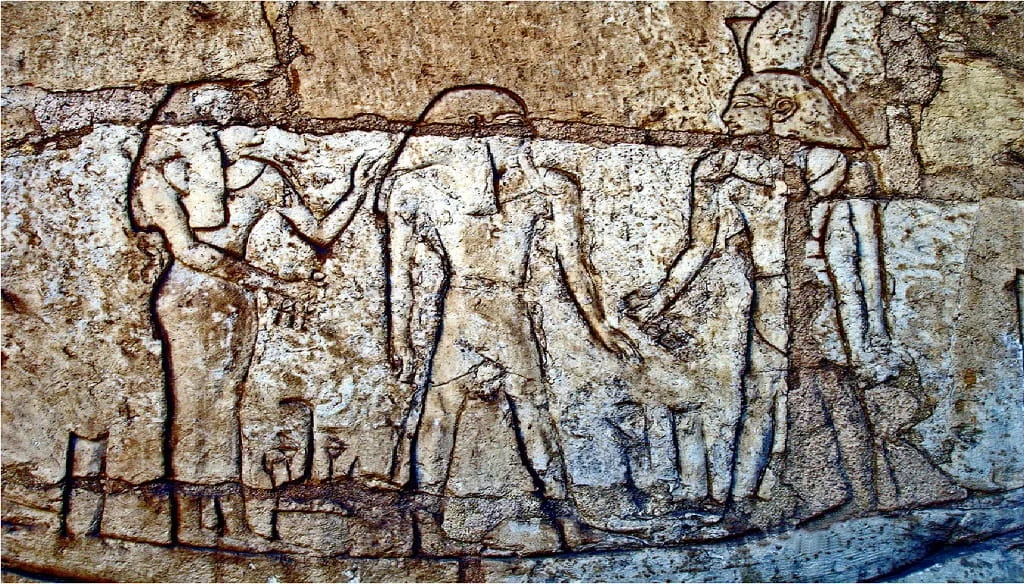
Shoshenq III (Usermaatre Setepenre) was a resilient pharaoh of the 22nd Dynasty who navigated a deeply fractured, multipolar Egypt for nearly forty years during the Third Intermediate Period. While his reign began under a facade of unified control from his northern delta stronghold of Tanis, a massive political rupture in his 8th regnal year led to the rise of Pedubast I and the rival 23rd Dynasty in Upper Egypt. Lacking direct access to the southern stone quarries, Shoshenq III relied heavily on clever political alliances to manage his southern rivals and launched an extensive architectural recycling program—systematically dismantling the nearby ruins of Pi-Ramesses to transform Tanis into a spectacular theological mirror of Thebes. Though his royal tomb (NRT V) was ultimately plundered by ancient grave robbers, his towering delta gateways and a hidden cache of over two hundred miniature ushabti statues remain enduring testaments to a monarch who used sheer political willpower to preserve the dignity of the pharaonic office even as the map of Egypt shattered around him.
The eye of Horus
WhatsApp
Email
Print

The Twenty-second Dynasty of ancient Egypt stands as a highly volatile era. Modern historians often call it the Libyan or Bubastite Dynasty. It belonged to the Third Intermediate Period. The powerful military commander Shoshenq I founded the lineage. Initially, the dynasty projected an image of unified pharaonic authority. They ruled smoothly from their northern strongholds in the eastern Nile Delta. However, everything changed around 825 BCE. The crown descended to King Shoshenq III (Usermaatre Setepenre). By this time, the structural fault lines of the fragmented empire were ready to rupture.

Shoshenq III’s reign is defined by a supreme historical paradox. He was one of the longest-ruling monarchs of his era, maintaining his grip on power for nearly four decades. Yet, his tenure witnessed the catastrophic structural collapse of centralized Egyptian governance. It was under his watch that Egypt fractured permanently into rival, co-existing kingdoms, an unprecedented political divorce that left the Nile Valley deeply divided, economically strained, and strategically paralyzed for centuries.

Divider

The Lineage Enigma: Who Was Shoshenq III?

The Lineage Enigma Who Was Shoshenq III

To fully comprehend the political instability that plagued the reign of Shoshenq III, one must first explore the highly contested nature of his ascension to the throne. Unlike the smooth generational transitions of the early New Kingdom, the chronology of the 22nd Dynasty is a labyrinth of overlapping co-regencies, short-lived rulers, and familial rivalries.

Shoshenq III: The Problem of Royal Succession

For decades, early Egyptologists assumed that Shoshenq III was the direct son and chosen heir of his predecessor, Osorkon II. However, modern epigraphic and genealogical analyses have thoroughly disrupted this simplistic narrative. Epigraphic tracking—the study of ancient inscriptions—revealed that Osorkon II already had an exceptionally powerful elder son named Shoshenq (historically designated by scholars as Prince Shoshenq “D”), who held the critical title of High Priest of Ptah at Memphis.

Because Prince Shoshenq D was a dominant political and religious figure in the north, the royal court widely expected him to inherit the dual crowns of Upper and Lower Egypt. Yet, archaeological records show that Shoshenq D predeceased his father or fell to the sidelines during a late-reign succession crisis. This opened a dangerous power vacuum within the royal court at Tanis.

Shoshenq III: Competing Academic Theories

Modern scholars are divided into two main camps regarding how Shoshenq III navigated this vacuum to claim the throne:

  • The Grandson Hypothesis: Prominent researchers suggest that Shoshenq III was actually the son of the deceased High Priest Shoshenq D, making him the grandson of Osorkon II. In this scenario, his ascension was an attempt by the core northern line to maintain control of the throne within a highly specific branch of the royal family.
  • The Sibling Hypothesis: Alternatively, some historians argue that Shoshenq III was a late-born, younger son of Osorkon II who carried the same name as his famous elder brother.

To solidify his arguably fragile claim and project an aura of continuity, Shoshenq III strategically adopted the same throne name (prenomen) as his grandfather: Usermaatre Setepenre (“The Justice of Ra is Powerful, Chosen by Ra”). This was a deliberate, calculated masterstroke designed to evoke the memory of Ramesses II and the glorious triumphs of the early 22nd Dynasty. To further legitimize his position among the powerful Libyan military elite, he married his aunt, Princess Tjesbastperu, binding himself explicitly to the core royal bloodline.

Golden Scarab

Year 8: The Great Rebellion and the Rise of Pedubast I

Year 8 The Great Rebellion and the Rise of Pedubast I

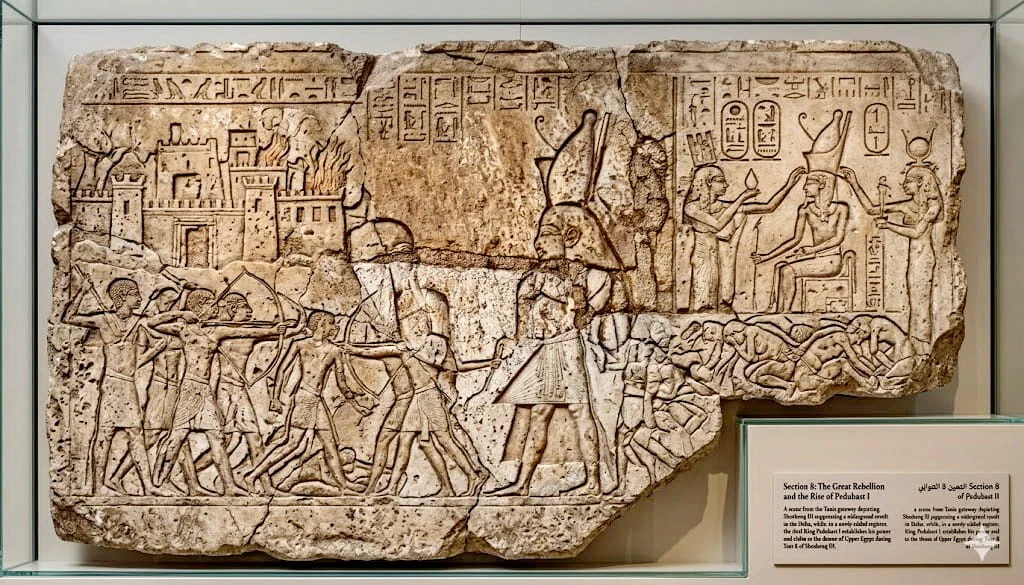
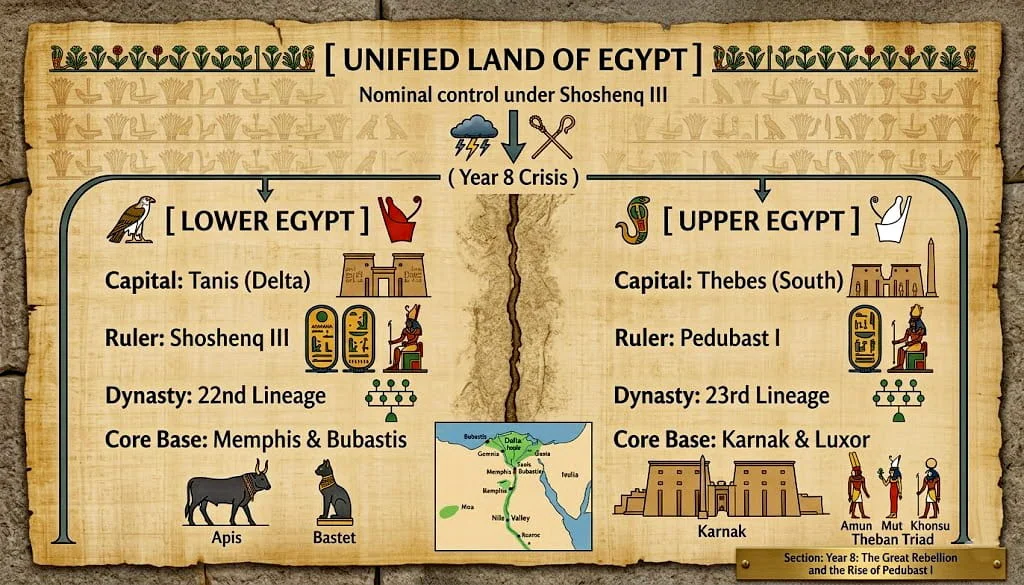
For the first seven years of his reign, Shoshenq III managed to maintain a fragile, nominal peace across both Upper and Lower Egypt. His name appeared on administrative dockets, and the powerful priesthoods of Memphis, Bubastis, and the sacred southern capital of Thebes technically recognized his authority. However, in his eighth regnal year (circa 818 BCE), the political dam broke.

The Southern Insurgency

Deep in Upper Egypt, a highly influential military commander and local noble named Pedubast I launched a massive, coordinated rebellion against the northern court at Tanis. Pedubast I was not a minor insurgent; he belonged to a parallel branch of the Libyan elite and possessed immense localized authority. Recognizing the growing resentment within the southern elite over how a distant Delta court governed them, Pedubast I boldly declared himself Pharaoh, adopting full royal titles and cartouches.

The primary catalyst for the success of Pedubast’s rebellion was the immediate, enthusiastic backing of the High Priesthood of Amun at Thebes. For generations, the Amun priesthood had functioned as a virtually autonomous theological state within a state. They controlled vast agricultural lands, dominated regional trade, and commanded their own private temple militias. By throwing their immense financial and spiritual weight behind Pedubast I, the Theban priests effectively severed the southern half of the country from Shoshenq III’s domain.

The Southern Insurgency

The Birth of the Twenty-Third Dynasty

This split was not a temporary civil war; it was a permanent geopolitical divorce. Pedubast’s rebellion marked the formal establishment of the Twenty-third Dynasty. For the remainder of Shoshenq III’s long life, Egypt was forced to adapt to a dangerous, highly unstable reality: two rival pharaohs ruling simultaneously along the same river.

The consequences for Egypt were devastating:

  1. Paralyzed Foreign Policy: With its internal resources completely consumed by regional rivalry, Egypt was utterly unable to project military power abroad. It completely abandoned its historic strategic interests in the Levant and Canaan, leaving the region open to the rapid expansion of the Neo-Assyrian Empire.
  2. Economic Fragmentation: Internal trade along the Nile became subject to dual taxation, internal customs checkpoints, and frequent military blockades, significantly dampening the domestic economy.
  3. Fragmented Legitimization: Local elites, mayors, and temple scribes were forced to choose which king to date their legal documents by, leading to chaotic administrative records that have puzzled modern historians for centuries.
The eye of Horus

Geopolitical Survival: Navigating a Multipolar Egypt

As his long reign progressed into its second and third decades, Shoshenq III faced an increasingly complex domestic landscape. The initial split between the 22nd and 23rd Dynasties quickly dissolved into an even more chaotic web of localized warlordism.

Shoshenq III: The Changing Landscape of Upper Egypt

Shoshenq III maintained firm control over the eastern Delta capitals of Tanis and Bubastis. However, his indirect influence over Upper Egypt fluctuated wildly. Historical records indicate that he frequently outlived his southern rivals. He watched a succession of 23rd Dynasty kings rise and fall in Thebes. Following the death of Pedubast I, new southern claimants arose to challenge the status quo. These included kings like Takelot III and Iuput I.

Remarkably, Shoshenq III did not rely solely on military force to handle the southern problem. Instead, he used highly nuanced political positioning. Records show a breakthrough in his 26th regnal year. Shoshenq III forged a critical alliance with Bakenptah. Bakenptah was the powerful military commander of Heracleopolis. This vital, strategic fortress city guarded the entrance to the Faiyum Oasis.

Bakenptah also happened to be the brother of the High Priest of Amun. Through this clever alliance, Shoshenq III succeeded in driving a political wedge right into the heart of the southern royal family.

Shoshenq III: The Loyalty of the West

While the south was lost to the 23rd Dynasty, Shoshenq III worked tirelessly to secure the loyalty of western Lower Egypt. He maintained close administrative ties with the powerful hereditary governors of Memphis and Kom el-Hisn. To ensure their continued support, he granted these local families immense autonomy, allowing them to manage regional agricultural yields and lead local military garrisons.

While this strategy successfully protected Shoshenq III from being overthrown, it had a disastrous long-term side effect: it accelerated the feudalization of Egypt. By handing deep, hereditary power to regional governors, he inadvertently ensured that future generations would view the central pharaoh as little more than a symbolic figurehead.

Divider

Monumental Defiance: The Architectural Transformation of Tanis

Shoshenq III faced a rapidly shrinking kingdom. He also lost access to the sacred southern temples of Luxor and Karnak. Because of this, the king turned his focus entirely toward his northern capital, Tanis. Today, we know this site as modern San el-Hagar.

The king could not physically rule over the ancient monuments of the south. Therefore, he chose to use monumental architecture at home. He wanted to transform Tanis into a spectacular theological mirror of Thebes.

Shoshenq III: The Great Pylon of Amun-Ra

The crown jewel of this architectural campaign was a massive, monumental granite pylon gateway. Workers built it directly into the colossal mudbrick enclosure wall of the great Temple of Amun-Ra at Tanis. Architects designed this pylon to serve as a stunning visual statement of the king’s enduring cosmic authority.

However, a major logistical problem stood in the way. The 22nd Dynasty lacked direct access to the famous red granite quarries of Aswan. His southern rivals controlled that entire region. Because of this obstacle, Shoshenq III’s engineers had to innovate. They launched one of the most extensive architectural recycling programs in human history.

The engineers marched to the nearby, abandoned New Kingdom capital of Pi-Ramesses. The great Pharaoh Ramesses II had built this city centuries earlier. The team systematically dismantled its towering temples, giant triumphal stelae, and monolithic obelisks. They transported thousands of tons of this second-hand stone down the Pelusiac branch of the Nile to Tanis.

Once the stone arrived, craftsmen re-carved the ancient granite blocks to feature Shoshenq III’s own names and titles. French Egyptologist Pierre Montet excavated the gateway in the 20th century. He discovered with absolute astonishment that builders had literally constructed the entire monumental gate out of the broken, reassembled bodies of Ramesses II’s ancient obelisks.

Shoshenq III: Localized Temple Building

Beyond the capital, Shoshenq III’s name appears on smaller temple foundations and donation stelae throughout Lower Egypt. Notable examples include:

  • Tell Umm Harb: The king funded local expansions here to honor regional agricultural deities.
  • Bubastis: This city was the ancestral home of the 22nd Dynasty. The king made lavish offerings to the cat-goddess Bastet to secure her divine protection over his fractured lineage.
  • Mendes: Massive limestone blocks bear his throne name here. These stones commemorate his patron contributions to the local ram-god Banebdjedet.

Through these widespread building projects, Shoshenq III aimed to prove a point. He wanted to show that his court still commanded immense wealth and exquisite artistic talent. Even during an era of political fracture, the Delta craftsmen maintained a breathtaking level of skill. They produced crisp, deeply carved relief work that brilliantly emulated the grand styles of the New Kingdom.

Death of a Monarch: The Archaeology of Tomb NRT V

Shoshenq III enjoyed an extraordinary reign lasting between 39 and 42 years. The king finally died around 786 BCE. His long survival meant that he tragically outlived his first five elder sons. This painful reality left his sixth son, Shoshenq IV, to inherit a deeply fragile northern crown.

Shoshenq III: The Discovery of NRT V

In the late 1930s, Pierre Montet successfully located the royal burial ground of the 22nd Dynasty. The ancient tombs sat buried deep beneath the heavy sand at Tanis. Hidden away from the world for millennia, Montet uncovered Tomb NRT V. This structure served as the final resting place of Shoshenq III.

The deep, sprawling valley tombs of the New Kingdom pharaohs looked very different from this structure. Instead, NRT V was a compact, subterranean stone chamber. Builders constructed it completely out of reused limestone blocks and sandstone slabs. They gathered these materials directly from nearby Ramesside ruins.

The interior design of the tomb was highly functional yet deeply spiritual. Intricate, painted reliefs adorned the walls of the burial chamber. These decorations featured critical defensive spells from the Book of the Dead and the Book of Night. Scribes designed these inscriptions to guide the pharaoh’s soul past the dangerous demons of the underworld. The spells helped the king achieve eternal life alongside the sun god Ra.

Shoshenq III: The Reality of Ancient Plundering

The structural architecture of the tomb survived intact, but the treasures inside did not. Professional grave robbers ruthlessly targeted NRT V during antiquity. The thieves easily smashed through the ancient roof seals. They stripped the pharaoh’s mummy of its golden amulets and plundered the precious grave goods.

When Montet’s team finally cleared the debris of the violated chamber, they made a poignant discovery. Shoshenq III rested inside a massive, heavy grey granite sarcophagus. Close forensic inspection revealed that an artisan had carved this second-hand sarcophagus centuries earlier for a wealthy New Kingdom court official.

Ancient thieves stripped the long-ruling pharaoh of his gold and silver. They left behind only fragments of his original funeral equipment, a few shattered canopic jars, and a collection of ceramic ushabti figurines. Priests placed these small servant statues in the tomb to magically awaken in the afterlife. Once awake, they would perform manual labor for the king.

The eye of Horus

The Historical Assessment of Shoshenq III

To judge Shoshenq III harshly for the political collapse of the 22nd Dynasty is to misunderstand the deeply systemic nature of Egypt’s Third Intermediate Period. He did not create the internal rivalries that tore his country apart; rather, he inherited a fragile feudal system where local military commanders had grown far too powerful to be controlled by a single throne.

Metric / AspectHistorical Analysis & Legacy
Total Reign Length39 to 42 Years (c. 825 – 786 BCE)
Primary CapitalTanis (Northern Nile Delta)
Geopolitical RealityLoss of Southern Egypt to the rival 23rd Dynasty
Major RivalPedubast I (Ruling from Upper Egypt / Thebes)
Key MonumentThe Great Recycled Granite Pylon at Tanis
Burial Site StatusTomb NRT V (Discovered, plundered by Pierre Montet)
Historical SuccessionOutlived his first 5 sons; succeeded by Shoshenq IV

Ultimately, Shoshenq III stands out as a resilient survivor. He navigated a highly fractured, multipolar world for nearly forty years, preserving the artistic, architectural, and cultural traditions of Lower Egypt through sheer political willpower. His towering gateway at Tanis and his beautifully decorated tomb remain enduring testaments to a king who stood firm against the tides of political chaos, preserving the dignity of the pharaonic office even as the map of Egypt shattered around him.

Comprehensive Shoshenq III FAQ

When exactly did Shoshenq III rule ancient Egypt?

Shoshenq III ruled during the 22nd Dynasty of the Third Intermediate Period, with his long reign lasting roughly from 825 BCE to 786 BCE.

Why did Egypt split into two rival kingdoms during his reign?

In the 8th year of Shoshenq III’s rule, a powerful northern noble named Pedubast I led a successful rebellion backed by the wealthy High Priests of Amun at Thebes. This permanent political split created the rival 23rd Dynasty in Upper Egypt.

What is unique about the famous Gate of Shoshenq III at Tanis?

Because the king lacked access to southern granite quarries, his architects launched a massive recycling program. They systematically dismantled old temples at Pi-Ramesses and reused the stone, columns, and broken obelisks of Ramesses II to construct his grand gateway.

Was the tomb of Shoshenq III discovered intact like Tutankhamun’s?

No. While his subterranean stone tomb (NRT V) was successfully located by Pierre Montet in the late 1930s, ancient grave robbers had thoroughly plundered the chamber, leaving behind only his reused granite sarcophagus and scattered funerary figurines.


Divider

Layover Tour in Cairo

This August, my boyfriend and I had quite a long layover in Cairo, 9 hours to be exact. Instead of wasting our time at the airport, we decided to do a layover tour of the city. I had been before, but my boyfriend hadn’t, so we wanted to hit the

More »

Cairo Day Trip

Great trip organised. I had a 12-hour layover in Cairo and had a great time with Sherif, who answered every question I had on ancient Egypt. Highly recommend.

More »

A great day!!!!

Thank you Hamada for an incredible day! Thank you for the stories and the history, you are so knowledgeable and we didn’t feel rushed at all or like we missed out on things, will definitely be recommending this tour to everyone 🙂

More »

Lenka Traverlers

Egypt Fun Tours was contracted by our travel agency, Lenka Travelers, to arrange and guide us through parts of Egypt and Jordon. They did a fabulous job. The hotels, restaurants, places we visited, and transportation were the best. Our guide in Egypt, Mohammad, was very knowledgeable, spoke perfect English, and

More »
God_Anubis_Icon

Top-rated Tour Packages

God_Anubis_Icon
WhatsApp
Email
Print