The Great Temple of Ramesses II: The Eternal Glory of the Sun King

The Great Temple of Ramesses II at Abu Simbel stands as the definitive monument of the 19th Dynasty, embodying the absolute power and divine status of Egypt’s most famous Pharaoh. Carved directly into the Nubian cliffs, its façade is dominated by four colossal 20-meter statues that have guarded the southern frontier for over three millennia. Inside, the temple reveals a complex narrative of military triumph through the Battle of Kadesh reliefs and a profound mastery of science through its biannual solar alignment. Following its historic relocation by UNESCO in the 1960s, the temple remains an enduring symbol of human ingenuity, bridging the gap between ancient engineering and modern preservation.

The Ultimate Statement of Power

Standing on the western bank of Lake Nasser, the Great Temple of Ramesses II at Abu Simbel represents the pinnacle of New Kingdom architectural ambition. While most Egyptian temples feature a structural entrance built of stone blocks, Ramesses II chose to carve this entire sanctuary directly into the solid sandstone cliffs of ancient Nubia. This decision transformed the mountain itself into a permanent billboard of Pharaonic power. Consequently, the temple served a dual purpose: it functioned as a sacred space for the gods and as a psychological deterrent for any travelers or rivals entering Egypt’s southern borders.

A Masterpiece of the 19th Dynasty
A Masterpiece of the 19th Dynasty

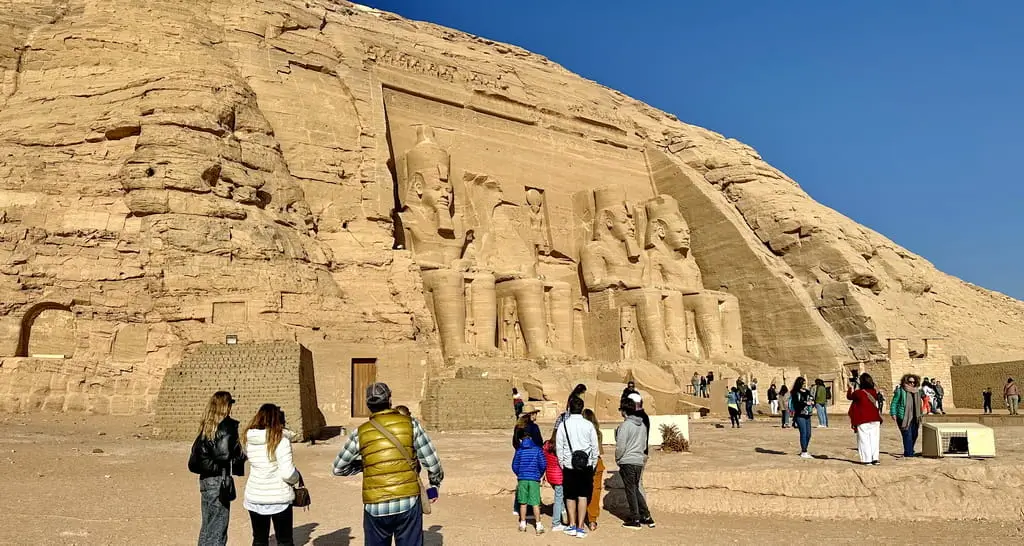
As a central piece of our 19th Dynasty research, this temple showcases the unparalleled resources available to Ramesses the Great during his sixty-seven-year reign. The scale of the construction is nearly impossible to grasp until you stand beneath the four seated colossi that dominate the façade. These statues do not merely represent the king; they depict him as a living god, integrated into the divine triad of Amun-Ra, Ra-Horakhty, and Ptah. Therefore, the monument serves as the ultimate expression of the “Sun King’s” desire to merge his earthly identity with the eternal celestial cycle.

Engineering the Impossible

Beyond its artistic grandeur, the Great Temple is a marvel of ancient physics and astronomy. The original architects calculated the temple’s orientation so precisely that, twice a year, the sun’s rays penetrate the dark interior to illuminate the statues in the innermost sanctuary. Furthermore, the modern history of the site is just as dramatic as its ancient origins. During the 1960s, a massive international UNESCO project rescued the temple from the rising Nile. This effort ensured that the temple of Ramesses II remains a definitive pillar of human heritage today. In the following sections, we will explore the military narratives of the Battle of Kadesh and the sophisticated solar engineering that makes this site a global wonder.
FUN

The Grand Façade: Faces of a Pharaoh-God

The Grand Façade Faces of a Pharaoh-God

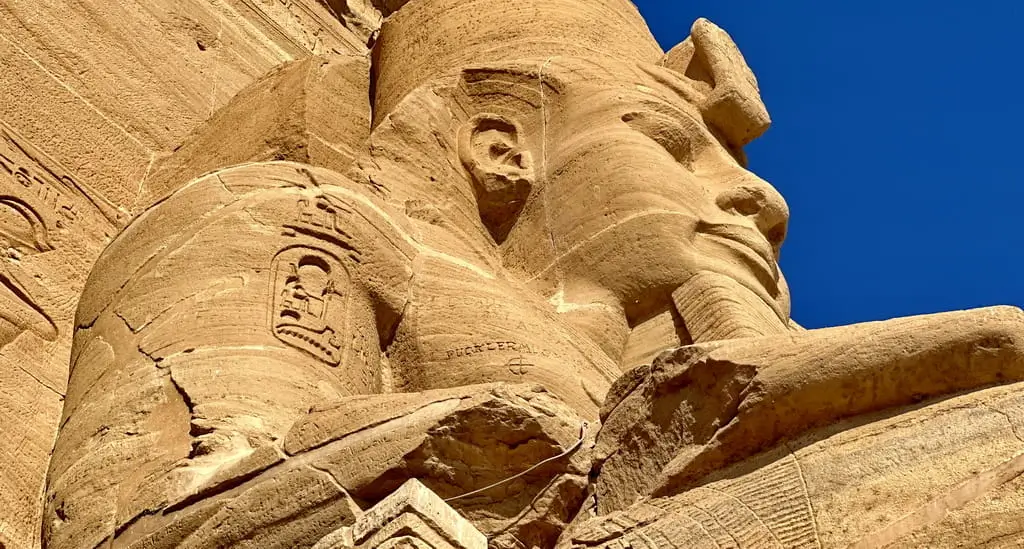
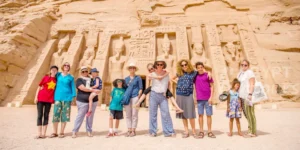
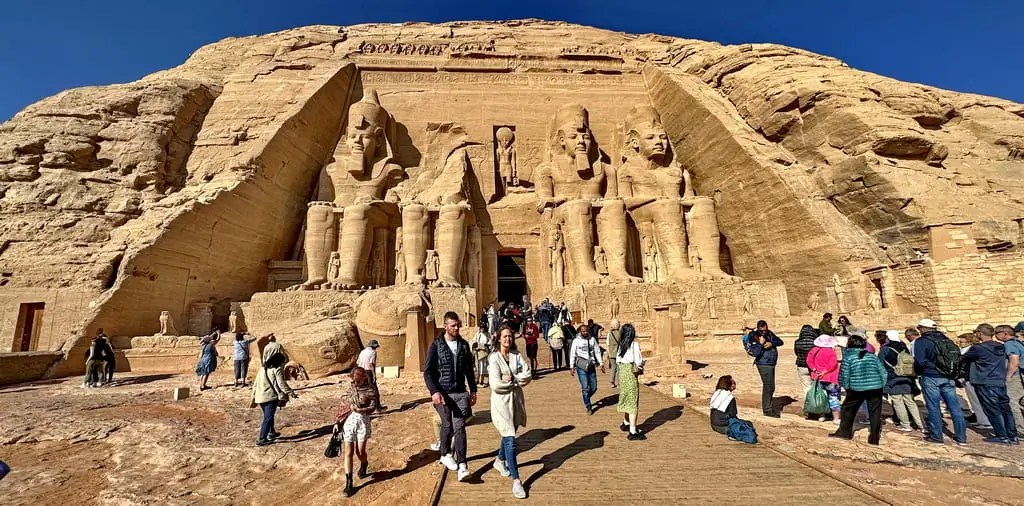
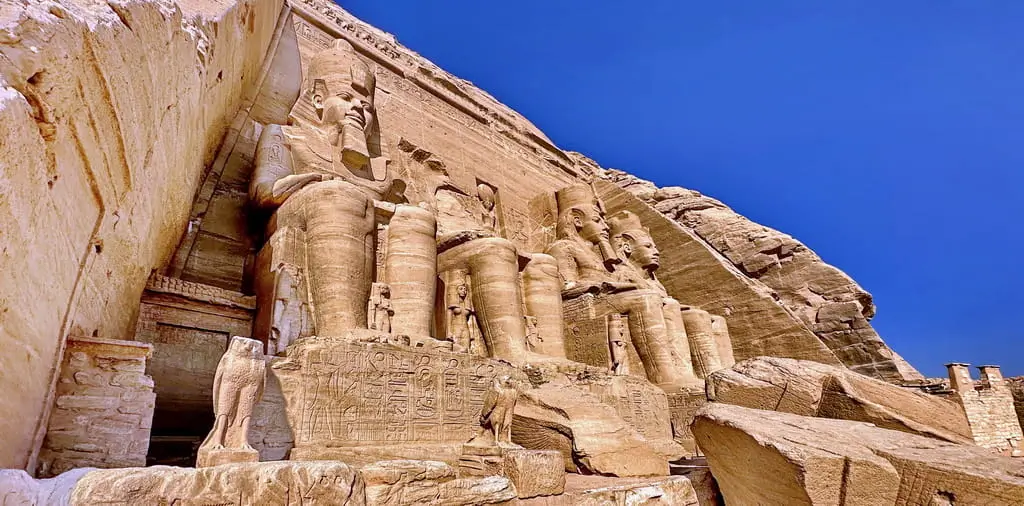
The façade of the Great Temple of Ramesses II at Abu Simbel serves as a breathtaking introduction to the power of the 19th Dynasty. Four colossal seated statues of Ramesses II, each towering 20 meters high, dominate the entrance. These figures depict the King wearing the pschent (the double crown of Upper and Lower Egypt) and the nemes headdress. Consequently, the sheer scale of these carvings was intended to make any visitor feel insignificant in the presence of the Pharaoh.

Symbolic Company and Divine Protection

Symbolic Company and Divine Protection

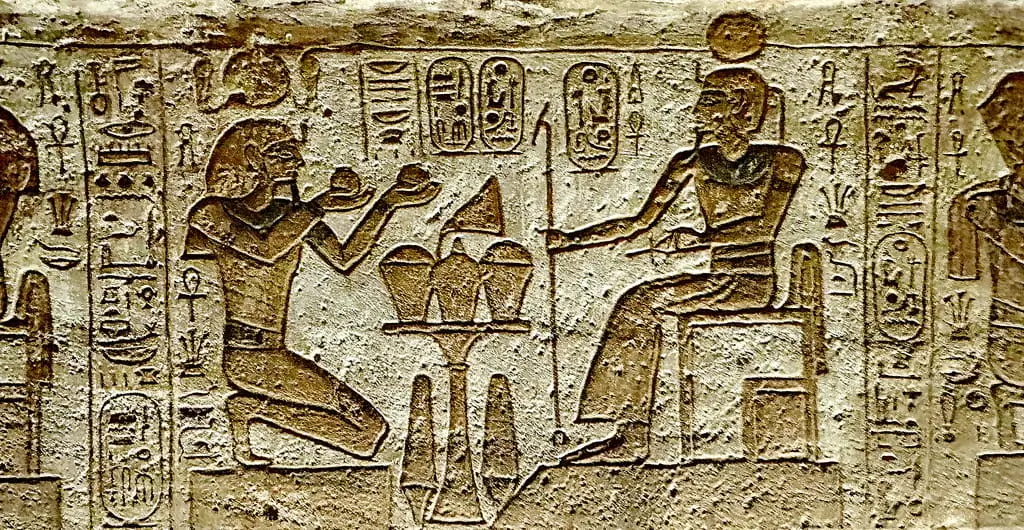
While the colossal statues represent the deified King, smaller figures stand around his feet to represent his family. These include his mother, Queen Tuya, and his beloved Great Royal Wife, Nefertari. Furthermore, statues of his children appear in smaller scale between his legs, emphasizing the continuity of the royal bloodline. Above the entrance, a central niche holds a statue of the falcon-headed god Ra-Horakhty. This placement is significant because it shows the King offering a small figure of Ma’at (truth and order) to the god, suggesting that Ramesses II’s reign was divinely sanctioned.

The Interior: The Hall of Conquerors

The Interior The Hall of Conquerors

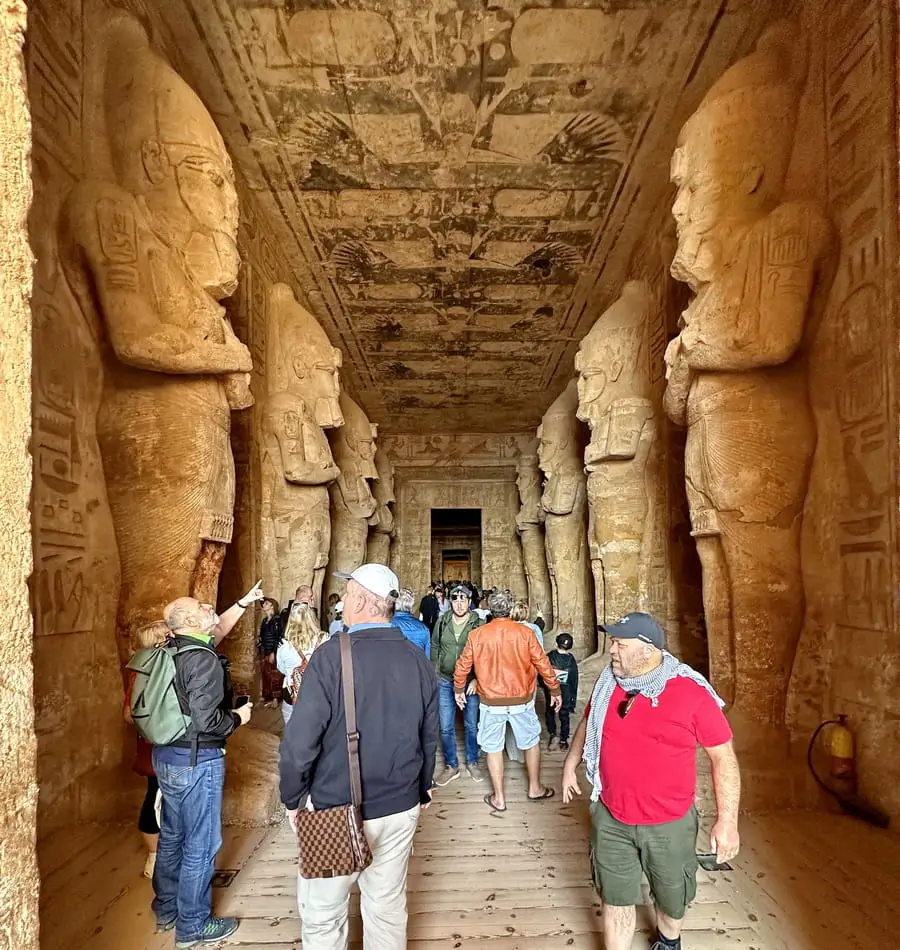
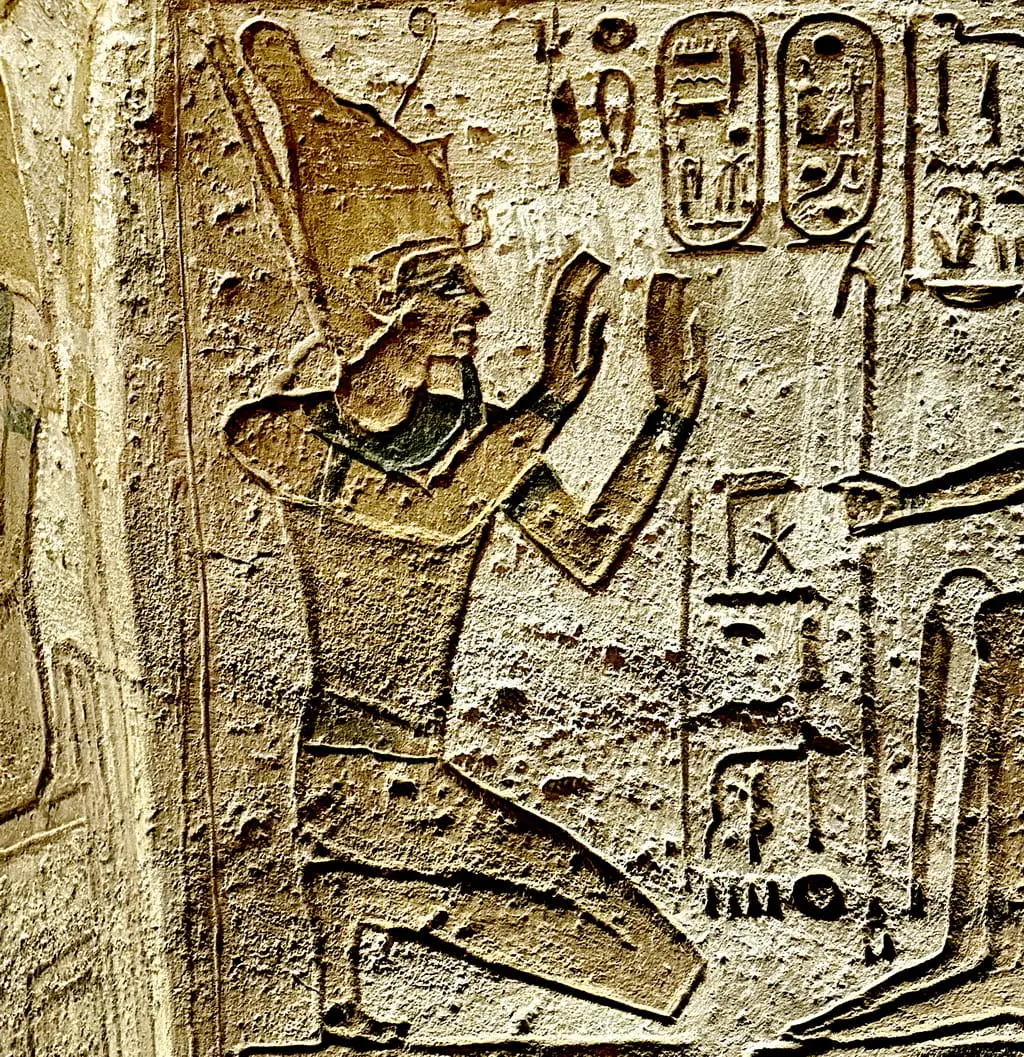
Stepping through the entrance leads to the massive hypostyle hall, where eight Osiride pillars line the central aisle. Each pillar features a statue of Ramesses II in the form of Osiris, the god of the afterlife, holding the crook and flail. These pillars support a ceiling decorated with vultures and stars, representing the protective sky. Unlike the refined “feminine” elegance found in the nearby Temple of Nefertari, this hall radiates a sense of martial strength and imperial dominance.

FUN

The Battle of Kadesh: A Narrative in Stone

The Battle of Kadesh A Narrative in Stone

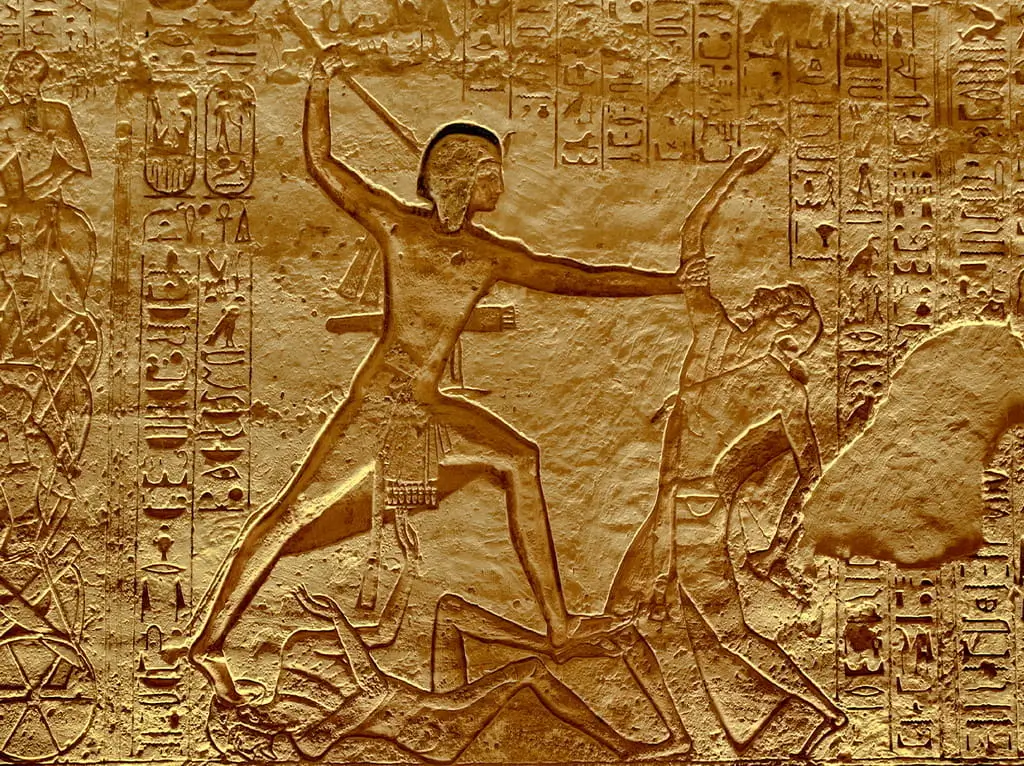
The walls of the Great Hall contain some of the most famous historical reliefs in Egypt: the detailed account of the Battle of Kadesh. These carvings depict Ramesses II charging into battle against the Hittites, standing in his chariot and raining arrows upon his enemies. In addition to the combat scenes, the reliefs show the Egyptian military camp, the council of war, and the eventual defeat of the Hittite spies. Because these scenes cover such a vast area, they serve as a definitive historical record of one of the greatest military engagements of the ancient world.

Strategic Artistic Messaging

Architects and artists used these battle scenes to reinforce the King’s role as the protector of Egypt’s borders. Even though the battle technically resulted in a stalemate, the temple reliefs portray it as a decisive victory. Therefore, the temple acted as a powerful propaganda tool, ensuring that the local Nubian populations and foreign emissaries understood the Pharaoh’s military prowess. This narrative of conquest sets the stage for the deeper, more spiritual areas of the temple where the King transitions from a warrior to a god.

The Solar Alignment: An Ancient Engineering Marvel

The Solar Alignment An Ancient Engineering Marvel

One of the most extraordinary features of the Great Temple of Ramesses II at Abu Simbel is the “Solar Miracle.” Ancient Egyptian architects possessed such a sophisticated understanding of astronomy and geometry that they oriented the entire temple to align with the sun twice a year. On these specific dates—traditionally February 22nd and October 22nd—the sun’s rays travel 60 meters deep into the mountain, cutting through the dark halls to illuminate the statues in the sanctuary. Consequently, this event showcases the perfect harmony between architectural design and celestial movement.

Abydos Temple: The Sacred Home of Osiris & the Masterpiece of Seti I

Take a pilgrimage to Abydos, the sacred "home" of the god Osiris and the spiritual...
Related post
FUN

The Sacred Statues of the Sanctuary

The Sacred Statues of the Sanctuary

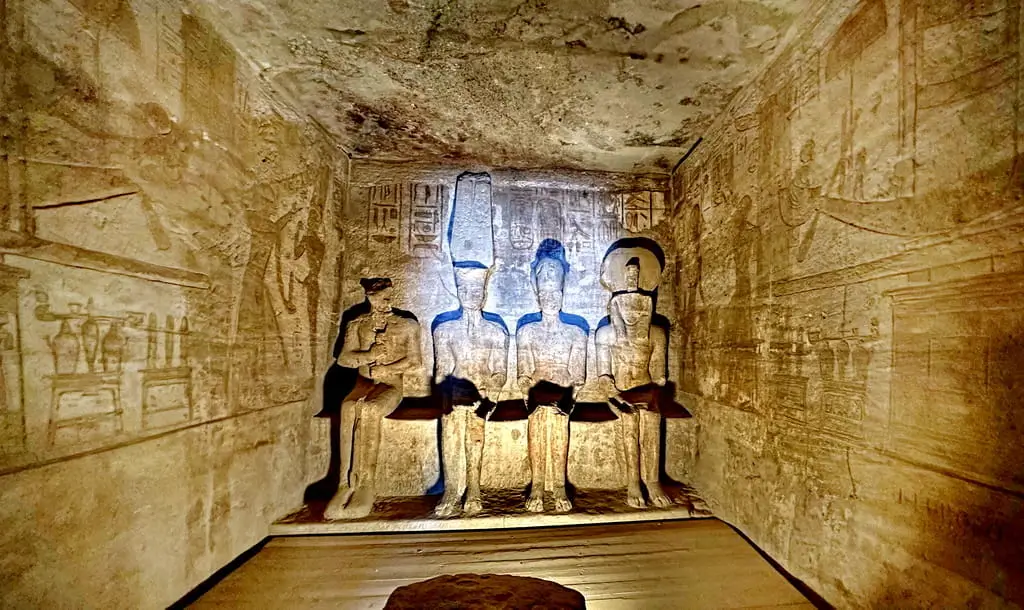
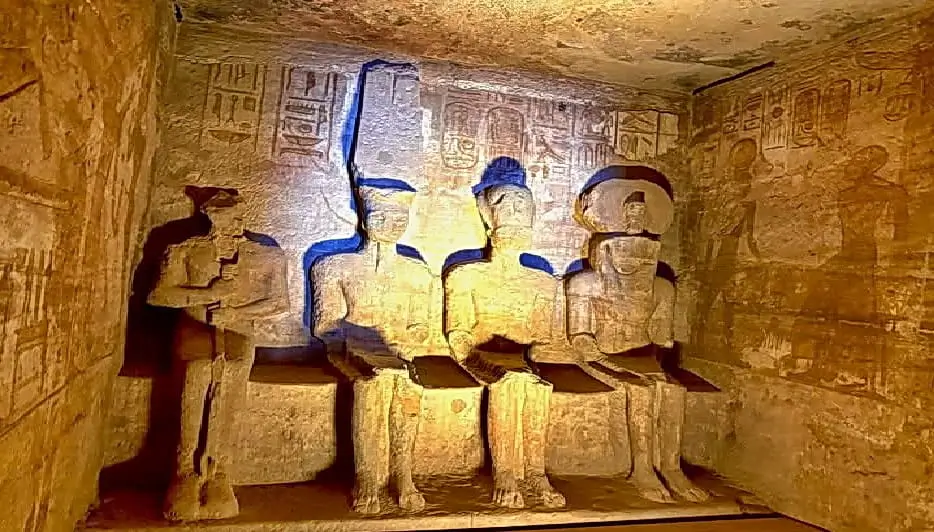
In the heart of the mountain lies the “Holy of Holies,” a small chamber containing four seated statues: Ptah, Amun-Ra, the deified Ramesses II, and Ra-Horakhty. During the solar alignment, the light specifically bathes the figures of Amun-Ra, Ramesses II, and Ra-Horakhty in a golden glow. However, the statue of Ptah, the god associated with the underworld and darkness, remains in the shadows even during this event. Therefore, the alignment serves a profound religious purpose, symbolically “recharging” the Pharaoh’s divine spirit with the energy of the sun god.

The Chronology of the Sun

Historians believe these two dates were not chosen at random. Many experts suggest they represent the anniversary of Ramesses II’s coronation and his birthday. Furthermore, the timing of the event relates to the agricultural and religious cycles of the Egyptian calendar. Because the sun illuminates the King alongside the most powerful gods of the empire, the phenomenon reinforces the idea that Ramesses II is a permanent, divine part of the cosmic order. This biannual spectacle continues to draw thousands of visitors today, proving that the King’s quest for eternal relevance was successful.

Beit el-Wali: The Vibrant Military Masterpiece of Ramesses II

The Temple of Beit el-Wali, the oldest of the Nubian monuments built by Ramesses II,...
Related post
FUN

Moving a Mountain: The UNESCO Rescue

Moving a Mountain The UNESCO Rescue

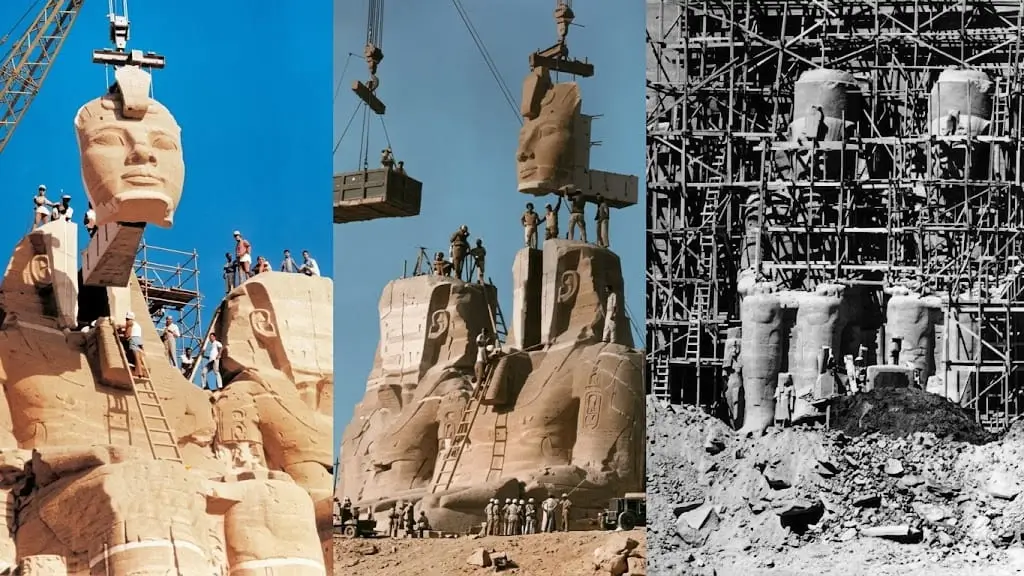
The fact that we can still witness this solar alignment today is a modern miracle. During the 1960s, the construction of the Aswan High Dam threatened to submerge the site under the waters of Lake Nasser. In response, UNESCO launched a massive international effort to save the monument. Engineers dismantled the Great Temple of Ramesses II at Abu Simbel by cutting it into over 1,000 massive blocks, some weighing up to 30 tons. They then meticulously reassembled the temple 65 meters higher and 200 meters back from its original location.

Preserving the Alignment

The greatest challenge of the relocation was maintaining the precise solar alignment. Engineers had to ensure the new orientation matched the original ancient calculations within a fraction of a degree. While the dates of the alignment shifted by one day due to the relocation, the phenomenon remains perfectly intact. Today, the temple sits inside a massive, artificial concrete dome covered with natural stone to mimic the original mountain cliff. As a result, this UNESCO project serves as a testament to what international cooperation can achieve in the name of heritage preservation.

The Temple of Nefertari: A Monument to the Queen of the Two Lands

The Temple of Nefertari at Abu Simbel is a unique masterpiece of the 19th Dynasty,...
Related post
FUN

Visiting the Great Temple Today

Visiting the Great Temple Today

To experience the full impact of the Great Temple of Ramesses II at Abu Simbel, one must consider the logistical journey to this remote corner of Egypt. Located deep in Nubia, the site offers a profound sense of isolation that enhances its ancient atmosphere. Today, the temple serves as the cornerstone of regional tourism, attracting those eager to witness the scale of the 19th Dynasty’s architectural legacy.

Essential Travel Tips

  • The Journey from Aswan: Most travelers reach the site via a three-hour desert drive or a short flight from Aswan.
  • The Best Time to Visit: Arriving at dawn allows you to see the first light hit the colossal faces of Ramesses II, highlighting the intricate details of the sandstone.
  • Photography and Lighting: The temple façade is best lit in the morning hours, while the interior requires a steady hand to capture the depth of the Osiride pillars.
  • Combining the Sites: A complete visit must include both the Great Temple and the adjacent Temple of Nefertari to appreciate the balance of masculine power and feminine elegance.

Why This Monument Matters

Why This Monument Matters

This temple is more than just a historical relic; it is a testament to the longevity of the Egyptian state and the ego of its most prolific builder. By integrating himself into the mountain and the solar cycle, Ramesses II ensured that his name would never be forgotten. As a 3,000-word pillar of your digital tourism repository, this guide provides the depth and authoritative insight necessary to understand one of the wonders of the ancient world.

The Living Legacy of the Sun King

The Living Legacy of the Sun King

The Great Temple of Ramesses II at Abu Simbel remains an unparalleled marvel of ancient engineering and imperial propaganda. From its towering 20-meter colossi to the hidden sanctuary that captures the sun’s rays, every inch of the monument was designed to project eternal divinity. Its survival through the 1960s UNESCO rescue mission stands as a modern victory for heritage, ensuring that the story of Ramesses the Great continues to inspire awe in the 21st century.

Experience the classical grandeur and allure of Egypt....
8 Days Group trip to Egypt wonders with a Nile Cruise....
FUN
God_Anubis_Icon

What an amazing day!

I had a 12 hour layover on my way to Dar es Salaam and wanted to take full advantage of my time in Cairo. After researching for many hours, I came across Egypt Fun Tours and emailed for more information. I received a prompt reply with full details of several

More »
A Royal Commission The History of Al-Rifa'i Mosque

Highly recommended

Salam, This company is very responsive and accommodating. From the moment we started to chat via email, to the moment we left Egypt at the airport, these fellows were very professional. The tour covered most of what we wanted to see! We customized it to our needs and added some

More »

Tour of Cairo

Despite a late start due to car trouble, Mohamed more than made up for it with his incredible knowledge and dedication. His explanations were detailed and thoughtful, and he went above and beyond to make sure we had a great experience. A memorable and informative tour, thanks to Mohamed’s hard

More »

Amazing Experience

Hamada was incredible! So knowledgeable and kind. He had information about every item, street corner, and relic we looked at. Any questions we had, he had answers! He even made sure to give us tips while walking through the crowds so that we would feel more comfortable when being approached

More »
hani ahmed 1

Hani Was our Awesome Tour Guide!

We had an 11-hour layover in Cairo on 12/15/2011. We wanted to go to see the Pyramids, Tahrir Square, and possibly the museum. We were so lucky to have a guide, Hani from Egypt Fun Tour, who made it possible to see all the above, plus the Bazaar, and time

More »
God_Anubis_Icon

Top-rated Tour Packages

God_Anubis_Icon