Queen Tuya: The Royal Matriarch of the 19th Dynasty

Queen Tuya stands as the definitive matriarch of the 19th Dynasty, serving as a vital bridge between the military foundations of her family and the imperial heights of the New Kingdom. As the Great Royal Wife of Seti I and the mother of Ramesses the Great, she wielded unprecedented influence that transcended domestic life. Specifically, she acted as a high-level diplomat, famously exchanging letters with the Hittite Queen Puduhepa to solidify the world’s first major peace treaty. Because she was central to the "Divine Birth" theology at the Ramesseum, she transitioned from a mortal royal to a semi-divine figure during her lifetime. Consequently, her legacy is preserved not only in the colossal statues that flank her son's temples but also in the sophisticated artistry of her final resting place, tomb QV80 in the Valley of the Queens. For the researcher, Tuya represents a unique era where royal motherhood was a primary pillar of Egyptian statecraft and religious stability.

Queen Tuya (also known as Mut-Tuya) remains one of the most significant women in ancient Egyptian history. She lived during the peak of the New Kingdom and served as the Great Royal Wife of King Seti I. However, her historical weight primarily stems from her role as the mother of Pharaoh Ramesses II. Specifically, she acted as a stabilizing force during the transition of power between the 18th and 19th Dynasties. Because she was the daughter of a military officer named Raia, her background reinforced the martial spirit of the Ramesside era. Consequently, Queen Tuya Ramesses II represents the ideal of the “King’s Mother” as a divine and political advisor.

Originally, Tuya held titles that emphasized her religious and social standing. As a “Singer of Hathor” and “Chief of the Entertainers of Amun,” she managed massive temple estates. Because she outlived her husband, Seti I, she witnessed the first 22 years of her son’s legendary reign. For this reason, Ramesses II treated her with immense reverence, depicting her on monuments from Abu Simbel to the Ramesseum. Therefore, Queen Tuya Ramesses II is not just a secondary figure; she is a central pillar of the 19th Dynasty’s success.
The eye of Horus

Diplomatic Power: The Peace Treaty of Year 21

battle kadesh political peace treaty Egypt Fun Tours

One of the most remarkable aspects of Queen Tuya’s life was her involvement in international diplomacy. Specifically, she played a vital role in the peace process with the Hittite Empire. After the Battle of Kadesh, Ramesses II negotiated a historic peace treaty in his 21st regnal year. Because Tuya was a respected elder, she exchanged personal letters and gifts with the Hittite Queen Puduhepa. Consequently, her influence extended far beyond the borders of Egypt.

These diplomatic efforts were crucial for maintaining regional stability.

  • The Correspondence: Tuya wrote to Puduhepa to celebrate the “eternal peace” between the two nations.
  • Symbolic Gifts: The exchange of luxury items solidified the bond between the two royal households.
  • A Stability Figure: Her involvement proved that the “Queen Mother” held authority in foreign affairs.

Therefore, the Queen Tuya Ramesses II connection was a primary tool of Egyptian statecraft. For the 2026 historian, these letters provide rare evidence of women’s roles in Bronze Age diplomacy. Specifically, they show that Tuya was a shrewd politician who understood the value of soft power. Consequently, her legacy is one of peace as much as it is of royal lineage.

Queen Tuya: The Ramesseum and the “Divine Birth”

Ramesses II took great care to honor his mother within his own mortuary complex, the Ramesseum. Specifically, he dedicated a magnificent chapel to her on the north side of the main temple. This structure is unique because it features scenes of the “Divine Birth” of the King. Because Ramesses wanted to prove his right to rule, he depicted the god Amun visiting Queen Tuya to conceive the future pharaoh. Consequently, Queen Tuya Ramesses II became a central figure in the king’s theological propaganda.

The chapel contained several masterpieces of Egyptian art:

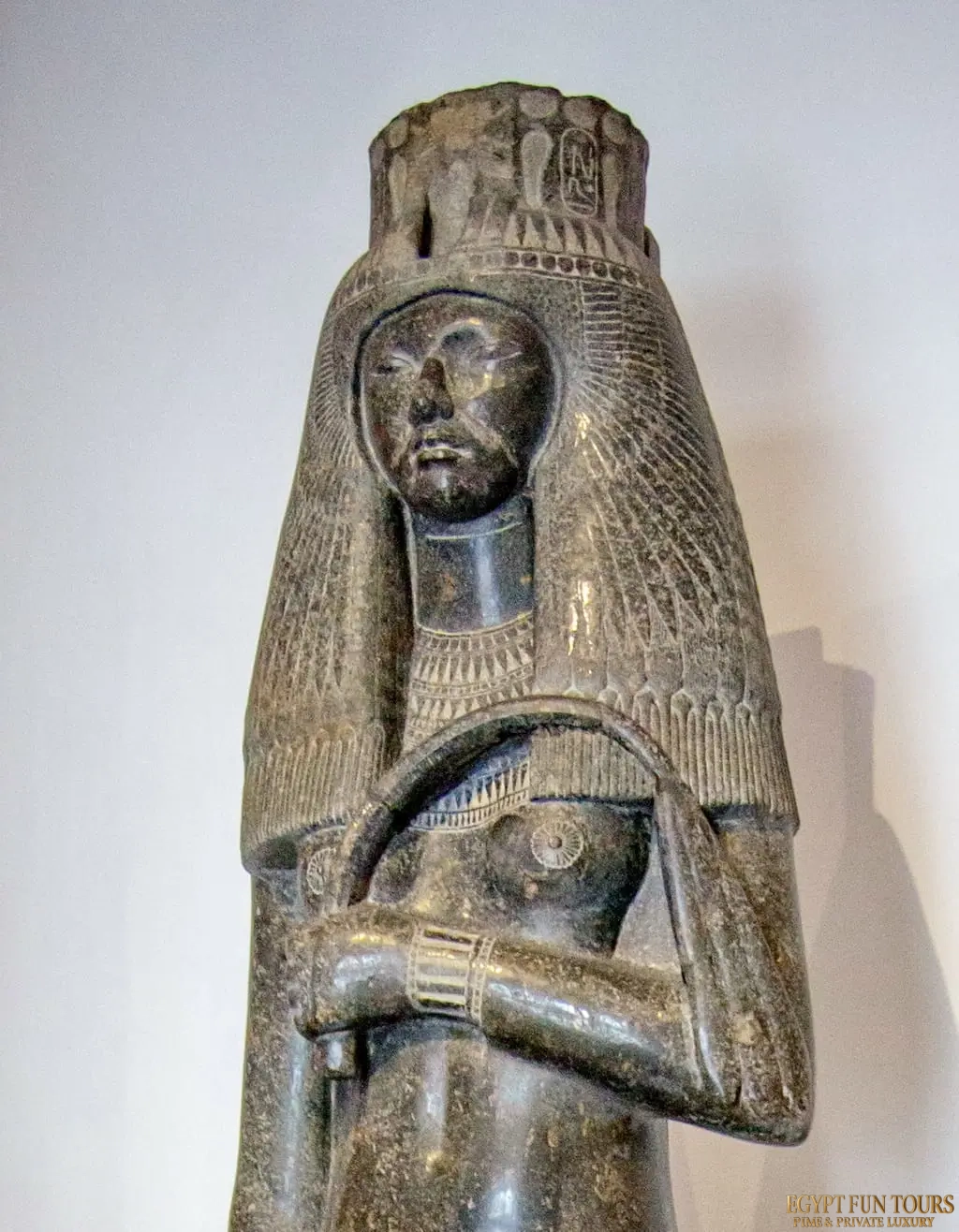
  1. The Black Granite Statue: Now in the Vatican Museum, this statue shows Tuya with her daughter-in-law (or granddaughter) Henutmire.
  2. Bas-Reliefs: Detailed carvings show Tuya participating in the foundation ceremonies of the temple.
  3. Colossal Statues: Massive figures of Tuya once flanked the entrance to the hypostyle hall.

By placing his mother at the heart of his mortuary cult, Ramesses II ensured her eternal memory. Specifically, he elevated her status from a mortal queen to a semi-divine protectress of the state. Therefore, the Queen Tuya Ramesses II narrative was essential for the King’s own religious identity. For the traveler in 2026, the ruins of her chapel at the Ramesseum remain a powerful site for study.

Golden Scarab

Tomb QV80: The Final Resting Place of Queen Tuya

Tomb QV80 The Final Resting Place of Queen Tuya

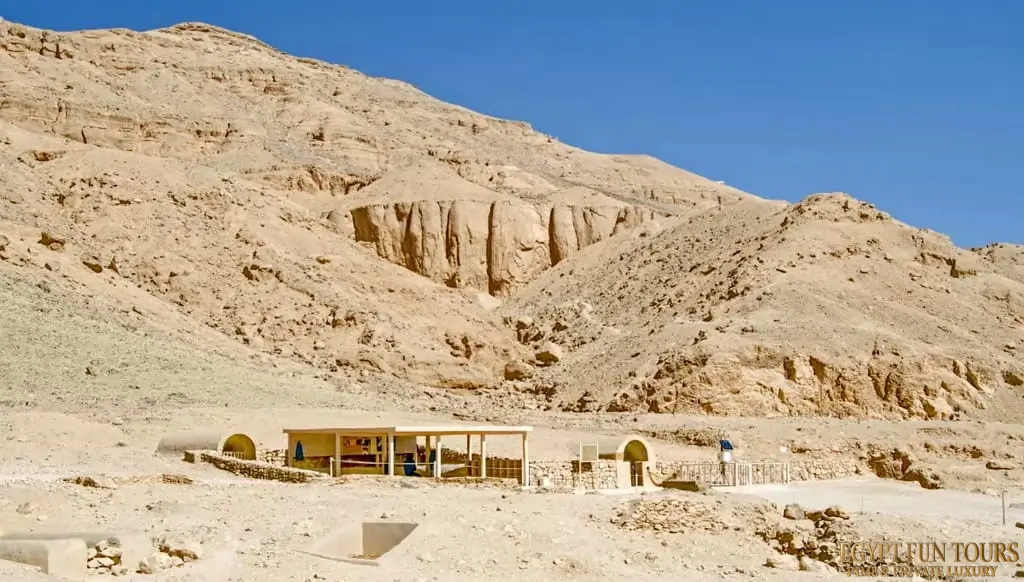
Queen Tuya died approximately in Year 22 of her son’s reign. Consequently, Ramesses II prepared a lavish burial for her in the Valley of the Queens, designated as QV80. This tomb is one of the most significant in the valley, reflecting her status as a “Great Royal Wife.” Because it was located on the north side of the main wadi, it stood out as a premier location. For the 2026 visitor, QV80 provides a stark look at the craftsmanship of the Ramesside era.

The architecture of QV80 is impressive:

  • The Entrance Hall: Features scenes of Tuya appearing before the gods of the underworld.
  • The Sarcophagus Chamber: Originally held a massive pink granite sarcophagus lid, now in the Luxor Museum.
  • The Decorative Shift: Upon her death, she dropped the “Mut” (goddess) prefix from her name. This suggests she had achieved a new, purely divine state in the afterlife.

Although the tomb suffered from ancient robbery and flood damage, fragments of her funerary equipment survive. Specifically, her alabaster canopic jar lid, carved in the likeness of her head, is a highlight of the Luxor Museum. This artifact shows her wearing a vulture headdress, a symbol of royal motherhood. Therefore, Queen Tuya Ramesses II remains a visible presence in the archaeological record of Thebes.

Alexander the Great: Travel the Path of a Pharaoh-King

Alexander the Great became Pharaoh in Egypt (332 BC). He founded Alexandria, a world capital,...
Related post
The eye of Horus

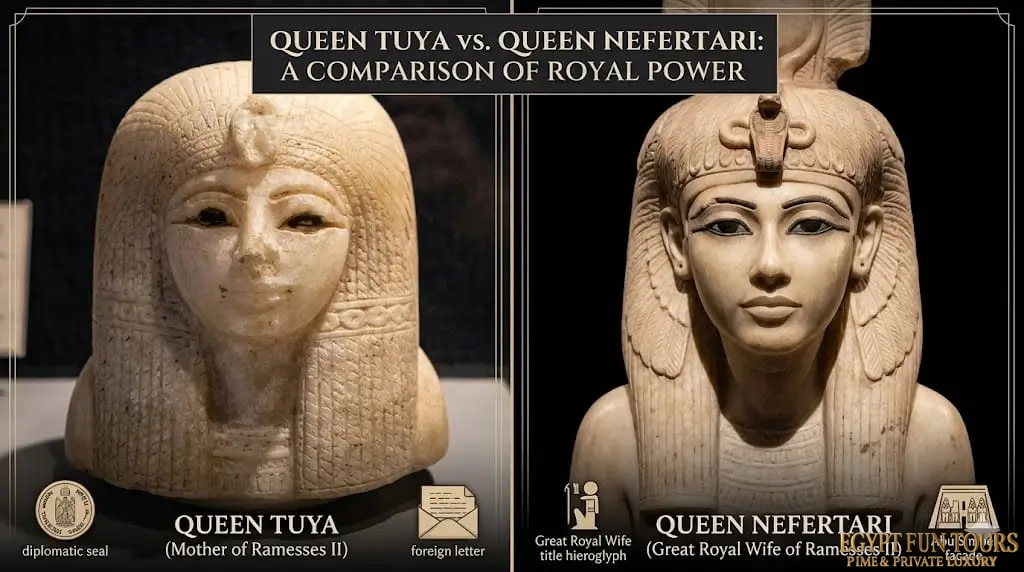
Queen Tuya vs. Queen Nefertari: A Comparison of Royal Power

Queen Tuya vs. Queen Nefertari A Comparison of Royal Power

The relationship between Queen Tuya and Queen Nefertari was one of familial and political partnership. Tuya, the mother of Ramesses II, acted as the senior matriarch of the 19th Dynasty. Nefertari, the King’s first and most beloved Great Royal Wife, represented the feminine peak of his reign. Specifically, the two women worked together to solidify the Ramesside line. Because both women possessed high intelligence and diplomatic skill, they were often depicted together on major monuments. Consequently, they established a dual standard for royal motherhood and queenship that lasted for generations. A primary difference lies in their visibility during the king’s reign.

  • Queen Tuya: She achieved her greatest influence as the “Queen Mother.” Because she outlived Seti I, her power was rooted in her status as a divine advisor to her son.
  • Queen Nefertari: She was a partner in power during the king’s youth. Specifically, Ramesses II depicted her as equal in size to himself on the façade of the small temple at Abu Simbel.

Therefore, the Queen Tuya Ramesses II connection was about continuity and lineage. In contrast, the Nefertari connection was about passion and partnership. For the 2026 traveler, seeing their statues side-by-side at Luxor Temple reveals the balanced structure of the royal family.

Burial Styles: QV80 vs. QV66

The final resting places of these two women in the Valley of the Queens offer a stark contrast in artistic evolution. While both tombs follow the standard New Kingdom layout, their internal atmospheres are very different. Specifically, the tomb of Nefertari (QV66) is widely considered the “Sistine Chapel of Egypt.” In contrast, the tomb of Tuya (QV80) focused on large-scale masonry and proximity to her son’s monuments.

The Artistic Masterpiece: Nefertari (QV66)

Nefertari’s tomb is the most beautiful in the valley. Because the colors remain so vibrant in 2026, visitors feel as if the paintings were finished yesterday.

  • Detail: The artists focused on Nefertari’s facial features, emphasizing her beauty and grace.
  • Themes: The walls feature extensive chapters from the Book of the Dead, guiding the queen through a colorful afterlife.
  • Scale: While not as large as a king’s tomb, the complexity of its decoration is unmatched.

The Matriarch’s Vault: Tuya (QV80)

The tomb of Queen Tuya is a monument of dignity and religious transition.

  • Architecture: The tomb features a wider entrance hall, designed to accommodate a massive pink granite sarcophagus.
  • Religious Shift: Upon her burial, the inscriptions dropped the “Mut” prefix from her name, symbolizing her transition into a purely divine state.
  • Current State: Because it suffered more from ancient flooding than QV66, the decorations are less preserved. However, the architectural “bones” show the immense status she held.

King Chephren (Khafre): The Pharaoh of the Sphinx and the 2nd Pyramid

King Chephren (Khafre) is the master of the Giza Plateau. While his father, Khufu, built...
Related post
Golden Scarab

The Legacy of Queen Tuya

The Legacy of Queen Tuya

The legacy of Queen Tuya is defined by her transition from a military officer’s daughter to the revered matriarch of Egypt’s most famous dynasty. As the wife of Seti I and mother of Ramesses II, she provided the essential link between the rise of the 19th Dynasty and its golden age. Her influence was not merely domestic; she was a pioneer of international diplomacy and a central figure in the religious propaganda that solidified her son’s “divine” right to rule.

The Pillars of Her Legacy:

  • The Diplomatic Architect: Tuya was one of the first Egyptian queens to engage directly in high-level foreign correspondence. Specifically, her letters to the Hittite Queen Puduhepa were instrumental in maintaining the world’s first major peace treaty.

  • The Divine Mother: Through the “Divine Birth” scenes at the Ramesseum, her legacy became a tool of theology. She was depicted as the woman chosen by the god Amun, elevating her status from a mortal queen to a semi-divine figure.

  • A Symbol of Stability: Having witnessed the transition from the 18th Dynasty’s chaos to the 19th Dynasty’s order, she represented continuity. Because she lived deep into her son’s reign, she provided a sense of traditional authority that helped anchor the early years of Ramesses II.

  • The Matriarch of the Valley: Her tomb, QV80, set a high standard for royal burials in the Valley of the Queens. Although damaged by time, the massive scale of her funerary equipment, such as her pink granite sarcophagus, proves her immense standing in the royal court.

Therefore, Queen Tuya’s legacy is a blend of political shrewdness and religious devotion. She remains the ultimate example of the power a “Queen Mother” could wield in the New Kingdom. For the traveler in 2026, her presence is still felt across Egypt, from the colossal statues in Luxor to the quiet, dignified halls of her tomb in Thebes. Consequently, she stands alongside Nefertari as one of the two most influential women of the Ramesside era.

Ramesses II (The Great): Biography of Egypt’s Most Powerful Pharaoh

Ramesses II (Ramesses the Great) is the defining figure of Ancient Egypt. Ruling for 66...
Related post
The eye of Horus

Access: Visiting the Valley of the Queens

Access Visiting the Valley of the Queens

For your 2026 itinerary, visiting both tombs is essential for a complete understanding of the 19th Dynasty. Because the Valley of the Queens is quieter than the Valley of the Kings, it offers a more intimate experience. Specifically, you can see the generational shift in art by comparing the two sites.

  • Tickets: Nefertari’s tomb requires a separate, premium ticket (approx. 2000 EGP as of 2026).
  • Conservation: To protect the murals, the Ministry of Tourism limits the number of daily visitors to QV66.
  • Proximity: QV80 (Tuya) and QV66 (Nefertari) are within a short walking distance of each other.

Consequently, these two tombs serve as the “pearls” of the Theban necropolis. Therefore, ensure you allocate at least two hours to explore both. By standing in the halls of Queen Tuya and then Queen Nefertari, you witness the full spectrum of Ramesside wealth and devotion.

God_Anubis_Icon

Excellent Adventure

These guys put together an amazing itinerary that allowed me see the sunrise at the sun festival in Abu Simbel, King Tut’s tomb, and mask! That was just the tip of the iceberg. Aswan, Kom Ombo, Edfu and Luxor. So much visited with plenty of rest time. An amazing trip

More »

Early Layover Tour in Cairo

My husband, 2 sons – aged 9 & 11 – and I landed in Cairo at 5:15am on Saturday 12 January 2013. We had booked an early layover tour with Egypt Fun Tours after reading the great reviews in TripAdvisor. As promised he and his driver awaited us in a

More »

Cairo Day Trip

Great trip organised. I had a 12-hour layover in Cairo and had a great time with Sherif, who answered every question I had on ancient Egypt. Highly recommend.

More »
6 Days Elegence of Egypt Group Tour - Cairo and nile cruise affordable tour

Superbly organized

I can’t recommend them enough. I got into Cairo on a 12-hour layover at 2:00 AM. By 3:15 Hani and his driver were meeting me at the airport. For the next five hours we strolled through lovely downtown Cairo & over the Nile, wandered through (friendly, well-organized) Tahrir Square, toured

More »

Excellent Egypt Adventure – All To Ourselves

Excellent trip to historic sites with no one else around. We came to see Egypt while most places still had COVID-19 fears. The staff at Egypt Fun Tours were professional, safe, and great to deal with. Very helpful, knowledgeable, and entertaining. I feel like I just got a year of

More »
God_Anubis_Icon

Top-rated Tour Packages

God_Anubis_Icon