Kom Aushim Museum: The Ultimate Guide to Faiyum’s Historical Gateway

Discover the rich cultural heritage of the Faiyum Oasis at the Kom Aushim Museum in Egypt. Strategically located next to the ancient ruins of Karanis, this exceptional regional museum showcases the fascinating daily lives, economic activities, and religious traditions of the area from the Pharaonic era through the Greco-Roman period. Visitors can marvel at the hauntingly beautiful Faiyum Portraits, well-preserved Sobek crocodile mummies, and rare domestic artifacts recovered from the desert sands. Consequently, this definitive guide provides essential travel logistics, expert visiting tips, and historical insights to help you maximize your exploration of Faiyum's premier historical gateway.
WhatsApp
Email
Print

Tucked away at the entrance of the fertile Faiyum Oasis lies one of Egypt’s most rewarding regional cultural repositories: The Kom Aushim Museum.

Conveniently situated adjacent to the sprawling archaeological site of ancient Karanis, this specialized museum serves as a critical gateway to understanding the daily life, religious practices, and unique cultural synthesis of the Faiyum region. It spans eras from the prehistoric periods through the Pharaonic, Greco-Roman, Coptic, and Islamic ages.

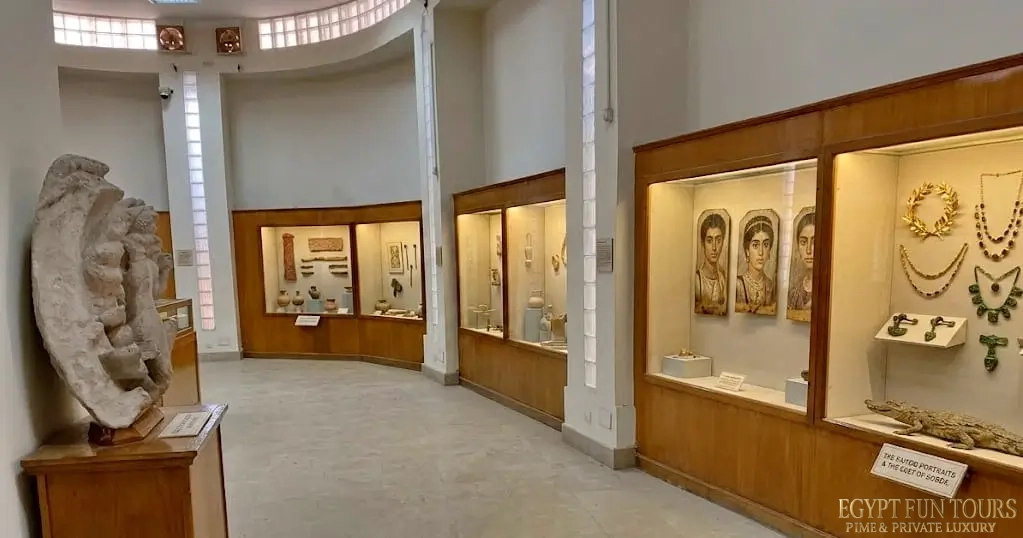
Unlike the massive, crowded halls of Cairo’s mega-museums, the Kom Aushim Museum offers an intimate, highly curated look at regional archaeology. Most notably, it showcases the world-famous Faiyum Portraits and the domestic artifacts of the Greco-Roman desert pioneers.

This comprehensive, authoritative guide provides everything you need to know about the history, exhibits, architectural significance, and visiting logistics of the Kom Aushim Museum.

The eye of Horus

Historical Context: Kom Aushim Museum is the Gateway to the Oasis

Historical Context Kom Aushim Museum is the Gateway to the Oasis

To fully appreciate the treasures housed within the Kom Aushim Museum, one must understand the unique geography and history of the Faiyum Oasis. Located roughly 80 kilometers southwest of Cairo, Faiyum has always attracted settlement due to its unique depression fed by a branch of the Nile River.

          [ Prehistoric Settlements in Faiyum ]
                            │
                            ▼
         [ Middle Kingdom Agricultural Boom ]
                            │
                            ▼
     [ Ptolemaic Expansion & Karanis Founding ]
                            │
       ┌────────────────────┴────────────────────┐
       ▼                                         ▼
[ Multi-Cultural Synthesis ]             [ Daily Life Artifacts ]
       │                                         │
       └────────────────────┬────────────────────┘
                            ▼
           [ Preservation at Kom Aushim Museum ]

During the Ptolemaic and Roman eras, the region experienced a massive agricultural expansion. The Ptolemaic rulers reclaimed vast swathes of land around Lake Moeris. Subsequently, they established thriving agricultural towns like Karanis (modern Kom Aushim) to house Greek veterans and native Egyptian farmers.

Consequently, this unique cultural melting pot fostered an incredible artistic and religious synthesis. Generations of inhabitants blended traditional Egyptian customs, such as crocodile worship, with Greco-Roman lifestyles. The Kom Aushim Museum beautifully preserves the material remnants of this vibrant local heritage, displaying artifacts directly excavated from the surrounding desert sands.

Golden Scarab

Kom Aushim Museum: The Evolution and Rebirth
Kom Aushim Museum The Evolution and Rebirth

The museum has a fascinating history of development, reflecting Egypt’s ongoing commitment to regional heritage preservation.

Kom Aushim Museum: The 1974 Foundation

The Egyptian Antiquities Service originally established the Kom Aushim Museum in 1974. At that time, authorities built a modest, single-story structure to store and display the numerous artifacts coming to light from the ongoing joint excavations at Karanis and other nearby Faiyum sites.

Kom Aushim Museum: The Modern Renovation (2016)

As decades passed, the original building required structural upgrades and better environmental controls to protect its delicate contents. Therefore, the Ministry of Antiquities closed the museum for an extensive renovation project.

Architects added a second floor to double the exhibition space. Furthermore, installation teams added modern lighting systems, advanced security, and state-of-the-art climate-controlled display cases. The museum reopened its doors to the public in November 2016, instantly becoming a premier cultural attraction in the Faiyum Governorate.

Kom Aushim Museum: Layout and Key Exhibition Highlights

The Kom Aushim Museum utilizes a well-organized, dual-level layout. The exhibition design intentionally guides visitors chronologically and thematically through the rich tapestry of Faiyum’s history.

+-----------------------------------------------------------------+
|                    KOM AUSHIM MUSEUM LAYOUT                     |
|                                                                 |
|  [ Ground Floor: Daily Life & Administration ]                  |
|  - Agriculture & Fishing Tools                                  |
|  - Pottery, Glassware, and Textiles                             |
|  - Local Industry & Trade Items                                 |
|                                                                 |
|  [ Upper Floor: Death, Religion & Synthesis ]                   |
|  - Sobek Crocodile Mummies                                      |
|  - The Iconic Faiyum Portraits                                  |
|  - Coptic Textiles & Islamic Ceramics                           |
+-----------------------------------------------------------------+

The Ground Floor: The Echoes of Daily Life

The ground floor focuses heavily on the domestic, economic, and administrative realities of ancient Faiyum, particularly during the Greco-Roman period.

Agricultural and Fishing Implements

Because Faiyum functioned as the breadbasket of Roman Egypt, the museum displays an impressive array of ancient farming tools. Visitors can examine remarkably preserved wooden sickles, winnowing forks, and woven baskets. Additionally, because of Lake Moeris, the collection features ancient fishing hooks, net weights, and bronze spears.

Glassware and Ceramics

Karanis housed sophisticated local glass-blowing workshops. Accordingly, the ground floor features a stunning collection of intact Roman glass vessels. These items range from delicate perfume vials to heavy household storage jars, showcasing a surprising variety of colors and techniques.

Textual Heritage

The arid climate of the Faiyum desert acted as a natural preservative for organic materials. Consequently, the museum displays fascinating fragments of papyri and ostraca (pottery shards used for writing). These texts, written in Demotic, Greek, and Latin, contain personal letters, tax receipts, and magical spells, offering a direct look into the thoughts of ancient residents.

The Upper Floor: Funerary Customs and Religious Synthesis

The upper floor transitions from the worldly to the divine, exploring how the diverse population of Faiyum approached religion, mummification, and the afterlife.

The Worship of Sobek

The crocodile god, Sobek, reigned supreme in the Faiyum Oasis. In fact, towns like Karanis featured massive stone temples dedicated to this deity. The upper floor proudly exhibits several well-preserved crocodile mummies of varying sizes. Ancient worshippers offered these mummies at local shrines to secure fertility and protection from the Nile’s floods.

The Faiyum Portraits

The crowning artistic achievement of the collection rests in its selection of Faiyum Portraits. These stunning, realistic funerary paintings date back to the Roman period.

  • Artists painted these highly individualized portraits on wooden panels using the encaustic (hot wax) technique.

  • Originally, embalmers wrapped these panels directly over the faces of mummies.

  • The haunting, expressive eyes of the subjects blend classical Roman portraiture styles with traditional Egyptian eternity beliefs.

Monastic and Islamic Heritage

The exhibition route finishes with a look at Faiyum’s later history. The upper floor displays exquisitely woven Coptic textiles from local Christian monasteries. Additionally, it features beautifully glazed ceramics, coins, and wooden screens representing the region’s rich Islamic era.
Discovering Gabal Qatrani: Fayoum’s 35-Million-Year-Old Fossil Mountain

Discover Gabal Qatrani in Fayoum, a 350-meter-high mountain and UNESCO-listed site just north of Lake...
Related post
The eye of Horus

Key Architectural & Artistic Highlights

Key Architectural & Artistic Highlights

Feature Description Cultural Significance
Encaustic Mummy Portraits Lifelike portraits painted on wood using pigmented hot wax. Represents the pinnacle of Roman-Egyptian artistic fusion and personal identity.
Sobek Crocodile Mummies Mummified desert crocodiles ranging from hatchlings to adults. Demonstrates the enduring local power of ancient Nile deity cults into the Roman era.
Preserved Roman Glassware Intact, locally manufactured glass vessels in vibrant hues. Highlights the advanced industrial and commercial status of ancient Karanis.
Bilingual Ostraca Written records on pottery pieces in both Greek and Egyptian scripts. Illustrates the daily administrative and cultural integration of the oasis population.

The Architecture of Kom Aushim and Nearby Karanis

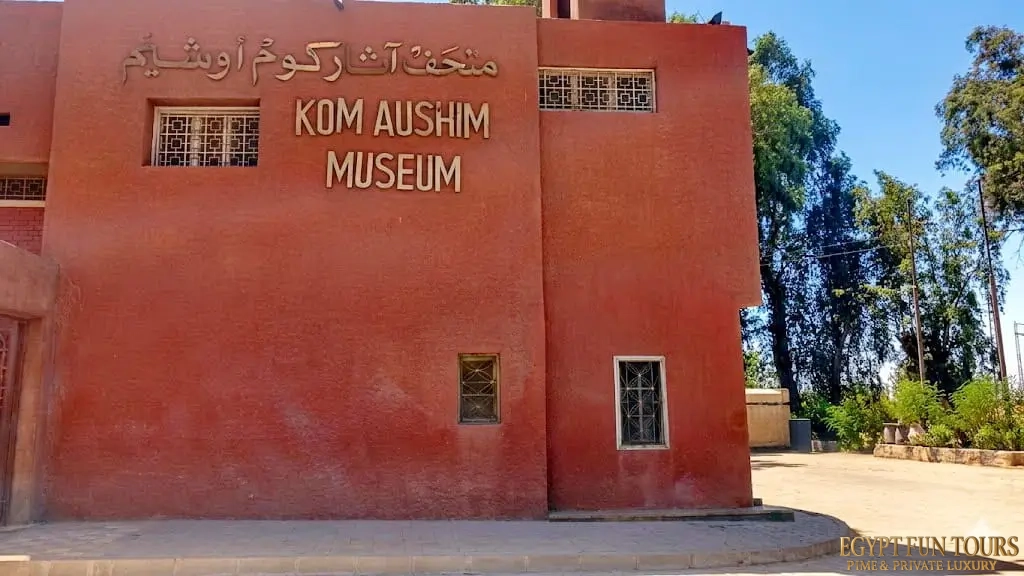
The museum building itself features a clean, modern sandstone facade that echoes the warm tones of the surrounding desert landscape. However, the true architectural marvel lies just outside the museum doors.

The Open-Air Museum

The courtyard of the Kom Aushim Museum acts as an open-air gallery. It displays large-scale stone monuments that could not fit inside the galleries.

  • Visitors can examine massive limestone millstones used for processing grain.

  • The courtyard houses beautifully carved Roman-era column capitals and funerary stelae.

  • A striking limestone statue of a sphinx stands guard near the entrance, welcoming travelers to the complex.

Connection to Karanis

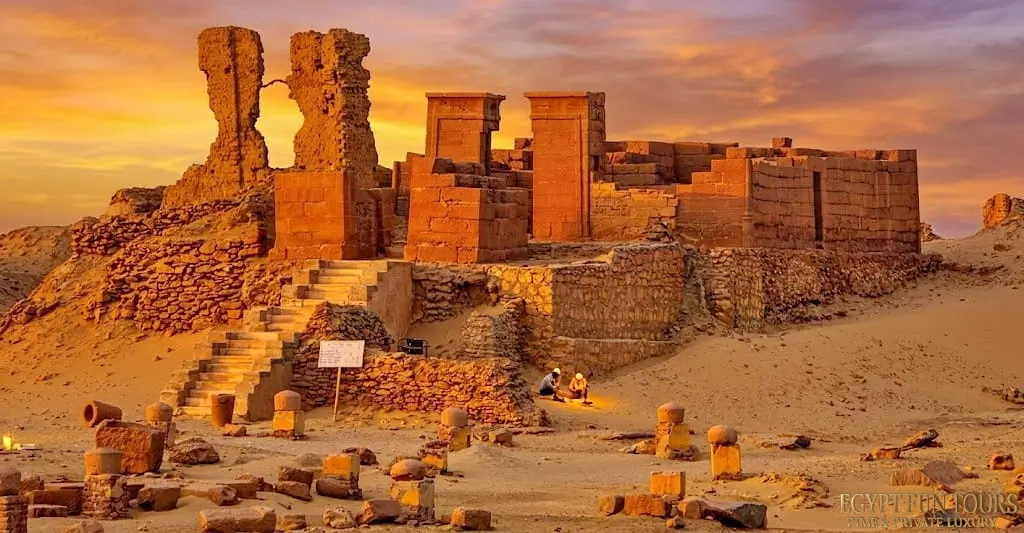
Because the museum sits right at the edge of the Karanis archaeological site, visitors can instantly connect the artifacts inside the cases to the physical structures outside. After viewing household pottery in the museum, you can walk through the actual mud-brick houses, multi-story villas, and monumental stone temples where those exact objects were used thousands of years ago.

Tunis Village: Fayoum’s Bohemian Lakeside Art Colony

Escape to Tunis Village, Fayoum's bohemian art colony perched above Lake Qarun. This charming village...
Related post
Golden Scarab

Practical Visitor Guide & Logistics

For travelers and tour operators planning an excursion to the Faiyum Oasis, the Kom Aushim Museum serves as the perfect inaugural stop.

Location and How to Get There

The museum occupies a strategic location at the intersection of the Cairo-Faiyum Desert Road and the regional oasis highway.

  • By Private Car/Tour Transport: Driving from Cairo takes approximately 1 to 1.5 hours, depending on traffic. Take the desert road heading southwest toward Faiyum. The museum and Karanis site appear prominently on your right side just as you enter the oasis boundary.
  • By Public Microbus: Travelers can catch a public microbus heading to Faiyum from Cairo’s Remayah Square (near the Giza Pyramids). Simply ask the driver to drop you off at “Kom Aushim” or “Mathaf Karanis.”

Opening Hours & Ticketing

  • Hours: The museum welcomes visitors daily from 9:00 AM to 5:00 PM. As with most sites, operating hours can shorten during the holy month of Ramadan.
  • Tickets: You can purchase tickets at the central ticketing window near the main gate. The ministry offers combined ticket options that grant access to both the Kom Aushim Museum and the adjacent Karanis archaeological city. Card payments are mandatory at the gate.

Photography and Regulations

The ministry permits standard smartphone photography inside the main galleries.

To safeguard the delicate organic pigments of the Faiyum Portraits and ancient textiles, authorities strictly prohibit flash photography inside the upper-floor galleries. Instead, use low-light settings to capture the striking details of these ancient faces without causing environmental degradation to the wood or wax.

Maximizing Your Visit: Expert Tips

  1. The Ultimate Faiyum Itinerary: Start your morning at the Kom Aushim Museum and Karanis around 9:00 AM. Afterward, continue deeper into the oasis to visit the Waterwheels of Faiyum, the stunning Tunis Village for lunch, and the UNESCO World Heritage site of Wadi El Hitan (Valley of the Whales) by late afternoon.
  2. Hire a Local Guide: While the museum features excellent bilingual labeling in Arabic and English, hiring a knowledgeable local guide adds immense value, especially when transitioning from the museum exhibits to the expansive outdoor ruins of Karanis.
  3. Beat the Midday Heat: Because the outdoor Karanis site features very little shade, explore the open-air ruins first during the cooler morning hours. Then, retreat into the beautifully air-conditioned Kom Aushim Museum to enjoy the indoor galleries comfortably during the midday heat.

Wadi El Hitan: Journey to the Valley of the Whales

Journey 40 million years into the past at Wadi El Hitan (Valley of the Whales),...
Related post
The eye of Horus

The Crucial Importance of Conservation

Preserving artifacts recovered from an arid desert environment and transferring them to a modern museum space requires sophisticated conservation strategies.

+-------------------------------------------------------------+
|               CONSERVATION CHALLENGES AT KOM AUSHIM        |
|                                                             |
|   [ Arid Organic Matter ] ──► Vulnerable to Quick Humidity  |
|                               Changes inside Cases          |
|   [ Encaustic Paintings ] ──► Highly Sensitive to Modern    |
|                               UV and Halogen Lighting       |
|   [ Ancient Glassware ]   ──► Requires Custom Mechanical    |
|                               Shock-Absorbing Mounts        |
+-------------------------------------------------------------+

Protecting Organic Material

The desert around Kom Aushim perfectly preserved wood, papyrus, and textiles for millennia due to the total absence of moisture. However, exposing these items to fluctuating ambient humidity can cause rapid decay. Therefore, the museum utilizes sealed, microclimate-controlled display cases filled with silica gel to maintain stable moisture levels.

Light Management

The iconic Faiyum Portraits are highly sensitive to ultraviolet light. Overexposure to harsh modern lighting can melt or discolor the ancient wax medium. To prevent this, the museum installed specialized, low-emission LED lighting tracks that illuminate the portraits clearly while filtering out harmful radiation wavelengths.

Summary: Why the Kom Aushim Museum Matters

The Kom Aushim Museum stands as a brilliant testament to the rich, multi-layered identity of the Faiyum Oasis. It bridges the gap between grand imperial history and the intimate daily lives of ordinary farmers, craftsmen, and priests who turned a desert frontier into a thriving cultural hub.

For any traveler looking to experience authentic Egyptian history away from the typical tourist trails, a visit to the Kom Aushim Museum offers an enlightening, unforgettable journey into the heart of the ancient world.

God_Anubis_Icon
Ancient Egyptian Sarcophagus - Egypt Fun Tours

Unforgettable experience with Fun Tours – Highly recommended!

Hello everyone! We would like to share our extremely positive experience with Fun Tours. Our tour was a complete success thanks to our guide, Osama, and our driver Hassan. Osama proved to be an enthusiastic and knowledgeable guide who answered all of our questions and catered to our individual wishes

More »

Amazing tour to the pyramids of Sakkara and Dahshur

This week we had a great tour with Mohamed to the pyramids of Sakkara and Dahshur, as well as Memphis. He tailored the tour to our preferences, took a lot of time with us, and gave us detailed background information on everything. It was also great that he never tired

More »
4-day-christmas-nile-cruise

Hossam Rashwan Tour Guide

We took this trip with Hossam Rashwan as our tour guide, and I must say that Hossam was the greatest tour guide in Luxor who showed us around. Our tour guide’s tales transported us to Luxor’s past, and we felt as if we were living in ancient Egypt. We really

More »

Amazing Experience

Hamada was incredible! So knowledgeable and kind. He had information about every item, street corner, and relic we looked at. Any questions we had, he had answers! He even made sure to give us tips while walking through the crowds so that we would feel more comfortable when being approached

More »

Egypt Fun Tours makes the most out of your layover!

I had a really short layover in Cairo and didn’t want to be stuck in the Cairo Airport for several hours. It was like Mission Impossible: Egypt Fun Tours’ mission was to show me around Cairo during my short 5 hour layover which was made even shorter because my plane

More »
God_Anubis_Icon

Top-rated Tour Packages

God_Anubis_Icon
WhatsApp
Email
Print