The Southern Tomb of King Djoser: The Mystery of Saqqara’s Blue Chambers

The Southern Tomb of King Djoser at Saqqara is a 3rd Dynasty subterranean marvel that mirrors the Step Pyramid's underground layout. Recently restored and reopened, it features a 30-meter shaft descending to a symbolic granite burial vault. The tomb is most famous for its "Blue Palace," where galleries are covered in vibrant turquoise faience tiles and exquisite limestone reliefs depicting the King’s ritual Heb-Sed jubilee.

The Saqqara Necropolis famously features the Step Pyramid, but a breathtaking monument also defines its southern boundary. This subterranean masterpiece, the Southern Tomb of King Djoser, remained hidden from the public for nearly a century. Following a massive 15-year restoration, the Egyptian government reopened this “twin” structure in 2021. It now offers a rare look at the world’s first stone funerary complex. While the pyramid dominates the skyline, the Southern Tomb hides its greatest treasures deep beneath the desert floor.

The Enigma of the “Second Tomb”

One of the most enduring mysteries of the 3rd Dynasty involves why King Djoser required two separate tombs. The Southern Tomb serves as much more than a simple storage room. Instead, it functions as a full-scale architectural mirror of the burial chambers located beneath the Step Pyramid itself. Because of this complexity, historians and archaeologists continue to debate its true purpose.

Many scholars believe this site served as the eternal home for the King’s Ka, or spiritual essence, rather than his physical body. Others argue it represented a symbolic burial in Upper Egypt to ensure Djoser ruled both halves of the kingdom in the afterlife. Some even suggest it housed the King’s internal organs, acting as a precursor to the canopic jars found in later dynasties. Regardless of its exact function, the superior craftsmanship proves that Imhotep—the legendary architect—valued this tomb as much as the pyramid itself.

A Modern Rebirth

Structural instability forced officials to keep the Southern Tomb off-limits for decades. In 2006, specialists began a meticulous restoration project to strengthen the limestone ceilings and clean thousands of turquoise tiles. Today, visitors easily descend into the heart of the 3rd Dynasty to see the complex exactly as the ancient priests intended.

What You Will Discover in This Guide

Since casual tourists often overlook this site, this deep-dive guide helps you appreciate its technical and spiritual brilliance. We first walk you through the 30-meter descent into the central shaft. We then explore the famous “Blue Palace” chambers and their thousands of shimmering faience tiles. Finally, we provide updated visitor logistics to ensure you enjoy a seamless experience at the Saqqara complex. This journey reveals the vibrant colors and revolutionary architecture of Egypt’s first great builder.

FUN

Exploring the Southern Tomb of Djoser Substructure

Exploring the Southern Tomb of Djoser Substructure

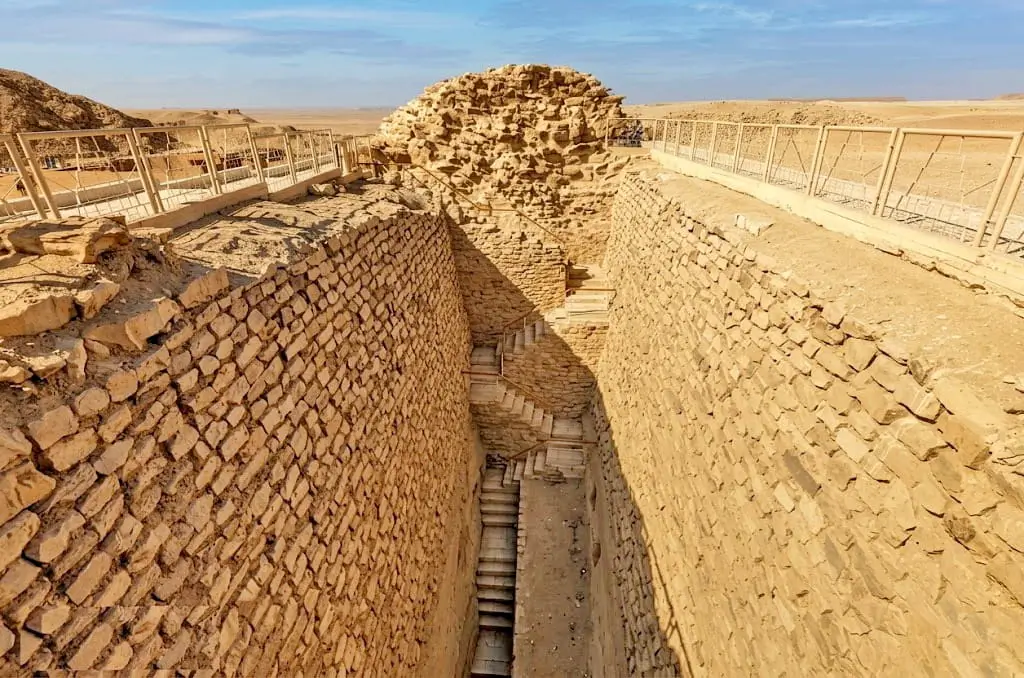
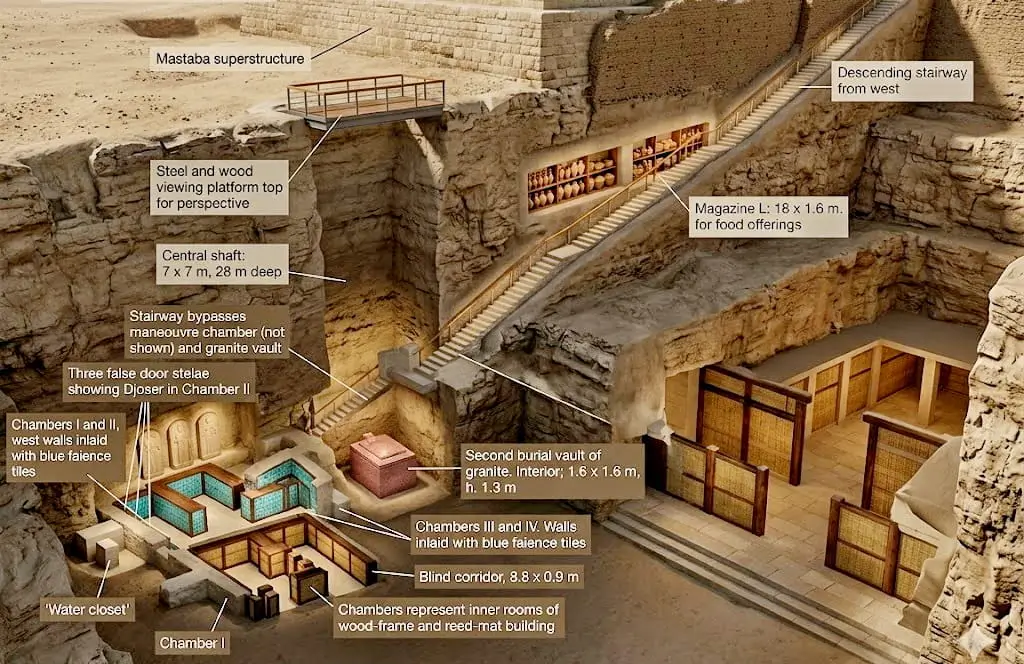
To appreciate the scale of this monument, you must leave the sunlight behind. The entrance to the Southern Tomb of Djoser begins with a long, sloping staircase that cuts directly into the limestone plateau. This narrow passage leads visitors down a 30-meter vertical shaft. This depth is significant because it mirrors the exact subterranean measurements of the Step Pyramid itself. Consequently, the descent creates a powerful sense of transition from the physical world into the eternal realm of the King.

The Granite Vault and the Burial Chamber

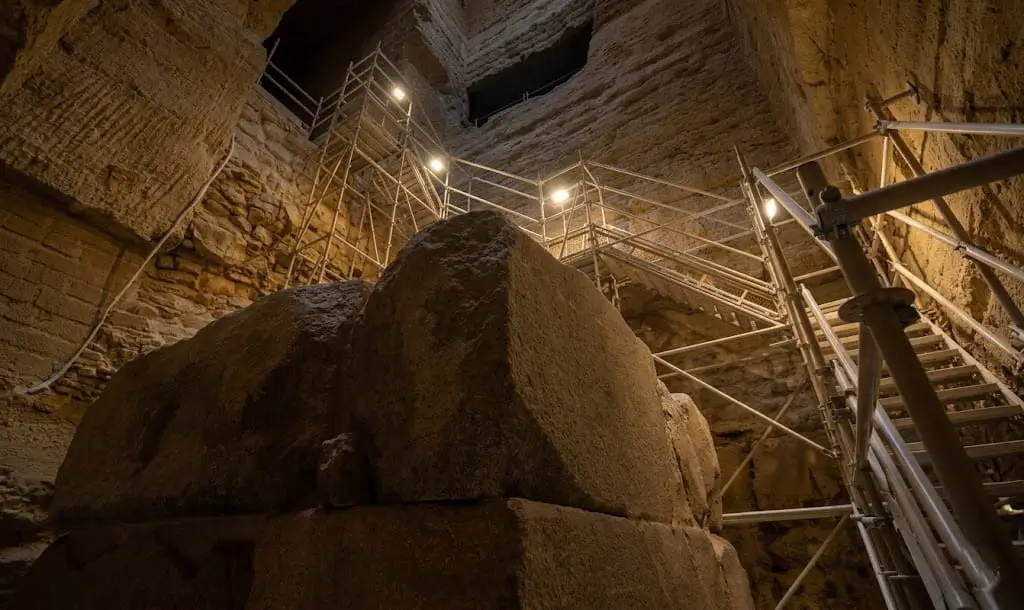
At the very bottom of this impressive shaft lies the central burial chamber. Builders constructed this vault using massive blocks of pink Aswan granite, a material reserved for the highest elite. Interestingly, the dimensions of the chamber are notably small. It could not comfortably fit a standard human-sized sarcophagus. This physical limitation strongly supports the theory that the tomb served a symbolic purpose, such as housing the King’s Ka or his internal organs, rather than his physical remains.

FUN

Faience Masterpieces of the Southern Tomb of Djoser

Faience Masterpieces of the Southern Tomb of Djoser

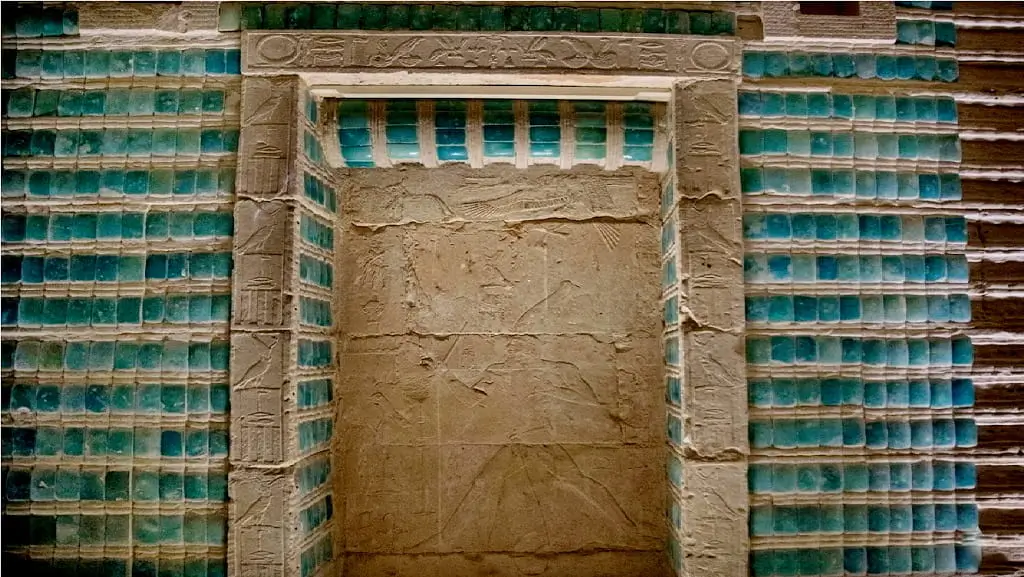
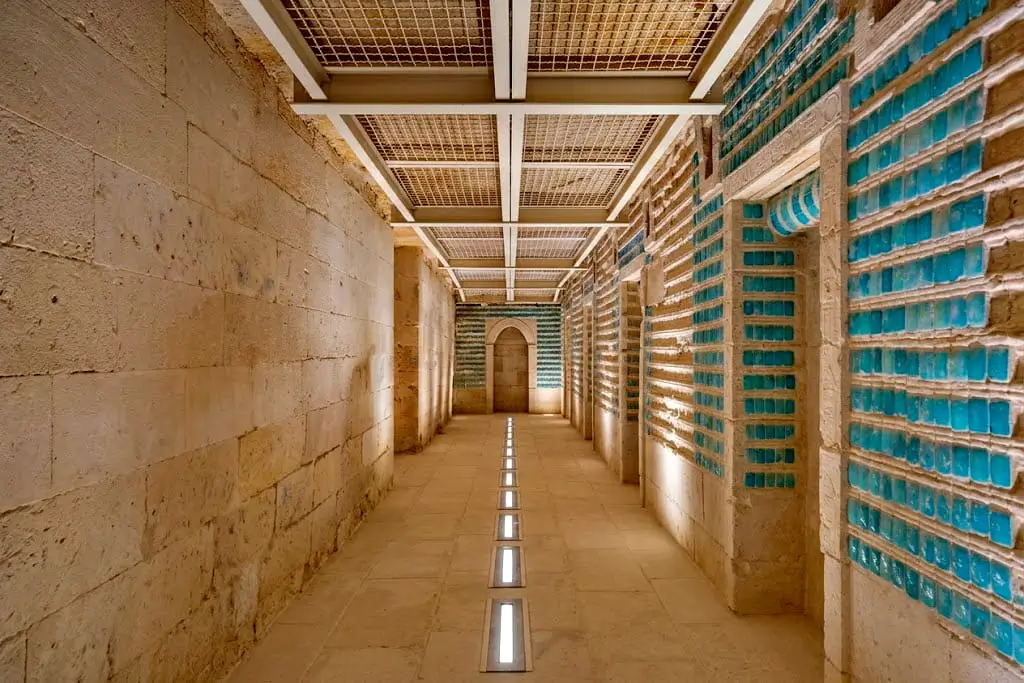
Once you move past the central shaft, you enter a series of galleries that define the artistic legacy of the Southern Tomb of Djoser. These rooms are famously known as the “Blue Palace.” Thousands of small, turquoise-blue faience tiles cover the walls in a meticulously organized grid. These tiles were designed to resemble the reed mats that adorned the royal palace in Memphis during Djoser’s life. This design choice effectively transformed a cold stone chamber into a comfortable, familiar home for the King’s spirit.

Decorative Panels and Royal Rituals

The craftsmanship within these blue chambers extends beyond the tiles. Three beautifully carved limestone stelae depict King Djoser participating in the Heb-Sed festival. This jubilee was a vital ritual where the King ran a physical course to prove his continued strength and right to rule.

  • The Running King: One relief shows Djoser in mid-stride, showcasing the agility required to maintain the throne.
  • The Protective Cobra: The artists included high-relief carvings of the Uraeus (cobra), symbolizing royal protection and divine authority.
  • Hieroglyphic Inscriptions: Fine inscriptions surround the figures, providing the religious context for the King’s movements.

Restoration Success in the South Tomb

The vibrant blue color you see today is the result of years of careful cleaning and stabilization. Specialists had to individually secure thousands of loose tiles that had shifted over the millennia. Because of their hard work, the Southern Tomb of Djoser now provides the most complete look at 3rd Dynasty interior decoration. The contrast between the neutral limestone and the shimmering turquoise creates a visual experience that is unique in all of Saqqara.

The Catacombs of Kom Esh-Shokafa: Roman-Egyptian Underworld

Descend into one of the "Seven Wonders of the Middle Ages" at the Catacombs of...
Related post
FUN

Essential Visitor Logistics for the Southern Tomb of Djoser

Visiting the Southern Tomb of Djoser requires specific planning, as it operates under different access rules than the main Step Pyramid. This guide provides the most current information to ensure a smooth visit to this subterranean wonder. Because the Ministry of Tourism and Antiquities frequently updates site access, checking the latest local announcements before your trip remains a wise decision.

Tickets and Entry Requirements

You must purchase a separate add-on ticket to enter the Southern Tomb of Djoser. The general Saqqara site ticket does not include access to this specific monument. Most travelers buy their tickets at the main entrance gate near the Imhotep Museum. We recommend purchasing the “Saqqara All-In” pass if you plan to explore the interior of the Step Pyramid, the Southern Tomb, and the Serapeum in a single day.

Physical Accessibility and Site Conditions

Physical Accessibility and Site Conditions

Navigating the Southern Tomb of Djoser involves physical effort. You should prepare for a steep and somewhat narrow descent.

  • The Staircase: A long, modern wooden staircase now covers the original stone steps to protect the structure and provide a safer grip for visitors.
  • Tight Spaces: While the main shaft is spacious, the corridor leading to the “Blue Palace” chambers can feel confined. If you experience claustrophobia, you should take this into account before descending.
  • Climate: The temperature drops significantly as you reach the 30-meter depth. This provides a refreshing break from the Egyptian sun, though the humidity can rise within the burial vault area.

The Tomb of Ptahemwia: A “Dream Discovery” at Saqqara

The Tomb of Ptahemwia at Saqqara is a significant 19th Dynasty discovery belonging to the...
Related post
FUN

Expert Photography Tips for the Southern Tomb of Djoser

Expert Photography Tips for the Southern Tomb of Djoser

Capturing the vibrant turquoise of the faience tiles requires the right technique. Professional photography equipment usually requires an additional permit, but most visitors use high-end smartphones for personal photos.

  1. Low Light Performance: Since the tomb uses artificial LED lighting to protect the pigments, ensure your device handles low-light environments well.
  2. Angle Matters: To capture the scale of the central shaft, stand at the top landing and shoot downward toward the granite vault.
  3. Detail Shots: Focus on the “reed mat” patterns of the blue tiles. The side-lighting in the galleries emphasizes the delicate texture of the 3rd Dynasty craftsmanship.

Why the Southern Tomb of Djoser is a Must-See

The Southern Tomb of Djoser serves as the perfect companion to the Step Pyramid. It completes the narrative of King Djoser’s eternal journey and showcases the architectural genius of Imhotep. By exploring the depths of this site, you witness the very birth of stone architecture and the first sophisticated use of color in Egyptian funerary art. No authoritative tour of Saqqara is truly complete without experiencing the silent, shimmering beauty of the South Tomb.

Giza Pyramids Complex: The Eternal Horizon of the Fourth Dynasty

The Giza Pyramid Complex remains the ultimate testament to human ingenuity, spanning the intersection of...
Related post
FUN

FAQs: The Southern Tomb of King Djoser

FAQs; The Southern Tomb of King Djoser

To help you prepare for your visit to this subterranean wonder, we have compiled the most common questions regarding the Southern Tomb of King Djoser. This section clarifies the history, logistics, and unique features of the site.

Why did King Djoser build a second tomb?

The exact reason remains a subject of intense debate among Egyptologists. Many experts believe the Southern Tomb of King Djoser served as a symbolic burial for the King’s Ka (his eternal spirit). Others suggest it represented his authority over Upper Egypt, mirroring the Step Pyramid, which represented Lower Egypt. It allowed the King to have a presence in both halves of his kingdom throughout eternity.

When did the Southern Tomb of Djoser reopen?

The Egyptian Ministry of Tourism and Antiquities officially reopened the monument in September 2021. Before this, the tomb remained closed to the public for nearly 100 years. A massive 15-year restoration project successfully stabilized the 30-meter deep shaft and meticulously cleaned the famous blue faience tiles.

Is it safe to descend into the Southern Tomb of Djoser?

Yes, the recent restoration included significant structural reinforcement. A modern wooden staircase with handrails now lines the shaft, making the descent much safer than in previous decades. However, the path is long and narrow. Visitors with severe claustrophobia or limited mobility should consider the physical requirements before purchasing a ticket.

What are the blue tiles in the Southern Tomb made of?

The vibrant walls of the Southern Tomb of King Djoser feature thousands of tiles made of faience. This is a non-clay ceramic material made of crushed quartz or sand, coated with a copper-based glaze. When fired, it produces the iconic turquoise-blue color. These tiles were specifically designed to imitate the appearance of woven reed mats found in royal palaces.

Do I need a special ticket for the Southern Tomb of Djoser?

Entry to the Southern Tomb of King Djoser requires an add-on ticket. The standard entrance fee for the Saqqara Necropolis does not grant access to the interior of this monument. You can purchase these tickets at the main Saqqara ticket office. If you plan to see multiple sites, ask about combined passes that may include the Step Pyramid and the Serapeum.

Is photography allowed inside the Southern Tomb of Djoser?

Photography rules in Egypt change frequently, but generally, personal photography with a smartphone is permitted. However, you must avoid using a flash to protect the ancient pigments and faience glazes. If you wish to use a professional DSLR camera or a tripod, you will likely need to purchase a specific photography permit at the entrance.

A journey across the vast time and space of Egypt....
Live the memories that make Egypt the ideal spot worthy of remembering....
God_Anubis_Icon

Outstanding layover tour

I had the opportunity to do a layover tour with Egypt Fun Tours this Friday, and it was amazing. I had a 10-hour layover tour in Cairo, and I was met by Mohamed on time at the airport. He picked me up in a clean, new, safe, and comfortable van.

More »
Tailored Services for Corporate Business Transportation Needs

On time, adaptable, and fun!

My friend and I planned a whirlwind trip to Dubai, the Dead Sea, Petra, Cairo, Luxor, and Sharm el Sheikh for early November 2011 – 6 cities in 10 days! We allotted one afternoon and evening for Cairo, and we wanted to see as much as we could! We drove

More »
4 Days Egypt Experience for Solo Woman Egypt Fun Tours min 1

Amazing experience

My husband and I had a ten-hour layover in Cairo and luckily found Egypt Fun Tours while researching tour companies online. The owner, Hamada, picked us up from the airport and brought us around Cairo. He took us to see the pyramids, which was a memory I will never forget.

More »
God_Anubis_Icon

Top-rated Tour Packages

God_Anubis_Icon